
Liturgy of the Word for the 23rd Sunday after Pentecost & the Commemoration of Martin, Bishop of Tours 397, November 8, 2020

If you are not a regular St. Martin’s supporter we invite you to

DONATE HERE

Thank you for supporting our ministry during this period of physical distancing.

A note about the structure of this webpage:

This page is set up to enable you to participate in the Liturgy of The Word, during which you will hear the sermon in its natural liturgical context; or you can scroll down the page to hear the stand-alone sermon webcast accompanied by the written text.

You can also view our return to eucharistic worship by clicking here.


Order of Service for the Liturgy of the Word

The Liturgy of the Word begins on page 355 of the Book of Common Prayer or online Eucharist Rt II here. Podcasts produced by Christian Tulungen.

The Prelude: Adagio from Toccata, adagio und fuge, BWV 564 by J. S. Bach (1685-1750), Steven Young, organ

Welcome: The Rev’d Mark Sutherland, Rector.

Read a biography of Martin, our patron, here.

The Introit: “Bread of the World in Mercy Broken,” att. Louis Bourgeois (1510?-1561?), The St. Martin Chapel Consort

The Greeting: Blessed be God, Father, Son, and Holy Spirit; and blessed be God’s Kingdom, now and for ever.

Hymn 174 “At the Lamb’s high feast” (vv. 1, 4), The St. Martin Chapel Consort

 1 At the Lamb's high feast we sing
 praise to our victorious King,
 who hath washed us in the tide
 flowing from his pierced side;
 praise we him, whose love divine
 gives his sacred Blood for wine,
 gives his Body for the feast,
 Christ the victim, Christ the priest. 

 4 Easter triumph, Easter joy,
 these alone do sin destroy.
 From sin's power do thou set free
 souls newborn, O Lord, in thee.
 Hymns of glory, songs of praise,
 Father, unto thee we raise:
 risen Lord, all praise to thee
 with the Spirit ever be. 

Collect for Purity

The Gloria S 279, The St. Martin Chapel Consort

The Collect of the Day:

Lord God of hosts, you clothed your servant Martin the soldier with the spirit of sacrifice, and set him as a bishop in your Church to be a defender of the catholic faith: Give us grace to follow in his holy steps, that at the last we may be found clothed with righteousness in the dwellings of peace; through Jesus Christ our Lord, who lives and reigns with you and the Holy Spirit, one God, for ever and ever. Amen.

The First Reading: Joshua 24:1-3a, 14-25, read by Laura Bartsch

Psalm 78:1-7, The St. Martin Chapel Consort

Refrain: God gave them drink as from the great deep.

1 In you, O LORD, have I taken refuge;
     let me never be ashamed.   
2 In your righteousness, deliver me and set me free; *
     incline your ear to me and save me.   
3 Be my strong rock, a castle to keep me safe; *
     you are my crag and my stronghold.   
4 Deliver me, my God, from the hand of the wicked, *
     from the clutches of the evildoer and the oppressor.   
5 For you are my hope, O LORD God, *
     my confidence since I was young.   
6 I have been sustained by you ever since I was born;
     from my mother's womb you have been my strength; *
     my praise shall be always of you.   
7 I have become a portent to many; *
     but you are my refuge and my strength.

Refrain

The Second Reading: 1 Thessalonian 4:13-18, read by Laura Bartsch

Hymn 309 “O Food to pilgrims given” (v. 1), The St. Martin Chapel Consort

 1 O food to pilgrims given,
 O bread of life from heaven,
 O manna from on high!
 We hunger; Lord, supply us,
 nor thy delights deny us,
 whose hearts to thee draw nigh.  

The Gospel: Matthew 25:1-13, proclaimed by Linda+

Hymn 309 (v. 2)

 3 O Jesus, by thee bidden,
 we here adore thee, hidden
 in forms of bread and wine.
 Grant when the veil is risen,
 we may behold, in heaven,
 thy countenance divine. 

The Sermon: Mark+  A stand-alone sermon recording and full text also appear below on this page.

The Nicene Creed: We recite together. Please note italicized inclusive language changes.

We believe in one God,
    the Father, the Almighty,
    maker of heaven and earth,
    of all that is, seen and unseen.
We believe in one Lord, Jesus Christ,
    the only Son of God,
    eternally begotten of the Father,
    God from God, Light from Light,
    true God from true God,
    begotten, not made,
    of one Being with the Father.
    Through him all things were made.
    For us and for our salvation
        he came down from heaven:
    by the power of the Holy Spirit
        he became incarnate from the Virgin Mary,
        and was made human.
    For our sake he was crucified under Pontius Pilate;
        he suffered death and was buried.
        On the third day he rose again
            in accordance with the Scriptures;
        he ascended into heaven
            and is seated at the right hand of the Father.
He will come again in glory to judge the living and the dead,
        and his kingdom will have no end.
We believe in the Holy Spirit, God, the giver of life,
    who proceeds from the Father and the Son.
    With the Father and the Son is worshiped and glorified
        and has spoken through the Prophets.
    We believe in one holy catholic and apostolic Church.
    We acknowledge one baptism for the forgiveness of sins.
    We look for the resurrection of the dead,
        and the life of the world to come. Amen.

The Anthem: “If Ye Love Me” by Thomas Tallis (c1505-1585), The St. Martin Chapel Consort

The Prayers of the People, led by Linda+

The Lord’s Prayer, The St. Martin Chapel Consort

The General Thanksgiving

Almighty God, Father of all mercies, 
we your unworthy servants
give you humble thanks
for all your goodness and loving-kindness
to us and to all whom you have made.
We bless you for our creation, preservation,
and all the blessings of this life;
but above all for your immeasurable
love in the redemption of the world
by our Lord Jesus Christ;
for the means of grace,
and for the hope of glory.
And, we pray, give us such
an awareness of your mercies,
that with truly thankful hearts
we may show forth your praise,
not only with our lips, but in our lives,
by giving up our selves to your service,
and by walking before you in
holiness and righteousness all our days;
through Jesus Christ our Lord,
to whom, with you and the Holy Spirit,
be honor and glory throughout all ages. Amen.

The Peace

Hymn 665, “All my hope on God is founded” (vv. 1, 5), The St. Martin Chapel Consort

1 All my hope on God is founded;
 he doth still my trust renew.
 Me through change and chance he guideth,
 only good and only true.
 God unknown,
 he alone
 calls my heart to be his own.

5 Still from earth to God eternal
 sacrifice of praise be done,
 high above all praises praising
 for the gift of Christ his Son.
 Christ doth call
 one and all:
 ye who follow shall not fall.

The Final Blessing

The Postlude:  Allegro giocoso from Sept Improvisations, Op.150 by Camille Saint-Saëns (1835-1921), Steven Young, organ

Permission to podcast/stream the music in this service obtained from ONE LICENSE with license #M-400498. All rights reserved.


Stand-Alone Sermon Podcast:
William Blake

Bridesmaids

Of the three synoptic gospels – so called because they follow a broad outline or synopsis of Jesus life – I like Matthew the least. Matthew’s depiction of Jesus lacks the accessible humanity of Mark’s presentation and comes nowhere near to the pastoral and social sensitivity of Luke’s portrayal. Matthew’s Jesus – modelled on the image of a new Moses is more elevated and detached – more guru like – a figure above the fray at whose feet the disciples gather to be inaugurated into the Kingdom of God.

The parable of the wise and foolish bridesmaids – a better translation of the Greek than virgin – is unique to Matthew and is one of his Parables of the Kingdom. Matthew’s parables of the kingdom all end with a warning – usually of severe punishment on those who are excluded or exclude themselves from the kingdom. Images of outer darkness with much wailing and gnashing of teeth abound. Themes of inclusion and exclusion form the heart of Matthew’s Parables of the Kingdom.  Themes of inclusion and exclusion articulate the central struggle for Matthew’s community of Jewish followers of Jesus, now excluded from mainstream of Jewish religious life.

Furthermore, the tones of harsh punishment for those excluded – echo the fierce and judgmental Christianity characteristic of so much white, rightwing, evangelical messaging. For this reason alone, Mathew’s message of judgement often jars upon my contemporary, progressive, Christian ear.

At the end of the parable of the wise and foolish bridesmaids Matthew sternly warns: Keep awake, for you know neither the day nor the hour”. This is a somewhat daunting demand and can only feed our American cultural preoccupation with self-sufficiency.

Of course, no one knows what the future will hold. We develop a tendency to anticipate events based on what we already know about life. Sometimes experience is an accurate guide, yet, often it’s misleading. Facing the uncertainties of the future armed only with a partial recollection of past experience, makes us even more anxious.

We alleviate our anxiety with the illusion of being prepared, and consequently we live a good portion of our lives caught up in a process of attempting to anticipate all eventualities – of perpetual and neurotic wakefulness.  No wonder many of us no longer sleep well.

The problem with anticipation of an assumed dangerous future is that it encourages risk aversion in life. Life lived too safely, is a very unsatisfying experience!

In our society we reserve our harshest judgments for those who fail the – be prepared – test. How easily the phrases: well it’s his own fault, or she has no one to blame but herself, or its time they really took responsibility for themselves, trip lightly off our tongues. In fact, one of my favorite comments to friends of either gender is: oh, what a foolish virgin you’ve been!

I detect in Matthew’s parable of the wise and foolish bridesmaids three themes that disturb me a lot.

  • The first is the stereotypical treatment of women. There would have been quite a number of wedding guests – men as well as women – so why does Matthew focus his treatment on a group of women? He seems to be playing upon the stereotyping of women into two groups – the wise and the foolish; echoing the patriarchal image of women as either virtuous virgins and chaste matrons or wantons and whores.

Motifs of virtue and shame are woven throughout this parable. We are not strangers to this kind of denigration of women -which today is a prevalent theme underpinning conservative (mostly male) hostility to women owning control of their own bodies as compared with so called virtuous women who accept male expectations for both the control as well as the exploitation of their sexuality.

  • Secondly, I’m disturbed by the picture Matthew paints of the relationship between the so called wise and foolish women. We see a group of women who do not share any sense of solidarity or a commitment to support and aid one another. Instead the wise bridesmaids exalt in the superiority of their preparedness, gloating over their sisters for their so-called foolishness in being unprepared – echoing our oft used judgment of others – well they’ve only got themselves to blame.

We catch a glimpse here of the gendered nature of traditional Middle Eastern wedding celebrations. In its gender bias this parable lets men off easily – as if  this parable could never describe a group of groomsmen – who being men would probably not have been left waiting outside for the bride groom’s return because wherever the groom had been – they would have been there partying along with him.

  • Thirdly, this parable reinforces our prevalent scarcity worldview. The lamp oil is a symbol for scarcity – there is only so much of it to go around.  In a culture of scarcity, you keep what you have by not sharing it with others. Within a worldview that sees resources as limited, the pie is only so big – people of necessity are divided into the haves and the have-nots. At St Martin’s like the wise bridesmaids there is no mistaking that we are among the haves when the world is viewed from the perspective of scarcity.

This year’s capital campaign, along with the final weeks of our annual renewal campaign are reminders the importance of our solidarity with and generosity towards each other.

Unlike the bridesmaids we discover again and again that only when our giving flows generously from our commitment to one another in community do we encounter the depths of our gratitude for God’s gracious providential love towards us.

A question remains, why did the so-called foolish bridesmaids panic? The bridegroom is clearly a metaphor for Christ, who is more likely to have rejoiced in their having waited for his arrival. For me it’s their faithfulness in waiting for the bridegroom rather than their self-sufficiency in oil that would commend them to Jesus. The reaction of these women to the bridegroom’s arrival has the whiff of shame about it. 

Matthew’s injunction to stay awake is an odd way to conclude. This isn’t a parable about staying awake – after all, they all fell asleep. His gripe is that they were unprepared and in this there is an aspersion of something shameful. What is their shame? It smells to me to be their failure to be self-sufficient. We all know that failure to be self-sufficient leaves us feeling foolish.

Whose problem (being prepared) is this? It’s clearly Matthew’s and it’s also ours, but it is definitely not Jesus’.

If you are not a regular St. Martin’s supporter, we invite you to

DONATE HERE.

Thank you for supporting our ministry during this period of physical distancing.
Liturgy of the Word for All Saints, November 1, 2020

If you are not a regular St. Martin’s supporter we invite you to

DONATE HERE

Thank you for supporting our ministry during this period of physical distancing.

A note about the structure of this webpage:

This page is set up to enable you to participate in the Liturgy of The Word, during which you will hear the sermon in its natural liturgical context; or you can scroll down the page to hear the stand-alone sermon webcast accompanied by the written text.

You can also view our return to eucharistic worship by clicking here.


Order of Service for the Liturgy of the Word

The Liturgy of the Word begins on page 355 of the Book of Common Prayer or online Eucharist Rt II here. Podcasts produced by Christian Tulungen.

The Prelude: Variations on “Sine Nomine” by Denis Bédard (b. 1950), Steven Young, organ

Welcome: The Rev’d Mark Sutherland, Rector

The Episcopal Office for Government Relations resources to meet the challenges of the election time.

The Introit: Introit by Iain Quinn (b. 1973), The St. Martin Chapel Consort

The Greeting: Blessed be God, Father, Son, and Holy Spirit; and blessed be God’s Kingdom, now and for ever.

Hymn 48 “O day of radiant gladness” (vv. 1, 4), The St. Martin Chapel Consort

1 O day of radiant gladness, O day of joy and light,
 O balm of care and sadness, most beautiful, most bright;
 this day the high and lowly, through ages joined in tune,
 sing "Holy, holy, holy" to the great God Triune.

4 That light our hope sustaining, we walk the pilgrim way,
 at length our rest attaining, our endless Sabbath day.
 We sing to thee our praises, O Father, Spirit, Son;
 the Church her voice upraises to Thee, blest Three in One.

Collect for Purity

The Gloria S 278, The St. Martin Chapel Consort

The Collect of the Day:

Almighty God, you have knit together your elect in one communion and fellowship in the mystical body of your Son Christ our Lord: Give us grace so to follow your blessed saints in all virtuous and godly living, that we may come to those ineffable joys that you have prepared for those who truly love you; through Jesus Christ our Lord, who with you and the Holy Spirit lives and reigns, one God, in glory everlasting. Amen.

The First Reading: Revelation 7:9-17, read by Melinda DelCioppio

Psalm 34:1-10, 22, The St. Martin Chapel Consort

1 I will bless the LORD at all times;
     his praise shall ever be in my mouth.   
2 I will glory in the LORD;
     let the humble hear and rejoice.   
3 Proclaim with me the greatness of the LORD;
     let us exalt his Name together.    
4 I sought the LORD, and he answered me
     and delivered me out of all my terror.   
5 Look upon him and be radiant,
     and let not your faces be ashamed.   
6 I called in my affliction and the LORD heard me
     and saved me from all my troubles.   
7 The angel of the LORD encompasses those who fear him,
     and he will deliver them.   
8 Taste and see that the LORD is good;
     happy are they who trust in him!   
9 Fear the LORD, you that are his saints,
     for those who fear him lack nothing.   
10 The young lions lack and suffer hunger,
     but those who seek the LORD lack nothing that is good.
22 The LORD ransoms the life of his servants,
     and none will be punished who trust in him.

The Second Reading: 1 John 3:1-3, read by David Whitman

Hymn 302 “Father, we thank thee” (v. 1), The St. Martin Chapel Consort

1 Father, we thank Thee who hast planted
 Thy holy Name within our hearts.
 Knowledge and faith and life immortal
 Jesus Thy Son to us imparts.
 Thou, Lord, didst make all for Thy pleasure,
 didst give man food for all his days,
 giving in Christ the Bread eternal;
 Thine is the pow'r, be Thine the praise.

The Gospel: Matthew 5:1-12, proclaimed by Mark+

Hymn 302 (v. 2)

2 Watch o'er Thy church, O Lord, in mercy,
 save it from evil, guard it still.
 Perfect it in Thy love, unite it,
 cleansed and conformed unto Thy will.
 As grain, once scattered on the hillsides,
 was in this broken bread made one,
 so from all lands Thy church be gathered
 into Thy kingdom by Thy Son.

The Sermon: Linda+  A stand-alone sermon recording and full text also appear below on this page.

The Nicene Creed: We recite together. Please note italicized inclusive language changes.

We believe in one God,
    the Father, the Almighty,
    maker of heaven and earth,
    of all that is, seen and unseen.
We believe in one Lord, Jesus Christ,
    the only Son of God,
    eternally begotten of the Father,
    God from God, Light from Light,
    true God from true God,
    begotten, not made,
    of one Being with the Father.
    Through him all things were made.
    For us and for our salvation
        he came down from heaven:
    by the power of the Holy Spirit
        he became incarnate from the Virgin Mary,
        and was made human.
    For our sake he was crucified under Pontius Pilate;
        he suffered death and was buried.
        On the third day he rose again
            in accordance with the Scriptures;
        he ascended into heaven
            and is seated at the right hand of the Father.
He will come again in glory to judge the living and the dead,
        and his kingdom will have no end.
We believe in the Holy Spirit, God, the giver of life,
    who proceeds from the Father and the Son.
    With the Father and the Son is worshiped and glorified
        and has spoken through the Prophets.
    We believe in one holy catholic and apostolic Church.
    We acknowledge one baptism for the forgiveness of sins.
    We look for the resurrection of the dead,
        and the life of the world to come. Amen.

The Anthem: “Praised Be the Lord” by Maurice Greene (1695-1755), The St. Martin Chapel Consort

The Prayers of the People: led by Mark+

The Lord’s Prayer, The St. Martin Chapel Consort

The General Thanksgiving

Almighty God, Father of all mercies, 
we your unworthy servants
give you humble thanks
for all your goodness and loving-kindness
to us and to all whom you have made.
We bless you for our creation, preservation,
and all the blessings of this life;
but above all for your immeasurable
love in the redemption of the world
by our Lord Jesus Christ;
for the means of grace,
and for the hope of glory.
And, we pray, give us such
an awareness of your mercies,
that with truly thankful hearts
we may show forth your praise,
not only with our lips, but in our lives,
by giving up our selves to your service,
and by walking before you in
holiness and righteousness all our days;
through Jesus Christ our Lord,
to whom, with you and the Holy Spirit,
be honor and glory throughout all ages. Amen.

The Peace

Hymn 343, “Shepherd of souls” (vv. 1, 4), The St. Martin Chapel Consort

1 Shepherd of souls, refresh and bless
 thy chosen pilgrim flock
 with manna in the wilderness,
 with water from the rock.

4 Lord, sup with us in love divine,
 thy Body and thy Blood,
 that living bread, that heavenly wine,
 be our immortal food.

The Final Blessing

The Postlude:  Toccata (Toccata, Villancico y Fuga) by Alberto Ginastera (1916-83), Steven Young, organ

Permission to podcast/stream the music in this service obtained from ONE LICENSE with license #M-400498. All rights reserved.


Stand-Alone Sermon Podcast:

Blessed Saints

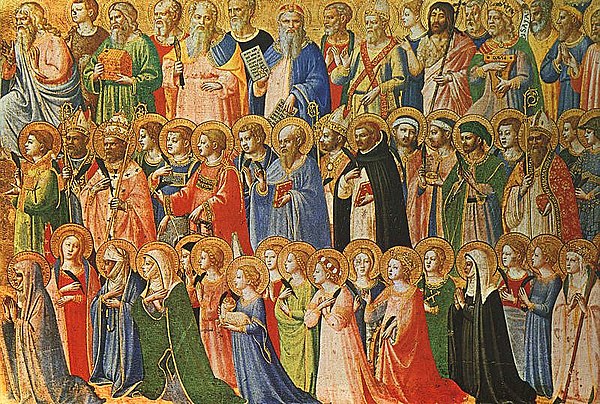
Fra Angelico: Fiesole Altarpiece, Convent of San Domenico

The Rev. Linda Mackie Griggs

“Who are these, robed in white, and where have they come from?”

Blessed are the Saints!

The sentimental (some would argue sappy) hymn, “I Sing a Song of the Saints of God” reminds us that we are surrounded by saints; the Big S Saints who toiled and fought and lived and died for the Lord they loved and knew, and for the little s saints who we meet every day in church or in trains or in shops or at tea. During the three-day observances of All Hallows, All Saints and All Souls the Church celebrates the bond between those in heaven and those on earth—the deep bond of fellowship that unites all of the children of God, past and present.

Today is a big deal.

All Saints is one of the seven (yes, seven!) Principal Feasts of the Church. A Principal Feast is a special observance that takes priority over any other festival or commemoration. It’s like a super-charged Sabbath, when we lay aside our work and our day-to-day concerns and just stop for a time of worship and praise. The other stuff will still be there tomorrow, but for today we celebrate.

What are the seven (yes, seven!) Principal Feasts? Christmas and Easter are the obvious ones, but of equal value in the eyes of the Church are Epiphany, Ascension, Pentecost, Trinity– and All Saints.

What strikes me about these feasts, in contrast with most of the other observances in the Church Year, is that Principal Feasts are celebrations of relationship. Think about it; you can see the relationship between God and Humanity in the Incarnation, the Resurrection, Ascension, Pentecost and Epiphany. The coequal relationship of God within Godself is celebrated uniquely in the Feast of the Trinity. The relationship between things earthly and things heavenly is seen at All Saints. We can argue about which feasts celebrate which kinds of relationships because there are fine distinctions and overlap in virtually all of them, but the point is that Principal Feasts are all about interweaving, engaging, and interrelating; and these are all things that define God and community.

At All Saints our community honors the relationship between life and death; indeed All Saints calls us to erase the boundary between the two entirely.

A colleague told me recently that someone had asked, “Why do we pray for the dead?” And he responded, “They’re not dead!” Which was a brilliant response, because, whether we think about it on a day to day level or not, that is what we, as Christians, believe.

Our journey is not from birth to death but from life to life.

“They will hunger no more, and thirst no more; the sun will not strike them, nor any scorching heat; for the Lamb at the center of the throne will be their shepherd, and he will guide them to springs of the water of life, and God will wipe away every tear from their eyes.”

Our journey is not from birth to death but from life to life; returning at the end to the God who loved us into being, and taking our place in the great cloud of witnesses that upholds, supports, and sustains us on our earthly walk.

What does that support and sustenance look like, and what does that mean for us now, as children of God in a chaotic world? There are different perspectives, which aren’t mutually exclusive, and often depend on the religious tradition in which we’ve have been rooted. For example there are those whose relationship with the saints is one of connection; they take deep comfort in the solidarity and witness of those who served, suffered and died in the faith—those, known and unknown, who knew the joy and cost of following Jesus. They feel a sense of communion with someone with whose joys and struggles they identify.

Others see the saints, especially the Big S Saints, as those who intercede for us when we pray to them. But praying to saints is a misnomer, and it has been the source of misunderstanding since the Reformation. We don’t pray to saints so much as we pray with them. Theologian Patricia Sullivan notes that the idea of praying to a saint for intercession can sound as though God needs to be persuaded or instructed to do what God already knows we need. This misinterpretation builds saints up at the expense of God, which is something the early reformers feared and opposed. Rather, Sullivan says, “When we ask a saint to intercede for us, what is happening at a deeper level is that we are taking refuge in the all-enfolding community of the redeemed, approaching God thru [sic] saintly symbols of Christ’s victory and of our hope…The value of our petitions is that they turn us in confidence toward the God who loves us, allowing God’s work to be more effective in us, and thru [sic] us in others.”

In other words, praying with the saints doesn’t turn God toward us; it turns us towards God. It opens our hearts to God’s work in us, and thus to God working through us as we do the healing work we are called to do in the world.

So no matter how we choose to connect or engage with the great Cloud of Witnesses, on this Feast of All Saints we are invited to acknowledge both the saints’ hold on us, and their call to us.

Blessed are the Saints!

Blessed.

In other words, praying with the saints doesn’t turn God toward us; it turns us toward God.

In today’s Gospel Jesus calls our attention to saints among us; hidden in plain sight.

He told his disciples, blessed are the poor in spirit, the grieving, the meek, the strivers for justice, the merciful, the compassionate, the peacemakers. Blessed are those who know the high cost of discipleship and keep paying it anyway.

Jesus saw saints everywhere. He saw a continuum of saintliness as it reached from earthly suffering to heavenly reward. He saw blessedness in the struggle and holiness in the vulnerable. And he called his disciples into his Kingdom vision, addressing them directly: Blessed are you when your ministry is reviled and persecuted, because you, believe it or not, are saints.

“Blessed are you, you saints.”

A couple of years ago Nathan LeRud of Trinity Episcopal Cathedral in Portland, Oregon updated the Beatitudes for our time. This is part of it:

“Blessed are you when you are depressed and anxious…

Blessed are you who are messed up and scared and vulnerable…

Blessed are you for whom loss, death is not an abstraction…

Blessed are you who are afraid for your kids…

Blessed are you who long to see justice, and blessed are you who have ceased giving a damn…

And blessed are you who have the courage to say “I am not okay,” for you will inherit the earth.

Blessed are you when people call you saints, and blessed are you when they call you things that I can’t even repeat.

Blessed are you when you show up to the glorious mess that is your life, for you are God’s saints, and to you belongs the kingdom of heaven.”

Blessed, this day, are the Saints we revere, the Saints with whom we pray, the saints we mourn. Blessed are the saints among us, and the saints within us. Amen.

If you are not a regular St. Martin’s supporter, we invite you to

DONATE HERE.

Thank you for supporting our ministry during this period of physical distancing.

Liturgy of the Word for the 21st Sunday after Pentecost, October 25, 2020

If you are not a regular St. Martin’s supporter we invite you to

DONATE HERE

Thank you for supporting our ministry during this period of physical distancing.

A note about the structure of this webpage:

This page is set up to enable you to participate in the Liturgy of The Word, during which you will hear the sermon in its natural liturgical context; or you can scroll down the page to hear the stand-alone sermon webcast accompanied by the written text.

You can also view our return to eucharistic worship by clicking here.


Order of Service for the Liturgy of the Word

The Liturgy of the Word begins on page 355 of the Book of Common Prayer or online Eucharist Rt II here. Podcasts produced by Christian Tulungen.

The Prelude: “Wenn wir in höchsten Nöten sein” (from Orgelbüchlein) by J. S. Bach (1685-1750), Steven Young, organ

Welcome: The Rev’d Mark Sutherland, Rector

The Episcopal Office for Government Relations resources to meet the challenges of the election time.

The Introit: “I Will at All Times Praise the Lord” by George Frideric Handel (1685-1759), The St. Martin Chapel Consort

The Greeting: Blessed be God, Father, Son, and Holy Spirit; and blessed be God’s Kingdom, now and for ever.

Hymn 423 “Immortal, invisible, God only wise” (vv. 1, 4), The St. Martin Chapel Consort

1 Immortal, invisible, God only wise,
in light inaccessible hid from our eyes,
most blessed, most glorious, the Ancient of Days,
almighty, victorious, thy great Name we praise.

4 Thou reignest in glory, thou rulest in light,
thine angels adore thee, all veiling their sight;
all laud we would render: O help us to see
'tis only the splendor of light hideth thee.

Collect for Purity

The Gloria S 277, The St. Martin Chapel Consort

The Collect of the Day:

Almighty and everlasting God, increase in us the gifts of faith, hope, and charity; and, that we may obtain what you promise, make us love what you command; through Jesus Christ our Lord, who lives and reigns with you and the Holy Spirit, one God, for ever and ever. Amen.

The First Reading: Deuteronomy 34:1-12, read by Sarosh Fenn

Psalm 90:1-6, 13-17, The St. Martin Chapel Consort

Antiphon: We shall rejoice all the days of our lives.

1 Lord, you have been our refuge
  from one generation to another.
2 Before the mountains were brought forth, or the land and the earth were born,
  from age to age you are God.
3 You turn us back to the dust and say,
  "Go back, O child of earth."
4 For a thousand years in your sight are like yesterday when it is past
   and like a watch in the night.
5 You sweep us away like a dream;
   we fade away suddenly like the grass.
6 In the morning it is green and flourishes;
   in the evening it is dried up and withered.
13 Return, O LORD; how long will you tarry?
    be gracious to your servants.
14 Satisfy us by your loving-kindness in the morning;
    so shall we rejoice and be glad all the days of our life.
15 Make us glad by the measure of the days that you afflicted us
    and the years in which we suffered adversity.
16 Show your servants your works
    and your splendor to their children.
17 May the graciousness of the LORD our God be upon us;
    prosper the work of our hands;
    prosper our handiwork.

Antiphon

The Second Reading: 1 Thessalonians 2:1-8, read by Joshua Maria Garcia

Hymn 505 “O Spirit of Life, O Spirit of God” (v. 1, 3), The St. Martin Chapel Consort

1 O Spirit of life, O Spirit of God,
in ev'ry need thou bring us aid,
proceeding forth from heaven's throne,
from God, the Father and the Son;
O Spirit of life, O Spirit of God.

3 O Spirit of life, O Spirit of God,
make us to love your sacred word;
the holy flame of love impart,
that charity may warm each heart;
O Spirit of life, O Spirit of God.

The Gospel: Matthew 22:34-46, proclaimed by Linda+

Hymn 505 (v. 4)

4 O Spirit of life, O Spirit of God,
enlighten us by that same word;
teach us to know God's radiant love,
lead us to Christ who reigns above;
O Spirit of life, O Spirit of God.

The Sermon: Mark+  A stand-alone sermon recording and full text also appear below on this page.

The Nicene Creed: We recite together. Please note italicized inclusive language changes.

We believe in one God,
    the Father, the Almighty,
    maker of heaven and earth,
    of all that is, seen and unseen.
We believe in one Lord, Jesus Christ,
    the only Son of God,
    eternally begotten of the Father,
    God from God, Light from Light,
    true God from true God,
    begotten, not made,
    of one Being with the Father.
    Through him all things were made.
    For us and for our salvation
        he came down from heaven:
    by the power of the Holy Spirit
        he became incarnate from the Virgin Mary,
        and was made human.
    For our sake he was crucified under Pontius Pilate;
        he suffered death and was buried.
        On the third day he rose again
            in accordance with the Scriptures;
        he ascended into heaven
            and is seated at the right hand of the Father.
He will come again in glory to judge the living and the dead,
        and his kingdom will have no end.
We believe in the Holy Spirit, God, the giver of life,
    who proceeds from the Father and the Son.
    With the Father and the Son is worshiped and glorified
        and has spoken through the Prophets.
    We believe in one holy catholic and apostolic Church.
    We acknowledge one baptism for the forgiveness of sins.
    We look for the resurrection of the dead,
        and the life of the world to come. Amen.

The Anthem: “Lord, I Lift My Soul to You” by G. F. Handel, The St. Martin Chapel Consort

The Prayers of the People: led by Linda+

The Lord’s Prayer, The St. Martin Chapel Consort

The General Thanksgiving

Almighty God, Father of all mercies, 
we your unworthy servants
give you humble thanks
for all your goodness and loving-kindness
to us and to all whom you have made.
We bless you for our creation, preservation,
and all the blessings of this life;
but above all for your immeasurable
love in the redemption of the world
by our Lord Jesus Christ;
for the means of grace,
and for the hope of glory.
And, we pray, give us such
an awareness of your mercies,
that with truly thankful hearts
we may show forth your praise,
not only with our lips, but in our lives,
by giving up our selves to your service,
and by walking before you in
holiness and righteousness all our days;
through Jesus Christ our Lord,
to whom, with you and the Holy Spirit,
be honor and glory throughout all ages. Amen.

The Peace

Hymn 537, “Christ for the world we sing!” (vv. 1, 4), The St. Martin Chapel Consort

1 Christ for the world we sing!
The world to Christ we bring
with loving zeal;
the poor and them that mourn,
the faint and overborne,
sin-sick and sorrow-worn,
whom Christ doth heal.

4 Christ for the world we sing!
The world to Christ we bring
with joyful song;
the newborn souls, whose days,
reclaimed from error's ways,
inspired with hope and praise,
to Christ belong.

The Final Blessing

The Postlude:  Finale from Variations on Handel’s “The Harmonious Blacksmith” by Edmund Chipp (1823-1886), Steven Young, organ

Permission to podcast/stream the music in this service obtained from ONE LICENSE with license #M-400498. All rights reserved.


Stand-Alone Sermon Podcast:

Shema Yisrael & Matthew 22:34-46

The early morning sun’s rays pouring through the great east window – bathing the whitewashed interior of the grey stone church in a golden hue -remains an evocative experience from my adolescence. Kneeling in the quiet reverence of the 8 o’clock Communion service – gazing towards the altar beneath the window which seems to be in fire – I watch as the priest enters and approaches the altar where he kneels and completes his preparatory recitation of the Lord’s Prayer – praying sotto voce to begin the 1662 Prayer Book Communion service. Bathed in the warm glow of summer sunlight falling through the stained glass I watch as the priest turns towards this small early morning congregation and loudly proclaims the words:

Our Lord Jesus Christ said:
Hear, O Israel, the Lord our God is one Lord;
and thou shalt love the Lord thy God with all thy heart,
and with all thy soul, and with all thy mind,
and with all thy strength.
This is the first commandment.
And the second is like, namely this:
Thou shalt love thy neighbour as thyself.
There is none other commandment greater than these.
On these two commandments hang all the law and the prophets.

to which we all respond

Lord have mercy upon us, and write all these thy laws in our hearts, we beseech thee.

This is a memory of a seminal spiritual experience – strongly formative in my subsequent development as a liturgical Christian. It is a reminder that I come closest to a sensory experience of God in the company of others for whom the sacramental presence of Christ through the celebration of the Eucharist becomes a tangible reality.

The memory is evoked by reading from Matthew 22:34-46 in which Jesus expands on the Shema Yisrael – the centerpiece of Jewish liturgical prayer – a memory that vividly flickers on the screen of my imagination.

Matthew tells us that this encounter between Jesus and the Pharisees is the last of Jesus’ theological interrogations by them. In response to the question about the greatest commandment Jesus cites the Shema Yisrael – and in combining Deuteronomy 6 you shall love the Lord your God with Leviticus 19:18 – Love your neighbor as yourself – Jesus breaks new ground.

This combination -while novel – cannot be argued with from a religious point of view. Consequently, Matthew reports that from that day – no one dared to ask him any more questions. From a doctrinal angle, there is no further disagreement of any consequence between Jesus and the Pharisees. The combination of the texts – Shema Yisrael of Deuteronomy 6 with Leviticus 19 has silenced them. It’s clear that any further action against Jesus cannot proceed on a doctrinal basis – although the Sadducees will continue with this fig leaf to cover their real motivation –which is political in nature.

For Matthew, Jesus is the new Moses who has come not to abolish the old law but to fulfil it by expanding its coverage – opening us to the heart of what Christianity in practice looks like. Nevertheless, despite wide agreement on the centrality of this text, a survey of current American Christianity reveals sharp divergence on the implications to be drawn from it for Christian practice.

Love of God conditional on love of neighbor as oneself.  

Jesus’ genius is to summarize the Mosaic law by combining three hitherto separate elements into one great commandment encompassing love of God, love of neighbor and love of self. By linking these as he does, he not only affirms the centrality of the Shema Yisrael but makes love of God conditional on love of neighbor as oneself.  

Yet much current Christian practice easily gives the impression that the distinct elements of the unified commandment are optional alternatives. There are those who emphasize love of God as the primary duty. Others counter this with an almost exclusive emphasis on love of neighbor – popularized as the Golden Rule – do unto others as you would have them do unto you. And then there are those whose disordered love of self – too much or too little violates their love of neighbor and of God.

Christians are fond of repeating Jesus’ Summary of the Law while mentally noting reservations.

The duty to love God extends only to loving certain neighbors. Reactions to Pope Francis’ recent statement of his support for the Church’s recognition of legal protections for members of the LGBTQ community starkly exposes the hypocrisy of contemporary Catholic practice – which is to exclude LGBTQ people from the love of neighbor – even suggesting their exclusion from the love of God. Of course, Catholics are not alone here. The recent decision by the Polish Constitutional Court in abolishing all grounds for abortion is the fulfilment of the a mostly white male dream much favored by Republican legislators in this country – whereby women as persons with reproductive rights become an excluded category to which love of neighbor no longer applies.

Despite the copiousness of a florid rhetoric designed to smoke screen this paradox at the heart of much Christian practice, the rub of Jesus’ words here means you cannot love God unless you love your neighbor – and not only love your neighbor but love your neighbor as yourself. You cannot love God and discriminate against certain categories of neighbor on the basis that they are other as in not me.

The corollary is also true that from a Christian perspective love of neighbor is incomplete unless it is reflected in -and is a reflection of – love of God. For a Christian’s love of neighbor is rooted in the love of God in whose image we are all created.

A number of further implications flow from Jesus summary of the law. You cannot love God and neighbor without honoring the integrity of the creation -i.e. the environment. Environmental desecration and degradation constitute a serious sin against neighbor and are inconsistent with a purported intention to love of God. Our actions and failure of action in the environmental sphere enshrine deep seated systemic discrimination against neighbor – damaging communities of the poor – white as well as black and brown – where life and health is blighted by having to live near sites of major pollution or in locations now completely vulnerable to the impacts of changing climate – processes of desertification, rising sea levels, and deforestation.

Our actions and failure of action in the environmental sphere enshrine deep seated systemic discrimination against neighbor.

Our purported love of God is just so much pious hot air if our political voting record testifies to a separation of love of neighbor from love of self. Evidence of this separation can be found in our refusal to extend to our neighbor the privileges and protections we demand as our birth right – things like well-funded kindergarten to college education, health care for all free at point of use, access to justice that is money blind. And then there are the hot button topics of the moment – political support for the restriction of voter rights, and the militarization of the police as agents of a racist criminal justice system. If our political preferences and voting record supports either of these – then we might consider a need for a deeper meditation on severing love of God from love of neighbor – our neighbor as someone conceived as someone different and from – and of less value as oneself.

There is a virtuous cycle that reveals the interconnections between love of God, love of neighbor, and love of self. All three are mutually interdependent points in a unbroken circle. We cannot privilege one without adversely affecting the other two. It is impossible to love God more while neglecting to love our neighbor. How can we know what love of neighbor looks if we have impoverished or disordered love of self?

Jesus understands love to be something far greater than a subjective individual feeling. The objective expression of love – its outward working in the world – is justice and a commitment to the ethical principle of justness.

Our love of God must be obvious through the way we treat our neighbor. Our love of neighbor must be as focused will often require a continual reordering of the way we love or don’t love ourselves.

Food for thought and an imperative for self-examination in prayer.


If you are not a regular St. Martin’s supporter, we invite you to

DONATE HERE.

Thank you for supporting our ministry during this period of physical distancing.

Liturgy of the Word for the 20th Sunday after Pentecost, October 18, 2020

If you are not a regular St. Martin’s supporter we invite you to

DONATE HERE

Thank you for supporting our ministry during this period of physical distancing.

A note about the structure of this webpage:

This page is set up to enable you to participate in the Liturgy of The Word, during which you will hear the sermon in its natural liturgical context; or you can scroll down the page to hear the stand-alone sermon webcast accompanied by the written text.

You can also view our return to eucharistic worship by clicking here.


Order of Service for the Liturgy of the Word

The Liturgy of the Word begins on page 355 of the Book of Common Prayer or online Eucharist Rt II here. Podcasts produced by Christian Tulungen.

The Prelude: “The peace may be exchanged” from Rubrics by Dan Locklair (b. 1949), Steven Young, organ

Welcome: The Rev’d Mark Sutherland, Rector

The Episcopal Office for Government Relations resources to meet the challenges of the election time.

The Introit: “Vere passum” by Josquin des Prez (c1455-1521), The St. Martin Chapel Consort

The Greeting: Blessed be God, Father, Son, and Holy Spirit; and blessed be God’s Kingdom, now and for ever.

Hymn 686 “Come, thou fount of every blessing” (vv. 1, 3), The St. Martin Chapel Consort

1 Come, thou fount of every blessing,
tune my heart to sing thy grace!
Streams of mercy never ceasing,
call for songs of loudest praise.
Teach me some melodious sonnet,
sung by flaming tongues above.
Praise the mount! O fix me on it,
mount of God's unchanging love.

3 Oh, to grace how great a debtor
daily I'm constrained to be!
Let thy goodness, like a fetter,
bind my wandering heart to thee;
prone to wander, Lord, I feel it,
prone to leave the God I love;
here's my heart, oh, take and seal it,
seal it for thy courts above.

Collect for Purity

The Gloria S 273, The St. Martin Chapel Consort

The Collect of the Day:

Almighty and everlasting God, in Christ you have revealed your glory among the nations: Preserve the works of your mercy, that your Church throughout the world may persevere with steadfast faith in the confession of your Name; through Jesus Christ our Lord, who lives and reigns with you and the Holy Spirit, one God, for ever and ever. Amen.

The First Reading: Exodus 33:12-23, read by Pat Nolan

Psalm 99, The St. Martin Chapel Consort

Antiphon: Proclaim the greatness of the Lord our God, who is the Holy One.

1 The LORD is King; let the people tremble;
    he is enthroned upon the cherubim; let the earth shake.
2 The LORD is great in Zion;
    he is high above all peoples.
3 Let them confess his Name, which is great and awesome;
    he is the Holy One.

Antiphon

4 "O mighty King, lover of justice, you have established
  equity;
    you have executed justice and righteousness in Jacob."
5 Proclaim the greatness of the LORD our God and fall down 
  before his footstool;
    he is the Holy One.

Antiphon

6 Moses and Aaron among his priests, and Samuel among those 
  who call upon his Name,
    they called upon the LORD, and he answered them.
7 He spoke to them out of the pillar of cloud;
    they kept his testimonies and the decree that he gave 
    them.

Antiphon

8 "O LORD our God, you answered them indeed;
    you were a God who forgave them, yet punished them for 
    their evil deeds."
9 Proclaim the greatness of the LORD our God and worship him 
  upon his holy hill;
    for the LORD our God is the Holy One.

Antiphon

The Second Reading: 1 Thessalonians 1:1-10, read by Jennifer Kiddie

Hymn 377 “All people that on earth do dwell” (v. 1), The St. Martin Chapel Consort

1 All people that on earth do dwell,
sing to the Lord with cheerful voice:
him serve with mirth, his praise forth tell,
come ye before him and rejoice.

The Gospel: Matthew 22:15-22, proclaimed by Linda+

Hymn 377 (v. 5)

5 To Father, Son, and Holy Ghost,
the God whom heaven and earth adore,
from men and from the angel host
be praise and glory evermore.

The Sermon: Mark+  A stand-alone sermon recording and full text also appear below on this page.

The Nicene Creed: We recite together. Please note italicized inclusive language changes.

We believe in one God,
    the Father, the Almighty,
    maker of heaven and earth,
    of all that is, seen and unseen.
We believe in one Lord, Jesus Christ,
    the only Son of God,
    eternally begotten of the Father,
    God from God, Light from Light,
    true God from true God,
    begotten, not made,
    of one Being with the Father.
    Through him all things were made.
    For us and for our salvation
        he came down from heaven:
    by the power of the Holy Spirit
        he became incarnate from the Virgin Mary,
        and was made human.
    For our sake he was crucified under Pontius Pilate;
        he suffered death and was buried.
        On the third day he rose again
            in accordance with the Scriptures;
        he ascended into heaven
            and is seated at the right hand of the Father.
He will come again in glory to judge the living and the dead,
        and his kingdom will have no end.
We believe in the Holy Spirit, God, the giver of life,
    who proceeds from the Father and the Son.
    With the Father and the Son is worshiped and glorified
        and has spoken through the Prophets.
    We believe in one holy catholic and apostolic Church.
    We acknowledge one baptism for the forgiveness of sins.
    We look for the resurrection of the dead,
        and the life of the world to come. Amen.

The Anthem: “There Is a Balm in Gilead” (trad., arr. Clayton White), The St. Martin Chapel Consort

There is a balm in Gilead
To make the wounded whole
There is a balm in Gilead
To heal the sin-sick soul

Sometimes I feel discouraged
And think my work's in vain
But then the Holy Spirit
Revives my soul again

Don't ever feel discouraged
For Jesus is your friend
And if you lack of knowledge
He'll ne'er refuse to lend

If you cannot preach like Peter
If you cannot pray like Paul
You can tell the love of Jesus
And say, "He died for all".

The Prayers of the People: led by Linda+

The Lord’s Prayer, The St. Martin Chapel Consort

The General Thanksgiving

Almighty God, Father of all mercies, 
we your unworthy servants
give you humble thanks
for all your goodness and loving-kindness
to us and to all whom you have made.
We bless you for our creation, preservation,
and all the blessings of this life;
but above all for your immeasurable
love in the redemption of the world
by our Lord Jesus Christ;
for the means of grace,
and for the hope of glory.
And, we pray, give us such
an awareness of your mercies,
that with truly thankful hearts
we may show forth your praise,
not only with our lips, but in our lives,
by giving up our selves to your service,
and by walking before you in
holiness and righteousness all our days;
through Jesus Christ our Lord,
to whom, with you and the Holy Spirit,
be honor and glory throughout all ages. Amen.

The Peace

Hymn 665, “All my hope on God is founded” (vv. 1, 5), The St. Martin Chapel Consort

1 All my hope on God is founded;
he doth still my trust renew,
me through change and chance he guideth,
only good and only true.
God unknown, he alone
calls my heart to be his own.

5 Still from earth to God eternal
sacrifice of praise be done,
high above all praises praising
for the gift of Christ, his Son.
Christ doth call one and all:
ye who follow shall not fall.

The Final Blessing

The Postlude:  Processional March by Samuel Whitney (1842-1914), Steven Young, organ

Permission to podcast/stream the music in this service obtained from ONE LICENSE with license #M-400498. All rights reserved.


Stand-Alone Sermon Podcast:

True allegiance: a matter of the heart or the wallet?

I hate talking about money and you hate hearing me talk about money – esp. in the sermon slot. But let me say two things and then get on with the task in hand.

The first is to say thank you. The good news is that we are within 10% of our achieving our capital campaign target. The mixed news is that 50% of our membership has yet to participate. Just imagine our sense of achievement if we can reach 100% of membership participation.

Spiritually and emotionally, each of us needs to know we have played our part. To those yet to make a gift, we need you to – not because we need the dollars – it looks like we will get these- but because we need your energy and enthusiasm as the real investment in our future. Remember any gift to Opening Our Doors to the Future – capital campaign can be spaced over three years beginning with 2020.

Secondly, today I am announcing the beginning of the five-week annual renewal campaign which focuses each year on recommitting the stewardship resources that will take us through a new church year in 2021. You all know how this works, so I need say no more other than to remind you to look out in the mail for the annual renewal letter and estimate of giving card from the Senior Warden and Treasurer. Both the annual renewal and the active phase of the capital campaign will end on Ingathering Sunday November 22nd – the Sunday before Thanksgiving and Advent Sunday.

So as promised – to the task in hand.

There is a change in tone and feel as Jesus arrives in Jerusalem. Fresh from the hopes and excitement of his teaching ministry in Galilee – the mood becomes increasingly confrontational. Jesus’ focus becomes one of avoiding the traps that are being set for him.

images-1

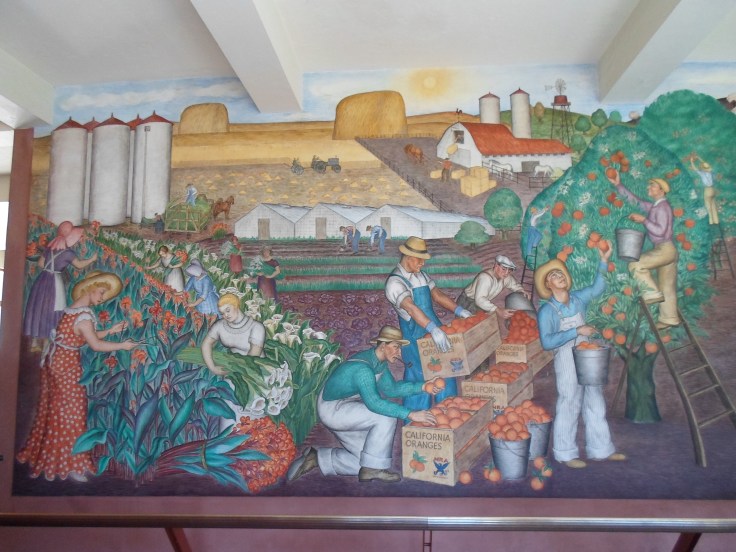
In the atmosphere of religious and political extremes that characterized Jerusalem under the yoke of Roman occupation, there is small wiggle room between blasphemy on the one side, and treason on the other.

In 2020, we are all too familiar with the spectacle of unholy alliances. It’s into the double-bind space of such an unholy alliance that Jesus walks. The unholy alliance Jesus faces is between the Herodian and Pharisee factions. The Herodians were the secular beautiful people; the designer clothes wearing, Jewish jet set; the royalist and collaborationist party. The Pharisees, were the strict, but also interestingly enough, the progressive religious party.

We find the improbable scene of these two antagonistic factions teaming up in a very, very, unholy alliance in order to pose for Jesus the question: is it lawful to pay the poll tax (a flat-rate personal tax) to Rome? 

If Jesus answers yes, he commits blasphemy – for Caesar’s coin bore the inscription son of god. If his answer is no, he commits treason – denying the lawful authority of Rome. Talk about little wiggle room!

How is Jesus to answer them? It’s dangerous to answer yes or no. Yet, so too is any attempt to offer a middle way answer.  As we know only too well from contemporary American political debate, when an atmosphere of fear and mutual contempt characterizes a separation of competing political and religious world views, a moderate view pleases no-one.

With the dexterity of a modern politician Jesus confronts the question by asking a question. He asks his interlocutors: whose, head is on the coin?  It’s they who are now in the jaws of a trap. Jesus’ next move is to state that some things are owed to civil authority and some things are owed to God. It appears simple, honor your obligation to each and don’t get them mixed up.

Jesus’ answer silences his opponents, but we are still left with the unanswered question: what does he really mean?

The health of the American body politic rests upon several neat separations, one of which – the separation of Church and State is connected with today’s Gospel reading. It’s complicated to follow Jesus inference here. Although some of us resent the right of the government to levy taxes, few of us refuse to pay them -we are less clear as to what: render unto God the things of God, means.

Jesus, the Pharisees, and the Great Seal of the United States are all in agreement. Each affirms the truth of the motto on the Great Seal: In God We Trust. It’s an interesting aside to note that from 1782 until 1956 the motto on the Great Seal was : E Pluaribus Unam -out of many, one. In 1957 it was changed to: In God We Trust. It is interesting to speculate on the reason for the change. Maybe it’s time to revert to the earlier tag – but best not go there at the moment.

In other words, while there is a constitutional distinction to be made between Church and State – incidentally, now much under attack – how are we to negotiate between our allegiance to God and duty to civil authority? Here, as in most areas of our lives we play a subtle game of selective cognizance.

There’s a nice story told about the Christian conversion of the Gauls. When the Christian missionaries submerged the Celtic warrior beneath the waters of baptism – he raised his right arm up so that his sword arm and hand remained above the water.  The intent here was clear. The warrior was saying: 

while my heart and soul now belong to Jesus, I reserve my sword arm - at least for the time being - to do with it as I so choose - i.e. to kill and maim.

Whatever the historical veracity of this story – it perfectly captures a common view today. While we may belong to Christ in baptism our money is ours.

That is to say – God can have our hearts and souls but not our wallets.

The heart of this Gospel encounter is not concerned with creating a clean separation between civil and religious authority. The central issue concerns allegiance and ownership. To whom, or to what do we owe allegiance? Over which aspects of our life do we have a right to exercise ownership?

The way we choose to answer these questions reveals the kind of persons we long to be, as well as the kind of community we envision ourselves belonging to?

This is an interesting Gospel for the Sunday that signals the beginning of the ARC for 2021. Several questions occur at this point:

1. The main question is not how much do we need to give to meet next year’s budget? The question before us is to whom do we owe allegiance for everything that is good in our lives?
2. Do we view the use of money in relation to our primary allegiance to God or is money - in effect - our Celtic warrior’s sword arm?
3. Do we think our financial health and security are the fruit of our own achievement, or the grace-filled gift from God?

Jesus’ confrontation with the Herodians and Pharisees challenges our comfortable assumption that our money is the product of our own skillfulness, our own good luck, or from a place of assumed privilege -our ability to command a nice financial reward?

Jesus challenges us to think about our primary allegiances. He also invites us to encounter gratitude as our primary response to God for the good things we have been given to enjoy.

Today, I invite us to enter into an intentional conversation about gratitude and generosity. We might begin our conversation with a recognition of our debt of gratitude to God. Drilling down to the next layer, I invite us to specifically reflect on three further questions:

1. Who are the persons who fill our lives with a joy - who bring us to our knees, overwhelmed by a deep thankfulness to God?
2. How has the generosity of God's providence manifested in our lives - often against all the odds - that brings us to our knees in thankfulness for the reckless generosity of God?
3. Can we go and do likewise, can we risk sharing our experience of gratitude by living lives of reckless generosity?

Jesus answers his opponents by implicating them in the tensions they seek to entrap him within. He does not say that it is easy living in the tension between the things of Caesar, and the things of God. He simply warns us about the competing powers and influences vying to sway us – to capture our hearts – ultimately to own us? 

When we are silent or that good old Episcopalian word, private about the primacy of our allegiance to God, we render ourselves vulnerable. Under the blasphemous illusion of owning ourselves, we become vulnerable to being owned by competing worldly allegiances – over which we really do have no control.

Jesus’ interlocutors in today’s Gospel go away amazed. Where our heart is, so there will be our treasure. Who knows, maybe we too can become amazed by what we begin to glimpse ourselves being capable of?


If you are not a regular St. Martin’s supporter, we invite you to

DONATE HERE.

Thank you for supporting our ministry during this period of physical distancing.
Liturgy of the Word for the 19th Sunday after Pentecost, October 11, 2020

If you are not a regular St. Martin’s supporter we invite you to

DONATE HERE

Thank you for supporting our ministry during this period of physical distancing.

A note about the structure of this webpage:

This page is set up to enable you to participate in the Liturgy of The Word, during which you will hear the sermon in its natural liturgical context; or you can scroll down the page to hear the stand-alone sermon webcast accompanied by the written text.

You can also view our return to eucharistic worship by clicking here.


Order of Service for the Liturgy of the Word

The Liturgy of the Word begins on page 355 of the Book of Common Prayer or online Eucharist Rt II here. Podcasts produced by Christian Tulungen.

The Prelude: Berceuse from 24 pièces, Op. 31, by Louis Vierne (1870-1927), Steven Young, organ

Welcome: The Rev’d Mark Sutherland, Rector

As mentioned in my welcome here is the link to Episcopal Office for Government Relations resources to meet the challenges of the election time.

The Introit: “Forgive our sins as we forgive” (Hymn 674), The St. Martin Chapel Consort

The Greeting: Blessed be God, Father, Son, and Holy Spirit; and blessed be God’s Kingdom, now and for ever.

Hymn 309 “O Food to pilgrims given” (vv. 1, 4), The St. Martin Chapel Consort

1 O food to pilgrims given,
O bread of life from heaven,
O manna from on high!
We hunger; Lord, supply us,
nor thy delights deny us,
whose hearts to thee draw nigh.

3 O Jesus, by thee bidden,
we here adore thee, hidden
in forms of bread and wine.
Grant when the veil is risen,
we may behold, in heaven,
thy countenance divine.

Collect for Purity

The Gloria S 279, The St. Martin Chapel Consort

The Collect of the Day:

Lord, we pray that your grace may always precede and follow us, that we may continually be given to good works; through Jesus Christ our Lord, who lives and reigns with you and the Holy Spirit, one God, for ever and ever. Amen.

The First Reading: Exodus 32:1-14, read by David Blake

Psalm 106:1-6, 19-23, The St. Martin Chapel Consort

Antiphon: Declare the mighty acts of God our Savior.

1 Hallelujah!
   Give thanks to the LORD, for he is good,
    for his mercy endures for ever.
2 Who can declare the mighty acts of the LORD
    or show forth all his praise?
3 Happy are those who act with justice
    and always do what is right!
4 Remember me, O LORD, with the favor 
   you have for your people,
    and visit me with your saving help;
5 That I may see the prosperity of your elect
   and be glad with the gladness of your people,
    that I may glory with your inheritance.
6 We have sinned as our forebears did;
    we have done wrong and dealt wickedly.
19 Israel made a bull-calf at Horeb
    and worshiped a molten image;
20 And so they exchanged their Glory
    for the image of an ox that feeds on grass.
21 They forgot God their Savior,
    who had done great things in Egypt,
22 Wonderful deeds in the land of Ham,
    and fearful things at the Red Sea.
23 So he would have destroyed them,
    had not Moses his chosen stood before him in the breach, 
    to turn away his wrath from consuming them.

Antiphon

The Second Reading: Philippians 4:1-9, read by Sammi Muther

Hymn 578 “O God of love, O King of peace” (v. 1), The St. Martin Chapel Consort

1 O God of love, O King of peace,
make wars throughout the world to cease;
the wrath of nations now restrain,
give peace, O God, give peace again!

The Gospel: Matthew 22:1-14, proclaimed by Linda+

Hymn 578 (v. 3)

3 Whom shall we trust but thee, O Lord?
Where rest but on thy faithful word?
None ever called on thee in vain,
give peace, O God, give peace again!

The Sermon: Mark+  A stand-alone sermon recording and full text also appear below on this page.

The Nicene Creed: We recite together. Please note italicized inclusive language changes.

We believe in one God,
    the Father, the Almighty,
    maker of heaven and earth,
    of all that is, seen and unseen.
We believe in one Lord, Jesus Christ,
    the only Son of God,
    eternally begotten of the Father,
    God from God, Light from Light,
    true God from true God,
    begotten, not made,
    of one Being with the Father.
    Through him all things were made.
    For us and for our salvation
        he came down from heaven:
    by the power of the Holy Spirit
        he became incarnate from the Virgin Mary,
        and was made human.
    For our sake he was crucified under Pontius Pilate;
        he suffered death and was buried.
        On the third day he rose again
            in accordance with the Scriptures;
        he ascended into heaven
            and is seated at the right hand of the Father.
He will come again in glory to judge the living and the dead,
        and his kingdom will have no end.
We believe in the Holy Spirit, God, the giver of life,
    who proceeds from the Father and the Son.
    With the Father and the Son is worshiped and glorified
        and has spoken through the Prophets.
    We believe in one holy catholic and apostolic Church.
    We acknowledge one baptism for the forgiveness of sins.
    We look for the resurrection of the dead,
        and the life of the world to come. Amen.

The Anthem: “O for a Closer Walk with God” by Erik Routley (1917-1982), The St. Martin Chapel Consort

O for a closer walk with God,
A calm and heavenly frame,
A light to shine upon the road
That leads me to the Lamb!

Return, O holy Dove, return,
Sweet messenger of rest;
I hate the sins that made Thee mourn
And drove Thee from my breast.

The dearest idol I have known,
Whate’er that idol be
Help me to tear it from Thy throne,
And worship only Thee.

So shall my walk be close with God,
Calm and serene my frame;
So purer light shall mark the road
That leads me to the Lamb.

The Prayers of the People: led by Linda+

The Lord’s Prayer, The St. Martin Chapel Consort

The General Thanksgiving

Almighty God, Father of all mercies, 
we your unworthy servants
give you humble thanks
for all your goodness and loving-kindness
to us and to all whom you have made.
We bless you for our creation, preservation,
and all the blessings of this life;
but above all for your immeasurable
love in the redemption of the world
by our Lord Jesus Christ;
for the means of grace,
and for the hope of glory.
And, we pray, give us such
an awareness of your mercies,
that with truly thankful hearts
we may show forth your praise,
not only with our lips, but in our lives,
by giving up our selves to your service,
and by walking before you in
holiness and righteousness all our days;
through Jesus Christ our Lord,
to whom, with you and the Holy Spirit,
be honor and glory throughout all ages. Amen.

The Peace

Hymn 362, “Holy, holy, holy!” The St. Martin Chapel Consort

1 Holy, holy, holy! Lord God Almighty!
Early in the morning our song shall rise to thee:
Holy, holy, holy! Merciful and mighty,
God in three Persons, blessed Trinity.

2 Holy, holy, holy! All the saints adore thee,
casting down their golden crowns around the glassy sea;
cherubim and seraphim falling down before thee,
which wert, and art, and evermore shalt be.

3 Holy, holy, holy! Though the darkness hide thee,
though the sinful human eye thy glory may not see,
only thou art holy; there is none beside thee,
perfect in power, in love, and purity.

4 Holy, holy, holy! Lord God Almighty!
All thy works shall praise thy Name, in earth, and sky, and sea;
Holy, holy, holy! Merciful and mighty,
God in three Persons, blessed Trinity.

The Final Blessing

The Postlude:  “Carillon du Longpont” from 24 pièces, Op. 31, by L. Vierne, Steven Young, organ

Permission to podcast/stream the music in this service obtained from ONE LICENSE with license #M-400498. All rights reserved.


Stand-Alone Sermon Podcast:

Mutual Need

I wrote in the E-News this past week about truth and untruth. I began with Lewis Carroll’s wonderful exchange between Alice and the White Queen about the dynamics of believing in impossible things. As the White Queen tells Alice, believing in impossible things takes some practice. Let those with ears to hear ….

Exodus 32:1-14 recounts the story of the Golden Calf. This is for our society an emblematic story – so much so that the term golden calf has even entered into common speech -used to refer to an alluring temptation or distraction. But is it a true story?

The late and renowned Biblical scholar Marcus Borg noted that the Bible is full of true stories – some of which actually happened. He drew a distinction between truth rooted in historical events and truth as history metaphorized, i.e. stories of events that never happened but nevertheless express a profound truth.

Historical truth and metaphorized truth both share a common feature which is absent in a belief in impossible things. Stories rooted in historical events or metaphorized – both resonate accurately in the reality of our day to day lives. Both address us in the lives we actually are living and offer us something fruitful and meaningful in the face of the challenges and opportunities we face.

Traditionally seen as a story about the sins of idol worship, the Golden Calf story — is at a deeper level – a profound exploration of the tensions within the divine-human encounter. These are tensions concerning the community’s experience of the availability or absence of God. Is God available- able to speak directly to the challenges and opportunities facing a community? At this level – Exodus 32:1-14 speaks directly into our own alienated experience.

Exodus 32:1-14 speaks not only into our own experience but also speaks to God’s suggestibility.

In its projected historical setting, this is a story revealing a mutuality of needs. It’s a story in which God and a community discover each other and find in that discovery that they share the same needs.

Previously – God had been the god of Abraham, or Isaac, or Jacob, now he’s [sic] the god of Moses. God has yet to fully emerge as god of a whole people – the God of Israel. It’s like the question – who is that man over there? Why that’s no man, that’s my husband, or my father, or my friend. If the Israelites were asked: do you know the Lord God? They would have replied: we don’t know the Lord God personally, but we know a man who does.

If the Israelites were asked: do you know the Lord God? They would have replied: we don’t know the Lord God personally, but we know a man who does.

God has called Moses to meet him on the mountain. Before Moses begins the ascent, God instructs him to tell the Israelites to set camp at the foot of the mountain but not to set foot upon it. Picture the scene. Moses treks up the mountain leaving the people waiting in expectation. They wait and they wait. Each day, the lookouts posted, strain their eyes in the hope of seeing Moses coming home. Day and night the people wait, and wait, and wait, and eventually come reluctantly, to the conclusion that Moses and his god are not coming back.

The Israelites then do what human communities faced with the absence of God have done over time and what we still do today. They look for a substitute. Their request to Aaron – the next best thing to Moses – is instructive. They plead:

Come make us other gods - useful gods - gods who will go before us - because Moses who brought us up out of the land of Egypt– well we don’t know what’s happened to him and its now clear to us he and his god are not coming back!

This is a story that speaks directly to our most human of needs – the need for an experience of divine intimacy – a god who is accessible to us– a god who is available to hear our concerns – able to protect and comfort us, to give us direction, to strengthen our flagging hope, and give us a sense of purpose.

When God is experienced as absent, we look for substitutes to fill the experience of emptiness left in the gap between us and God. In 21st-century America we try to fill the emptiness with money, or shopping, or a charismatic leader, or even family, or nation, or replacing an absent God with our own narcissistic self-preoccupation.

There is a myriad of golden calves to distract us from the experience of divine absence.

There is a myriad of golden calves to distract us from the experience of divine absence. For many of us today, even when we say we believe in God, God is now remote from us – like the central character in a play who has now left the stage – leaving us center stage – alone and bereft.

This is a story that reveals the truth of our human struggle to find fulfilment and purpose, our need for connection and intimacy and to know ourselves as we really are – relational beings who need relatable images of the unseen God.

But it’s also a story that tells us something about God’s developing needs. The books of the Torah reveal – at least from the human perspective – a God who is far from unchangeable. In fact, God is presented as actually highly suggestible.

The books of the Torah reveal – at least from the human perspective – a God who actually highly suggestible.

In this story we see God coming to realize his [sic] own need for wider relationship. Not for the first time God uses a relationship with a significant human being – this time Moses – in order to become more fully aware of the implications of a tendency to act first and only then to ask questions. When God hears the noise of the Israelite celebration his response is one of roused jealousy with profound genocidal implications.

Moses appeals to God to cool it – by reminding God not to lose sight of the longer and larger objective here in bringing the people out of Egypt. In the process he appeals to God’s past experience with Abraham, Isaac, and Jacob -who had each played a similar role in moderating and containing God’s hot impulsivity.

The upshot of the action is that God recognizes he [sic] needs to change. After Moses returns to the camp and destroys the idol, God comes down from the mountain top into the camp – to for the first time – dwell among the Israelites. The place of encounter is aptly called the Tent of Meeting. God is now present as a pillar of fire by night and pillar of cloud by day – hovering and when needed – leading the people to the next resting place on their journey.

In the story of the Golden Calf we see God coming to a new realization – the need to become present in the midst of the community of the people.

Throughout succeeding Israelite history God dwells among the people in the Ark of the Covenant that travels about with them before eventually finding a home in the Jerusalem Temple. For Jews today, God remains present through the living tradition of Torah – made real on a daily basis in the practice of the law.

For us, the Christian people of God, God dwells among us through Jesus as the relatable image of the unseen God. The face of Jesus is not simply an historical image, but an image in real time – continually alive in the life of the community through the celebration of the sacraments – the outward and visible signs of God’s inner and spiritual presence.

In a time of pandemic when enforced social distancing easily becomes emotional isolation, our need for the tangible presence of God has never been greater. The question facing us is when it’s no longer safe for worship as a community gathered together – to what extent can God’s sacramental presence be shared virtually? We are going to be working out the implications of that question for the foreseeable future as we struggle to work with God to fashion new versions of the Tent of Meeting. Amen.


If you are not a regular St. Martin’s supporter, we invite you to

DONATE HERE.

Thank you for supporting our ministry during this period of physical distancing.
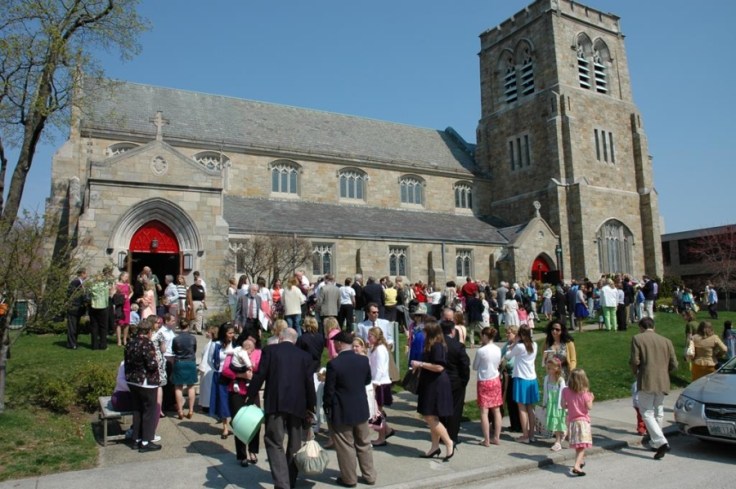
Liturgy of the Word for the 18th Sunday after Pentecost, October 4, 2020

If you are not a regular St. Martin’s supporter we invite you to

DONATE HERE

Thank you for supporting our ministry during this period of physical distancing.

A note about the structure of this webpage:

This page is set up to enable you to participate in the Liturgy of The Word, during which you will hear the sermon in its natural liturgical context; or you can scroll down the page to hear the stand-alone sermon webcast accompanied by the written text.

You can also view our return to eucharistic worship by clicking here.


Order of Service for the Liturgy of the Word

The Liturgy of the Word begins on page 355 of the Book of Common Prayer or online Eucharist Rt II here. Podcasts produced by Christian Tulungen.

The Prelude: Adagio (Troisième Symphonie, Op. 28) by Louis Vierne (1870-1927), Steven Young, organ

Welcome: The Rev’d Mark Sutherland, Rector

As mentioned in my welcome here is the link Episcopal Office for Government Relations resources to meet the challenges of the election-time.

The Introit: “Lift Thine Eyes to the Mountains” from Elijah by Felix Mendlessohn (1809-1847), The St. Martin Chapel Consort

The Greeting: Blessed be God, Father, Son, and Holy Spirit; and blessed be God’s Kingdom, now and for ever.

Hymn 639 “Come, O thou Traveler unknown” (vv. 1, 4), The St. Martin Chapel Consort

1 Come, O thou Traveler unknown,
whom still I hold, but cannot see;
my company before is gone,
and I am left alone with thee.
With thee all night I mean to stay,
and wrestle till the break of day.

4 'Tis Love, 'tis Love! Thou diedst for me!
I hear thy whisper in my heart:
the morning breaks, the shadows flee.
Pure universal Love thou art;
thy mercies never shall remove,
thy nature and thy name is Love.

Collect for Purity

The Gloria S 280, The St. Martin Chapel Consort

The Collect of the Day:

Almighty and Everlasting God, you are always more read to hear than we to pray, and to give more than we either desire or deserve: Pour upon us the abundance of your mercy, forgiving us those things of which our conscience is afraid, and giving us those good things for which we are not worthy to ask, except through the merits and mediation of Jesus Christ our Savior; who lives and reigns with you and the Holy Spirit, one God, for ever and ever. Amen.

The First Reading: Exodus 20:1-4, 7-9, 12-20, read by Fla Lewis

Psalm 19, The St. Martin Chapel Consort

Antiphon: The statutes of the Lord rejoice the heart.

1 The heavens declare the glory of God,
    and the firmament shows his handiwork.
2 One day tells its tale to another,
    and one night imparts knowledge to another.
3 Although they have no words or language,
    and their voices are not heard,
4 Their sound has gone out into all lands,
    and their message to the ends of the world.
5 In the deep has he set a pavilion for the sun;
    it comes forth like a bridegroom out of his chamber;
    it rejoices like a champion to run its course.
6 It goes forth from the uttermost edge of the heavens
    and runs about to the end of it again;
    nothing is hidden from its burning heat.
7 The law of the LORD is perfect and revives the soul;
    the testimony of the LORD is sure
    and gives wisdom to the innocent.
8 The statutes of the LORD are just and rejoice the heart;
    the commandment of the LORD is clear
    and gives light to the eyes.

Antiphon

9 The fear of the LORD is clean and endures for ever;
    the judgments of the LORD are true
    and righteous altogether.
10 More to be desired are they than gold,
    more than much fine gold,
    sweeter far than honey, than honey in the comb.
11 By them also is your servant enlightened,
    and in keeping them there is great reward.
12 Who can tell how often he offends?
    cleanse me from my secret faults.
13 Above all, keep your servant from presumptuous sins;
    let them not get dominion over me;
    then shall I be whole and sound,
    and innocent of a great offense.
14 Let the words of my mouth and the meditation of my heart
    be acceptable in your sight,
    O LORD, my strength and my redeemer.

Antiphon

The Second Reading: Philippians 3:4b-14, read by Melinda DelCioppio

Hymn 308 “O Food to pilgrims given” (v. 1), The St. Martin Chapel Consort

1 O food to pilgrims given,
O bread of life from heaven,
O manna from on high!
We hunger; Lord, supply us,
nor thy delights deny us,
whose hearts to thee draw nigh.

The Gospel: Matthew 21:33-46, proclaimed by Mark+

Hymn 308 (v. 3)

3 O Jesus, by thee bidden,
we here adore thee, hidden
in forms of bread and wine.
Grant when the veil is risen,
we may behold, in heaven,
thy countenance divine.

The Sermon: Linda+  A stand-alone sermon recording and full text also appear below on this page.

The Nicene Creed: We recite together. Please note italicized inclusive language changes.

We believe in one God,
    the Father, the Almighty,
    maker of heaven and earth,
    of all that is, seen and unseen.
We believe in one Lord, Jesus Christ,
    the only Son of God,
    eternally begotten of the Father,
    God from God, Light from Light,
    true God from true God,
    begotten, not made,
    of one Being with the Father.
    Through him all things were made.
    For us and for our salvation
        he came down from heaven:
    by the power of the Holy Spirit
        he became incarnate from the Virgin Mary,
        and was made human.
    For our sake he was crucified under Pontius Pilate;
        he suffered death and was buried.
        On the third day he rose again
            in accordance with the Scriptures;
        he ascended into heaven
            and is seated at the right hand of the Father.
He will come again in glory to judge the living and the dead,
        and his kingdom will have no end.
We believe in the Holy Spirit, God, the giver of life,
    who proceeds from the Father and the Son.
    With the Father and the Son is worshiped and glorified
        and has spoken through the Prophets.
    We believe in one holy catholic and apostolic Church.
    We acknowledge one baptism for the forgiveness of sins.
    We look for the resurrection of the dead,
        and the life of the world to come. Amen.

The Anthem: Spiritual: “My Lord What a Mourning” (trad., arr. Clayton White), The St. Martin Chapel Consort

The Prayers of the People: led by Mark+

The Lord’s Prayer, The St. Martin Chapel Consort

The General Thanksgiving

Almighty God, Father of all mercies, 
we your unworthy servants
give you humble thanks
for all your goodness and loving-kindness
to us and to all whom you have made.
We bless you for our creation, preservation,
and all the blessings of this life;
but above all for your immeasurable
love in the redemption of the world
by our Lord Jesus Christ;
for the means of grace,
and for the hope of glory.
And, we pray, give us such
an awareness of your mercies,
that with truly thankful hearts
we may show forth your praise,
not only with our lips, but in our lives,
by giving up our selves to your service,
and by walking before you in
holiness and righteousness all our days;
through Jesus Christ our Lord,
to whom, with you and the Holy Spirit,
be honor and glory throughout all ages. Amen.

The Peace

Hymn 174, “At the Lamb’s high feast” (vv. 1, 4), The St. Martin Chapel Consort

1 At the Lamb's high feast we sing
praise to our victorious King,
who hath washed us in the tide
flowing from his pierced side;
praise we him, whose love divine
gives his sacred Blood for wine,
gives his Body for the feast,
Christ the victim, Christ the priest.

4 Easter triumph, Easter joy,
these alone do sin destroy.
From sin's power do thou set free
souls newborn, O Lord, in thee.
Hymns of glory, songs of praise,
Father, unto thee we raise:
risen Lord, all praise to thee
with the Spirit ever be.

The Final Blessing

The Postlude:  Allegro (Deuxième Symphonie, Op. 20) by L. Vierne, Steven Young, organ

Permission to podcast/stream the music in this service obtained from ONE LICENSE with license #M-400498. All rights reserved.


Stand-Alone Sermon Podcast:

Cautionary Tales

“Wicked Tenants”
The Rev. Linda Mackie Griggs

“Therefore I tell you, the kingdom of God will be taken away from you and given to a people that produces the fruits of the kingdom. The one who falls on this stone will be broken to pieces; and it will crush anyone on whom it falls.”

At least two things are happening here, and neither of them is for the faint of heart. In one instance we have Jesus invoking the prophet Isaiah for his audience, reminding them of Israel’s history; their rejection of God and God’s Commandments that resulted in destruction and exile to Babylon in 587BCE. Jesus’ implication was that if God did it once, that God could, and would, do it again.

In the second instance we have the author of Matthew’s Gospel invoking more recent history for his first century audience. His implication in relating this story about Jesus’ parable was that God in fact DID do it again, in 70 AD with the destruction of Jerusalem, this time by the Romans. So for those with ears to hear this would bode ill for anyone who dared to reject Jesus, the “chief cornerstone” of the true faith.

Jesus’ parable, often referred to as the Parable of the Wicked Tenants, seems to have skewered the Temple authorities and Roman collaborators for their lack of faithfulness to God. But the images are more complicated and disturbing than they seem at first. A Jewish audience would have recognized that, under the tenant farming system in first century Palestine, the original hereditary landholders of that region had been pushed off of the land and replaced by Roman colonial outsiders or local collaborators who then leased the land back to the tenants who had formerly owned the land in the first place.

To the people living in the time of Jesus and Matthew, the landowner represents empire, not God. Which is it? God or Rome? Are the tenants wicked, or rebellious?

In other words, imagine someone who is disinherited from their land then being required to send the fruits of their labor to the person who has taken the land from them.

Who is wicked now?

This is really disturbing. The most common reading of this story portrays the landowner as God. This is a fair interpretation, since that’s clearly what Isaiah intended in the passage that Jesus alludes to, where Isaiah speaks of the landowner carefully and painstakingly setting up the vineyard. But, to the people living in the time of Jesus and Matthew, the landowner represents empire, not God. Which is it? God or Rome? Are the tenants wicked, or rebellious?

Yes.

Did Jesus’ and Matthew’s audiences feel a knot in their stomach as they experienced this contradiction? Did they rebel inwardly at the lack of expected clarity; the lack of distinction between Us and Them? Who is the good person here?

This is really messy. That may be the point.

Just like the Jews of the first century, not even what we have most in common can hold us together.

The author of Matthew’s Gospel was writing in the late first- early second century. This period, following the crush of a Jewish revolt and destruction of Jerusalem by Rome, was a time of tremendous conflict between different Jewish groups as they sought to clarify their identity as a people who were now living without the Temple that had been the center of their faith. The Jewish followers of Jesus disagreed with the Jewish non-followers of Jesus over issues of authority, interpretation of the Law, and of course the identity of Jesus himself. And ultimately the Jewish Christians were excluded from the synagogue by the Jewish non-Christians, which was a major source of the contentious tone that Matthew often used in his Gospel.

The important thing to remember here is that they were all Jews.

The split that ultimately took place between these groups was like a really messy divorce.

And the rest of the people of God at that time were witnesses to that trauma, as the parties hurled insults, prophecy, and threats at each other, angrily barreling down the road to complete alienation and fracture.

Sounds familiar, doesn’t it.

To be honest, I’m not sure where else to go with this passage beyond how, once it’s been parsed out, it resonates today. It’s possible that Matthew, in addition to communicating his disdain for opposing parties, also expressed the grief and confusion of one whose family is being torn apart. And maybe that’s all we’re meant to understand with this reading, in this October of 2020, when everywhere we turn we see outrage and reasons for outrage, verbal and literal violence, and the fracturing of communities and families as lines are drawn and sides chosen, even between people of faith. Just like the Jews of the first century, not even what we have most in common can hold us together.

This past Wednesday I observed the dazed look on people’s faces as they remembered, or for those who couldn’t stomach seeing it, heard details of Tuesday’s presidential debate. Eyes widened, brows furrowed, and shoulders tensed as they contemplated the rabbit hole.

They said:

“What in the world just happened?”

“I got NO sleep last night…”

“I don’t recognize this country anymore.”

“I can’t take any more of this.”

“I’m afraid for us.”

There is nothing I would love more than to stand here and say the magic words of comfort, wisdom and healing that would make this all vanish. It hurts to feel powerless to fix things that feel just too big and beyond our control as individuals.

It’s our desire to control the uncontrollable that is often the source of so much anxiety, tension and worry. But the fact remains that God is God and we are not, and the only thing that God calls us to do is what we can do. As people of faith we are not without resources, and we are certainly not without hope. St. Paul, suffering “the loss of all things,” still held fast to his belief that he was Christ’s own, as we all are. And as Christ’s own we are called to not give in to fear and worry; not to let the rabbit holes suck us in. We belong to Christ, the chief cornerstone of our faith.

“If prayer is the deep secret creative force that Jesus tells us it is, we should be very busy with it…”

Friends, I’m preaching to myself. I have to remind myself every day that worry is a failure of imagination. And the best way to counteract worry is to replace it with prayer. Even if it is just to breathe. Because, as Paul says in his letter to the Romans, the Spirit intercedes for us with sighs too deep for words. Prayer is a connection to God—tapping in to the flow of love, compassion, healing and renewal that are part of the God who sustains us.

It is easy to forget in times of chaos that prayer is truly powerful. It may not always ‘work’ in ways that we expect, but we can always count on it to change us by releasing our fear and worry into the hands of the One who is the gracious lover of souls, renewing us for whatever challenges confront us. One of my favorite quotes is from activist and educator Vida Dutton Scudder, whose feast day is coming up on October 10. She believed that prayer was a mighty force for social change, and said, “If prayer is the deep secret creative force that Jesus tells us it is, we should be very busy with it…”

Indeed.

So let us pledge to get busy with it. Let us pray.

Lord, make us instruments of your peace.
Where there is hatred, let us sow love; 
where there is injury, pardon; 
where there is discord, union; 
where there is doubt, faith; 
where there is despair, hope; 
where there is darkness, light; 
where there is sadness, joy. 
Grant that we may not so much seek to be consoled as to console; 
to be understood as to understand; 
to be loved as to love. 
For it is in giving that we receive; 
it is in pardoning that we are pardoned; 
and it is in dying that we are born to eternal life. Amen.

If you are not a regular St. Martin’s supporter, we invite you to

DONATE HERE.

Thank you for supporting our ministry during this period of physical distancing.

Liturgy of the Word for the 17th Sunday after Pentecost, September 27, 2020

If you are not a regular St. Martin’s supporter we invite you to

DONATE HERE

Thank you for supporting our ministry during this period of physical distancing.

A note about the structure of this webpage:

This page is set up to enable you to participate in the Liturgy of The Word, during which you will hear the sermon in its natural liturgical context; or you can scroll down the page to hear the stand-alone sermon webcast accompanied by the written text.

You can also view our return to eucharistic worship by clicking here.


Order of Service for the Liturgy of the Word

The Liturgy of the Word begins on page 355 of the Book of Common Prayer or online Eucharist Rt II here. Podcasts produced by Christian Tulungen.

The Prelude: Prelude on Rhosymedre by Ralph Vaughan Williams (1872-1958), Steven Young, organ

Welcome: The Rev’d Mark Sutherland, Rector

The Introit: Introit by Iain Quinn (b. 1973), The St. Martin Chapel Consort

The Greeting: Blessed be God, Father, Son, and Holy Spirit; and blessed be God’s Kingdom, now and for ever.

Hymn 309 “O Food to pilgrims given,” (vv. 1, 3), The St. Martin Chapel Consort

1 O Food to pilgrims given,
O Bread of life from heaven,
O Manna from on high!
We hunger; Lord, supply us,
nor thy delights deny us,
whose hearts to thee draw nigh.

3 O Jesus, by thee bidden,
we here adore thee, hidden
in forms of bread and wine.
Grant when the veil is risen,
we may behold, in heaven,
thy countenance divine.

Collect for Purity

The Gloria S 279, The St. Martin Chapel Consort

The Collect of the Day:

O God, you declare your almighty power chiefly in showing mercy and pity: Grant us the fullness of your grace, that we, running to obtain your promises, may become partakers of your heavenly treasure; through Jesus Christ our Lord, who lives and reigns with you and the Holy Spirit, one God, for ever and ever. Amen.

The First Reading: Exodus 17:1-7, read by Marty Flaherty

Psalm 78:1-4, 12-16, The St. Martin Chapel Consort

Refrain: Our forefathers have told us of the power of the Lord, and the wonderful works he has done.

1 Hear my teaching, O my people; *
    incline your ears to the words of my mouth.
2 I will open my mouth in a parable; *
    I will declare the mysteries of ancient times.
3 That which we have heard and known,
    and what our forefathers have told us, *
    we will not hide from their children.
4 We will recount to generations to come
    the praiseworthy deeds and the power of the LORD, *
    and the wonderful works he has done.
12 He worked marvels in the sight of their forefathers, *
    in the land of Egypt, in the field of Zoan.
13 He split open the sea and let them pass through; *
    he made the waters stand up like walls.
14 He led them with a cloud by day, *
    and all the night through with a glow of fire.
15 He split the hard rocks in the wilderness *
    and gave them drink as from the great deep.
16 He brought streams out of the cliff, *
    and the waters gushed out like rivers.

Refrain

The Second Reading: Philippians 2:1-13, read by Amy Esposito

Hymn 690 “Guide me, O thou great Jehovah” (v. 1), The St. Martin Chapel Consort

1 Guide me, O thou great Jehovah,
pilgrim through this barren land;
I am weak, but thou art mighty;
hold me with thy powerful hand;
bread of heaven, bread of heaven,
feed me now and evermore,
feed me now and evermore.

The Gospel: Matthew 21:23-32, proclaimed by Linda+

Hymn 690 (v. 3)

3 When I tread the verge of Jordan,
bid my anxious fears subside;
death of death, and hell's destruction,
land me safe on Canaan's side;
songs of praises, songs of praises,
I will ever give to thee,
I will ever give to thee.

The Sermon: Mark+  A stand-alone sermon recording and full text also appear below on this page.

The Nicene Creed: We recite together. Please note italicized inclusive language changes.

We believe in one God,
    the Father, the Almighty,
    maker of heaven and earth,
    of all that is, seen and unseen.
We believe in one Lord, Jesus Christ,
    the only Son of God,
    eternally begotten of the Father,
    God from God, Light from Light,
    true God from true God,
    begotten, not made,
    of one Being with the Father.
    Through him all things were made.
    For us and for our salvation
        he came down from heaven:
    by the power of the Holy Spirit
        he became incarnate from the Virgin Mary,
        and was made human.
    For our sake he was crucified under Pontius Pilate;
        he suffered death and was buried.
        On the third day he rose again
            in accordance with the Scriptures;
        he ascended into heaven
            and is seated at the right hand of the Father.

He will come again in glory to judge the living and the dead,
        and his kingdom will have no end.
We believe in the Holy Spirit, God, the giver of life,
    who proceeds from the Father and the Son.
    With the Father and the Son is worshiped and glorified
    and has spoken through the Prophets.

    We believe in one holy catholic and apostolic Church.
    We acknowledge one baptism for the forgiveness of sins.
    We look for the resurrection of the dead,
        and the life of the world to come. Amen.

The Anthem: Benedictus by Franz Schubert (1797-1828), The St. Martin Chapel Consort

The Prayers of the People: led by Linda+

The Lord’s Prayer, The St. Martin Chapel Consort

The General Thanksgiving

Almighty God, Father of all mercies, 
we your unworthy servants
give you humble thanks
for all your goodness and loving-kindness
to us and to all whom you have made.
We bless you for our creation, preservation,
and all the blessings of this life;
but above all for your immeasurable
love in the redemption of the world
by our Lord Jesus Christ;
for the means of grace,
and for the hope of glory.
And, we pray, give us such
an awareness of your mercies,
that with truly thankful hearts
we may show forth your praise,
not only with our lips, but in our lives,
by giving up our selves to your service,
and by walking before you in
holiness and righteousness all our days;
through Jesus Christ our Lord,
to whom, with you and the Holy Spirit,
be honor and glory throughout all ages. Amen.

The Peace

Hymn 686, “Come, thou fount of every blessing” (vv. 1, 3), The St. Martin Chapel Consort

1 Come, thou fount of every blessing,
tune my heart to sing thy grace!
Streams of mercy never ceasing,
call for songs of loudest praise.
Teach me some melodious sonnet,
sung by flaming tongues above.
Praise the mount! O fix me on it,
mount of God's unchanging love.

3 Oh, to grace how great a debtor
daily I'm constrained to be!
Let thy goodness, like a fetter,
bind my wandering heart to thee;
prone to wander, Lord, I feel it,
prone to leave the God I love;
here's my heart, oh, take and seal it,
seal it for thy courts above.

The Final Blessing

The Postlude:  Postlude by Norberto Guinaldo (b. 1937), Steven Young, organ

Permission to podcast/stream the music in this service obtained from ONE LICENSE with license #M-400498. All rights reserved.


Stand-Alone Sermon Podcast:

Christ-mindedness

Common Mind in Action -[My title] from the Murals at Coit Tower by artists of the Diego Rivera School, 1934, San Francisco

Despite our huge polarization as a society, that we are living through tumultuous days is perhaps the one of the things we can all agree on. Another is the question on all our lips – can we survive the days leading up to November 3rd and at the same time maintain our sanity? Following the President’s dark and veiled warnings about election fraud the prospect opening up for all of us is the realization that November 3rd may not put paid to our state of heightened anxiety.

The dilemma we face is that we have become a society so deeply divided on the picture of the change we want to see. Christians of all persuasions believe the Christ of Faith is on their side. Even non-Christians and secularists take Jesus teaching in the gospels to be the inspiration for why they are in the right.

In the epistle for this week Paul encourages the Philippians to:

work out your salvation with fear and trembling for it is God who is at work in you!

Paul’s letter to the Philippians is most probably a compilation of a series of letters written over time and brought together by him some ten years after his first momentous visit to Philippi. Writing probably from his prison cell in Rome and facing a sentence of death, Paul encourages them to:

let the mindset of Christ be yours as you draw your life from him by letting him live in you.

What does this mean?

Paul warns the Philippians to proceed with fear and trembling. Be careful about the attitudes you hold, the choices you make, and the actions you take, and esp. the reactions you express. Consider the what if –two little big words – what if, you’re wrong?

Our attitudes form and inform the choices we make, the actions we take, and the reactions we express. To a very large extent our attitudes are based on life experience. When our attitudes are influenced by misleading information, driven by inflated fears stoked up by malignant forces – then our choices, our actions and our reactions will follow suit. We need to be increasingly aware of how vulnerable we all are to malignant forces that sow discord and exploit us through the unregulated saturation of social media that now colonises even the most private spaces in our personal lives.

Paul’s warning to approach the most important aspect of our life [my paraphrase] with fear and trembling is an encouragement for us to pause and lower the I-me quotient in order to make room for the Christ of faith through the power of the Holy Spirit to be at work in us.

What are the characteristics of Christ-mindness? It’s helpful to listen to an unusual Bible translation to surprize us out of the way we only half hear words that have become too familiar. Paul’s warning takes on greater forcefulness in the less familiar cadences of The Message’s idiomatic translation of Philippians 2:1-13 this way:

If you’ve gotten anything at all out of following Christ, if his love has made any difference in your life, if being in a community of the Spirit means anything to you, if you have a heart, if you care— then do me a favor: Agree with each other, love each other, be deep-spirited friends. Don’t push your way to the front; don’t sweet-talk your way to the top. Put yourself aside, and help others get ahead. Don’t be obsessed with getting your own advantage. Forget yourselves long enough to lend a helping hand.

Here’s the answer to my question. These are the qualities that characterise the mindset of Christ or what I’m calling Christ-mindedness.

Paul’s words then soar to the height of poetic eloquence in his moving hymn to Christ which begins:

Though in the form of God Jesus did not regard equality with God something to be exploited, but emptied himself – and being born in human form – humbled himself and became obedient to the point of death – even death on a cross.

Here in Jesus’ self-emptying of ego we find the best description of what Christ-mind looks like in action.

Many of us believe that living the Christian life is to live our lives with the inspiration of the Jesus’ example before our eyes. This is a fine way to live but it’s actually not what being a Christian is about. Many non-Christians are inspired by the pre-Easter Jesus and fold his influence into their lives.  

Paul encourages us in his letter to Philippi to take a bigger step than this. For to be Christian is to live not simply inspired by the historical example of the man Jesus of Nazareth – the prophet of God’s justice. It is not enough to carefully work out our salvation with our own discernment and astuteness – which smacks too much of progressing under our own steam and not through God’s grace. Paul is asking a simple question: who is in the driving seat?

Paul and the early Christian communities he writes to – experience the power of the Christ of Faith who turns all our worlds upside down. Our power to change the world flows from our shared experience of the mind of Christ so that it’s no longer me, us, we who are in the driving seat but God working in us through the power of the Holy Spirit.

Christ mindedness is not a state of emulation or imitation, a kind of pretending to be Jesus. It’s allowing the working of the Holy Spirit to de-center our preoccupation with me, mine, and I in the service of a larger truth working for good beyond that which we are able to see.

It’s very hard to empty myself of myself. It’s even harder to do so without the reassurance that another who threatens me by the attitudes she holds, the choices he advocate, the actions he or she takes – will do likewise and empty him or herself- so that together we may discover that our differences are simply the product of different life experience dressed up as ideology. Christ-mindedness is the antidote to all ideology.

Currently so much about religion recast as some kind of ideology seems to be getting in the way.

Christ-mindedness emerges within and between us when we recognize that the other is not the enemy. I’m not saying there are no bad actors or movements that are evil in nature and effect. I’m just pointing out that generally speaking the other – normally defined as someone different from me – who holds a different worldview from mine – is not by default my enemy. We share the same desires to love and be loved, the same need to console and be consoled, the same love of family, community, and country; the same need for encouragement and empathy to contain the fears that push us to protect ourselves through self or group assertion and dominance.

To become empty of the highly self-protectionist part of our minds – is very hard and risky and I am not sure I can do it – at least not on my own.

Paul reminds us that if we approach the task of ultimate meaning and purpose with hesitancy – not assuming we are right – with fear and trembling – then God – inspirited within us – does the heavy lifting, A question is do we have the will to relinquish self-serving and passionately held certainties and projected fears to make room for the Christ of faith to take the wheel?


If you are not a regular St. Martin’s supporter, we invite you to

DONATE HERE.

Thank you for supporting our ministry during this period of physical distancing.

Liturgy of the Word for the 16th Sunday after Pentecost, September 20, 2020

If you are not a regular St. Martin’s supporter we invite you to

DONATE HERE

Thank you for supporting our ministry during this period of physical distancing.

A note about the structure of this webpage:

This page is set up to enable you to participate in the Liturgy of The Word, during which you will hear the sermon in its natural liturgical context; or you can scroll down the page to hear the stand-alone sermon webcast accompanied by the written text.

You can also view our return to eucharistic worship by clicking here.


Order of Service for the Liturgy of the Word

The Liturgy of the Word begins on page 355 of the Book of Common Prayer or online Eucharist Rt II here. Podcasts produced by Christian Tulungen.

The Prelude: Adagio from Sonata I, Op. 10, by Henry M. Dunham (1853-1929), Steven Young, organ

Welcome: The Rev’d Mark Sutherland, Rector

The Introit: “Now that the daylight fills the sky,” The St. Martin Chapel Consort

The Greeting: Blessed be God, Father, Son, and Holy Spirit; and blessed be God’s Kingdom, now and for ever.

Hymn 343 “Shepherd of souls,” (vv. 1, 4), The St. Martin Chapel Consort

1 Shepherd of souls, refresh and bless
thy chosen pilgrim flock
with manna in the wilderness,
with water from the rock.

4 Lord, sup with us in love divine,
thy Body and thy Blood,
that living bread, that heavenly wine,
be our immortal food.

Collect for Purity

The Gloria S 277, The St. Martin Chapel Consort

The Collect of the Day:

Grant us, Lord, not to be anxious about earthly things, but to love things heavenly; and even now, while we are placed among things that are passing away, to hold fast to those that shall endure; through Jesus Christ our Lord, who lives and reigns with you and the Holy Spirit, one God, for ever and ever. Amen.

The First Reading: Exodus 16:2-15, read by David Blake

Psalm 105:1-6, 37-45, The St. Martin Chapel Consort

Refrain: Remember the marvels God has done.

1 Give thanks to the LORD and call upon his Name; *
    make known his deeds among the peoples.
2 Sing to him, sing praises to him, *
    and speak of all his marvelous works.
3 Glory in his holy Name; *
    let the hearts of those who seek the LORD rejoice.
4 Search for the LORD and his strength; *
    continually seek his face.
5 Remember the marvels he has done, *
    his wonders and the judgments of his mouth,
6 O offspring of Abraham his servant, *
    O children of Jacob his chosen.

Refrain

37 He led out his people with silver and gold; *
    in all their tribes there was not one that stumbled.
38 Egypt was glad of their going, *
    because they were afraid of them.
39 He spread out a cloud for a covering *
    and a fire to give light in the night season.
40 They asked, and quails appeared, *
    and he satisfied them with bread from heaven.
41 He opened the rock, and water flowed, *
    so the river ran in the dry places.

Refrain

42 For God remembered his holy word *
    and Abraham his servant.
43 So he led forth his people with gladness, *
    his chosen with shouts of joy.
44 He gave his people the lands of the nations, *
    and they took the fruit of others' toil,
45 That they might keep his statutes *
    and observe his laws.
    Hallelujah!

Refrain

The Second Reading: Philippians 1:21-30, read by Laura Bartsch

Hymn 307 “Lord, enthroned in heavenly splendor” (v. 1), The St. Martin Chapel Consort

1 Lord, enthroned in heavenly splendor,
first-begotten from the dead.
Thou alone, our strong defender,
liftest up thy people’s head.
Alleluia! Alleluia! Alleluia!
Jesus, true and living bread!

The Gospel: Matthew 20:1-16, proclaimed by Mark+

Hymn 307 (v. 5)

5 Life-imparting heavenly Manna,
smitten Rock with streaming side,
heaven and earth with loud hosanna
worship thee, the Lamb who died.
Alleluia! Alleluia! Alleluia!
Risen, ascended, glorified!

The Sermon: Mark+  A stand-alone sermon recording and full text also appear below on this page.

The Nicene Creed: We recite together. Please note italicized inclusive language changes.

We believe in one God,
    the Father, the Almighty,
    maker of heaven and earth,
    of all that is, seen and unseen.
We believe in one Lord, Jesus Christ,
    the only Son of God,
    eternally begotten of the Father,
    God from God, Light from Light,
    true God from true God,
    begotten, not made,
    of one Being with the Father.
    Through him all things were made.
    For us and for our salvation
        he came down from heaven:
    by the power of the Holy Spirit
        he became incarnate from the Virgin Mary,
        and was made human.
    For our sake he was crucified under Pontius Pilate;
        he suffered death and was buried.
        On the third day he rose again
            in accordance with the Scriptures;
        he ascended into heaven
            and is seated at the right hand of the Father.

He will come again in glory to judge the living and the dead,
        and his kingdom will have no end.
We believe in the Holy Spirit, God, the giver of life,
    who proceeds from the Father and the Son.
    With the Father and the Son is worshiped and glorified
    and has spoken through the Prophets.

    We believe in one holy catholic and apostolic Church.
    We acknowledge one baptism for the forgiveness of sins.
    We look for the resurrection of the dead,
        and the life of the world to come. Amen.

The Anthem: “Come Sunday” by Duke Ellington (1899-1974), The St. Martin Chapel Consort

The Prayers of the People: led by Mark+

*Among the remembrance of the dead we recall Justice Ruth Bader Ginsberg who has died since the pre-precording of this service on Friday.

The Lord’s Prayer, The St. Martin Chapel Consort

The General Thanksgiving

Almighty God, Father of all mercies, 
we your unworthy servants
give you humble thanks
for all your goodness and loving-kindness
to us and to all whom you have made.
We bless you for our creation, preservation,
and all the blessings of this life;
but above all for your immeasurable
love in the redemption of the world
by our Lord Jesus Christ;
for the means of grace,
and for the hope of glory.
And, we pray, give us such
an awareness of your mercies,
that with truly thankful hearts
we may show forth your praise,
not only with our lips, but in our lives,
by giving up our selves to your service,
and by walking before you in
holiness and righteousness all our days;
through Jesus Christ our Lord,
to whom, with you and the Holy Spirit,
be honor and glory throughout all ages. Amen.

The Peace

Hymn 414, “God, my King, thy might confessing” (vv. 1-2, 6), The St. Martin Chapel Consort

1 God, my king, thy might confessing,
ever will I bless thy name;
day by day thy throne addressing,
still will I thy praise proclaim.

2 Honor great our God befitteth;
who his majesty can reach?
Age to age his works transmitteth;
age to age his pow'r shall teach.

6 All thy works, O Lord, shall bless thee,
thee shall all thy saints adore.
King supreme shall they confess thee,
and proclaim thy sovereign pow'r.

The Final Blessing

The Postlude:  Postlude on Redhead 46 by Eric H. Thiman (1900-1975), Steven Young, organ

Permission to podcast/stream the music in this service obtained from ONE LICENSE with license #M-400498. All rights reserved.


Stand-Alone Sermon Podcast:

The Kingdom of Heaven is Like …. Read On

Labor Dignified -[My title] from the Murals at Coit Tower by artists of the Diego Rivera School, 1934, San Francisco

The Kingdom of heaven is like a landowner who went out early to hire laborers for his vineyard.

Setting the scene

The Thomas Avenue Home Depot car park in Phoenix AZ around 6 am. Men – one or two African looking but mostly Central American in appearance squat in ones or twos or small groups seeking whatever shade the sparse Acacia trees of Phoenix’s ubiquitous car park desert plantings are able to provide from the sun which even at this hour of the day grows hot. Every so often a pickup truck drives slowly by – stopping at a group of men – and after a brief exchange of words – the men climb into the back and the pickup drives off.   Maybe the driver of the pickup is in construction, maybe he’s a farm foreman – either way he’s on the lookout for day laborers who can be found at any number of carpark rendezvous that dot the Phoenix landscape.

At whatever time of day you can find scatterings of such men –seeking the only work easily available to them as below minimum wage – undocumented – day laborers. Numbers throughout the day fluctuate, yet, even towards the end of the working day some still patiently wait for the ever-decreasing possibility of finding a day’s hire. What of those who are not hired as the sun sets?

For anyone who has lived in the Southwest this experience will not be new to you. The scene I describe is a symptom of the huge upheaval as Central American populations of men, women, and of course children escape the grinding poverty and violence of civic breakdown – the causes of which we in the US – continue to pretend has nothing to do with us.

To have nothing but your body to sell is the dehumanizing condition we impose on those who have no power, no voice, no country. That this continues in today’s America should be a matter for great shame on the part of those of us – who despite our recognition of the urgency for change – are still complicit if not by intention at least by default- in our tacit support the status quo.

And so – it was ever thus – as we plainly see from Jesus’ parable in Matthew 20 – in which Jesus addresses the economic consequences for the class of Jewish tenant farmers and landowners who had become the losers in the 1st-century’s increasingly global economic and social upheavals.

Jesus

Listening to the strident White Evangelical and single-issue Catholic voice, an observer unfamiliar with the teaching of Jesus might conclude that the exclusive focus of his teaching concerned individual sexual behavior. Yet, Jesus never speaks about this area of social life. The closest he comes is in his parable about the woman taken in adultery and we know upon whose heads his judgment is heaped here. The other example is his teaching on the indissolubility of marriage – but this is a teaching honored mostly in the breach. 99.8% of Jesus teaching directly addresses the socio-religious and economic issues of his day.

To exclude the entirety of Jesus teaching on social and economic justice would reduce the gospels to stories about his birth and death devoid of the larger context that demonstrates the significance of these events.

Uncomfortable though it is for many Christians, the historical record shows clearly that Jesus was among other things – a social justice prophet agitating for religious, social, and economic change. His challenge to the religious authorities is not theological but one of economic justice. It is this challenge to the Temple authorities at the center of the domination system that will ultimately bring about his death.

Marcus Borg observes Jesus’ passion for social and economic justice arising from the observation or experience of injustice firsthand. Of being:

from a marginalized social class in a marginalized village in Galilee, an area undergoing rapid social change and social dislocation in his time. He would have seen injustice happening all around him, and whether or not he was personally a victim of it, he had an unusual sensitivity to the poor and marginalized. (The Meaning of Jesus: Two Visions pg 65)

His context

Jesus lived in a time of economic and social upheaval not dissimilar to our own. In the 1st-century – Galilee was a cosmopolitan soup where Syro-Phoenicians, Greeks, Romans and Jews mixed freely. It was the most fertile and productive agricultural region in the Middle East. Therefore, Galilee was also at the heart of the social upheavals that accompany any agrarian revolution.

Jewish tenant farmers and some larger landowners were being displaced by the influx of Roman new money. The Roman new money wanted to amalgamate land holdings to create larger farms to form more economic units to maximize the agricultural production necessary to feed the Empire’s rapidly increasing population. This is not an unfamiliar story in American history. As a result the dispossessed tenant farmers were reduced to the status of day laborers – many of whom Jesus would have encountered standing idle in the marketplace awaiting hire to work the land they had once farmed.

Jesus’ parable of the landowner is clearly about a man with a strong social conscience – acting to do what he could to stem the tsunami of injustice afflicting his society. He not only pays his laborers above the daily minimum wage but is concerned for the plight of those who as the day progresses have still not been hired. He goes out at intervals and hires them in batches, promising them the same daily rate as those he had engaged in the early morning. At the end of the day he surprisingly pays everyone the same amount regardless of the hours worked. I mean, who does that?

He’s accused of being unfair by the laborers who had toiled all day and – and I’ve little doubt that we share their indignation. His counter is why accuse me of being unfair when I am actually being generous. Those who have worked since sunrise receive exactly the wage I’d promised. In effect, my generosity is my own business and not your concern.

You and me

There are few at St Martin’s who would be offended by my presentation of Jesus as a prophet for social change. We can tolerate or even embrace such a presentation – until that is – we unpack what following Jesus the prophet for social and economic justice might mean when we take a closer look at our place in the world.

We are those who in current terminology enjoy the benefits of white privilege. Some of us willingly accept this designation while some of us are becoming somewhat fed up with it – at least secretly so. Yet, white privilege is a term that is still only breaking into our consciousness.

Drinking the koolaid is a pervasive metaphor for denial of reality.

White privilege can be enjoyed with an untroubled conscience only by imbibing regular drafts of the koolaid – as the President referred to it in an interview which Bob Woodward reports in his latest book Rage.

When we wean ourselves off the daily dose of the koolaid we are likely to experience a growing discomfort. Some of us may choose to express our discomfit in constructive ways by acting to combat racial, social, and economic injustice. Another option is to hit out angrily at those whom we perceive to be out to make us feel guilty.

We should welcome our growing discomfort because it indicates a slow but exorable – as in being capable of being moved by entreaty – shift in our personal attitudes. What was once invisible to us, is now creeping into peripheral vision and soon it will be impossible for us to pretend not to see.

Putting aside the politicization of labels for a moment- let’s recognize that Jesus’ parable of the just landowner – like all his parables relies on its counter-intuitiveness. In its reversal of what we normally consider fair – we are challenged to take a hard look at our assessment not only of what is fair but also what is just.

Our construction of what is fair and who qualifies as deserving of reward – is often unjust in the way it obscures the need for change in our society.

It’s increasingly a truism – a statement that is obviously true and says nothing new – that the pandemic is exposing the underlying structures of injustice, exclusion, and exploitation in our society. Jesus’ parable challenges us to reassess our concept of fairness and square it with justice. When we divide the world up between the deserving and undeserving we ignore the plight of the Hispanic day laborers who gather in the modern-day equivalent of the market square to await the luck of chance for hire. After all they’re illegals, and like all the poor – undeserving of the privilege of justice that we consider our birthright.

Perhaps a koolaid free diet will reveal to us the surprising truth that there is no lasting benefit for us in a system in which there is not justice for all.

I quoted on Labor Day Weekend the three core requirements considered essential  for human flourishing; someone to love and be loved by, a safe place to live, and the dignity of work. What something like a pandemic exposes – as nothing else could – is that no one is safe until all are safe; no one is protected from the risk of infection until all are protected from infection; that the boundaries erected to protect those included in privilege from those excluded from privilege are illusory – they function only to hide from us the uncomfortable realization that we are all in the soup- together!

Jesus said: So the last shall be first and the first shall be last. Like the day laborers who had toiled in the vineyard since sunrise, we must also discover that God’s view of justice is not fairness but generosity!


If you are not a regular St. Martin’s supporter, we invite you to

DONATE HERE.

Thank you for supporting our ministry during this period of physical distancing.

Liturgy of the Word for the 15th Sunday after Pentecost, September 13, 2020

If you are not a regular St. Martin’s supporter we invite you to

DONATE HERE

Thank you for supporting our ministry during this period of physical distancing.

A note about the structure of this webpage:

This page is set up to enable you to participate in the Liturgy of The Word, during which you will hear the sermon in its natural liturgical context; or you can scroll down the page to hear the stand-alone sermon webcast accompanied by the written text.

You can also view our return to eucharistic worship by clicking here.


Order of Service for the Liturgy of the Word

The Liturgy of the Word begins on page 355 of the Book of Common Prayer or online Eucharist Rt II here. Podcasts produced by Christian Tulungen.

The Prelude: Prelude in A flat by Jan Koetsier (1911-2006), Steven Young, organ

Welcome: The Rev’d Mark Sutherland, Rector

The Introit: “If Ye Love Me” by Thomas Tallis (c1505-1585), The St. Martin Chapel Consort

The Greeting: Blessed be God, Father, Son, and Holy Spirit; and blessed be God’s Kingdom, now and for ever.

Hymn 48 “O day of radiant gladness,” (vv. 1, 4), The St. Martin Chapel Consort

1 O day of radiant gladness, O day of joy and light,
O balm of care and sadness, most beautiful, most bright;
this day the high and lowly, through ages joined in tune,
sing "Holy, holy, holy" to the great God Triune.

4 That light our hope sustaining, we walk the pilgrim way,
at length our rest attaining, our endless Sabbath day.
We sing to thee our praises, O Father, Spirit, Son;
the Church her voice upraises to thee, blest Three in One.

Collect for Purity

The Gloria S 278, The St. Martin Chapel Consort

The Collect of the Day:

O God, because without you we are not able to please you, mercifully grant that your Holy Spirit may in all things direct and rule our hearts; through Jesus Christ our Lord, who lives and reigns with you and the Holy Spirit, one God, now and for ever. Amen.

The First Reading: Exodus 14:19-31, read by Sarosh Fenn

Psalm 114, The St. Martin Chapel Consort

Refrain: Tremble, O earth, at the presence of the Lord. Hallelujah!

1 Hallelujah! When Israel came out of Egypt, *
    the house of Jacob from a people of strange speech,
2 Judah became God's sanctuary *
    and Israel his dominion.
3 The sea beheld it and fled; *
    Jordan turned and went back.
4 The mountains skipped like rams, *
    and the little hills like young sheep.
5 What ailed you, O sea, that you fled? *
    O Jordan, that you turned back?
6 You mountains, that you skipped like rams? *
    you little hills like young sheep?
7 Tremble, O earth, at the presence of the Lord, *
    at the presence of the God of Jacob,
8 Who turned the hard rock into a pool of water *
    and flint-stone into a flowing spring.

Refrain

The Second Reading: Romans 14:1-12, read by Amy Esposito

Hymn 383 “Fairest Lord Jesus” (v. 1-2), The St. Martin Chapel Consort

1 Fairest Lord Jesus,
ruler of all nature,
O thou of God and man the Son,
Thee will I cherish,
Thee will I honor,
thou, my soul's glory, joy, and crown.
 
2 Fair are the meadows,
fairer still the woodlands,
robed in the blooming garb of spring:
Jesus is fairer,
Jesus is purer
who makes the woeful heart to sing.

The Gospel: Matthew 18:21-35, proclaimed by Mark+

Hymn 383 (v. 3)

3 Fair is the sunshine,
fairer still the moonlight,
and all the twinkling starry host:
Jesus shines brighter,
Jesus shines purer
than all the angels heaven can boast.

The Sermon: Mark+  A stand-alone sermon recording and full text also appear below on this page.

The Nicene Creed: We recite together. Please note italicized inclusive language changes.

We believe in one God,
    the Father, the Almighty,
    maker of heaven and earth,
    of all that is, seen and unseen.
We believe in one Lord, Jesus Christ,
    the only Son of God,
    eternally begotten of the Father,
    God from God, Light from Light,
    true God from true God,
    begotten, not made,
    of one Being with the Father.
    Through him all things were made.
    For us and for our salvation
        he came down from heaven:
    by the power of the Holy Spirit
        he became incarnate from the Virgin Mary,
        and was made human.
    For our sake he was crucified under Pontius Pilate;
        he suffered death and was buried.
        On the third day he rose again
            in accordance with the Scriptures;
        he ascended into heaven
            and is seated at the right hand of the Father.

He will come again in glory to judge the living and the dead,
        and his kingdom will have no end.
We believe in the Holy Spirit, God, the giver of life,
    who proceeds from the Father and the Son.
    With the Father and the Son is worshiped and glorified
    and has spoken through the Prophets.

    We believe in one holy catholic and apostolic Church.
    We acknowledge one baptism for the forgiveness of sins.
    We look for the resurrection of the dead,
        and the life of the world to come. Amen.

The Anthem: “Pie Jesu,” by Andrew Lloyd Webber (b. 1948), The St. Martin Chapel Consort

The Prayers of the People: led by Linda+

The Lord’s Prayer, The St. Martin Chapel Consort

The General Thanksgiving

Almighty God, Father of all mercies, 
we your unworthy servants
give you humble thanks
for all your goodness and loving-kindness
to us and to all whom you have made.
We bless you for our creation, preservation,
and all the blessings of this life;
but above all for your immeasurable
love in the redemption of the world
by our Lord Jesus Christ;
for the means of grace,
and for the hope of glory.
And, we pray, give us such
an awareness of your mercies,
that with truly thankful hearts
we may show forth your praise,
not only with our lips, but in our lives,
by giving up our selves to your service,
and by walking before you in
holiness and righteousness all our days;
through Jesus Christ our Lord,
to whom, with you and the Holy Spirit,
be honor and glory throughout all ages. Amen.

The Peace

Hymn 537, “Christ for the world we sing!” (vv. 1, 4), The St. Martin Chapel Consort

1 Christ for the world we sing!
The world to Christ we bring with loving zeal;
the poor and them that mourn,
the faint and overborne,
sin-sick and sorrow-worn, whom Christ doth heal.
 
4 Christ for the world we sing!
The world to Christ we bring with joyful song;
the newborn souls, whose days,
reclaimed from error's ways,
inspired with hope and praise, to Christ belong.

The Final Blessing

The Postlude:  Fugue in A flat by Koetsier, Steven Young, organ

Permission to podcast/stream the music in this service obtained from ONE LICENSE with license #M-400498. All rights reserved.


Stand-Alone Sermon Podcast:

Trusting

St. Martin’s Parish Gathering

Last week, Linda+ quoted from Corrie Ten Boom, a Dutch Christian who survived her time at Ravensbrueck concentration camp where she was sent after she was arrested for sheltering Jews in WWII. In her book, The Hiding Place, she offered this advice for perilous times:

Never be afraid to trust an unknown future to a known God.

Ten Boom’s words resonated deeply for me. They are one of the clearest affirmations of my understanding of the workings of divine providence.

The 12 months between Homecoming in 2019 to Homecoming this year offers us a snapshot on the operation of divine providence in our common life together. So, for the moment hold that thought.

In my sermon Restoration for Homecoming 2019 I expressed some amazement with the gospel from Luke 14 which read:

For which of you, intending to build a tower, does not first sit down and estimate the cost, to see whether he has enough to complete it? Otherwise, when he has laid a foundation and is not able to finish it, all who see it will begin to ridicule him, saying “this fellow began to build and was not able to finish”.

Having begun the costly $1.2 million restoration project in the spring of that year – a project we had had to embark upon before fully securing the necessary funds – receiving Jesus’ words at that time was both unnerving and at the same time spookily prescient.

At the time I noted the tension between Jesus’ words in Luke 14 and the predominant operational mode in his ministry. The message of prudent preparation contrasted with his more typical approach to events. For Jesus, life was not a dress rehearsal and his ministry was one of taking risks and then dealing with the consequences.

On Homecoming last year, it certainly felt to me and to others in parish leadership that we had taken a substantial risk – the consequences of which would be judged by the success or failure of a capital campaign I was about to officially announce.

I consider it providential that six years into my tenure as rector I was greatly blessed with having the right people with the right skills stepping forward at the right time to undertake the restoration project. Looking back, it seems something of a miracle to have had the team with the right skill mix in place. Who knew? Well the point is this – that unbeknownst to us, God knew! A courageous Vestry and finance subcommittee with the holy trinity of Bracken, Brookhart, and Lofgren – enabled me to focus on my responsibility to set the restoration and the following capital campaign within the spiritual context of our refusal to be afraid to trust an unknown future to a known God.

It’s a peculiarity of our language that the word church refers to both the building and the community that flourishes under the protection of its roof in order to announce God’s presence in the world.  Viewed from the perspective of divine providence the elemental disaster of a massive rainstorm presented challenge as opportunity. The challenge of repairing the damage became the opportunity to restore – not only the building but also the community thriving under the protection of its roof. The cosmic conspiracy of the elements presented the perfect spiritual catalyst for God to nudge us beyond the boundary of complacency.

The spiritual life has a variation of the old maxim no pain, no gain no risk, no gain. To realize the next stage in St Martin’s spiritual journey required us to be open to the thrill and terror of taking the risk to do the right thing with future generations in mind.

Fast forward one year. Our courage to entrust an unknown future to a known God, has enabled God’s providence to bless us. Opening Our Doors to the Future – capital campaign is the providential outworking of the cosmic conspiracy between God and Nature.

Facing into an opaque future, our steps are illuminated by the light of experience pouring through the rear window view of where God has – in the past – been with us – and can be expected to continue to remain faithful to us.

 Never be afraid to trust an unknown future to a known God.

In about ten days or so you will receive information detailing the launch of the public phase of Opening Our Doors to the Future – capital campaign. The last thing many of you may recall hearing about the capital campaign was 12 months ago at the end of the discernment phase when in small cottage gatherings we shared together our future hopes and expectations for St Martin’s. In January we followed up with an electronic feasibility questionnaire which informed us that it was within our reach to aim for a campaign goal of at least $2 million with a stretch target of $2.2 million.  

Since then it may seem that all has gone quiet on the campaign front. In a manner of speaking this is the nature of the quiet phase for a capital campaign. However, the quiet phase is only quiet in terms of wider public awareness. Since February, when Mary Gray agreed to step into the role of campaign consultant – a new providential combination of the right people, with the right skills, stepping up at the right time – with Mary as chair, the campaign committee has throughout the spring and summer been quietly translating God’s providence into fruitful campaign action.

At Homecoming in 2019 I predicted that the challenge of storm, restoration project, and capital campaign would be the catalyst we needed to harness our energy to propel us across the threshold of complacency into the next stage of an exciting future.

On Homecoming 2020 I can report that my theological radar was spot on. Opening Our Doors to the Future – expresses the essence of our our concern is to ensure that as good stewards – we can pass onto future generations the providential legacy – bequeathed to us.

We are now able to launch the public phase of the campaign bolstered by the progress made during the quiet phase. The success of the quiet phase has rested on four elements:

  • the hard work of the committee
  • the generosity off a small number of members approached during the quiet phase
  • a generous estate legacy resulting from Al Howes untimely death
  • a hard-won storm insurance payout

These four factors when taken together now allow us to launch the public phase of the campaign having already received pledges for 85% of our campaign goal.

Every campaign has a narrative. This campaign is deeply rooted in St Martin’s historical story. You can visit the campaign cast statement here or go to stmartinsprov.org. Emily Gray has taken her creative red doors logo and reinterpreted it as the campaign barometer – depicting our progress measured in both dollar amounts pledged – and – the degree of member participation.

The focus and emphasis of the public phase is to achieve 100%-member participation!

This means that whatever the dollar amount you pledge – your pledge represents your desire to be a part of ensuring that our doors will remain open to the future. Structured over three years – some of us will be able to pledge from financial resources that are surplus to our daily needs. For others among us, our pledge will represent a sacrificial investment.

The spiritual significance for your gift lies in your participation as a measure of your courage to entrust our unknown future into the care of a known God.


If you are not a regular St. Martin’s supporter, we invite you to

DONATE HERE.

Thank you for supporting our ministry during this period of physical distancing.

Liturgy of the Word for the 14th Sunday after Pentecost, September 6, 2020

If you are not a regular St. Martin’s supporter we invite you to

DONATE HERE

Thank you for supporting our ministry during this period of physical distancing.

A note about the structure of this webpage:

This page is set up to enable you to participate in the Liturgy of The Word, during which you will hear the sermon in its natural liturgical context; or you can scroll down the page to hear the stand-alone sermon webcast accompanied by the written text.

You can also view our return to eucharistic worship by clicking here.


Order of Service for the Liturgy of the Word

The Liturgy of the Word begins on page 355 of the Book of Common Prayer or online Eucharist Rt II here. Podcasts produced by Christian Tulungen.

The Prelude: Chant de Paix (Neuf pièces) by Jean Langlais (1907-1991), Steven Young, organ

Welcome: The Rev’d Mark Sutherland, Rector

The Introit: “A Prayer of St. Richard of Chichester,” L. J. White (pub. 1919), The St. Martin Chapel Consort

The Greeting: Blessed be God, Father, Son, and Holy Spirit; and blessed be God’s Kingdom, now and for ever.

Hymn 174 “At the Lamb’s high feast,” (vv. 1, 4), The St. Martin Chapel Consort

1 At the Lamb's high feast we sing
praise to our victorious King,
who hath washed us in the tide
flowing from his pierced side;
praise we him, whose love divine
gives his sacred Blood for wine,
gives his Body for the feast,
Christ the victim, Christ the priest.

4 Easter triumph, Easter joy,
these alone do sin destroy.
From sin's power do thou set free
souls newborn, O Lord, in thee.
Hymns of glory, songs of praise,
Father, unto thee we raise:
risen Lord, all praise to thee
with the Spirit ever be.

Collect for Purity

The Gloria S 279, The St. Martin Chapel Consort

The Collect of the Day:

Grant us, O Lord, to trust in you with all our hearts; for, as you always resist the proud who confide in their own strength, so you never forsake those who make their boast of your mercy; through Jesus Christ our Lord, who lives and reigns with you and the Holy Spirit, one God, now and for ever. Amen.

The First Reading: Exodus 12:1-14, read by Pat Nolan

Psalm 149, The St. Martin Chapel Consort

Refrain: Sing to the Lord a new wong.

1 Hallelujah! Sing to the LORD a new song; *
    sing his praise in the congregation of the faithful.
2 Let Israel rejoice in his Maker; *
    let the children of Zion be joyful in their King.
3 Let them praise his Name in the dance; *
    let them sing praise to him with timbrel and harp.
4 For the LORD takes pleasure in his people *
    and adorns the poor with victory.
5 Let the faithful rejoice in triumph; *
    let them be joyful on their beds.
6 Let the praises of God be in their throat *
    and a two-edged sword in their hand;
7 To wreak vengeance on the nations *
    and punishment on the peoples;
8 To bind their kings in chains *
    and their nobles with links of iron;
9 To inflict on them the judgment decreed; *
    this is glory for all his faithful people.
    Hallelujah!

Refrain

The Second Reading: Romans 13:8-14, read by Jennifer Kiddie

Hymn 518 “Christ is made the sure foundation” (v. 1/tune by Henry Purcell), The St. Martin Chapel Consort

1 Christ is made the sure foundation,
Christ the head and cornerstone,
chosen of the Lord, and precious,
binding all the Church in one;
holy Zion's help for ever,
and her confidence alone.

The Gospel: Matthew 18:15-20, proclaimed by Mark+

Hymn 518 (v. 4)

4 Here vouchsafe to all thy servants
what they ask of thee to gain;
what they gain from thee, for ever
with the blessèd to retain,
and hereafter in thy glory
evermore with thee to reign.

The Sermon: Linda+  A stand-alone sermon recording and full text also appear below on this page.

The Nicene Creed: We recite together. Please note italicized inclusive language changes.

We believe in one God,
    the Father, the Almighty,
    maker of heaven and earth,
    of all that is, seen and unseen.
We believe in one Lord, Jesus Christ,
    the only Son of God,
    eternally begotten of the Father,
    God from God, Light from Light,
    true God from true God,
    begotten, not made,
    of one Being with the Father.
    Through him all things were made.
    For us and for our salvation
        he came down from heaven:
    by the power of the Holy Spirit
        he became incarnate from the Virgin Mary,
        and was made human.
    For our sake he was crucified under Pontius Pilate;
        he suffered death and was buried.
        On the third day he rose again
            in accordance with the Scriptures;
        he ascended into heaven
            and is seated at the right hand of the Father.

He will come again in glory to judge the living and the dead,
        and his kingdom will have no end.
We believe in the Holy Spirit, God, the giver of life,
    who proceeds from the Father and the Son.
    With the Father and the Son is worshiped and glorified
    and has spoken through the Prophets.

    We believe in one holy catholic and apostolic Church.
    We acknowledge one baptism for the forgiveness of sins.
    We look for the resurrection of the dead,
        and the life of the world to come. Amen.

The Anthem: “How Beautiful Upon the Mountains,” by John Stainer (1840-1901), The St. Martin Chapel Consort

How beautiful upon the mountains
are the feet of him that bringeth good tidings,
that publisheth peace; that publisheth salvation;
that saith unto Zion, Thy God reigneth!

The Prayers of the People: led by Mark+

The Lord’s Prayer, The St. Martin Chapel Consort

The General Thanksgiving

Almighty God, Father of all mercies, 
we your unworthy servants
give you humble thanks
for all your goodness and loving-kindness
to us and to all whom you have made.
We bless you for our creation, preservation,
and all the blessings of this life;
but above all for your immeasurable
love in the redemption of the world
by our Lord Jesus Christ;
for the means of grace,
and for the hope of glory.
And, we pray, give us such
an awareness of your mercies,
that with truly thankful hearts
we may show forth your praise,
not only with our lips, but in our lives,
by giving up our selves to your service,
and by walking before you in
holiness and righteousness all our days;
through Jesus Christ our Lord,
to whom, with you and the Holy Spirit,
be honor and glory throughout all ages. Amen.

The Peace

Hymn 593 “Lord, make us servants of your peace” (vv. 1, 2, 4, 5), The St. Martin Chapel Consort

1 Lord, make us servants of your peace:
Where there is hate, may we sow love;
Where there is hurt, may we forgive;
Where there is strife, may we make one.
 
2 Where all is doubt, may we sow faith;
Where all is gloom, may we sow hope;
Where all is night, may we sow light;
Where all is tears, may we sow joy.

4 May we not look for love's return,
But seek to love unselfishly,
For in our giving we receive,
And in forgiving are forgiven.

5 Dying, we live, and are reborn
Through death's dark night to endless day;
Lord, make us servants of your peace,
To wake at last in heaven's light.

The Final Blessing

The Postlude:  Fugue in D minor, Opus 7b, by Richard Bartmuß (1859-1910), Steven Young, organ

Permission to podcast/stream the music in this service obtained from ONE LICENSE with license #M-400498. All rights reserved.


Stand-Alone Sermon Podcast:

Coming Home

St. Martin’s Parish Gathering

The Rev. Linda Mackie Griggs

Homecoming Sunday is next weekend. A harbinger of fall after a long strange trip of a summer.  In the past six years that I’ve been at St. Martin’s I’ve come to appreciate the energy and bustle of the preparations for the annual ministry showcase and first-of-the-season Coffee Hour in the Great Hall, signing up people for our programs and, especially, greeting friends we haven’t seen in a couple of months.

Of course this year it’s different. Homecoming is different because spring and summer were different; not so much relaxed and renewing as it was difficult and anxiety-filled, leaving many of us in a state of exhaustion rather than anticipation. Our new program year will be marked by hand sanitizer, masks, Zoom, and live-stream video instead of crowding around the coffee urns and trying to get a good parking space on Orchard Avenue. To be fair, planning around COVID has challenged us to thrive as we learn new technologies and discover new gifts and possibilities for engaging in the life of the community. But there is still a wistfulness that we won’t be as fully together as we would like to be. When I think of the people that I haven’t seen since March, and probably won’t see for several more months, I feel a little sad, and I suspect I’m not the only one.

We need to recommit, this year more than ever before, to our church Home. Because it is our Home that forms and equips us for the work we are called to do.

It’s not just missing the faces (and the smiles and the hugs). It’s this tiny irritating mosquito buzz of fear that this time of COVID will cause our community to drift apart, leaving us diminished. But that will only happen if we let it. Which is why Homecoming is so important this year, even if in a non-traditional guise. It’s important to remember that whenever—and however– we gather as community—two or three in Jesus’ name– we are strong and filled with potential. We support one another. We affirm and challenge each other.  We heal one another, and we reach out to heal the world. All of this is vital for our individual and communal well-being and flourishing. So how do we keep those bonds strong, especially in the coming months? How does a worshipping and serving community retain its identity during a time when worshipping and serving together are difficult and, for some of us, impossible?

This isn’t an idle question. We are in truly perilous times. And that isn’t a hyperbolic statement, though make no mistake, for the marginalized in our country and our world the times have been perilous for longer than, and in ways that, we privileged can’t fully imagine. And that’s the point. Many of us are at a time of awakening to suffering and injustice like we haven’t seen in decades, and thus the vitality and resilience of our communities and institutions are in need of shoring up and encouragement.

We need to recommit, this year more than ever before, to our church Home. Because it is our Home that forms and equips us for the work we are called to do.

And recommitting means remembering who and whose we are.

“The Lord said… This month shall mark for you the beginning of months”

The Israelites had been in bondage for generations. As God had promised, they had multiplied like the stars in the sky and grains of sand on the shore. And now the time had come for liberation from Pharaoh. God spoke to the people and instructed them in their first communal liturgical act; the sacrifice of the lamb, the marking of the doorposts with blood, the unleavened bread and bitter herbs, the girded, hurried eating; all a collective act of remembrance and witness that would be reenacted for millennia, reminding them, year after year, of the God who fought evil on their behalf and liberated them from slavery.

Paul tells us to wake up from complacent dreaming and open our eyes to the life-giving work of love that lies before us.

It is this perpetual ordinance–this remembering– that formed the Israelites as a people exhorted to love God, love their neighbor, and in so doing to be part of the healing of the world. And the Christian household is part of that legacy, loved into being and called to reconciliation with God, one another, and Creation.

Paul, in his letter to the Romans, wove these traditions together as he alluded to Jesus’ summary of the Law: “Love does no wrong to a neighbor; therefore, love is the fulfilling of the law.”  This is not sentimentalized love. It is the love that challenges us to surrender the tyranny of self-interest and selfishness to the good of another—ultimately to make existential decisions about how we live our lives individually and communally: If we are not to kill our neighbor, how do we rationalize capital punishment, or war? If we are not to steal or covet, how does that affect our decisions about how we earn and spend our money, and how we treat those whose livelihood is bound up in our political and fiscal choices? Paul tells us to wake up from complacent dreaming and open our eyes to the life-giving work of love that lies before us.

For Paul, the church was not just a voluntary association of autonomous individuals; it was a body, joined limb to limb, member to member, by Christ. Matthew saw it the same way. Matthew was the only Evangelist who used the term, “church” in his Gospel, and both times he put the word in Jesus’ mouth, first speaking of a community strong enough to withstand the gates of Hades, and in today’s passage, speaking of a community that, for all its strength, still must deal with conflict, just like any family. In the original translation Matthew says, “If a brother [or sister] sins against you” rather than “another member of the church.” The nature of the Christian community is one of deep kinship; a reflection of the Trinitarian

relationship that defines God’s interrelated Self. And it’s important to know this because this relationship informs Jesus’ instructions concerning conflict: Speak the truth in love, and always seek reconciliation. This instruction, which immediately follows the parable of the lost sheep—leaving the ninety-nine to bring back the one—this instruction’s focus is on reclaiming the offender, not on punishment. Even in the final instance, in which Jesus says, “…if the offender refuses to listen even to the church, let such a one be to you as a Gentile and a tax collector”, even here it can be argued that, knowing Jesus’ compassion for Gentiles and tax collectors, even at the last instance the church was still called to remain open to reconciliation. Because it was bonded by Christ. Bonded by love.

“Never be afraid to trust an unknown future to a known God.”

So. Where does all of this leave us as we approach Homecoming Sunday, a Homecoming Sunday like no other in memory, when we will gather in different and disparate ways, wondering how our ministries will be called to respond to the storms that swirl around us?

That, friends, is totally up to us. But if we remember whose we are, we will find ourselves enfolded and emboldened by the God who is our Home: The God of creation and liberation. The God of compassion and justice. The God of healing and reconciliation.

Corrie Ten Boom was a Dutch Christian who survived her time at Ravensbruck concentration camp where she was sent after she was arrested for sheltering Jews in WWII. In her book, The Hiding Place, she offered this advice for perilous times:

“Never be afraid to trust an unknown future to a known God.”

This is the God we know, and who knows us. This is the God in whom we hope, from whom we draw courage, and in whom we will always find our true Home. 


If you are not a regular St. Martin’s supporter, we invite you to

DONATE HERE.

Thank you for supporting our ministry during this period of physical distancing.

Blog at WordPress.com.

Up ↑