
Verse 9 of Mark’s first chapter opens with these words:
In those days, Jesus came from Nazareth in Galilee and was baptized by John in the Jordan. And just as he was coming up out of the water, he saw the heavens torn apart and the Spirit descending like a dove on him. And a voice came from heaven, “ You are my beloved Son, with you, I am well pleased.”
It ‘s so good to get back to Mark’s gospel in the Lectionary’s three-year cycle of gospel readings. Mark’s narrative is spare and uncluttered with extraneous detail. As we can see in the passage above, Mark does not describe events from the safety of the past tense. He writes in the continuous present. Using the ing verb ending, Mark ushers us into the action as it happens, e.g. and just as he was coming up out of the water he saw the Spirit descending like a dove on him.
Mark’s language is also personal and direct. God speaks directly to Jesus: “You are my son, the Beloved, with you, I am well pleased”. It’s interesting to compare Mark with Matthew’s version of this same story where God says: “This is my son, the Beloved, with whom I am well pleased”.
So who does Matthew think God is addressing? Certainly not Jesus! Perhaps the reason for the difference is that Matthew has already identified who Jesus is in his birth narrative. In Matthew and Luke Jesus is born as God’s son. Jesus already knows who he is and so God’s speaking at his baptism seems to be for someone other than Jesus’ benefit. But in Mark, there is no doubt that God is speaking directly to Jesus.
The question that intrigues me is this: is Mark suggesting that God is telling Jesus something he does not already know? Does Jesus know he is the Son of God before God identifies him as such at this moment of baptism?
Because Mark gives us no backstory on Jesus birth or origin, his appearing before John to be baptized is his first arrival on the scene. What really excites me is that in Mark, God does not talk about Jesus in the third person as reported in Matthew and Luke, but names Jesus, to his face, as the Beloved with a capital B. This is not a beloved, but THE BELOVED. And it appears from Mark’s construction of the story that the process by which Jesus comes to be the Beloved is not by birth, but adoption. We are also children of God, not by birth, but through adoption. And our adoption, like that of Jesus’, is through baptism, a baptism at which God names us also as beloved – although with a small b.
****
This leads me to ask what is our experience of being be-loved by God?
We are coming to the end of the first week of our participation in the Lent Program from SSJE and The Virginia Seminary – Meeting Jesus in the Gospel of John. The theme of this week has been the love of God. Each day we have been invited to respond to a short Scriptural passage and journal our responses and associations as the text as it works it’s way into us. I have found that what really works well for me is not to journal at a single sitting, but to carry the journal around with me throughout the day. In those moments of trying to remember to pause by creating a space between the ending of one activity and the beginning of the next, I read the text again and jot down some more associations and responses.
The real challenge for me has been to take seriously John’s message that God loves me. I am beloved, not because of anything in myself that is particularly lovable. I am God’s beloved, because God has first and foremost, loved me.
I have been curious to note my emotional response to being addressed as beloved. Theologically and intellectually I understand myself to be the recipient of God’s love. Yet, emotionally, I shy away from this for I feel and know myself to be both unworthy and ungrateful.
George Herbert’ poem Love Bade Me Welcome exactly describes my shying away. When God tells me I am beloved my natural reaction perfectly echoes Herbert’s words:
….I, the unkind the ungrateful? Ah, my dear, I cannot look on thee.
It’s as if I want to tell God: thank you, but no thank you! To be beloved of God is too intrusive and potentially demanding, too intimate a suggestion. It’s too much for me to accept because the reality of God’s love for me takes me way out of my comfort zone.
The human existential reality is that it’s hard to be loved. It is so much easier to the lover. The lover has all the control. Between us, and God, there is a continual negotiation going on around this issue of loving and being loved. As the lover, God pursues us and has no intention of respecting our intimacy comfort zones.
The Rev. Mr. Herbert says it best when he puts God’s negotiation and pursuit of us in this way:
….I, the unkind the ungrateful? Ah, my dear, I cannot look on thee.
Love took my hand and smiling did reply, ‘Who made the eyes but I?’
Truth Lord, but I have marred them, let my shame go where it doth deserve.
Because Herbert lived and wrote in a time when Anglican theology was strongly influenced by a Calvinist emphasis on Jesus’ sacrifice, he naturally continues:
And know you not, says Love, who bore the blame?
Ah, My dear, then I will serve.
You must sit down, says Love, and taste my meat,
So I did sit and eat.
Finally, comes the human capitulation in the face of God’s relentless pursuit.
If I was more spiritual I might say that my experience of God’s love for me is humbling. In reality, I shy away from it because I find it humiliating. I know that heaven is not about earning and deserving, but believing and receiving, yet, so much of my identity is predicated on being worthy as one deserving of God’s love only to the extent of having somehow, earned it – a ridiculous notion I know, but it’s buried deep in me and seems impervious to theological reason.
The truth is I am loved. We are all beloved because God’s love is gifted to us. Our response should be to open and receive this gift; letting our humiliation – our shame go where it doth deserve.
****
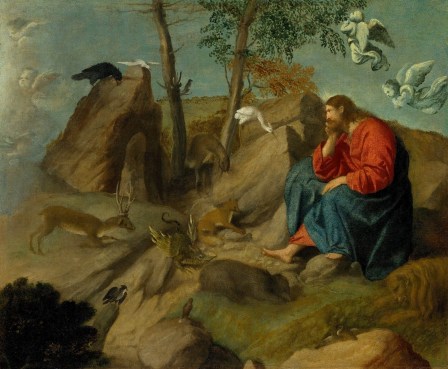
Notice how Mark simply tells us that the Spirit drove Jesus out, in effect expelling him into the 40-day wilderness experience, being tempted by Satan? Again, note Mark’s preference for strong and active verbs; compare: immediately drove out – with Matthew’s more passive: was led out.
Also, note how Mark provides no details as to the nature of the confrontation between Jesus and Satan. The detailed series of temptations come from Matthew and Luke, not  from Mark.
I like Mark’s version better, not only for the stark beauty of its sparseness but because it allows us to populate Jesus’ time in the wilderness with our own imaginings.
Might Mark’s lack of prescriptive detail provide space to populate Jesus’ experience in the wilderness from within our own imaginations so that the 40-days become a more intimate struggle with our own demons?
As we move into Lent, let us look more deeply into our own experience of temptation and struggle. In particular, let us look head-on at the greatest temptation of all – to shy away from receiving our true identity as beloved of God
Mark ends this section with Jesus returning from his time of preparation in the wilderness to find John has been arrested. The time he says has come, the Kingdom of God has come near, repent and believe the good news! For us also, there’s no time to lose!
Listen here to Ralph Vaughan Williams setting of Herbert’s poem.

 Taylor’s massive opus
 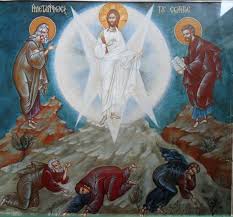 and out. Thus God inhabits sacred mountaintops, sacred spaces. The encounter between the divine and human takes place only after a laborious journey up to the mountaintop where God dwells in a self-revelation in blinding light.
 It’s not a major revelation that time’s passage is puzzling. It purports to be steady and measured; marked in precise intervals by atomic clocks—and on our cell phones. But anyone who has lain awake at 3:39 in the morning and contemplated the endless sleepless and usually worry-filled hours ahead, and then compared that to the fleeting seconds of cozy sleep that pass so quickly after you hit the snooze button— anyone who has had that experience knows that time is fickle. It even varies from person to person; I read recently that the past year has gone by either painfully slowly or relatively quickly depending upon how we respond to current events.
 2017 Rector’s Report
 What do you know about the book of Jonah? Put up your hands (metaphorically if you are reading this) if you know the name of the city to which God asks Jonah to go? Do likewise if you know the name of the city to which he escapes in order to take a ship going in the opposite direction from the one God asks him to take? Raise your hands if you know what happens to Jonah after he is thrown overboard from the ship in the midst of the storm? I imagine if you can’t answer the first two questions you will get the third right. Because what we all know about the story of Jonah is that he is swallowed by a whale and spends three days cooling his heels in its fishy belly before being vomited up onto the seashore.
 Relationalrealities
