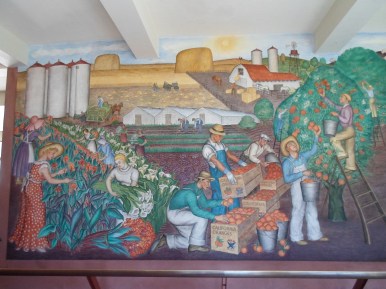
Kingdom Talk and Empire Walk

A former colleague and friend from Phoenix emailed me during this last week with a desperate plea: are you preaching on Sunday? I assumed some feeling desperation at the prospect of preaching on the lessons for Sunday in the light all that’s happening in the world around us? Why did I assume so? Maybe it was because of my own sense of desperation. We both faced a similar struggle of how to cope with the demands of standing in the pulpit, which if you haven’t noticed before, stands several feet above contradiction.

As clergy, and particularly as preachers, we feel the pain and dysfunction we see in the world around us just like everyone else does. Yet, there is a keenness, a sharpness in our experience of the world in a time of crisis because we are called upon to process our own fear, our own profound disappointment at the seemingly unstoppable backward slide in civic values and shared the vision for the benefit of a wider community. This can feel a risky and exposing business, for the preacher’s processing of fear and uncertainty is always a public matter, open to community scrutiny.

Using the analogy of the grain of sand trapped in the shell of the oyster that produces the pearl, the text for the coming Sunday irritates its way through me as the days pass. How will God’s vision for humanity found Sunday-by-Sunday in the appointed Biblical passages inform the processing of my own experience?

For the pastor generally, but more specifically for the preacher whose words are weighted and measured in the responses of a community, the stressful question remains- how do we speak of the expectations of God’s kingdom in a way that does more than just appear to conscript God to our own personal worldview?

Speaking for myself, how can I as someone charged with the task of interpreting the Scriptures for a whole community do so in a manner that is respectful of difference and able to respond fruitfully to what is needed? For what is needed is always a contested subject. In any community that is not a self-selected gathering of the like-minded, its members will have a variety of needs some of which may be difficult to reconcile. Perhaps it’s an impossible ambition to bring comfort, inspiration, and challenge in equal measure? All I know is, however possible or not it may be, it is nevertheless the struggle God and the community have entrusted to me in my role as the preacher.

Jesus and the great Hebrew prophets who preceded him seem remarkably untroubled by a need to measure their words according to their likelihood of being accepted or rejected. Maybe, wanting to be liked is a relatively modern human predicament.

The prophets of Israel when not firing outright condemnations and anathemas, arrows regrettably unavailable in the Episcopal priest’s quiver, spoke through parables about the tensions between God’s kingdom and human empire. At heart, parables draw their power from juxtaposing familiar experience of everyday life with a startling and shockingly unexpected conclusion.

The phrase human empire is the code for the systemizing of power through the threat of violence.

As we have been learning through the daily Bible Challenge readings from I Samuel through to II Kings, the Hebrew prophets arose for the specific purpose of speaking kingdom truth to human empire embodied by kings who sought to free themselves from the constraint on their authority imposed by the Law.

Vineyards often feature in the construction of biblical world parables. Jesus’ parable of the vineyard and the wicked tenants begins with a deliberate echo of Isaiah’s love song parable of the vineyard in chapter 5, heard in the alternative first reading for Sunday. At the outset, Jesus evokes his hearers’ association to Isaiah’s mournful parable of lament concerning God’s response to Israel’s unfaithfulness. But have you noticed how Jesus plays fast and loose with Scripture? He uses Scripture to simply set the scene as in – here’s the story so far – before jumping onto a completely new trajectory, and taking Scripture to a new place never imagined by the original writers of a text.

Jesus uses Isaiah to simply set the scene as in – here’s the story so far – before jumping onto a completely new trajectory, and taking Scripture to a new place never imagined by the original writers of a text. In his hands, Isaiah’s parable becomes a completely new story with an unexpected conclusion.

Jesus shifts the focus from the vineyard as an identification with Israel to the tenants who farm the vineyard. Yet, his hearers’ would nevertheless have easily followed his change of tack because property disputes between tenants and landowners were the meat and drink of everyday life in a 1st-century agrarian society. Jesus redirects focus away from the vineyard itself, and onto its expropriation with violence by the aggressive tenants.  He turns the story into a self-indicting mirror’ for the religious leaders whom he accuses of opposing God [1].

From our vantage point I would suggest that the somewhat dangerous conclusion to which Jesus is moving is framed by three key questions[2]:

  1. Will we respond to God’s climactic messenger before the crisis comes?
  2. Will we acknowledge the claims of God’s story in their lives or reject his messenger in favour of their more limited and self-serving culture-shaped stories?
  3. Will we live fruitfully within the realization that the Kingdom comes with limitless grace but also with limitless demand? 

Jesus addresses the parable to the religious-political leaders of his time. My task is to identify for us the parable’s core questions, recasting them as questions to be asked of political leaders and religious opinion formers in our own time.

This parable speaks into our own time of tension between God’s kingdom and human empire. As it has always been so, today’s politicians and global capitalists, affirmed and supported by predominantly white, conservative male religious leaders are those who resort to violence to evade accountability.

Violence in this sense is not only overt physical acts although overtly physical violence seems written into the DNA of our society, as evidenced from:

  • The regular encounters between black men and an overly anxious, and militarized exercise of policing.
  • The repeated militant inspired gun slayings of which Las Vegas is only the most recent and tragic example. The subtlety of the unacknowledged and endemic violence in our society extends even to the way we refer to a perpetrator of this kind of civic violence. If white, he is usually referred to as a lone wolf, implying personal eccentricity of an extreme kind and or mental illness. This is to distinguish him from a terrorist, who is someone other than us, different from us in skin color, race, and religion.

The violence of empire is also cultural and systemic as opposed to overtly physical as in:

  • The contamination and degradation of the environment, exacerbated by the deregulation of environmental protections for the economic enrichment of global capital.
  • The exploitation of unregulated labor.
  • The lack of consumer rights when it comes to the collection, use, and sale for profit of our vital information.
  • The politically inspired generation, manipulation, and exploitation of social and cultural fear for the purpose of maintaining power.

According to the Bible, these are all imperial acts of violence.

The preceding paragraph is my attempt to transpose the core of the parable of the vineyard and the wicked tenants into our contemporary context. I am actively guided by the long Hebrew prophetic tradition, which comes into its most powerful focus in the ministry, teaching, death, and resurrection of Jesus. This is, after all, the job I am called and paid to do as preacher and religious leader. Yet, I am only the preacher and at least in my tradition, no one is compelled to agree with me.

So let me end with what I consider to be the ultimate question in this parable of Jesus and the kingdom. Transposing this parable into our modern American civic and religious context – who do you think the vineyard’s tenants are?

[1] Klyne Snodgrass, Stories with Intent: a comprehensive guide to the parables of Jesus.

[2] My questions include italicized words directly drawn from Snodgrass, Ibid.

Of One Mind, with Fear and Trembling, And Other Good Stuff

Paul at Philippi

Luke in Acts 16 gives us the picture of Paul’s visit to the city of Philippi in response to a dream in which a man appeared asking him to come over to Macedonia, thus creating Philippi as the first beachhead for Paul on the European continent.

Philippi, named after himself by Philip, the father of Alexander the Great in 356 BC had in 168 BC become part of the Roman Empire. By the time of Paul’s arrival around 49AD, the city had a mixed population of Greeks and Romans.

After his arrival, Luke tells us that Paul went outside the city and there encountered a group of women among whom Lydia, possibly a convert to Judaism, but most probably a Gentile, sympathetic to Judaism becomes a pivotal figure for him in the Philippi mission. We know she was a wealthy woman in her right because Luke tells us that she was a dealer in purple cloth, the most expensive kind. After listening to Paul she and her whole household were baptized.

At Philippi, another powerful event took place with serious consequences for Paul and Silas when they encountered a slave girl possessed by a demonic ability to tell the future. They prayed for her deliverance and when the demon left her, so did her power to tell the future. This landed Paul and Silas in serious trouble with the girl’s owner. As a result, they were arrested and thrown into prison. While in prison an earthquake shattered the doors, but instead of fleeing Paul and Silas remained to share the gospel with the amazed and grateful jailor. He also was baptized. Having protested his Roman citizenship, Paul was released by the magistrates and returned to Lydia’s villa for the duration of the rest of his short stay in Philippi.

Paul’s authorship of Philippians is not the subject of serious dispute among Biblical scholars. Philippians is a letter or maybe a series of letters later edited into one, written while Paul was imprisoned, though the location of his imprisonment is debated. The main purpose of the letter seems to be to address discord among the Philippian Christians.

In Philippians 2:1-13 Paul pens words of such power and beauty that they became a universal hymn in the Early Church. Compared with the later philosophical complexities of the Nicene Creed, Paul encapsulates the essence of the Incarnation in words of poetic simplicity.

Paul implores the Philippians to be of the same mind and to ensure that their common mind reflects the values and attitudes displayed by Jesus. On the face of it, it’s a simple enough request. Simple statements are often the most open to widely differing interpretations.

The problem addressed

Even in Paul’s world, there existed news and fake news. Who were the Philippians to listen to? Who were they to believe –  Paul or the teaching of the Judaizes – Christian missionaries who preached gentile conformity to the Law of Moses?

Interestingly, Paul does not assert his doctrine over that of the false teachers. At least in this instance, Paul seems to realize that no Philippian mind was likely to be changed through impassioned argument.

Instead, Paul reminds his readers of the intimacy he enjoys with them. He assures them of his continued love and concern for them, despite the drastic situation he finds himself in. Such love is clearly mutual, evidenced by the Philippians sending Paul one of their own, Epaphroditus to assist him in his imprisonment. It’s probable that Paul composes his letter to be taken back by Epaphroditus on his return to Philippi.

Paul’s substantive point

Paul asks the Philippians to reject the spirit of individualism, a powerful counterforce to relationship building. He asks them to put personal ambition and conceit aside, regarding one another with a humility that sees one’s own interests as intertwined with the interests of others. In short, he is asking them to open to the possibilities of a common vision the blueprint for which was to be found in Jesus’ relationship with God.

What do we hear?

Paul recognized the powerful forces working against his vision for the Philippians. Today we can easily see the effect of equally powerful, polarizing influences dividing us from one another and working against the rebuilding of a common vision in society. In their modern guise, the equivalents of the Judaizers of Paul’s time continue in the cultural expressions of Christianity that are little more than a baptism of contemporary society’s popular social values.

The baptism of contemporary values can take a number of differing forms. There is the very popular and smug wealth-righteous feel-goodness of the Joel Osteen’s, for there are many who embrace this facile creed. There is the espousal of condemnatory hatred for difference of which Roy Moore is but the latest poster boy for a Christianity marked by its narrow intolerance, and message of exclusion. There is yet another form of cultural baptism, one that perhaps at St Martin’s we are more aligned with. This is the baptism of post-Enlightenment, ethical reason, expressive of a belief in the moral and ethical superiority of liberal, inclusive values. This is the Christianity of the good and the reasonable, whose sense of moral satisfaction leaves little room for the God Paul preached.

Here’s Paul speaking:

Though in the form of God, Jesus did not count equality with God something to be exploited. He did not stand on his superior status but emptied himself, taking the form of a servant.

The primacy of relationship with God is the basis upon which Paul issues his heartfelt plea to the Philippians. The relationship between Christians, Paul contends, must always be modeled on the relationship Jesus shared with God:

For being born as a human being, Jesus humbled himself, and became obedient even to the point of death, and not just any death but death on a cross.  

Hence, our humanity is defined not by our God-like aspiration, which is a kind of deluded omnipotence, but through our sacrificial action of service to, and for, one another.

In Jesus, we have our blueprint of God’s vision for humanity, a vision in which humility and obedience become the hallmarks.

Therefore, my beloved, just as you have always obeyed me, not only in my presence but much more now in my absence, work out your own salvation with fear and trembling, for it is God who is at work in you.

Do we have the courage to approach the practice of our faith in a spirit of fear and trembling, allowing God greater scope to work in, and through, us? Fear and trembling here do not mean fearfulness or weakness, but possessing a spirit of respectful listening to God, of being open to the intimations of the divine, through which a growing conscious awareness of God begins to reshape us. It is not what we do that matters, but what we allow God to accomplish, working in, and through, us.


“The Kingdom of Heaven is like…”

A sermon from the Rev. Linda Mackie Griggs, Assistant Priest.

Jesus must have known that you don’t argue with grapes. When they’re ready, they’re ready. Now. The sugar is right, the tannins are right. Laborers need to be available at a moment’s notice to bring in the harvest quickly –often as early as 3:00 a.m. to get started while it’s still reasonably cool. Jesus’ parable of the vineyard depicts a landowner who knew the pressure of time and the race against nature to make good wine. But this landowner is a little unusual. That’s because this is a parable.

“The Kingdom of God is like…” When you hear those six words it’s time to fasten your seatbelts.

As you probably know, most of Jesus’ parables drew upon themes that were common to his audience—things they identified with, like family relationships, herding sheep, farming. But there was always a twist—otherwise it wasn’t a parable. He wouldn’t say “The Kingdom of God is like a shepherd who has sheep, now everyone go home.“ and leave it at that. The parable by definition challenges the status quo, not confirms it. Parables challenge the audience’s expectation of what they already know about sheep herding, or fishing. Or vineyards. Or economics. Or fairness. Or community.

The beauty and the curse of parables is that they can be interpreted in so many ways. One of the early takes on the parable of the laborers in the vineyard posits the laborers as different communities of the people of God: Those who came earliest to work were a metaphor for the Jews, and those who came later were the Gentiles. The conflict, then, was over who had greater rights to the Kingdom of God, and the challenge lay in understanding that the Gentiles’ claim was equal to the that of the Jews.

Another interpretation is economic; the parable proposes that the Landowner/God employs an economic model that turns current models –of payment proportional to work–on their ear. In other words, God’s economy is not the same as ours: God is generous, which is not necessarily the same as fair. And we are left to wrestle with how to live into that idea.

I have no argument with either of these interpretations. Each is a product of its historical/political/cultural context, and context is crucial to how we interrogate and are challenged by what we read.

The context in which we read the parable of the laborers today is the context of this particular day in history, in this church, in this service. Today we find the Gospel neatly in conversation with the passage from Exodus about the Israelites’ whining and God’s response of manna in the wilderness. This story isn’t just about food. It’s about the people’s relationship with God–about the enoughness of God. It’s about God’s call to look beyond the tyranny of fear of scarcity toward the promised land of a liberating trust in God’s abiding love. God says, “I am enough. YOU are enough—you are my children.”

Now when we look at the parable of the laborers, we see that they, like the Israelites, have a complaint, and it is summed up in three words: “It’s not fair!” It’s not fair that THEY get more than we do! WE worked harder! They aren’t equal to us! Notice the exact phrasing: “You have made them equal to us…” Not, “you have paid them equally”, but “you have MADE them equal…” Maybe it’s a distinction without a difference, but perhaps it points us to an interpretation that isn’t purely economic. What if the challenge of this parable, like the story of the manna, isn’t just an issue osubsistence? ? Perhaps Jesus has taken the concept of enoughness and expanded it? The people of Israel were reassured of God’s provision to them, and that was enough for the people at that point in their journey and history. But then Jesus seeks to take that concept and tweak it—to take it to a new level. In his parable he’s not just calling his hearers to think about themselves in relationship to God, but also around themselves, into their relationship with others.

The key to this lies in the final words of the passage: “So the last will be first, and the first will be last.”

“The Kingdom of heaven is like…”

When I was a kid I used to love to ponder the old question, “Who came first, the chicken or the egg?” I loved watching in my head as the paradox went around and around…, in a loop of causation that never ended, the images ever-filling and ever-emptying, one always dependent on the other.

“The last will be first and the first will be last.”

I used to think about these words just like the chicken and the egg. If the first is last and the last is first, then when the first becomes last then it has to be first again, and the first has to be last…” And around and around it goes. It was great fun for a distractible kid.

What is the Kingdom of Heaven like?

The Kingdom of Heaven is like…a landowner who provides enough—a daily wage—for his laborers, and challenges them to see one another in a less competitive and more mutually dependent relationship. A relationship where envy and fear of scarcity give way to trust.

“You have made them equal to us…” Well yes. That’s the point, and the challenge of the parable. All children of God, and all with gifts to offer one another in the work that needs to be done in the world.

The laborers know better than to argue with the grapes. But they also have to learn that they need each other to get the whole crop in by nightfall. Some are better at cutting the grapes from the vine, while others have stronger backs to carry heavy baskets. The ones with fresh hands and feet can relieve those with blisters and aches. It takes all of them to complete the harvest. – together.

So to see this parable as a simple economic inversion is to rob it of some of its richness. It’s not just about payment for work. Yes, God is gracious and generous in ways that only God knows. But the generosity of God extends beyond substance and subsistence into relationship. We need to see, not simply a single static instance of inversion, but the dynamic movement of interdependence—of mutual strength and vulnerability that complement and nurture each other.

That’s what the Kingdom is like.

Our default position is to scoff at this as idealistic, unrealistic and naïve. One look at the headlines will suggest that the Kingdom that Jesus invites us into is a pipe dream. You would be forgiven for skepticism. Believe me, there are days when the idealist in me is sorely, sorely challenged.

But it’s really important not to let that negative mindset take control. We have to fight sometimes to see the Kingdom breaking through, but this parable tells us what to look for. And when you seek, you find.

I found Gould Farm is in western Massachusetts. When I visited the farm and began to learn more about it, that is when this parable came into new focus.

Gould Farm is not a new thing: One hundred years ago Will and Agnes Gould established a community of healing in the Berkshires; a place where people with emotional and psychiatric vulnerabilities could come and find healing in a setting that focused on work, therapy, kindness and community. The patients, called guests, do much of the work of the farm and its companion bakery and restaurant, guided by supervisors who depend on them in order to provide a livelihood for the community. Clinical staff work with the guests, and live on the farm as part of that community. Everyone cooperates in a nurturing cycle in which each person depends upon others and is likewise depended upon by others.

The first shall be last and the last shall be first, shall be last…shall be first…

And you know what the motto of Gould Farm is?

“We harvest hope.” Not grapes– Better. Healing and wholeness.

In his e-news epistle this week Father Mark wrote that the challenges of our time call for more than individual action; they require efforts of collective imagination—new visions of community. Gould Farm is one such community. It’s not a parable pipe dream—it’s a harvest of hope, and God knows it’s not the only one out there.

As a matter of fact, we can see it here this morning when we learn more about the work of Youth in Action, whose leader and members are here today with a new exhibit and information about an initiative that seeks to bring the community together around issues crucial to the well-being of our society and common life. I’m delighted to see this opportunity for new relationship, and I pray that it will be fruitful for the young people of our community, and for all of us.

The harvest is ready. Don’t argue with the Hope.


God, Breaking out

Through a glass, darkly

Forgiveness runs contrary to self-interest, whereas judgment is instinctual. In Romans, Paul speaks of a community as a place where we are faced with having to tolerate difference – or not, as more often the case may be. Toleration of difference seems to run contrary to our natural instincts while fear and judgment seem to be our natural inclinations. The toleration of difference requires reframing the instinctual desire to condemn. Have you noticed how much condemnation and judgment is in the Bible?

If we read the Bible as if God is the author, then we can’t but help notice that God appears to be rather too much like ourselves for comfort. For like us, God appears incredibly inconsistent – mostly judgmental, yet unpredictably forgiving.

Are the images of God we encounter in the Bible God’s self-representation, unchanging for all time? To approach the Bible in this way is very dispiriting. How can we have any confidence in being loved and accepted by such an unpredictable and inconsistent figure, the very worst kind of parental model?

Alternatively, we can read the Bible as the record of its human authors’ picturing of God. Such imaginings are always limited by the human writers’ historically and culturally shaped experience and expectations. This is why the Bible is so amazing because it presents a long historical record of how God gradually emerges into human consciousness within Israel’s particular history. God seems to grow and change in sync with the development of Israelite experience, because although human authors’ project themselves onto God, God rebuffs their projections by acting in unanticipated ways.

As the Biblical images of God develop and deepen over time, the Bible’s human authors’ gain a little distance from their own projections to discover something new about God. Through behaving unexpectedly, God shows each generation that the divine nature is always more than we can imagine.

The Bible Challenge is aptly named. However, the challenge lies not in meeting the daily commitment of reading so much Scripture, although at times it can feel like this. No, the challenge lies in encountering the Israelite authors’ images of God – images that are not in sync with our 21st-century imagination.

Day 120 brings us to the First Book of Kings. On the way to this point, God has emerged repeatedly as a contradictory tyrant who on the one hand is a liberator, and on the other hand, is a genocidal tyrant. God seems to be a very human figure, by turns angry and then merciful, condemning and then forgiving; who turns a blind eye to the unspeakable abuse of women and the ruthless politically motivated murder of rivals.

It’s difficult to share the conservative fundamentalist defense of the Bible as a rulebook for family values and modern good government.

The parable of the forgiving king

One commentator on this parable in Matthew 18 asks:

“Could it be that judgment is something we do to ourselves when we face the infinite love of God who does not judge, because God, after all, forgives even unpayable debt and sin?” [1]

How do we who are prone to harsh judgments experience the novelty of being forgiven? The unforgiving steward in this parable is a case study in the human response to being forgiven, offering insight into the unconscious rage that being forgiven can provoke.

To be forgiven that which we are powerless in any case to repay is both liberating and humiliating.

This story is set in a world where the economic structure of society is predicated on the continual flow of wealth from the 99% at the base, upwards through the layers of the hierarchical pyramid to those in the top1%. Each successive layer of the social hierarchy is organized to exploit those beneath it for the benefit of those above it.

The king is at the top of the 1%, and immediately below him is his steward who is also still part of the 1%. The impossible size of the steward’s debt indicates that this is not a personal debt, i.e. money he borrowed from the king, but maybe something akin to the national debt that he is responsible for collecting and delivering to the king. Although the direction of the flow of revenue is always upwards, at each level the collectors take their cut. This story is a vignette of the economic exploitation that characterizes non-egalitarian societies.

This is a particular kind of story called a parable. A parable is a teaching tool that exploits what’s familiar from the hearer’s everyday life to make an unexpected point. In this parable, the king acts unexpectedly.

The steward is the immediate beneficiary of the king’s action, for which he is grovelingly thankful. But he remains unchanged by the king’s generosity. Once he leaves the throne room he continues with his conventional expectations of business, as usual, evidenced by his behavior towards the steward immediately under him. It is this, his remaining unchanged by generosity, that leads to his eventual condemnation and punishment.

We can pride ourselves on being cleverer than the unjust steward, leading us to feel morally superior and judgmental towards him. We quickly perceive that the king is modeling an action intended to be the blueprint for forgiveness and generosity.

That’s because, with the benefit of hindsight, we know that the forgiving king is Jesus’ metaphor for a new and radical image of God that breaks open the limited imaginations of his 1st-century hearers’.

With 20/20 hindsight, we recognize that this is a story about human resistance to being changed by gratitude. Authentic gratitude changes us because it motivates in us new expressions of generosity. Yet, understanding this, in theory, so to speak, is one thing, but letting it have the power to actually change us, is another.

Let’s not feel too clever because there is a message in this parable that we probably will miss. Our imaginations are shaped by a cultural focus on accountability as a personal and individual matter. Whether we act on it or not we get the point that when we locate God as the source of our gratitude we become less likely to pass up an opportunity to for generous action. Yet, there’s a deeper interpretation that takes the meaning of this parable far beyond the sphere of individual generosity.

David Brooks writing in the New York Times last week noted:

“People are still good at acting individually to tackle problems. Look at how many Houstonians leapt forth to care for their neighbors. But we have trouble with collective action, with building new institutions, or reviving old ones, that are big enough to deal with the biggest challenges”.

Viewed politically, the king’s action is an upending of the economic system. Leading by example, his action is intended to suggest a different and more collectively sensitive vision of God. How many of us are ready for the implications of this for our own society? As David Books suggests, not many of us, it seems.

Both Matthew and Paul in the readings for Sunday are showing how God by acting in unanticipated ways administers a seismic shock to the human ordering of things. Jesus presents a vision of a God of limitless forgiveness. This changes everything in the trajectory of Israel’s story, leading Paul to envision communities where people refrain from judgment about petty rules and learn to tolerate difference. Thus a step change was brought about in human consciousness awareness of God out of which, new images of God emerged that were big enough to deal with the new challenges of a post-Jesus world.

Might this parable become more for us than we otherwise imagine? Could it speak to our period of upheaval and crisis, catapulting us into a step change that will enable our collective imagination to build new institutions, or to revive old ones that are big enough to deal with the momentous challenges facing us today?

Belonging to-gather

SAM_0011

As we journey soon into the new beginnings of post-Labor Day autumn, what will it mean to deny ourselves, take up our crosses, and follow Jesus? More, certainly, than giving up a few things; more than suffering as part of the human condition; more than moving forward on new paths—peering into autumn’s transitions, we belong to one another.  Matthew Skinner

Today’s episode in Matthew

In Matthew chapter 18, Matthew puts words into Jesus’ mouth that reflect issues in his community. Yet, his words are consistent with the way Jesus would have approached differences as he addresses how his disciples are to behave towards one another as they begin to travel with him on the road to Jerusalem. One might imagine that his comments are particularly addressed to the process by which the disciples will negotiate differences and conflict between them.

If Skinner’s assertion that we belong to one another is to have any meaning then we have to understand Jesus’ teaching on our responsibility to one another, and our individual accountability for one another, especially around issues of difference and potential conflict.

“No one is going to tell me what to do”, we mutter to ourselves and, “if I find I don’t like it, then I will just leave”.

In a culture where Episcopalians have come to treat membership of the Church as another version of our membership of any number of voluntary and non-profit organizations, the idea that we are responsible for, and accountable to, one another rings alarm bells. Leaving is often our solution of choice when faced with the inevitability of conflict in our social worlds.

I love Rick Morley’s tongue in cheek characterization of so much of our behavior in the Christian community in a blog entitled Before you un-friend [1]:

If another member of the church sins against you…just talk about them behind their back. If another member of the church sins against you…just call a bunch of people in the church to complain about them. You may even want to start a letter-writing campaign against them. If another member of the church sins against you…just send them a nasty email. Copy the clergy. And, while you’re at it, CC the bishop. If another member of the church sins against you…don’t say anything. Just avoid them. Unfriend them on Facebook. And, if you can’t avoid them on Sundays, then just leave the church

Matthew 18: 15-20 has become ingrained in our collective unconscious as the epitome of the abusive and oppressive way religious communities treat individuals and the way we pass this abuse on in our treatment of one another. These verses are the basis of the practice in some religious communities called shunning. Shunning is a form of officially sanctioned scapegoating.

For not to

We don’t particularly care for the experience of being accountable to another person, especially if the other seems to be just like us, with no more nor less claim to authority than we possess. Yet, what happens if we read Matthew within a new frame created by substituting the word to with the word for?

I take Jesus to mean that within our community life we are to be accountable for one another. This means looking out for one another. Sometimes, looking out for one another involves addressing behaviors that are harmful to relationships between individuals. Sometimes, looking out for one another makes it necessary to challenge one another when if left unchallenged, our behavior might endanger the stability of the whole community.


Watch our for your verbs

We should not be surprised when we disagree with one another. Conflict is rarely the problem, but fear of conflict often is. Fear of conflict makes us secretive and avoidant. It cultivates an atmosphere of paranoia in groups and communities.

We might take particular note of Jesus’ final words in this section. He does not say where two or three agree in my name – he says where two or three gather in my name, I am there among them. the only agreement necessary is the agreement to gather. This is why despite our differences, worship has always been the glue for gathering in Anglican communities.

In The Essential Ingredient, David Lose commenting on Matthew 18:15-20 asks:[2]

So what kind of community do we want from our congregation — largely social, images-2somewhat superficial (which is, of course, safe)? Do we want something more meaningful or intimate (which is riskier and harder)? Do we want a place that can both encourage us and hold us accountable? Are we looking for a place we can be honest about our hopes and fears, dreams and anxieties? Do we want somewhere we can just blend in or are we looking for a place we can really make a difference? 


These are great questions on Homecoming Sunday when: peering into autumn’s transitions, we find that we belong to one another.  


The Bible Challenge, Day 110 editorial comment

Luke, in Acts chapter 7 reports the death of Stephen. Stephen was one of those who in chapter 6 we learned were entrusted with the social and pastoral support of the members of the community, especially among the poorer Hebrew Christians. These men were called servants or diakonoi and are the first in the ministry of those today we call deacons.

Stephen is brought before the Sanhedrin, the Jewish religious council where he retells the history of Israel. Stephen’s speech is reminiscent of the long speeches that occur in Exodus and Judges in which Israelite history is rehearsed for the benefit of the people, lets they forget their origins as those whom God brought out of slavery in Egypt.

Every time Hebrew history is rehearsed it’s always to make a particular point. With Stephen we get a good view of how the first generation of Christians related to the Hebrew Scriptures. They were incredibly inventive. Unlike us to day, they did not feel constrained to paint only within the lines of conventional interpretation.  For the early Christians, Jesus had changed the course of Jewish history and vastly expanded the destiny of Abraham’s children.

Luke employs the literary convention of rehearsing Israel’s history throughout the early chapters of Acts. When Peter addresses the authorities he, like Stephen begins with historical rehearsal as the basis of introducing a new twist to account for the effect of Jesus. It’s this new twist that gets them into trouble. The purpose of Stephen’s rehearsal of history is to land in a new and different place in order to explain how Jesus has changed everything. So we see Stephen landing on the theme of the Jews rejection of their prophets, and so their rejection of Jesus was nothing new. Now, stung by his words, his hearers become consumed with murderous intent.

The purpose of Stephen’s rehearsal of history is to land in a new and different place in order to explain how Jesus has changed everything. The purpose of Stephen’s rehearsal of the story all his hearers already knew by heart was to land on the theme of the Jews rejection of their prophets. This is the point he wants to bring out about Jesus. He is saying you killed him like you killed or rejected all the prophets before him. So their rejection of Jesus was nothing new. This is too much for his religious hearers. Stung by his words, they become consumed with murderous intent.

When we rehearse the history of God’s relationship with Israel, what is our 21st-century twist that leads us to land on a point of particular emphasis? What do we hear in the story and what conclusion does it lead us to that informs us of God’s presence among us?

Luke concludes chapter 7 with one seemingly insignificant detail. He tells us that the man entrusted with holding the cloaks of the men who stone Stephen is one call Saul. Luke’s introduction of this seemingly insignificant bystander prepares us for a dramatic shift taking his narrative of the early days of the church in a new direction.

Signs of Hope Amid Crisis

I look forward to Labor Day weekend. Who does not enjoy a 3-day break? Although in my case, because my day off is Monday, 3-day weekends are somewhat compromised for me. Yet, I rejoice in them because I know that many of the people I live and work among will enjoy three consecutive days of relaxation as summer ebbs into autumn.

Coming from the UK, where we enjoy six 3-day or bank holiday weekends, two additional public holidays – Good Friday being one, and an average of 3 – 4 weeks of paid vacation leave a year, I am appalled by American attitudes to time off. The average vacation leave in the US is 11 days a year. I wonder why it never occurs to us that falling productivity, increasing family and marital breakdown, rising tides of depression, suicide, and addiction, and rising civic strife are not recognized as the fruits of a work system that denies hope to many through the low pay and long hours that reflect an exploitative use of human beings? So, I am appreciative for the Labor Day weekend.

As summer ebbs into Autumn the Labor Day Weekend is a chance for last visits to the beach, or forests, for family and community barbeques; each occasion a reminder to us that these activities are winding down for another year.

How many of us know, let alone remember the origins of the day we celebrate as an extra day of leisure? Let me cite from the US Department of Labor website:

Labor Day, the first Monday in September, is a creation of the labor movement and is dedicated to the social and economic achievements of American workers. It constitutes a yearly national tribute to the contributions workers have made to the strength, prosperity, and well being of our country.


Through the years the nation gave increasing emphasis to Labor Day. The first governmental recognition came through municipal ordinances passed during 1885 and 1886. From these, a movement developed to secure state legislation. The first state bill was introduced into the New York legislature, but the first to become law was passed by Oregon on February 21, 1887. During the year four more states — Colorado, Massachusetts, New Jersey, and New York — created the Labor Day holiday by legislative enactment. By the end of the decade Connecticut, Nebraska, and Pennsylvania had followed suit. By 1894, 23 other states had adopted the holiday in honor of workers, and on June 28 of that year, Congress passed an act making the first Monday in September of each year a legal holiday in the District of Columbia and the territories.

In 1993 on the 100th anniversary of organized labor in Rhode Island the following appeared in the Old Rhode Island publication:

In the midst of the financial panic of 1893, Rhode Island workers secured a long-sought ambition—the establishment of the first Monday in September as a legal holiday. The state’s horny-fisted sons and daughters of toil had marched, petitioned, and agitated for over a decade. Rhode Island workers witnessed New York and Oregon pass holiday legislation in 1887, and by the spring of 1893 most other states had followed suit. The General Assembly, under the prodding of elected representatives from various mill towns, finally joined the bandwagon, and Governor D. Russell Brown signed the authorization.

Rerum Novarum (from its first two words, Latin for “of revolutionary change”, or Rights and Duties of Capital and Labor, is an encyclical issued by Pope Leo XIII on 15 May 1891. It was an open letter, passed to all Catholic Patriarchs, Primates, Archbishops and bishops that addressed the condition of the working classes.

Rerum Novarum discussed the relationships and mutual duties between labor and capital, as well as government and its citizens. Of primary concern was the need for some amelioration of The misery and wretchedness pressing so unjustly on the majority of the working class.” It supported the rights of labor to form unions, rejected socialism and unrestricted capitalism, whilst affirming the right to private property.

John Paul II on the 100th anniversary of Rerum Novarum issued Centesimus Annus in which he said:

Man [sic] fulfills himself by using his intelligence and freedom. In so doing he utilizes the things of this world as objects and instruments and makes them his own. The foundation of the right to private initiative and ownership is to be found in this activity. By means of his work, man commits himself, not only for his own sake but also for others and with others. Each person collaborates in the work of others and for their good. Man works in order to provide for the needs of his family, his community, his nation, and ultimately all humanity.

Judaism and Christianity both understand labor as the source of all wealth. Labor bestows dignity on the human person. Labor is the basis for all human flourishing. Core psychological needs for human beings comprise someone to love and be loved by, a safe place to live, an activity that brings meaning and purpose. If labor is right up there among the conditions supportive of human flourishing it must nevertheless be balanced by leisure. Work and leisure in a balanced relationship contribute to a life of well being.

Marx defined capital as stored labor. I am fully aware that in citing Marx and advocating for a need of balance between labor and leisure in our contemporary social climate, I will be dismissed by some, as a Marxist. Yet, as over 100 years of Catholic social teaching asserts, to champion the rights of workers, to assert the dignity of labor, and to confront the abuses of labor at the hands of unrestrained capitalism is not Marxism, but Christianity! I am not advocating the abolition of capital but for a reclaiming of the true soul of capital. The generation of capital is part of a holistic system in which the role of capital is to support the maintenance of the common wealth.

In their current statement on the dignity of work and the rights of workers the US Conference of Catholic Bishops cite 13 Biblical references in support of their affirmation that:

The economy must serve people, not the other way around. Work is more than a way to make a living; it is a form of continuing participation in God’s creation. If the dignity of work is to be protected, then the basic rights of workers must be respected–the right to productive work, to decent and fair wages, to the organization and joining of unions, to private property, and to economic initiative.

As a society, America finds balancing competing needs difficult because competition and the adversarial spirit are intrinsic to the way we view our individual and collective social life. The true meaning of the word com-petition  is to strive together. In our society competition describes the way individuals and groups strive against each other.

A society where the sole purpose of the capitalist enterprise is the maximizing of shareholder returns obscures the reality that capital is stored labor and those whose labor contributes to the generation of wealth deserve far greater respect and enjoyment of the benefits. This is not simply an altruistic idea, it is the necessity for a well ordered and stable society.

Any casual observer of our socio-political scene must conclude that a house divided against itself cannot long stand. The results of the last electoral cycle is a registration of widespread and deep dissatisfaction with the state of our society – our common wealth, where the rights and dignity of ordinary people whose only resource is the sale of their labor, energy, and talent are routinely exploited and abused.

We arrive at the paradox of voting into power, again and again, those who lack the talent, experience, and most shockingly of all, the vision and will to recognize that the accumulation of wealth by the few at the expense of ordinary people has clear ethical limits. These ethics are rooted in our deeper religious traditions of a just society.

In Exodus 3:1-15 God tells Moses:

I have observed the misery of my people who are in Egypt; I have heard their cry on account of their taskmasters. Indeed, I know their suffering, and I have come down to deliver them from the Egyptians.

God is attentive to those who are denied justice. Liberator is one of the core names claimed by God.

In Romans 12:9-21 Paul invites us to:

Let our love be genuine, hate what is evil and hold fast to what is good: love one another with mutual affection; outdo one another is showing honor. … Contribute to the needs of the saints; extend hospitality to strangers. Bless those who persecute you, do not curse them.

Paul appeals to the creation of communities where justice is the systemic expression of love.

This year’s Labor Day Weekend occurs within the context of environmental disturbance on a monumental scale along the Gulf Coast and now further inland. I will confine myself to two comments.

Firstly, Joel Osteen, the millionaire megachurch evangelist told Houstonians to not fear, for “God’s got this”. My hope is that many will finally wake up and realize that Osteen’s is a profoundly corrupted theology of God that is at odds not only with Judeo-Christian Tradition but flies in the face of the experience ordinary people have in the world. God does not cause hurricanes and so God is not in control of them. Even the rich, those in Osteen’s eyes who are right with God, this time took a hit. Explain that away, Joel.

Secondly, Texas is synonymous with a culture that champions the American idea of competition as each individual for him and herself. Yet, in the face of disaster, the communitarian action of Texans in selfless support for one another reveals something deeper about how people really experience one another. Texans can pride themselves not on their spirit rugged individualism, but on their communitarian actions of compassion.

It’s only together that we can realize Paul’s injunction to:

Rejoice in hope, be patient in suffering, persevere in prayer. … Rejoice with those who rejoice, weep with those who weep.

In the midst of unparalleled disaster hope triumphs through the solidarity of one human being with another. Alongside the tragic loss of life, the disruption to livelihood, the destruction of property, the demonstration of hope through solidarity shows us new possibilities for the future of our society. Is this not the central reason for real rejoicing this Labor Day Weekend.

Who Tells You Who Your Are?

A sermon from the Rev. Linda Mackie Griggs, on Matthew 16:13-20


I first read this question in William Sloane Coffin, Jr’s book, Letters to a Young Doubter, about ten years ago, early in my discernment process. It was one of those instances when you encounter something that hits you at just the right time, with just the right balance of challenge and comfort to be formative. It wasn’t until much later (this past week, actually,) that I discovered that Coffin didn’t just toss that question out one time for his book: It was his signature question.

Coffin, who died in 2006, was a passionate social and political activist, senior minister at Riverside Church in New York City, and Yale University Chaplain. He asked this question in various contexts on a regular basis. Whether he was talking about politics, religion or education, this was invariably the basis of whatever he had to say.

“Who tells you who you are?”

In many ways it’s a rhetorical question, isn’t it? When a person of deep faith and authority looks you in the eye and asks you that question, you know what the answer should be—but the process of answering can be a journey in itself, and it may not be a comfortable one.

How you ponder in the silence after the question mark; the answer you ultimately give can have a profound effect on your life going forward; on your very identity.

“Who tells you who you are?” is another way of asking a bleaker question:

“Who are you—really?”

It’s not a coincidence that Coffin’s words echo Jesus’ questions in today’s gospel. This passage is foundational in many ways.

Both Matthew and Mark record this episode, wherein Jesus asks the disciples about his identity, but Matthew expands on Mark’s original—and earlier–depiction of Simon Peter’s response to Jesus’ pointed question, “Who do YOU say that I am?” In Mark’s Gospel, Simon’s response is simply, “You are the Christ.” But in Matthew’s version, Simon blurts out, “You are the Messiah, the Son of the Living God.” This is serious Christology and Matthew needs to spell it out: Jesus is the Anointed One spoken of by the prophets, directly connected to God as God’s son. In other words, Matthew’s project as encapsulated in the words of Simon Peter is to establish Jesus’ identity.

And what happens next?

In Jesus’ response to Simon, Matthew again expands on Mark. Whereas Mark writes only that Jesus says to speak of his identity to no one, Matthew augments this with a statement that is pure ecclesiology—a foundational declaration of both Simon’s and the church’s identity: “You are Peter and upon this rock, I will build my church…” Much of the argument for Apostolic Succession was built on these words; Peter was the first authority of the Church for “binding and loosing”—that is, for the establishing and teaching of doctrine. This passage is of specific interest to the Roman Catholic Church; Peter’s keys to the kingdom are a papal symbol. Of course, there are other households of the Christian faith who have argued since the Protestant Reformation that papal authority is not the only Christian authority. Nevertheless, the point made here about the establishment of the authority and identity of the Body of Christ, even as it ends up being interpreted in different ways, can be traced to this statement in Matthew.

But doctrinal Christology and ecclesiology aside, this passage is rich with still more to ponder about identity. Let’s think a little more about Peter. For all that he is given the keys of the Kingdom, we (as so often happens) find ourselves wondering about God’s choice of a standard bearer for the Church. Peter is extraordinarily prone to stick his size 10 fisherman’s foot in his mouth and will do so again in just two verses when he tries to rebuke Jesus for foretelling his crucifixion. And in response to this rebuke Jesus will call Peter Satan and a hindrance; an inauspicious beginning for the Rock of the Church…

So what are we to think of this? What does Jesus see in this impetuous disciple? Pastor and preacher Jin S. Kim says that what distinguishes Peter in his confession of Jesus as Messiah isn’t so much his righteousness or his rightness but his testimony; his willingness to articulate how he experiences Jesus and God in that moment. “Who do you say that I am?” In other words, Jesus says, “How do you understand and experience me, my teaching and my witness in the world?”

Peter’s response in that moment of clarity, “You are the Messiah, the Son of the Living God,” serves, then, not just to identify Jesus, but it also becomes a statement of Peter’s identity as well.

Testimony

This is the kind of thing that makes many Episcopalians feel a little squirmy. Testimony, for us, is best left in the courtroom. But we are invited here to seriously consider how we experience Jesus and God in our lives. That testimony, even if we don’t stand on the street corner and shout it to the world, and only whisper it to ourselves, reveals a lot about who we are and who we are called to be. Our identity.

“For flesh and blood has not revealed this to you, but my Father in heaven.”

Peter’s testimony regarding Jesus’ identity is rooted in his understanding of the God who calls him into relationship and discipleship. In that moment of clarity, he knows who tells him who he is: It is Jesus, Messiah, the son of the Living God who calls him Peter, the rock of the Body of Christ.

That has got to be a humbling realization. To be confronted with the fact of his identity in God—to know that all the other things that he thought defined who he is are peanuts by comparison—nothing. He is not defined by his occupation, his status, his looks, his possessions. Not by his successes, and thank God not by his failures or regrets either.

Who tells you who you are, Peter? Grace. Grace tells me.

That’s the kind of thing that can knock you to your knees.

Peter’s testimony was a moment of connection and realization, and it would define him until his martyrdom years later. But it was only the beginning of a long and bumpy road, much like that of the Church, which has encountered its share of both glory and shame. But God keeps finding ways to bring us back to the signature question of who—and whose—we truly are.

I recently saw a picture on social media. It was a photo of a young man in Charlottesville during the chaos of that Saturday three weeks ago. In the picture, this young white man stood alone and shirtless on a street corner. A documentary filmmaker had observed him crying out for help as he tore off his white polo shirt, which is part of the uniform of one of the White Supremacist groups. He didn’t want anyone to hurt him, he said. He said he hadn’t really meant it—that he was just doing it for fun.

The filmmaker, C.J. Hunt, made an outstanding point about this young man as he walked away and faded into the crowd. He wrote of the privilege of being able to disappear—to be able to shed one’s identity in order to be safe. Hunt noted that people of color don’t share that privilege. I found this argument to be both compelling and convicting.

But I also saw something else as I looked at that picture of that young man, and I have to say it was a challenging realization. Because in that simple image I experienced a different moment of clarity from what Mr. Hunt had so eloquently observed.

I saw in that young man in that instant—if only an instant—the naked vulnerability of each and every human being in the eyes of a God who loves and calls them. I saw the face of a scared young man as though he has just heard someone ask, “Who tells you who you are?” and who has just been confronted with the answer. And it scares the heck out of him.

Because when you realize the identity of who it is who calls you, it can transform you, and that can be scary.

I don’t know if that’s what happened to the young man in the picture. Sadly and realistically I doubt it, because life is complicated and painful, and it doesn’t always provide us with neat little stories packaged with happy endings. But for a second there was a vision—maybe a little like the corona of Monday’s eclipse—a vision of the arc of history bending through these troubled days. Bending us toward discipleship. Bending the Church closer to the Beloved Community. Bending the universe, by grace, toward justice, reconciliation, and hope.

Who tells you who you are? Who tells the Church who we are? And how will we respond?

Uncomfortable Mirrors

Musings on the experience of reading the Bible

I find the Bible a tough read, even the good bits. So there I’ve said it. To say this makes me feel bad, especially when I am insisting that my community engages with The Bible Challenge, a 360-day reading program encompassing the entire Bible. But I will get back to why this is also important, later.

The truth is I feel guilty about the Bible and my attitude towards it. How can I feel this way towards something I also believe to be an inspired vehicle for God’s communication? Donald Winnicott is one of my psychoanalytic heroes. He was that rare man, a psychoanalyst and also a pediatrician. This gave him a unique aspect

Donald Winnicott is one of my psychoanalytic heroes. He was that rare man, a psychoanalyst and also a pediatrician. This gave him a unique aspect on early infant development.

Winnicott believed that the emergence of guilt marked an important milestone in human infant development. Guilt, he explained, was the development of the realization of having damaged what is also most loved. Remorse, repentance, sorrow, and a capacity for healing through the process of reparation are all dependent on a capacity for guilt.

For so-called modern Christians, previous generational emphasis on punishment makes a healthy acceptance of guilt more difficult. Thus, mainline Christians like Episcopalians tend nowadays to deemphasize the importance of guilt. According to our therapeutic deism guilt and punishment no longer matter to the God of love, gentle in all his ways.

So much religion equates guilt with the dire fate of Penny Pingleton in John Water’s 1988 musical Hairspray. Penny’s mother Prudence has a real old time religion approach to the raising of her daughter: 

Penny Pingleton, you know you are punished. From now on you’re wearing a giant P on your blouse every day to school so that the whole world knows that Penny Pingleton is permanently, positively, punished.

Our attempt to get away from the image of ourselves permanently wearing a giant P has led us to throw the baby out with the bathwater. Because the problem is that abolishing guilt is as spiritually damaging as responding to it with threats of punishment. By eradicating guilt we’ve tried to communicate an image of God as never wanting us to feel bad. The God of therapeutic deism – our contemporary heresy, is a God who is all understanding and non-judgmental. No matter how we are attracted to this self-projection onto God, this is not the Christian vision of God.

The crucial role of guilt in spiritual development

As Winnicott explained, feeling guilt arises when the infant reaches the developmental stage of connecting up its damaging, aggressive feelings with its loving, protective feelings. It discovers that the mother who frustrates it and provokes hatred is the same mother it desperately seeks to preserve through its power to love. The growing child thus learns about accountability and the predominance of love over hate.

I feel guilty about finding the Bible a tough read because at the edge of my conscious awareness I fear my attitude damages my relationship with the God I deeply love. I’ve been taught that this makes me bad, and punishment is what awaits bad boys and girls.

I want a nice God, a God who is forgiving but gentle with it. So when I turn to the pages of the Bible I am confronted with a not nice God. I find there a God who does not easily fit with my expectations and this leaves me feeling guilty – after all, it’s not meant to be this way, surely I must have misunderstood.

Maybe this explains my attraction to traditions that sit lightly to Bible reading outside of the weekly liturgy. The fact is that reading the Bible is the fastest way to really challenge one’s own self-projection onto God. Throughout the pages of the Bible God simply refuses to act according to our expectations and play nice.

Those of us at St Martin’s, who have been persevering with The Bible Challenge, will on Monday arrive at day 93. Along the way, we have waded through some pretty tedious and gruesome stuff. Recently in the Bible, the book of Joshua’s depiction of Israel’s genocide of the Canaanites as God’s chosen instrument gives way to the same storylines, now retold through the lens of the book of Judges. If we detect Judges retelling the Joshua story let’s not be too hasty and skip over. If we do we will miss noting that the two books tell two different versions of the same story of the settlement of the Promised Land. Joshua presents it as a blitzkrieg campaign during which no quarter is given to the poor old Canaanites. However, Judges presents it as a long process of gradual infiltration with the Israelites winning some and losing some. The end result is a picture of assimilation, with Canaanites living cheek by jowl with Israelites.

The book of Joshua’s unremitting chronicle of slaughter, worthy of a Viking Saga or from the Game of Thrones gives way to a more complex picture in which the tensions of fidelity to the old ways and assimilation into newfangled ones – an age-old story, forms the central narrative. It’s interesting to note that modern archaeology tends to confirm the Judges version.

Here is an interesting thing about the Bible. When we read through the lens of modern expectations of reading either descriptive truth or even reliable history, we get bogged down at the level of the words on the page. Read as descriptive truth or somewhat vague yet reliable history the words describe events that outrage our modern expectations of a loving God, gentle in all his ways. Yet, if we raise our eyes from the words on the page and pay attention to the directional flow of the narrative, e.g. take-in the story flow from Joshua to Judges, we begin to catch a glimpse of the shape of the forest above the tree line, a forest stretching towards the horizon.

If the arc of the moral universe bends towards justice it’s because the Judeo-Christian epic bends it in that direction.

It’s something of an overstatement, but not much of one to say that the consistent directional narrative of the Bible concerns the keeping of promises. The repeating plot line is one of the covenant -the reciprocity of promise keeping. The ups and downs in the relationship between God and the Chosen People chronicle the repetitive cycles of remembering and forgetting promises. Things go well when the people remember their promise to worship the Lord. Things go badly when they forget God and stray into worshiping other gods. All the while the long epic of the relationship is moving towards greater inclusion under laws of justice and mercy, thus bending the arc of the universe towards justice.

Hypothesis put to the test

The hardening of the Jews against receiving the revelation of Jesus as the Messiah was one of the deep pains of the Apostle Paul’s life. Romans, chapter 11 brings his exploration begun in chapter 9 of the fate of the Jews in a post-Jesus world to a climax.

I ask then, has God rejected his people? Hell no! ….For the promises of God are irrevocable.

Paul arrives at a somewhat unsatisfactory conclusion that: 

God has imprisoned all in disobedience so that he may be merciful to all.

Paul’s confidence in the mercy and love of God rests on his refusal to accept that God can be unfaithful, for God keeps promises whether or not we keep our end of the covenantal bargain. We may not like the results, and Paul choked on Jewish rejection of Jesus, he could not conceive of God going back on his promise to Israel. Although God desires that we keep our promises also, the point is not so much to be faithful in return but to trust that no matter what we do, God is always trustworthy. Wanting desperately for some clarity on who’s in and who’s out of God’s favor, Paul has to settle for living in the tension of contradiction.

We read in Matthew 15 of Jesus dispute with the Pharisees about ritual practice. The Pharisees seem to be taking the position that performing the purification rituals rendered one spiritually clean. Jesus contends that these are simply external practices that at best confirm the internal state of purity. It’s not what we eat or drink that defiles us, but the words and actions the emanate from an impure heart.

Note that when Jesus is in the Jewish heartland this is the kind of disputation he is confronted by – wrangling over rules. Contrastingly, he then travels among the gentiles and here he encounters another kind of disputation with a woman Matthew archaically refers to as a Canaanite woman.

Now, the Canaanites had long since departed the historical scene by Jesus’ time. From our reading of Joshua and Judges we are immediately alert to the way Matthew wants to project the historical tension between Israelite and Canaanite into the current context of Jew and Gentile with a new twist in mind.

At first, Jesus rejects the woman’s claims on him reciting that God’s promises are exclusive to Israel only. Seemingly for us, he uses the very offensive Jewish metaphors of giving the children’s (read Jews) food to the dogs (read gentiles). It’s her response that startles him and maybe we catch a glimpse of Jesus learning on the job. She takes his line of reasoning and pushes it in a new direction. She boldly asks, do not the dogs eat of the crumbs that fall from their masters’ table? Is this a new insight for Jesus, being confronted by the expansion of God’s promises? Whether or not, we see the application of his earlier teaching to his disciples on the nature of spiritual acceptability. God is not only faithful to his promises but he desires to extend them to new, hitherto unacceptable and excluded groups.

The text is always written by the authors for those of the generation who first read what is written.

Why read the Bible, especially the early books of the Torah? In them, we read page after page of the violent practices of tribal exclusion. We read about an image of God that we vehemently protest is not our image of God. But me think we protesteth too much. As current events swirl around us, the surfacing of tribal memories assail us. Animosities we thought long since transcended raise their ugly heads again. White tribalism, racism, and anti-Semitism dare to speak their names once again upon the civic stage.

The text is always written by the authors for those of the generation who first read what is written. There are three contextual aspects to keep in mind as we read Scripture. The first is the context described in the text itself. The second is the context within which the text is actually written. The third is our contemporary context readers. Scripture is written for the writers and their context. The story’s setting is a fiction constructed to confront the generation who author and first read the text. Whatever mythological events described, and whatever the authors of the text intended to convey, as contemporary readers we have our own context. How does the text inform us about ourselves and our unacknowledged projections into God?

Context 1. The books of Joshua and Judges describe the conquest of the Promised Land, now shrouded in the mists of time. Primitive tribal nomads, as a rule, do not write down their experience. At best, they record their experience in oral stories, repeated by word of mouth. All generations project themselves onto the blank canvas presented by God. So we should not be surprised that Moses and Joshua’s God is remarkably like them.

Context 2. Scholarship now indicates that the books of Joshua and Judges were written down during the period after the fall of Jerusalem in 586 during the prolonged experience of captivity in Babylon and Persia. Joshua and Judges make their appeal to a captive people who are struggling to hold onto their identity after the destruction of nation and Temple. The message is, don’t lose faith, do to not forget their glorious past. God’s faithfulness and Israel’s unfaithfulness are incisions that cut to the heart of the experience of captivity. The books encourage a people at the darkest point to remember how in the past God has blessed them. This is a call to turn away from disobedience and return to God as their ancestors did.

Context 3. As we read the history of the Israelites and their struggles with God, let’s not be too hasty to rush to judgment. Do we not see more of ourselves in these pages than we might care to admit? Are we not a people with genocide in our history? Does not our history of the institution of slavery continue to disturb and disrupt the security of our identity as a people? As the greatest military superpower, is there not a deep contradiction between how we see ourselves and the perception other nations have of us?

The text is often an uncomfortable mirror.

Reading Joshua and Judges provides us with a larger context that aids our introspection so that better prepared and forewarned, our own primitive Israelite likeness, lurking just beyond sight, will not so easily ambush the unwary.

A Complex Matter of Chosen-ness; Romans 9-11

Some look at things as they are and ask why. I dream of things that never were and ask why not?


So Geroge Bernard Shaw opined. I was put in mind of his words when I faced up to one of Paul’s most controversial sections; Romans chapters 9-11, three excerpts from which comprise the New Testament readings for the Sundays August 6-20th. Romans 9-11 are somewhat controversial because in them Paul gropes around his core dilemma – the place of the Jews in a post-Jesus world.

In the shadow of the Holocaust, Christians rightly should be wary of reading Paul, or any of the canonical writers for that matter through the later lens of anti-Semitism. I say later lens because while anti-Semitism casts a long and very dark shadow across the fabric of Western Civilization, it’s not an attitude found in the New Testament. Perhaps with the possible exception of Luke, the New Testament writers were all Jews doing what Jews had always done and continue to do – namely, engage in fierce internal disputations with one another. For this reason, it’s all the more ex-cru(x)-ciating [1]  when we find the history of anti-Semitic sentiment inflamed by a most heinous misuse of New Testament texts as justifying a later widespread attitude of persecution towards the Jews.


The word is very near you, on your lips, and in your heart – for one believes in the heart and is justified, and one confesses with the mouth and so is saved. 


Romans Chapters 9-11 reveals Paul agonizing over the fact that despite the conversion of large imagesnumbers of gentiles, his own people, the Chosen People, reject the message of the good news. Being a good Jew he draws from Moses’ words recorded in Deuteronomy 30:1-14 reminding the Israelites that: the word is very near you, on your lips, and in your heart:. Paul interprets these words to mean the word of faith, which is now Jesus. He says: for one believes in the heart and is justified, and one confesses with the mouth and so is saved. 

Citing Isaiah: How beautiful are the feet of those who bring good news!, Paul is led to proclaim that: anyone who calls on the name of the Lord shall be saved. His concern is not for those who have yet to hear the good news. His concern is for those who have heard the good news and still reject it.

Paul loves his nation. He is a Jew, and not just any kind of Jew, but a Pharisee of the strict observance party. He struggles here and elsewhere in his writings to make sense of what for him is the source of greatest suffering; his own people’s rejection of Jesus as the Messiah.

In this past week, I came across one commentator saying in his commentary on Romans 10:

Will it finally work for Israel?  Will they hear something that at long last opens their hearts and their eyes to embrace what until now they have rejected?  It is, as Paul knew painfully well, hard to say or predict.  What we know for sure is the obvious answer to Paul’s rhetorical question: How can they hear unless someone preaches to them in the first place? [2]\

It’s unclear to me whether the writer’s words are describing Paul’s dilemma or affirming a contemporary supersessionist sentiment. Supersessionism is the name given to the doctrine that in Christ God has superseded the Mosaic Law; the New Covenant signed in Christ’s blood has now displaced the old dispensation of God’s convent with Israel. You don’t have to be a rocket scientist to see that the seeds of anti-Semitism germinate well in the fertile supersessionist soil.

I cannot in any sense support the conclusions of supersessionism, which to me are not only personally repugnant but also theologically wrong. I’m a good liberal to my core. So this confession would come as no surprise to those who know me. However, my rejection of supersessionism has nothing to do with being liberal or otherwise. It has to do with being a Christian.

On Providence’s Eastside, a small lane lies between the congregations of St Martin’s Episcopal Church and the Reform Temple of Beth-El. The challenges and opportunities of Jewish Christian relations are a daily reality for me. To this end, St. Martin’s and Temple Beth-El are seeking to establish a regular Temple-Church Conversation, open to both congregations and members of the wider public. However, as a religious leader, liberal sentiment is not a robust foundation on which to stand. Instead, the ground upon which I take a stand relies on the Bible and my ability to interrogate my own Scriptural tradition. This is the basis upon which I am led to the firm conclusion that supersessionism is not simply illiberal, it’s unchristian.


 Past and future promises; a conundrum


At the heart of Paul’s struggle lie the crucial questions about God’s reliability, constancy, and fidelity. Does God’s history (past promises) matter for God’s future (pledges about what lies ahead?)[3] He refers to his own people as Israelites. Why would he use such an archaic term, no longer used in his time, if not to deliberately conjure up the loaded imagery of God’s historic promise to Israel?

Paul’s heartfelt question is that in the light of what God has done through Jesus – is God still going to remain faithful to the promises made to Israel enshrined in the Law of Moses? If the answer is no, this cuts at the foundation of Paul’s understanding of God’s faithfulness as promise keeper. If yes, then how come the Jews don’t respond affirmatively to God’s invitation? You see his dilemma.

Unlike the Church in the centuries that follow, actually, Paul implies no judgment on the Jews for rejecting Christ. He writes as one steeped in the Hebrew prophetic tradition in which he struggles to make theological sense of the age old repetitive themes of disobedience and restoration within the relationship between God and his chosen people. In the end, despite the pain of his people’s rejection of Christ, Paul’s affirmation of what he knows to be true about God’s faithfulness as a keeper of promises compels him to shout out his startling conclusion: For there is no distinction between Jew and Greek; the same Lord is Lord of all and is generous to all who call on him.


The word is not very far for the same Lord is Lord of All


Paul wants to dream of things that are clearly not the case and ask why not? He has an argument to make, which is not the liberal one of everything is everything and so it doesn’t matter that the Jews reject Christ. In chapters 10 – 11 he continues to painstakingly lay out his case for why the Jews should accept Christ, while the unlikeliness of this happening is increasingly dawning on him. At the end, all he can be sure of is that the word of salvation remains very near, and it’s a matter of God’s gift how Jew and now Greek access the promise of salvation.

Shaw’s comment that some look at things as they are and ask why, while he dreams of things that never were and asks why not strikes me as going to the heart of the challenge Scripture presents. Each generation approaches Scripture from a generational context within which each of us is invited to respond to texts that refuse to behave according to our expectations.

Whether liberal or conservative, the Bible can confirm as well as confront our socially constructed sensibilities. It is true that at the level of words on the page, Biblical texts are frequently ambiguous. As we read through the Book of Joshua, the portrayal of genocide as a God sanctioned tool in the hands of the Israelites challenges us to our core as we look out on a world where once more genocide becomes a political and ethnic weapon. Genocide as God’s will affronts our sense of right action and the God whose law is love. Yet, lurking below the surface of our own cultural belief in American manifest destiny lays an appeal to the Israelite conquest of the land of Canaan as our justification for the westward expansion that claimed a land we came to perceive as promised to us.

Yet, when we raise our eyes above the words on the page to pay attention to the multigenerational story we call the Judeo-Christian epic’s historical trajectory, we are confronted with a story that bends in the direction of justice and freedom for all. From our cultural and historical perspective, the claim that the arc of the moral universe bends towards justice is because the Judeo-Christian epic bends it in that direction. It continually refuses to settle for the way things are and dreams of the way things could be.

Coming down from the lofty heights I want to get back to Paul. It seems to me that this is actually what Paul is trying to do. He finds himself trying to reconcile his conflict between the reality of Jewish rejection of Jesus and what he knows to be true about God’s faithfulness to past promises made to Israel.

In the Lectionary we still have one more week to go in our helicopter exploration of Romans 9-11. For me, it’s always been easier to skip over Romans 9-11 as if they’re not there. Skipping over unpalatable bits is after all our most frequently used hermeneutical tool.

Yet, as my community struggles with the challenges of working through The Bible Challenge, a 360-day program of reading the entire Bible, since Easter we’ve been daily confronted with the bewildering and often unpalatable texts of the Torah and its images of a tribal God. Currently, as we struggle through the genocidal accounts in the Book of Joshua, we are fast learning together that the Bible is not a nice book that behaves itself according to our post enlightenment expectations. Because as Paul himself finds out, God is not a God who behaves according to our expectations.

To move beyond merely looking at things as they are and settling for asking why, into dreaming of things that are still to come and asking why not, remains Scripture’s most enduring promise.

[1] My peculiar treatment of the word excruciating is to allude to the Latin for cross – crux that forms the semantic root of this word.

[2] Scott Hoezee

[3] Matt Skinner

Blog at WordPress.com.

Up ↑