'relationalrealities' is the recognition human beings are designed to be in relationships. Relationality is the meaning of being made in the image of God who is by divine nature, relational – Lover, Beloved, and Love-sharer..
In the E-news, I commented on the phrase every member ministry community. It requires the investment of each and every person to ensure our community continues to be fit for the purpose God calls us to be.
The New Testament has a simple word that encompasses every aspect of being fit for purpose. The word is disciple. I increasingly draw a distinction between two terms often used interchangeably – member and disciple.
Members are concerned with supporting the organization to which they belong:
Members see themselves as supporting the clergy and others to whom they look to perform ministry.
The demands of membership are intentionally kept low so as not to discourage people from joining, and to encourage people to remain.
Members notoriously vote with their pocket books and ultimately with their feet, when they don’t get what they want or feel their specific needs are not being met.
Disciples see themselves as active participants in the Church’s ministry and not just supporters of the organization:
Disciples are invested in their relationship with God.
For them building a strong church is the most effective way of making a difference in the wider world with which they feel deeply involved.
Disciples practice lives of prayer, study, and reflection.
They experience deep gratitude for the good things they enjoy, seeing them not as things to own, but hold in trust.
Disciples express their sense of gratitude in generous lives of service.
The contours of discipleship vary from person to person because God not only calls us as we are as we are in the process of becoming. Our temperament, our gifts, our passions, and concerns are the lenses that illuminate God calls each of us to service in the world. We respond to our call through loving God and loving the people in whose company we live out our lives, moment-by-moment, day-by-day, one breath at a time.
When he saw the crowds, he had compassion for them, because they were harassed and helpless, like sheep without a shepherd.
Jesus could well have been addressing the current plight of our own experience. Most of us feel harassed by the pace of life and it’s increasing level of demands. Our ability to respond to the rapid pace of change and the level of demand is decreased by the seemingly unstoppable rise in our levels of anxiety. We are now sorely afraid in the world in which we find ourselves, and Americans, who enjoy higher levels of prosperity than any other nation, seem to be the most afraid of all.
Spiritual community offers release from both fear and a sense of futility because it provides a way for us to work together to become the change we long to experience in the world around us. Our community, however, is currently operating at the outer limits of our capacity, continuing to run a program that is too large for the pool of disciples on hand. We find ourselves in the situation Jesus describes in: the harvest is plentiful but the laborers are few.
Our continued high-level priority is to grow. I have outlined the ways in which the need for growth is currently being supported as together we become a more magnetic community; a community shaped to attract others who long to grow more in love with God and thus be equipped to make a greater difference in the world.
We have a job to do and I believe that at St Martin’s we have done it well in 2016-17. I firmly believe that only when we do our part is God enabled to do God’s part. So with all that we’re currently doing, and with the new directions that will undoubtedly open up in 2017-18, we must not neglect the second have of Jesus statement:
Then he [Jesus] said to his disciples: The harvest is plentiful, but the laborers are few; therefore ask the Lord of the harvest to send out laborers into his harvest.
Jesus then called his disciples and sent them out. He sent them out in teams, two-by-two. It’s together that we become equipped for ministry in the world. There’s no such thing as a ministry of one.
We arrive at our end of year story Sunday when we celebrate the achievements of our last program year. The success of our financial appeal this time last year has freed us this year to focus on a theme of giving thanks for the enlivened passions of the members of our various ministry teams. During the coffee hour, Laura Bartsch will present a slide show in which we will also recognize ministries and ministry leaders by name. In my overview here, I have not included the music or education ministries because I will speak more directly about these in the coffee hour presentation.
An organizational vision of ministry
In speaking of our achievements over the last program year I want to make the point that all our ministry activities align with the fruits of the RenewalWorks Program out of which three key priorities have emerged to guide our future direction of travel. These are:
Embedding the Bible in community life,
Getting people going,
Developing the heart of the leader.
As part of our first core priority of embedding the Bible in community life, we completed the yearlong reading of The Story. This was at best, a mixed experience but it achieved its purpose of placing engagement with the Biblical narrative at the heart of our spiritual growth. Following Easter, we began to deepen this process as we embarked on The Bible Challenge – a 365-day program for reading the entire Bible. I view this initiative as a multi-year program because reading the Bible is a tough sell among Episcopalians. Thus it will take time for a commitment to daily Bible reading to become a priority for us.
The Bible Challenge will continue over the summer months and as we move into a new program year in September we will give particular emphasis to the formation of small discussion groups to provide venues for sharing our experience as a major element in strengthening our identity as disciples.
Embedding the Bible contributes to a deepening of our lives of spiritual practice. In addition to public morning prayer said in the Church, we have an active virtual Daily Office group whose members commit to saying the Daily Office at home in the knowledge that others are doing likewise. The Thursday Meditation Hour is a gateway for the spiritual but not religious folk. The big discovery for me is how the Meditation Hour seems to be offering a valuable space for traditional religious but not spiritual members who seem to relish exploring the hitherto mysteries of meditation.
Our second priority getting people movingcovers the greater number of our ministries.
An example is the arrival of the Welcome Table at the back of the Church. Working with the greeters and ushers, and increasingly by ordinary members of the congregation without greeter portfolio, we are seeing a steady stream of new arrivals being welcomed and successfully incorporated into our community journey.
The Women’s Spirituality Group has continued from strength to strength and is a model for passion-led engagement that is building a robust experience of discipleship. This ministry has a wider ‘neighborhood’ aspect as another non-Sunday church gateway for involvement in the St Martin style of community life.
The Knitting Ministry has blossomed into a major nexus where fellowship interfaces with the crucial ministry of praying for healing. The Knitting Ministry neatly dovetails with the commitment of the members of the Pastoral Care Team who on a weekly basis serve in the liturgy as well as visit on average as many as 10 folk, either housebound or in supported living. The team also supports Linda+ in her monthly visits to Wingate and Bethany care facilities, and regular visits are also made to Laurelmead. Those who offer healing prayers on Sunday during Communion have also become more linked to the wider Pastoral Care Team Ministry.
The Hospitality Team continues its well-established ministry of food as a core aspect of our communal life. Hospitality Team members work tirelessly around the high points of celebration throughout the liturgical year. No other parish throws a party like our Hospitality Team and as one diocesan official commented, St Martin’s events are a style act!
The Thrifty Goose Ministry teams – Wednesday and Saturday – devote a great deal of time to their passion. The thrift shop and Cloak ministries represent important aspects of community outreach. However, the Thrifty Goose has the additional distinction of being a crucial revenue-generating ministry. Revenue generation has not traditionally been embraced as a ministry. We will need to change this attitude as our future will rely increasingly on our ability to use our resources in revenue-generating ways. As a consequence, a new Additional Revenue Think-tank has formed to address this particular area of increasing importance.
Outreach is an umbrella term that covers a variety of ministry initiatives. We have a grant-making group that distributes our outreach budget among applicants from the wider community. The Rector’s Discretionary account makes grants to a number of community organizations as well as responding to parishioners and others at points of crisis need. Each year folk work tirelessly to support the DCYF, St Mary’s Children Home, and Amos House appeals. Episcopal Charities, May Breakfast and Thanksgiving Lunch are key elements of our outreach as is the Epiphany Soup Kitchen as is the annual Good Friday Walk. As in the recent past, the men of the parish took responsibility for Shrove Tuesday, which this year morphed into a highly successful and outreach focused Mardi Gras celebration.
Worship infrastructure ministries cover Ushers, Greeters, Readers, Eucharist Ministers, Acolytes, and Altar and Flower Guilds. Most of these ministries are well supported, however, this program year we have struggled to maintain three acolyte teams, and going forward we will increasingly need to rely on adult acolyte support. The Altar Guild remains a ministry most in need of new volunteers. The Flower Guild continues under strong leadership.
The Memorial Garden Group continues its good work. This year we had a change in leadership in this ministry and Laura will refer to this in her presentation.
The Buildings and Property Committee has been greatly strengthened this past year. Working closely with our buildings supervisor, Gordon Partington, the committee has developed a rolling prioritized buildings maintenance program.
To many developing the heart of the leader may seem the most mysterious key priority. The word leader and leadership are interchangeable and this last year this priority has focused largely on developing leadership vision within the Vestry, and its all-important Finance subcommittee. Traditionally, the Vestry is charged with clear responsibilities for finance and buildings. Yet, today much more is needed from our lay leaders, and we have streamlined review and discussion of routine monthly matters and earmarked more time for spiritual reflection and leadership visioning. Currently, under the leadership of the Church Wardens, the Vestry is becoming a more inspirational leadership forum. Laura’s very competent meetings management has meant that I no longer feel the need to chair the Vestry, releasing me the spiritual leader to become more of a participant-observer.
Going forward, a key initiative, which I invite the Vestry to give more serious consideration and commitment to is the development of small group leadership skills as part of any plan to seed new small group structures in the parish.
More individuals are now stepping forward and showing a desire to take leadership on specific initiatives. An example of this was the Carol Sing before Christmas and the Mardi Gras party, both new initiatives resulting from individuals stepping forward to take leadership responsibility.
A theology of ministry
In the E-news, I commented on the phrase every member ministry community. It requires the investment of each and every person to ensure our community continues to be fit for the purpose God calls us to be.
The New Testament has a simple word that encompasses every aspect of being fit for purpose. The word is disciple. I increasingly draw a distinction between two terms often used interchangeably – member and disciple.
Members are concerned with supporting the organization to which they belong:
Members see themselves as supporting the clergy and others to whom they look to perform ministry.
The demands of membership are intentionally kept low so as not to discourage people from joining, and to encourage people to remain.
Members notoriously vote with their pocket books and ultimately with their feet, when they don’t get what they want or feel their specific needs are not being met.
Disciples see themselves as active participants in the Church’s ministry and not just supporters of the organization:
Disciples are invested in their relationship with God.
For them building a strong church is the most effective way of making a difference in the wider world with which they feel deeply involved.
Disciples practice lives of prayer, study, and reflection.
They experience deep gratitude for the good things they enjoy, seeing them not as things to own, but hold in trust.
Disciples express their sense of gratitude in generous lives of service.
The contours of discipleship vary from person to person because God not only calls us as we are as we are in the process of becoming. Our temperament, our gifts, our passions, and concerns are the lenses that illuminate God calls each of us to service in the world. We respond to our call through loving God and loving the people in whose company we live out our lives, moment-by-moment, day-by-day, one breath at a time.
When he saw the crowds, he had compassion for them, because they were harassed and helpless, like sheep without a shepherd.
Jesus could well have been addressing the current plight of our own experience. Most of us feel harassed by the pace of life and it’s increasing level of demands. Our ability to respond to the rapid pace of change and the level of demand is decreased by the seeming unstoppable rise in our levels of anxiety. We are now sorely afraid in the world in which we find ourselves, and Americans, who enjoy higher levels of prosperity than any other nation, seem to be the most afraid of all.
Spiritual community offers release from both fear and a sense of futility, because it provides a way for us to work together to become the change we long to experience in the world around us. Our community however, is currently operating at the outer limits of our capacity, continuing to run a program that is too large for the pool of disciples on hand. We find ourselves in the situation Jesus describes in: the harvest is plentiful but the laborers are few.
Our continued high-level priority is to grow. I have outlined the ways in which the need for growth is currently being supported as together we become a more magnetic community; a community shaped to attract others who long to grow more in love with God and thus be equipped to make a greater difference in the world.
We have a job to do and we have done it well in 2016-17. I firmly believe that only when we do our part is God enabled to do God’s part. So with all that we’re currently doing, and with the new directions that will undoubtedly open up in 2017-18, we must not neglect the second have of Jesus statement:
Then he [Jesus] said to his disciples: The harvest is plentiful, but the laborers are few; therefore ask the Lord of the harvest to send out laborers into his harvest.
Jesus then called his disciples and sent them out. He sent them out in teams, two-by-two. It’s together that we become equipped for ministry in the world. There’s no such thing as a ministry of one.
Three folds of the cloth yet only one napkin is there,
Three joints in the finger, but still only one finger fair,
Three leaves of the shamrock, yet no more than one shamrock to wear. Frost, snowflakes, and ice, all in water their origin share. Three Persons in God: to one God alone we make our prayer.
Ancient Irish poem to the Trinity
The Trinity emerging in historical experience.
For the first generation of Christians, their radical transformation on the Day of Pentecost was a confusing, yet exhilarating experience. They had an experience of God as the God of Abraham, Isaac, and Jacob – the Eternal One, creator of heaven and earth, whose dwelling place was far away. The Law had been given by God as a gift of his presence, yet in another way, it also emphasized God’s distance.
For the first Christians, their experience of Jesus posed something of a conundrum in relation to the God of their Fathers. As they had lived through the roller coaster of events and emotions of Holy Week, and Easter, they could not shake off their undeniable gut sense that in the life of Jesus, they had had an experience of God, no longer remote, but God as part of their everyday lives in the world. Their hearts had been set ablaze by an experience of God face to face: living, breathing, walking, in whose gaze they discovered new selves and a new sense of God.
Then on the Day of Pentecost, a new and unexpected experience crashed in upon them as they encountered the living Spirit of Jesus. No longer Jesus the human person whom they had known as a part of their lives, but the dynamic power of Jesus now fully experienced from within. What really confronted all their hitherto expectations was their direct experience of God, no longer solitary, but dynamic, relational and communal.
The first generations of Christians lived out their new experience of God, it seems without too much controversy. As Luke in Acts reveals, they lived the life of dynamic, energetic, and empowered transformation. Yet, the New Testament nowhere describes God in the language of the Trinity. The first Christians didn’t need to think about the nature of their experience of God because they were too busy living it.
The Trinity solidified in doctrine
The doctrine of the Trinity as we have inherited it today is the result of a need that arose with the passing of time. In the early days of any movement, people just live out their experience of inspiration. But as movements grow up, they morph into institutions. Between the third and fifth centuries, the Church grew from a charismatic movement into a powerful institution, second only to the institution of the Empire, itself.
Institutions need to develop official policies to ensure consistency and conformity. For later generations, the conundrum at the heart of the Christian revelation of God became something less to be reconciled through living and more to be explained, protected, and defended. The Church of the first five centuries needed not so much to explain the nature of God as to protect the nature of Christ from being reduced to one of two simple assertions. Was he divine or human?
This question provoked two competing assertions. The first was that Jesus was God masquerading in human form. Being divine, Jesus was not genuinely human in any meaningful way that you and I are human. The second assertion was that Jesus was only a man, although a great man, nevertheless just a human being uniquely attuned with God in the sense of an avatar like Moses, or the Buddha, or the prophet Mohammed.
Yet the conundrum at the heart of the Christian experience was that Jesus was both divine and human, both natures existing simultaneously, yet independently. As an experience that you don’t think about but just live, the notion of Jesus as human and divine is not such a problem. When you begin to need to understand it, to protect and defend it from attack, you need a way to explain what on the face of it, seems absurd.
The doctrine of the Trinity evolves to protect the core mystery of God as experienced by Christians. In Jesus, the divine and the human might lie at polar ends of a continuum, but it is the same continuum. If to be human is to be most like God, then God must first have experienced being fully human.
I don’t think we can imagine the heat of controversy and accompanying violence out of which the doctrine of the Trinity was forged. As the bishops hotly debated the issues in council, their followers roaming the streets in armed bands settled the issues in rivers of blood.
The bishops, steeped in the philosophy of Aristotle applied the best thinking of the day to address the conundrum at the heart of the Christian experience. How can God who is one be also experienced in three distinct ways? The purpose of the Great Councils was never to explain the mystery of God, but to protect the Christian experience of the mystery of God’s divine nature from being reduced to only that which made sense viewed from the perspective of human logic. Good doctrine gives us enough certainty to be going on with while preserving the ultimate unknownness of God from domestication within the limitations of the collective human imagination.
The Trinity reinterpreted within a contemporary experience
Each generation must interpret the Christian Tradition in ways that maintain continuity with what has gone before while, at the same time, speaks with the particular voice needed in the here and now. Theology says less about God and more about our current state of awareness of God. Whereas once Aristotelian logic offered a vehicle for theological articulation, today, a psychologically informed understanding of human nature becomes one of our key vehicles for theologically expressing ourselves.
A psychologically informed view of being human reveals how our individual identities emerge through the processes of being in relationship with others. Identity is constructed relationally because who I think I am is to a very great degree shaped by my perception of the ways others experience me.
Being able to contemplate others as separate from our own thoughts is a crucial milestone in human development. As we behold another, we catch a glimpse of ourselves in the face of the other looking back at us. All of this is rooted in our earliest experience as infants. Increasing brain development during infancy allows us to gradually build up a sense of separate selfhood as we discover ourselves in our mother’s face. We catch from our mother her sense of us, communicated through her touch, the sound of her voice, and principally through her gazing back at us.
Andrei Rublev’s archetypal depiction of the Trinity, from 1410, shows the Trinity as three identical persons sharing the same loving gaze. His depiction shows God not as a singular entity but as a relational community. The figures are identical, reflecting the oneness of God, yet at the same time, each figure represents the separate and distinct ways in which Christian’s experience God.
Rublev shows God the creator on the left gazing at God the Son in the center and at God the Holy Spirit on the right. Son and Spirit each encounter themselves in the reflection of the Creator’s face as they mirror God’s gaze. For the identity of the Son and the Spirit are inseparable from the identity of the Creator. What the Councils of the early Church referred to as three persons being of one substance, we might rephrase as three expressions sharing one identity.
Today, any serious exploration of the Trinity cannot be separated from the debate about gender. The Tradition of the Trinity ascribed masculine identities to the relational elements as Father, Son, and Holy Spirit. Despite the feminine noun for spirit in both Hebrew and Greek, even the Holy Spirit has been referred to as he. As 21st century Christians, we hear God’s voice more clearly in nongendered ways. The traditional ascription of Father, Son, and Holy Spirit is simply a by-product of patriarchal language and culture. Today we need to be sensitive to the fact that although Tradition has spoken in male terminology, the theological emphasis lies not in the genderedbut in the relational nature of the names.
Understanding the relational nature of the patriarchal names, it then becomes possible to avoid the gendered terms and still retain the relational emphasis that binds the members of the Trinity into a unity. It’s common to hear Father, Son, and Holy Spirit referred to as creator, redeemer, and sanctifier. However, creator, redeemer, and sanctifier denote economy of function, not unity in relationship. I prefer to refer to God as Lover, Beloved, and Love-Sharer, thus emphasizing the relational quality within the community of God that commends itself so powerfully to us in a world where the presence or absence of being in relationship is the significant measure of meaning and a key indicator of our quality of life.
The Trinity as devotion
Can we recapture in our own time and place a devotional approach to the Trinity?History turns full circle. As it was for the first followers of Jesus living in a pre-Christendom world, so for us living in a post-post Christendom world. Like them, our faith is less and less about conforming to right belief and more and more about living lives of right practice.
At the center of my daily devotional practice sits an icon of the Trinity written in the style of Rublev by Laura Smith, an accomplished icon writer, living and working in Phoenix, Arizona. This icon was a farewell gift to me from Laura and the congregation of Trinity Cathedral. When I gaze at each identical figure seated around the three sides of a table, I observe their mutual gaze of intimate love. This intimation of loving intimacy evokes in me my yearning for God. I too, long to catch a glimpse of my greater-truer self as I gaze upon and sit before the gaze of the members of the divine community.
Sitting before the icon of the Trinity I am reminded that my identity is constructed within me through the interplay of my relationships around me. I experience myself shaped and reshaped continually through the way I experience others looking back at me.
Participating in the mutual gaze of Rublev’s representation of the Holy Trinity invites me to reaffirm my personhood as the image of God. I am reminded that I belong to a community that is, albeit and imperfect one, nevertheless a reflection of the Divine Community. Fashioned to be a relational being, I discover my individual identity as a fruit of being in divine community.
Three folds of the cloth yet only one napkin is there,
Three joints in the finger, but still only one finger fair,
Three leaves of the shamrock, yet no more than one shamrock to wear,
Frost, snowflakes, and ice, all in water their origin share,
Three Persons in God: to one God alone we make our prayer.
Picture if you can the moments following the Big Bang. Picture the intense concentration of matter and energy exploding outwards into the vacuum of space. Theologically, the uncreated source and first cause of all energy we name as God the Creator.
In your mind’s eye imagine the arresting image of dark, empty-formlessness covering an impenetrable deepness and the Spirit of God brooding over the dark emptiness of deep space. To my modern mind, this is an image of an organizing energy, an intentional energy that brings order out of chaos, creating form out of formlessness.
The Hebrew word used for Spirit is the feminine noun Ruach. It’s a surprise for many English speakers to realize that the Spirit of God carries the pronoun – she. The feminine principle evokes the images of bringing order out of chaos. Out of chaos, the universe is birthed- a process St. Paul in Romans imagines as the whole creation [which] has been groaning in labor pains until now.
Paul fashions this metaphor further as he tells us that as we too, have a part in the universe’s laboring. We groan, we pant, and we push driven by the hopeof imminent new birth. In this state of travail, the Holy Spirit, like a midwife comes to our aid, brooding over our birthing of a new world.
For Luke, God’s Spirit brooding over the empty darkness of the deep at the beginning of creation now broods over the world a second time in a display of pyrotechnic, splendid, terror. For Luke, in this Pentecostal coming the Holy Spirit impregnates our DNA with God. Jesus has now ascended and God becomes built into our very nature empowering us to continue Jesus’ work as the agents for the coming of the kingdom.
*
Having seen the new Wonder Woman movie with my granddaughter Claire on Friday afternoon, I am reminded that Luke’s purpose is not to impress us with pyrotechnics like the latest blockbuster special effects. He wants to draw our attention, not to the manner of the Spirit’s descent, but to the effect upon humanity of the descent of the Spirit. The tongues of flame and the noise and rush of wind are metaphors for a new birth. At the Day of Pentecost the curse of Babel was lifted; difference no longer a scourge of division becomes the source for enrichment. Paul, in I Corinthians reminds us that in each of us, the Spirit takes appropriate expression so that our differences and diversity contribute to the building up of the whole.
Luke’s theological message is that for those born anew as members of the Church, it is no longer the business as usual of the old order; a business based on discrimination, exclusion, and oppression of differences.
**
In the sonnet God’s Grandeur,the 19th century Jesuit poet Gerard Manley Hopkins, proclaims that:
The World is charged with the grandeur of God.
It will flame out, like shining from shook foil;
It gathers to a greatness, like the ooze of oil – Crushed.
Yet against the background of this optimistic proclamation, Hopkins questions why humanity is so reckless of God’s gift of creation:
Why do men then now not reck his rod?(not recognize God’s rule?)
Generations have trod, have trod, have trod;
And all is seared with trade; bleared, smeared with toil and wears man’s smudge
and shares man’s smell:
The soil is bare now, nor can foot feel, being shod.
Spirit Imperatives
In 21st-century America the Holy Spirit broods over us still; birthing through us a new world order. If our commitment is not to the common ownership – from each according to ability, to each according to need – of the first Christian Communities, then it must be to the continual renewal of the ideal of the common good.
Among our politicians, lawyers and more latterly businessmen are overly-represented, producing a politics dominated by transactional thinking. This is not a phenomenon invented in the last four months. The early decades of the 21st-century have seen the complexities of society reduced by transactional thinking into a division between winners and losers. Transactional thinking corrodes our civic life to the point where now investment in long-term development is routinely sacrificed to short-term gain. Ideals degenerate into deals and the art of the deal has become the new way of being smart.
As a result, the disproportionate influences of transactional thinking produce a society where childcare, education, support of the elderly and infirm; where access to both legal representation and effective health care are all reduced to buying-power transactions.
Hopkins images our social relations: seared with trade, bleared, smeared, with toil wearing man’s smudge, sharing man’s smell.We have become a society where the differences of race, gender, and class most often translate into differentials of power and privilege. A society where access to the protections necessary for all in a thriving civic society are afforded the few but denied to the many.
We continue in our insensible stupor, failing to believe that climate change is not something that happens to other people, but is actually happening to us. Hopkins: The soil is bare now, nor can foot feel, being shod., gives us an image, of dangerous mental insulation in the face of the disavowed realities of lived experience.
***
The birth of the new Spirit-filled order comes as a challenge to the human propensity to distribute power, unequally. Luke’s vision of the Holy Spirit is of the anima – the feminine energy of new birth, embracing and celebrating the rich diversity of being human. Difference, no longer the scourge of division becomes the celebration of diversity as the Holy Spirit broods to birth the Kingdom among us.
The real point in Luke’s description of the Day of Pentecost lies not in the pyrotechnics of the Spirit’s arrival but in the transformation brought about in those gathered on the day. Lives were changed. A community of the fearful was transformed into a community of risk taking, radical living.
The question that should obsess us is not how to mimic early Christian social structure, but to ask what does the experience of transformed risk taking, radical living look like in our own time and place?
For many of us, a key agent for feeding personal transformation into the process for social change is our Christian faith. Yet, we have an expectation of the life of faith letting us off lightly. I believe this is what prevents us really taking this question seriously. We want to enjoy the comfort and sustenance of religion while expecting to escape largely unchanged by its radical imperatives.
We engage in acts of charity towards the less fortunate while failing to contend against systems that deprive whole communities of access to the fruits others of us expect to enjoy. We want to preserve our self-contained privacy from one another’s demands, and to be left untroubled to enjoy the fruits of our own material success, insulated by faith, carefully avoiding any imperative to change our worldview and shift our emphasis for our daily living.
God as Spirit is brooding over the abyss of the world continually calling forth order from chaos, creation from emptiness. At Pentecost God, as Spirit impregnated deep within the human DNA, filling the God-shaped space within us and the emptiness between us empowering us to now become co-creators with God in the healing of a broken world. I give way before the eloquence of Hopkins:
And for all this, nature is never spent;
There lives the dearest freshness deep down things;
And though the last lights off the black West went
Oh, morning, at the brown brink eastward, springs –
Because the Holy Ghost over the bent World broods –
with warm breast and with ahhhhh! – bright wings.
Vada Roseberry’s Creation Window, Trinity Cathedral, Phoenix, Arizona.
A sermon from the Rev Linda Mackie Griggs for the Sunday after the Ascension
For about two precious weeks each Spring, the scent of lilacs sweetens the air around my house. During that time I never miss the chance to stick my nose into a cluster of the blooms and take a big whiff. The key is to exhale, completely, so there’s nothing left in your lungs but anticipation. Then inhale—completely. Breathe it all in.
Bliss.
There’s something about finding that tiny point of emptiness before breathing in that makes the scent all the sweeter. Finding that point where you’re waiting to inhale.
Now, hold that thought.
“…as they were watching, he was lifted up, and a cloud took him out of their sight.”
Believe it or not, Luke, the author of Acts, wasn’t really concerned about physics. You might think that the focus would be upon this great upward movement of Jesus into the clouds. My mother (a post-Enlightenment woman if there ever was one) used to scoff and mumble about staring at the soles of Jesus’ feet, and if you google the Ascension you will find a number of interesting images. Actually , mom was in good company—there are theologians who find the whole episode to be a little embarrassing.* The Incarnation? No problem. Resurrection? We can handle that. Ascension? Please. Even laying physics aside, the very idea of God as being exclusively UP THERE no longer works, cosmologically or theologically. While we often still gesture upward when talking of God in heaven, most of us on reflection will acknowledge God as immanent—being all around and within Creation and not just above it.
But Luke was part of a world that believed in a three-tiered universe of Underworld, Earth, and Heaven. In the first century the idea that Jesus would ascend was not in the least bit out of the ordinary. Of course the Son of God would ascend and be exalted to God’s right hand. If you look more closely at Luke’s description of the disciples’ reaction, you see that they just gaze upward—they just watch him go. They don’t fall down in fear like, for example, the shepherds on that first Christmas. In the conventional wisdom of multiple cultures of the time, ascension was what happened to those who were especially favored by God or the gods. Hercules, Moses, Enoch, Elijah, even the Roman emperor Augustus were said to have ascended from earth into the heavens. If Jesus hadn’t ascended; now that would have been a surprise.
But to dwell on this argument is really beside the point; it’s the equivalent of standing and staring upward with our mouths hanging open long after Jesus is gone. The angels bid us to move along; nothing more to see here.
But just because we shift our gaze away from heavenly acrobatics doesn’t mean that this episode isn’t significant. The Ascension story is not as important for what the disciples saw as it is for the fundamental nature of the moment itself. It is in fact an existential moment in the life of the Body of Christ.
I have talked before about something I called the “liminal millisecond”—that fleeting yet infinitely deep moment of God’s time in which everything can change. And the fact is that liminal milliseconds happen all the time; it’s just that you can see some more clearly than others. Like now.
A liminal millisecond is a threshold between the past and the future, when (theoretically) virtually anything is possible. It is moment that often requires a decision: Who or what is God calling me to be now?
It was in such a moment—this Ascension—that we see the completion of Incarnation: When the two men (or angels) tell the disciples to stop looking upward, and when they return to Jerusalem, Luke’s focus shifts from Jesus in the world to the community in the world. What he shows us here is the singularity that will become, on Pentecost, the Body of Christ.
“You will receive power when the Holy Spirit has come upon you; and you will be my witnesses in Jerusalem, in all Judea and Samaria, to the ends of the earth.”
As usual, this was not the response the disciples expected when they asked if NOW Jesus was going to restore the kingdom. It wasn’t what they expected, but when has Jesus ever given them an answer they expected? But it was the answer they needed. This was not the time to revisit old expectations. This was a time to prepare for something new. The purpose of Jesus’ ascension was to make room for his promised gift of the Holy Spirit.
Waiting to inhale. Just like the lilacs.
What Luke describes here is that liminal millisecond when all is emptiness and anticipation. Waiting to inhale the Spirit.
The disciples, a couple of them perhaps reluctantly, turned toward Jerusalem and an uncharted future, equipped with each other and a promise from Jesus. They faced a world in pain and turmoil. A world of empty places just waiting to be filled with the Gospel.
So here we are, like the disciples, at a pivotal moment between Ascension and Pentecost, facing a world still in pain, still broken and begging for hope. Where do we find the empty places just waiting to be filled with the power of the Spirit?
The thing about emptiness is that it contains its own kind of fullness. On the one hand it can be filled with anxiety about an unknown future. This carries the risk of denial—a desire to dwell nostalgically on a (allegedly) simpler (and arguably rosier) past in order to avoid confronting the challenge of seeing things from new perspectives. That’s a form of gazing upward into the clouds. All we get is a crick in the neck. So what is the alternative? Instead of anxiety we can let the empty places that await us be sources of invitation, drawing us forward to new opportunities for formation and ministry.
For example: St. Martin’s was invited a few weeks ago to the 9th Annual Interfaith Poverty Conference, and those of us who attended were blessed to hear a bracing keynote by The Rev. Dr. James Forbes of Union Seminary calling us out as God’s “Dream Team” in the fight against poverty in Rhode Island. Conference attendees participated in workshops on immigration issues, minimum wage issues, racial and economic disparities in education and housing, and challenges faced by low-income seniors.
The facts presented were startling. 13.9%. That’s the percentage of people in poverty in Rhode Island in 2015; that’s 141,000 people, mostly people of color living in poverty. 19.4% of children- children—again, mostly youngsters of color, in poverty. And 9.2% of children living in extreme poverty between 2011 and 2015. Almost one in ten? I have to confess something here. These figures shouldn’t have startled me. And they wouldn’t have, if I had been paying attention. These people are our neighbors.
You may have heard (and if you haven’t, you have now…) that the Episcopal Church and the ELCA (Lutheran) Church have joined together in a call for fasting, prayer and advocacy on the 21st day of each month through the end of the 115th Congress to stimulate awareness and action in combating poverty in this country and throughout the world. Why the 21st of each month? Here’s another statistic: That’s when 90% of Supplemental Nutrition and Assistance Program benefits run out. For our neighbors. You do the math.
In our Gospel today we are reminded that God has given us to each other, that we may be one, as Jesus and God are one. And to be blind to our neighbors is to be blind to God’s call to oneness with all of God’s beloved; to commit to compassion, service and justice.
For those of us coming up for air in our first week of The Bible Challenge, there may still be at the back of our minds the lingering question of why we do this—what is the point of reading the Bible all the way through? Here’s a little more encouragement: Did you know that there are over 2000 references in the Bible to issues of the poor, wealth, poverty and social justice? Over 2000. As we engage more and more deeply every day with Scripture, I pray that it becomes not just an intellectual exercise or isolated spiritual discipline that we pick up once a day, like a set of free weights, and then lay aside until tomorrow. This work should be building our muscles to be fit for God’s purpose—the fulfilling of God’s dream of healing and reconciliation. We are not learning just to speak of the faith that is in us, but to live it, in how we engage with the world and with all of our neighbors.
This liminal moment in which we find ourselves as Pentecost approaches is an existential moment. Who are we? What are we becoming? As we wait to inhale the Spirit, filled with nothing but anticipation, may the God who surrounds and enfolds us draw our gaze, not upward, but into the eyes of our neighbor, because it is there that we will find Jesus.
*”Rudolf Bultmann in his essay The New Testament and Mythology: “We no longer believe in the three-storied universe which the creeds take for granted… No one who is old enough to think for himself supposes that God lives in a local heaven … And if this is so, the story of Christ’s … ascension into heaven is done with.”
In the lead up to beginning The Bible Challenge at St Martin’s, there are two key questions that will focus our attention as we go forward. Firstly, how do we approach the language of the Bible? Secondly, how are we to understand what we read there?
The Bible contains multiple literary genres and they can’t all be approached in the same way. For instance, the New Testament contains gospel, letter, historical, and apocryphal literary genres. They are not all nails for which the hammer is always the right tool.
Gospel language is narrative language. Stories unfold through parables, i.e. confrontational tales drawn from ordinary life. Gospel language is rich in metaphor and allegory, both devices hinting at meaning beyond the literal face meaning of the words used.
The N.T. letters use the language of instruction, guidance, and often condemnation. Yet here we find metaphor and allegory used to nudge us in the direction from what is, towards what should be.
Biblical historical writing, unlike modern history, is not an objective analysis of events but a highly constructive arrangement of events to communicate a clear theological meaning.
Apocryphal writing evokes the language of dreams as a response to unendurable suffering, made endurable by a vision of victory in the end.
Acts 17:22-31 is an example of the historical genre. Luke is the historian of the early Church and in this sense, his history is very close to, if not is actual propaganda. His intention as a propagandist is two-fold. Firstly, he writes a history of the early years of the Church to commend Christianity to the wider pagan world of his time. His history is also intended for later generations of Christians, commending us to emulate in our lives the patterns of the first generation of Christians. Luke intends for us to read his history in order to develop a certain spiritual worldview.
A case study in reading history: Acts 17
Paul had been cooling his heels in Athens for a few days after arriving from Borea, a town south of Thessalonica. It had been a tense time in Jerusalem during the recent council with the other Apostles. But at the council, Paul had won the argument. Gentile Christians did not have to submit to circumcision and the Jewish dietary codes.
Of course, he had known that Peter would eventually be won over; Peter, whose gregarious and generous personality led him to want to agree with everyone. But James? Paul had not been so sure that James, the leader of the conservative faction could have been persuaded. But in the end, James and the others had all agreed to give Paul a free hand in his mission among the gentiles. Buoyed up by his victory, Paul, accompanied by Silas and Timothy had set out immediately on a second missionary journey, swinging through the house church communities in Asia Minor and Greece.
Things had gone badly in Borea, however. There, Paul had encountered strong opposition from the Jews who came to hear him in the synagogue. It had been agreed with Silas and Timothy that Paul should hightail it out of town and go down to Athens and wait for them to join him there.
Paul had spent the last few days just ambling about splendid Athens with its many temples and impressive public buildings. He had never before found himself in such a sophisticated and cosmopolitan city and had been taken aback by the plethora of sects and cults all competing in a boisterous religious marketplace for custom among the curious Athenians. He had to admit he had found it all more than a little shocking. But yesterday, he had come across a temple dedicated to the unknown god. He had been a little amused at how these Athenians liked to hedge their bets. He realized that it really was true what they said about the Athenian insatiable craving for the latest novel idea and exotic practice.
Athens remained the center of learning and philosophy in the Classical World. Rather like the Great Britain of its day, Athens’ political and military power had long ago been usurped by an upstart new power centered at Rome. Yet, Rome still bowed before the hallowed Athenian Oxbridge[1] halls of learning.
This very morning Paul had found himself at the Areopagus, the rocky outcrop where the philosophical schools of Athens met to debate and dispute the pros and cons of various approaches to religion.
He hadn’t intended to speak and no one was more surprised than he when the learned Stoic and Epicurean scholars invited him to address them on this new teaching that seemed so strange to their ears.
In such august company, he had begun by measuring his words; not his usual preaching tactic. He had praised his audience for the quality of their religious thought and identified his new teaching about God with the object of their worship at the shrine to the unknown god. They had recognized his reference to Epimenides, one of their great poets when he had described God as the one in whom we live, and move, and have our being. They had also recognized his reference when he told them that we are the offspring of God, the god they recognize in the unknown one.
Oh yes, things had been going well. They had applauded when he had launched into a blistering critique of the pagan idols all around the city. This sophisticated audience had no truck with the popular worship of gods of gold and stone. Had he not ridden the rising energy of the crowd, now emboldened to proclaim that hitherto God had overlooked times of human ignorance but now called all to repentance through the raising of his son Jesus from the dead.
Having arrived at the crux of his thesis he had been stopped in full flood by the deafening silence in that moment before the whole Areopagus had erupted into scoffing cries of ridicule. Stoics and Epicureans, who agreed on nothing, both scoffed this Hellenized Jew’s ludicrous claim of resurrection from the dead.
Amidst the cries of derision, a small group had come to him and said we will hear you again. Compared to the thousands added to the church day in and day out through Peter’s preaching this was small success. But Dionysius the Areopagite and a woman named Damaris, both seemingly important citizens had been among the small group who had been persuaded by his words. Yet, Paul was kicking himself because he had so easily forgotten that those who consider themselves wise by worldly standards have no need of God.
Reading Luke’s history in Acts is a different kind of experience from the metaphor-rich language of the gospel writers. Historical narrative is less impactful – less heart changing in the moment.
Luke’s historical narrative functions in the same way that we might go to a play. We don’t attend Shakespeare to dismiss his characters because of their lack of historical plausibility. Watching Lear or Macbeth on the stage, they become knowable to us because we are drawn into identifying with them.
There is a tendency in some circles to idealize the characters we encounter in the Bible. We read about Paul’s exploits and we imagine him to be a much better Christian than we can ever be. I don’t regard idealization ever to be very helpful. On the other hand identifying with Paul, allows us to see him as a human being struggling with life in the same way we struggle with life.
I have viewed Paul standing on the rock of the Areopagus through the lens of my own speculations. Paul’s dilemmas and his challenges are so familiar to me. Paul’s way of resolving them offers a model for how we might do the same. Our context differs from his in so many ways and yet across all historical contexts the experience of speaking faith into a faithless world is remarkably the same.
At this point, I could take the direction of drawing out the parallels between the challenges facing Paul in 1st century Athens and our challenges in 21st century America. Idolatry – the placing of a lesser object in the place of ultimate concerns, still abound as much now as it did then. Like then, so also now. How are we to speak our faith into our public lives, not for the purpose of telling other people how to live their lives, but because we long to give a good account of the hope that is within us? How do we share the good news with others who like us, are struggling, seeking, and searching for that something more to living? In the midst of a world of material preoccupation, the longing for that something more to living seems to elude us as never before.
Yet, I want to stay close to the questions I mentioned at the outset: how do we approach the language of the Bible, and how are we to understand what we read there?
I propose these as questions to guide us forward as on May 22nd we begin day 1 of The Bible Challenge. As we have moved closer to the date, the immensity of the challenge comes home to us more and more. Will we be up to it?
The answer will be at times yes we will. But at other times, our answer will be no we are not. The relentlessness of a 365-day reading program that doesn’t even let up for weekends will mean that there will be days, maybe even weeks when we are not up to it. The point will be – are we prepared to keep going or will we take this as a sign to give up?
Any discussion of reading Scirpture has to engage with the really big question. Why should we even consider reading the Bible?
Have you wondered why it is that in a community where most of us pride ourselves on our levels of education and skill amidst the sophistication of our ways of viewing the world, we seem prepared to remain as children in the life of faith, undereducated, unformed, the products of a spiritually arrested development – grappling to apply faith concepts learned as children to the adult complexity of the world? It’s a question to ponder.
To meet the demands of The Bible Challenge within the concept of life-long learning is the only way for us to grow up in our faith lives so that developmentally, our spiritual perspectives match the other aspects of our worldview.
As in all other areas of our lives, this will require commitment, dedication, and most of all perseverance in the face of the temptation to give up because we imagine reading Scripture is all too much for us, or worse, we don’t need it.
Paul’s life mission was to give a good account of the hope that was within him. This is our life mission also. This will require us to bring our faith life up to levels of emotional and intellectual maturity that characterize the way we live, and work, and have our being in all the other areas of our lives?
[1] A term conflating the names Oxford and Cambridge to refer to these centers of hallowed learning.
Evidence from RenewalWorks, a data gathering and strategic direction setting program from Forward Movement, shows that many Episcopal congregations are now placing spiritual deepening as a key priority. At St Martin’s in Providence, our experience of the RenewalWorks process certainly bears this out. The data we collected revealed 33% of the congregation self-describe as exploring a life with God. These are people taking their first small steps towards an intentional spiritual journey. The Episcopal statistical norm for this stage of spiritual development is 19%. A further 43% self-identify as growing in a life with God. These people are more committed to an intentional faith but still feel they are at an early stage in this experience. The Episcopal statistical norm for this group is 56%. 22% as against an Episcopal norm of 21% self-describe as deepening in life with God. These folk experience and increasing reliance upon God’s presence and power in their lives. Only 2% self-describe as living a life with God at the center. Interestingly, the Episcopal norm for this group is also quite low at 4%, whereas another statistical indicator, the All Churches norm is 24%. Further evidence from RenewalWorks shows that the fastest way for facilitating a community’s spiritual deepening is through community Bible reading programs.
When these stats are put together with our very high 110% response rate to the data gathering questionnaire and the positive response to the questions on spiritual growth, we can see why our first priority at St Martin’s since 2016 has been embedding the Bible in community life.
In my posting last week I wrote that Bible reading for Episcopalians is a tough sell, especially in the North East. I believe two key reasons account for this:
The fruits of 150 years of what’s known as Biblical Criticism has left us feeling that the Bible is for experts, scholars, and clergy trained to be able to unpack the sitz im leben, which simply means the ability to interpret the text guided by the historical, cultural, and theological settings in which the text was originally written. This has led to a propensity among Episcopalians to encounter the Bible through the lens of commentary. Thus learning about rather than engaging with the text keeps us in our detached comfort zone.
The resistance to the reading of Scripture resides in the attitude that the Bible no longer belongs to us because it has been appropriated by them – them – being a reference to the fundamentalists. We not only find literal interpretation uninteresting, but we deeply reject many of the social and theological attitudes such an approach fosters.
Yet our Anglican Tradition speaks in the imagery of the three-legged stool in which Scripture, Tradition, and Reason are held in a mutual tension of equals. Today, we still honor Scripture but we now only hear it within the context of worship. Outside of the formality of liturgy, we attempt to sit on a two-legged stool of Tradition and Reason. Straddling a two-legged stool requires considerable acrobatic dexterity.
St Martin’s is a community where few of us find it possible to accept faith as a matter of unquestioning obedience to the literal interpretation of words on a page. We are a community where faith depicted as an allegiance to a major life shaping narrative now finds deeper resonance and is taking root. Many of us look for the way meaning is conveyed through language that is complex, and nuanced. We are beginning to understand how the stories we tell and the stories we imbibe shape us individually and communally. We believe that metaphor more effectively conveys truth-plus, and that truth is poorly conveyed when limited to the face value of the words on the page.
On May 22nd we begin Day 1 of The Bible Challenge, a 365-day reading program taking us through the greater part of both Old and New Testaments. As a community, we increasingly see ourselves being on a spiritual journey together. Embedding the regular reading of Scripture into our spiritual life as a community will be a productive achievement. Yet, it still leaves the thorny question of how are we to understand what we read?
Our Anglican Tradition appreciates the way the language of the Bible conveys meaning imaginatively through the use of metaphor, parable storytelling, and allegory. Meaning is fluid and open-ended able to speak to the challenges encountered in our lived experience. Stimulated by the power of curiosity we are encouraged to explore beyond the simple meaning of words on the page. A rich appreciation of this approach to Scripture allows us to echo the words of the prophet Jeremiah[1]:
Whenyour words came, I ate them; they were my joy and my heart’s delight, for I bear your name, Lord God Almighty.
Reading Jeremiah’s words conjures for us images of joyful ingestion in the sense of taking in, absorption of God’s words. We do not picture him physically eating the words. This is a metaphor not the description of a literal action.
The question of meaning
The question of how are we to understand what we read is a vitally important question as we begin The Bible Challenge. This question takes us to the heart of a struggle over the meaning of Jesus words in the gospel for Easter 5, where chapter 14:1-14 continues the series of I am statements made by Jesus in John’s Gospel.
One important tenet of interpreting Scripture is that no single text can be taken in isolation from the larger context in which it occurs. Jesus begins the section with the statement: in my father’s house are many dwelling places.Jesus tells the disciples that he will soon go to prepare places for them and that they too, will soon know the way to where Jesus is going. Thomas, the naysayer, and skeptic of the group, wanting clear GPS coordinates blurts out: Lord we don’t know where you are going so how can we know the way? Jesus ignores Thomas’ literal-mindedness, instead, responding with a new I am statement: [Thomas] I am the way, and the truth, and the life. No one comes to the Father except through me.
The nature of truth plus
Metaphors conjure truth they do not describe what is true. A metaphor is a way of putting words together to express truth-plus. Each word in the metaphor has a literal meaning, yet when placed alongside one another they create an association that opens up hitherto unforeseen possibilities of new and extended meaning. I am the bread of life, I am the door of the sheepfold, I am the true vine all communicate meaning that takes us well beyond the words literal, descriptive meanings.
Despite the doctrine of Eucharistic Real Presence few of us literally understand Jesus to be a piece of bread. We don’t think of him as an actual door, or as a grape vine. Yet, each of these metaphors creates an image that communicates an intimate connection to Jesus and through him, to God. These are images of nourishment, protection, connection, location, and direction-finding.
John 14:6
Taken in isolation John 14:6 has become the basis for the assertion of Christian exclusivity in the matter of salvation. Yet, interpreted in this way it directly contradicts Jesus’ assurance that with God there are many dwelling places. Each line when taken literally leaves us wondering how can contradictory statements both be true?
What we usually miss are the first words of Jesus’ response to Thomas. John tells us that: Jesussaid to him – I am the way, the truth, and the life … The only one being addressed here is Thomas. In John’s Gospel when Jesus meets a lack of understanding he employs a new figure of speech. He does so in the passage about the Good Shepherd at 10:6, and he does so again at 14:6. In effect, Jesus is telling Thomas to stop worrying about the details and focus on the relationship.
The promise give through, not to
The Bible records, again and again, instances where God takes an individual like Abraham, or a people like Israel and singles them out in order to affirm the promise of inclusion, of salvation. Often these instances have been and continue to be interpreted exclusively to limit the promise of inclusion to the person or people named, i.e. to Abraham and his genetic offspring, or to the Jewish people. However, when God blesses Abraham he does not bless Abraham the man, he blesses the promise made through Abraham that many nations will become included in the promise. It is on this basis that Christians and Muslims count themselves included among the children of Abraham. When God blesses Israel he blesses the destiny that through Israel all nations will be drawn to worship on God’s holy mountain.
I am the way, the truth, and the life. No one can come to the Father except through me –is a challenge made to Thomas as a representative of all with a tendency to get mired in the weeds of doctrine and forget that belief is really a matter of relationship. It is a promise not limited to Thomas, the disciples, or the Church. It is a promise that comes to fruition through us; a promise for the world.
Salvation, a promise of inclusion
As The Bible Challenge leads us through a yearlong systematic reading of the Bible we are going to be presented with many texts that appear on the face of things to challenge the message of inclusive, of salvation. We will encounter texts such as John 14:6 which has been and remains interpreted by some to restrict the promise of inclusion in God’s kingdom.
It will be important for us to remember that Jews come to God through their fidelity to the covenant God made with Moses on Mt. Sinai. Muslims obey the revelation of God given to them and articulated by the Prophet Muhammed, peace be upon him. Christians are called to be faithful to the revelation of God in Jesus Christ. We come to God through Jesus. Holy Scripture is the lamp for our feet and a light on our path. Psalm 119:105.
Truth is an ever-moving target and at the end of the day all we can do is attest to what is the truth for us and be faithful to it. It is through our fidelity to the truth we have been given that the inbreaking of the reign of God advances.
In the 12th-century, St Bernard of Clairvaux, founder of the great Cistercian reform of Benedictine life described Holy Scripture as:
a vast sea in which a lamb can paddle and an elephant can swim.
When it comes to our encounter with the Bible through a regular practice of reading Holy Scripture, most of us will be lambs paddling. Yet maybe some of us if not already elephants swimming the depths will be encouraged to grow in that direction.
In 2015 St Martin’s engaged with a process called RenewalWorks. Our first strategic priority emerging from this engagement became and remains embedding the Bible in parish life. This is a tough sell because Episcopalians have come to share the Liberal Protestant dis-identification with the importance of reading the Bible.
Our dis-identifcation takes two forms. The fruits of 150 years of what’s known as Biblical Criticism has left us feeling that the Bible is for experts, scholars, and clergy trained to be able to unpack the sitz im leben, which simply means the ability to interpret the text guided by the historical, cultural, and theological settings in which the text was originally written. This has led to a propensity among Episcopalians to encounter the Bible through the lens of commentary. Thus learning about rather than engaging withthe text keeps us in our detached comfort zone.
The second form of dis-identificaiton from the reading of Scripture resides in the attitude that the Bible no longer belongs to us because it has been appropriated by them – them – being a reference to the fundamentalists. We not only find literal interpretation uninteresting, but we deeply reject many of the social and theological attitudes such an approach fosters.
Yet our Anglican Tradition speaks in the imagery of the three-legged stool in which Scripture, Tradition, and Reason are held in a mutual tension of equal relationship. We still honor Scripture, but we now only hear it within the context of worship. Outside of the formality of liturgy, we attempt to sit on a two-legged stool of Tradition and Reason. Straddling a two-legged stool requires considerable acrobatic dexterity.
St Martin’s is a community where few of us find it possible to accept faith as a matter of unquestioning obedience to the literal interpretation of words on a page. We are a community where faith depicted as an allegiance to a major life shaping narrative now finds deeper resonance and is taking root. Many of us enjoy the way meaning is conveyed through language that is complex, and nuanced. We are beginning to understand the way story shapes us individually and communally. We believe that metaphor more effectively conveys truth-plus, and that truth is poorly conveyed when limited to the face value of the words on the page.
****
The language of the Bible is such that meaning is conveyed imaginatively. Meaning is fluid and open-ended able to speak to the challenges encountered in our lived experience. Stimulated by the power of curiosity we are encouraged to explore beyond the simple meaning of words on the page. A rich appreciation of metaphor allows us to echo the words of the prophet Jeremiah[1]:
When your words came, I ate them; they were my joy and my heart’s delight, for I bear your name, Lord God Almighty.
Approaching the text for Easter 4 can we discover our experience revealed as truth-plus through the way text uses of metaphor and poetic figures of speech?
****
The Fourth Sunday after Easter conveys the arresting metaphor of The Good Shepherdconveyed through the powerful imagery of the 23rd Psalm and John 10. In 2015 when I last preached on these texts I drew upon what for preachers can become a clichéd contrast between biblical and contemporary images of shepherding. However, coming from a country where sheep outnumber people by 40-1, I am very familiar with the contemporary experience of shepherding sheep.
In 2015 I spoke about my nephew Hamish who on his sheep station in The Lord of the Ringshigh country of N.Z’s. South Island, shepherds his Marino sheep either from the seat of an ATV or the saddle of a horse, depending on the terrain. In response to a complex set of whistles and verbal commands from Hamish, his dogs dive and dart among the sheep barking and nipping at their heals. With his dogs, he drives his sheep before him in the direction he wants them to go. Hamish and his dogs, together with all New Zealanders regard sheep as animals gifted by the Creator with a double dose of stupidity.
How often our human relationship with God is depicted as a version of modern New Zealand sheep herding; God in the rear driving us on with the dogs of guilt barking in our ears and fear nipping at our heals. Yet, contrast the words of Psalm 23 in which God is the shepherd and we the sheep. God as the Good Shepherd does not drive us before him, setting his dogs upon us whose bark frightens us, and whose teeth nip us into line. Instead, he leads us beside still waters so that we may lie down in green pastures. Even through the valley of death, he accompanies us so that we need not fear any harm befalling us. His rod and staff are not symbols of discipline and control, but of protection and comfort. The Biblical image of sheep is one of cherished objects upon which the shepherd lavishes love and concern.
Again, a contrast between sheep and people reveals that it is not sheep who are created with a double dose of stupidity. Jesus, teaching in poetic metaphors discovers again and again that it’s the human beings that fail to hear his voice. The biblical image draws a distinction between the sheep who hear his voice and the people who are deaf to his voice. Hearing in this sense is a metaphor for knowing, for recognition.
In John 10 Jesus uses a number of figures of speech centered on the notion of the sheepfold. He speaks of robbers, identified as those who do not enter the sheepfold by the gate. His metaphor for the entrance shimmers between images of gateand gatekeeperbefore Jesus finally identifies himself as the gate. Jesus is not some arbitrary gatekeeper but with his body becomes the gate across the entrance of the sheepfold, so that those who seek to enter to do us harm must first encounter him.
In response to hearing his voice, the sheep come and go, responsive to the shepherd’s voice, in pursuit of the green pasture. The mention of green pasture is a metaphor for life lived to the full takes us full circle back to the imagery of Psalm 23.
****
As lambs paddling on the edge of a vast sea of Scripture we begin to hear in the imagery of the Good Shepherd’s voice our own experience of the world as a place of both safety and danger. Both in Psalm 23 and John 10 danger surrounds the green pasture and still waters. Beyond the safety of the sheepfold lies the valley of death where we risk being catapulted to the precipitous heights of the illusion of self-sufficiency or cast down to the depths of isolation and despair.
As elephants swimming beyond the safety of the shore we face the prospect of no longer living in a place of security, but with a trust in God’s leadership –we swim heeding the sound of God’s voice as we follow with confidence and trust into the more turbulent waters of life’s sea.
But how can we know God’s voice when we have not learned to hear it? The narrative of faith provides a safe space within which our lives can be shaped in the direction of living with confidence and courage. Yet the shepherd does not keep the sheep penned up in the fold. He leads them out, but they can only follow if they follow secure of being able to recognize the sound of his voice.
As we count down the days until we launch The Bible Challenge to guide the next phase of our deepening engagement with Scripture on May 21st -22nd, I would like us to understand that rather than ceding control of the Bible to either scholars or literalists, we recommit ourselves to an older and more venerable tradition of engaging with Scripture through concepts of story rich with imagination stimulated by poetic figures of speech.
The ancient tradition of reading the Bible shared by Benedict and Bernard, that reads text through the images of allegory and metaphor invites us to a similar kind of engagement with reading the Bible. Despite the great distances of time, place and mindset separating us from Bernard of Clairvaux, John the Evangelist, the prophet Jeremiah, and the psalmist of the 23 Psalm, we share the experience of being shaped by the power of a poetic imagination whose rich language of allegory and metaphor opening our ears to recognise the distinctiveness of God’s voice among the cacophony of competing, false voices in the world. We may remain lambs paddling on the shores of the great Scriptural sea so long as like lambs we come to recognize the Shepherd’s voice.
A sermon for Easter 3 from the Rev Linda Mackie Griggs, assisting priest, St Martin’s Providence: Luke 24: 13-35
There are places in the Holy Land where it is possible to feel that you’re walking where Jesus walked. The shore of the Sea of Galilee. The Temple Mount in Jerusalem. A garden near the Mount of Olives. But not the Road to Emmaus; at least not for me. Its precise location is debated and claimed by various localities in the area, so one knows from the outset that the exact Road these days is a matter of speculation. Still, a girl can hope, right? So we got on a bus. And took a multi-lane highway (already inauspicious) leading out of Jerusalem to a gravel parking lot, next to a ruin of a Byzantine church, and a gift shop. Sigh. Not exactly a place of picturesque transcendence where one can contemplate the disciples’ encounter with the Risen Lord. Even MY imagination couldn’t summon it up through the diesel fumes and the sounds of nearby traffic. I had so wanted my own personal Road to Emmaus Experience. But I was disappointed.
In retrospect that’s not such a bad thing. Because the story of the Road to Emmaus begins with disappointment and dashed hopes. “We had hoped…” The disciples had had a vision of who Jesus was supposed to be, in spite of his pointed assertions throughout his ministry that their expectation of an earthly liberator was unfounded. And Good Friday was the end of their hopes of political influence. Even the surprising news of an empty tomb wasn’t enough to open their eyes to the reality of the Resurrection. It took an encounter with a Stranger on the road to show them the foundation of what it is to be People of the Resurrection.
The first hint of this foundation is seen in a single question posed by the Stranger to the two disciples trudging down the road on the evening of that first Easter day. Cleopas grumbles, “Are you the only stranger in Jerusalem who does not know the things that have taken place there in these days?” And Jesus says simply, “What things?”
“What things?” This phrase has been described as the beginning of pastoral ministry. Jesus has come upon two friends who are obviously in a state of anxiety and distress, and he walks with them, asks them a simple question, and then waits. And when they begin to speak, with their words sometimes tumbling over one another’s, he listens. And then, because he’s Jesus and not a licensed pastoral counselor, he teaches. But first, he listens, and that is the key point here: The disciples’ very first experience with the Risen Christ is with his willingness to walk with them and to hear what they have to say. This is a crucial aspect of any meaningful relationship. And it is not a coincidence.
“When he was at the table with them, he took bread, blessed and broke it, and gave it to them. Then their eyes were opened…” Table fellowship is one of the most significant characteristics of community and family relationship. The breaking of bread is the beginning of the Jewish family meal, particularly on the Sabbath; each person takes part of the bread as it is blessed. So here Jesus becomes known to his companions in an activity that not only commemorates what he did at the Last Supper, but, for anyone who had not been present in the Upper Room on the night of his arrest, the breaking of bread would still be emblematic of the relationship of family members to one another and to God.
“…And they recognized him; and he vanished from their sight.”
I have always pictured this scene in a particular way: Jesus is seated between his companions and they are focused on him as he breaks the bread. And then as he vanishes they are left looking…at one another.
This is also not a coincidence. First, he walks with them and listens. And then he breaks bread with them. Then he leaves them with each other, and within the hour they returned to the rest of their friends. To their community.
Think about it. There are too many examples to name of how often Jesus shows or speaks of the importance of relationship. During his ministry he refers to himself as shepherd, as vine—both forms of relationship. And on the cross he gives his mother and the Beloved Disciple to one another in a new family: “Woman, behold your son…behold your mother.” And after he rises from the dead he sends Mary; “Go, and tell the others…” Later he tells Peter, “Feed my sheep.”
Relationship: The basic building block of Christian Hope and of what it is to be People of the Resurrection. There is a temptation to dismiss this as simplistic. But basic is not the same as simplistic. Basic is fundamental.
What was Jesus’ lowest, most wrenching moment on the cross? “My God, my God, why have you forsaken me?” Forsaken. Alone. Out of relationship. This is not a coincidence. When we speak of our Trinitarian God—Father, Son and Holy Spirit, or as Lover, Beloved, and Love-Sharer—we are referencing a God who is, by definition, relationship. And we are made in that image. Jesus’ life and ministry was all about showing us that the Dream of God is first and foremost about reconciliation—reconnecting with our fundamental nature and the fundamental nature of all Creation—and that is right relationship.
What is the basis of modern psychotherapy? The healing of relationship. What is the basis of spiritual direction? Spiritual friendship—two people who agree to listen for and discern God’s voice together. What is crucial to the building of resilience in children who have experienced traumatic loss? According to a recent New York Times op-ed, strong loving relationships that name and face grief together. All of these are examples of how people can seek healing and wholeness in a society threatened by isolation; an isolation that is fed largely by the myth of self-reliance; by the fallacy that needing help is a moral failure.
We treat the myth of self-reliance as foundational and weakness as marginal when in fact it is weakness and vulnerability that can lead us, if we will let them, into deeper knowledge of our foundational interdependence; into deeper relationship with each other, God, and Creation. After all it was Jesus at his most vulnerable who exhibited the profound strength of love to forgive every hurt, to meet us in our suffering and shattered hopes, and to render powerless that which would isolate and forsake us. And having done that, he gave us to each other in the breaking of the bread.
So what does that mean for us? What does it look like to be People of the Resurrection? That was the question in the back of my mind as I drove home from church on Easter Sunday. And that is when I heard, on an NPR storytelling program, about The Council of Dads.
In his story author Bruce Feiler told of receiving a devastating diagnosis of a rare form of bone cancer. His life was turned upside down—all of his hopes and expectations thrown out the window. His greatest concern was that his three-year-old twin daughters would grow up without a father—he wouldn’t get to teach them to ride a two-wheeler, to schlep their belongings to their dorm rooms, to walk them down the aisle. It was an overwhelming disappointment. In times like these there is a temptation to close ranks emotionally; to try to muscle through a crisis—to give in to the myth of self-reliance. But rather than shutting himself off he chose another path; he decided instead to seek out the men that he had known in his life who had shaped his identity. He decided to convene The Council of Dads.
The Council of Dads were chosen for the gifts that they could offer to Feiler’s daughters—gifts of bravery, curiosity, adventure, perseverance. Each member of the Council agreed to be there for the girls in the event of their friend’s death, and immediately began doting on them. And, since they were from different parts of Feiler’s life and were strangers to each other, now they got to know one another.
And it changed all of them. Feiler muses, “Something in our culture conspires against friendship…We have our work, we have our family, but friends keep getting pushed aside…[The Council of Dads] had built a bridge and allowed us to invite our friends into the thing that means the most to us, and that is our family.”
Relationship. What does it look like to be People of the Resurrection? Look around you. You never know who you’ll meet on the road.
Sermon for the Second Sunday of Easter from John P. Reardon, a former Roman Catholic priest, currently in the process of recognition of priestly orders in the Episcopal Church.
We all turn to stories to find narratives to explain our lives to us, to give us some way of making sense of our what has happened to us and to our world and what we hope for the future. Stories have structures. There are tragedies and comedies. There are formulas for “buddy movies” and romances and spy thrillers. There is a Marxist narrative of class struggle. The modernist tale of inevitable progress. Then, there is the Theater of the Absurd, in which plots make no sense.
In J.R.R. Tolkein’s Lord of the Rings Trilogy, the hobbits Sam and Frodo try to decipher the meaning of their own narrative. “I wonder what sort of tale we’ve fallen into?” Sam asks Frodo. Frodo replies, “I wonder. But I don’t know. And that’s the way of a real tale. Take anyone that you’re fond of. You may know, or guess, what kind of a tale it is, happy-ending or sad-ending, but the people in it don’t know. And you don’t want them to.”
As we turn to Scripture, which contains the story that is the guidepost for Christians, we find the disciples of Jesus at a point of confusion. All their hopes have been dashed with the execution of Jesus. They live in fear that they may be next to feel the wrath of Jesus’ enemies. Then, they begin to get intimations of a possibility beyond what they could have conceived, that the death of this Jesus they had followed was planned, and that the same Jesus who had died now lived in a new and very different way, turning the apparent meaning of his death upside down. Each of them had to decide, “Do I believe?”
We are happy to sing the songs of Easter and to speak the comforting words of everlasting life. We want to believe. But do we? This is not the story we are used to. In the story we would tell, events would unfold as they do in romantic comedies and James Bond movies—there is a development, a crisis, all is nearly loss, and then loss is averted at the last minute and all is turned into victory and a happy ending. Jesus wouldn’t be crucified. He might come close, but some last intervention would stop it from happening and the tables would be turned in favor of Jesus and his followers. Obviously, that is not what happened. The story ended badly. Belief in the resurrection of Jesus requires us to step outside the bounds of our predictable story. The narrative ends. There is sadness. The curtain goes down and the audience goes home. It is only several days later that a new narrative develops that swallows up the former one and gives it new meaning.
Dare we trust in that broader and deeper narrative put in place by the resurrection of Jesus? We all say we do. In private, I wonder how sure we are. Perhaps we all have moments when we sense, in the words of Shakespeare, that life is merely “a tale told by an idiot, full of sound and fury, signifying nothing.” I’m reminded of a cartoon I once saw in which an Anglican priest arrives in heaven. Walking across a crowd to meet Jesus, he cries out, “Well, well! Who’d have believed it?” The name “Thomas” means “twin.” Twinship implies two individuals who are alike in every way, yet are individual and different. Perhaps there is both a believer and an unbeliever inside all of us. That may be inevitable for, as Frodo observes, people don’t get to choose the kind of narrative in which they find themselves. Like the great masters of suspicion of modernity—Freud, Marx, and Feuerbach—Thomas may have hesitated to place faith in something that he so desperately wanted to be true that he could not be sure he was not creating the story he wanted instead of facing the one in which he actually found himself. He wanted to see and touch the nail marks and the hole in Jesus’ side, to know that what he was seeing was in fact the same Jesus of Nazareth he knew and who had been put to death.
But when given the opportunity, Thomas only looked. He did not touch. Instead, he leapt to faith, going beyond the realization of the resurrection’s first witnesses to proclaim the divinity of Christ, crying out, “My Lord and My God!” Jesus then proclaims that those who have not seen and yet believe are blessed indeed.
The First Letter of Peter addresses early Christians who share with us the reality of never having seen Jesus in the flesh. “Although you have not seen him, you love him; and even though you do not see him now, you believe in him and rejoice with an indescribable and glorious joy, for you are receiving the outcome of your faith, the salvation of your souls.” We do not have full knowledge, only faith, a hint that the Christian story explains the data of our lives more thoroughly and convincingly than any other. We are already receiving the outcome of our faith, the salvation of our souls. We can taste the reality of that salvation when we are able to turn away from selfishness and start over, when we are able to forgive and to seek forgiveness, when we come to care more deeply about the fate of our world even when to do so costs us our sense of innocence, when we see addiction overcome and suffering endured nobly. All these instances are perhaps ways we can look at the glorified wounds of the Risen Jesus. We know the wounds. We also know that faith makes new life possible. The more we live out of the faith that the Gospel is true, the more, in fact, it comes true for us, even now, even in the darkness of our own lives and of our world.We can believe in Easter because we can, in fact, touch and feel it at work in ourselves and in others.
The first light of Easter is in our grasp. I would like to close with a prayer composed by the poet Gerard Manley Hopkins in his masterpiece, “The Wreck of the Deutschland.” It is a poem written in memory of five Franciscan nuns being deported from Germany who perished alongside with many of their shipmates when their vessel, the Deutschland, ran aground onto a shoal at the mouth of the Thames in December 1875. In this poem, Hopkins wrestles with the brutality of death in freezing winds and waters on a harsh winter’s night and tries to place those images in dialogue with the sovereign and gracious presence of Christ in all things. He writes of one of the sisters standing and calling out to Christ in a spirit of complete trust and acceptance that he is with her even in circumstances that would feel like abandonment. She does not expect to be rescued or to survive. But she confidently awaits her Lord’s embrace in the midst of his apparent absence. I suggest that we make our own the prayer in which Hopkins turns to this sister for intercession:
Dame, at our door
Drowned and among our shoals,
Remember us in the roads, the heaven-haven of the Reward:


 Andrei Rublev’s archetypal depiction of the Trinity, from 1410, shows the Trinity as three identical persons sharing the same loving gaze. His depiction shows God not as a singular entity but as a relational community. The figures are identical, reflecting the oneness of God, yet at the same time, each figure represents the separate and distinct ways in which Christian’s experience God.
 Picture if you can the moments following the Big Bang. Picture the intense concentration of matter and energy exploding outwards into the vacuum of space. Theologically, the uncreated source and first cause of all energy we name as God the Creator.
 And for all this, nature is never spent;
 But Luke was part of a world that believed in a three-tiered universe of Underworld, Earth, and Heaven. In the first century the idea that Jesus would ascend was not in the least bit out of the ordinary. Of course the Son of God would ascend and be exalted to God’s right hand. If you look more closely at Luke’s description of the disciples’ reaction, you see that they just gaze upward—they just watch him go. They don’t fall down in fear like, for example, the shepherds on that first Christmas. In the conventional wisdom of multiple cultures of the time, ascension was what happened to those who were especially favored by God or the gods. Hercules, Moses, Enoch, Elijah, even the Roman emperor Augustus were said to have ascended from earth into the heavens. If Jesus hadn’t ascended; now that would have been a surprise.
 Acts 17:22-31 is an example of the historical genre. Luke is the historian of the early Church and in this sense, his history is very close to, if not is actual propaganda. His intention as a propagandist is two-fold. Firstly, he writes a history of the early years of the Church to commend Christianity to the wider pagan world of his time. His history is also intended for later generations of Christians, commending us to emulate in our lives the patterns of the first generation of Christians. Luke intends for us to read his history in order to develop a certain spiritual worldview.

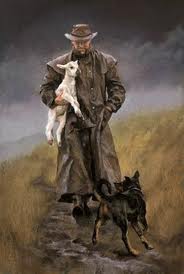 The Fourth Sunday after Easter conveys the arresting metaphor of
  Relationalrealities