There is no time like the present

The only certainty in life is change. Opportunities arise, and challenges are confronted—some overcome, and others accommodated as we learn to live with what we cannot control. The other great certainty in life is the passing of time. Time passes, memories accrue, future expectations arise, while present-time successes are celebrated, and disappointments are weathered.

The future is unpredictable because however we imagine it, the sorry truth is we just don’t know what it will bring. Uncertainty leads us to hold two conflicting illusions at the same moment—that change can be resisted by turning back the clock and that time flows only in one direction, from past to future, and not the other way around. Advent is a season for the contemplation of change – signifying God’s intrusion, disrupting the smooth running of our broken world by playing fast and loose with the linear flow of time. Advent’s message speaks of new beginnings and ultimate endings in the same breath. Only in the depiction of the ending is the deeper meaning of the beginning revealed.

In a recent piece for Christian Century, Brian Bantum noted the difference between our experience of time and God’s—the feeling of being stretched between past, present, and future—akin to singing a song where the words we’ve just sung are still in our mind as we sing new words in the moment—anticipating the words still to come.

Bantum notes that we live in a current of time that flows like a great river of being within God’s life. For us, time is segmented and linear. For God, past, present, and future could be imagined as braided together, flowing like drops moving and twisting in a river.

Advent Sunday in 2024 coincides with the commemoration of Nicholas Ferrar, who, in 1625, in a place called Little Gidding – a tiny hamlet on his family estates in Huntingdonshire northeast of Cambridge – formed a small religious community centred on a disciplined life of prayer, work, and pastoral care modelled on the liturgical heart of the daily offices in the Book of Common Prayer. In 1941, the poet T.S. Eliot – in the depths of war-time winter, made a pilgrimage to the church at Little Gidding with the memory of Ferrar’s brave little community very much in mind.

In the final quartet, Eliot reflected on this visit, appropriately titled Little Gidding of his Four Quartets. Here, he articulates the multidirectional interplay of past, present, and future. He challenges the notion of time as only linear, with a single flow of direction flowing from the past to the future. For example, he wrote, We shall not cease from exploration/ And the end of all our exploring will be to arrive where we started/ And know the place for the first time.

If the past is memory and the future expectation, the present time is opportunity. Advent, if seen as only a future-oriented expectation, runs the risk of consigning the present to a period of passive waiting for the real action to begin. Advent becomes rather like sitting in the cinema, playing with our phones as the ads and previews play – distractedly anticipating the imminent arrival of the main feature. Seen like this, Advent becomes a period of marking time – a season marked by passivity – as the possibility and opportunity pass us by unnoticed. Future-oriented expectation has only one purpose – that is to guide and shape the actions we are called upon to take now.

There’s that time-honoured saying most recently placed in the mouth of Sonny, the manager of the Exotic Marigold Hotel – when seeking to offer reassurance, he says that everything will be OK in the end—if it’s not OK now, that means it’s not yet the end.

But Sonny’s advice is a false comfort. Today, things are not OK – in fact, things are very far from being OK in our world!  We wait passively – enduring the evils around us in the reassurance that things will all work out in the end? We look toward future expectations while missing the more important question of what do we need to be doing now? If we wait for our future expectations to come to realization we miss the point of them because the purpose of our vision of the future is to guide and energize our actions in the present. Our expectation of the future is realised in our actions in the present time.

Jeremiah predicts the fulfilment of God’s promises as future event. The past becomes realized only as future fulfilment. In projecting the past into the future like this, he seems to leapfrog the present. But perhaps this is understandable. The Babylonians are at the gates of Jerusalem. Destruction and exile seem the most likely outcomes, and maybe Jeremiah can be excused for skipping over the present – facing an impending catastrophe, there is nothing to be done. Yet, although not recorded in this passage, Jeremiah does have a sense of the importance of present-time action. Imprisoned in the palace guard room as the hostile army masses at the city gates – he instructs his scribe to exercise a purchase option on a piece of family land. Amidst the impotence of crisis – Jeremiah still believes in a future he will not live to see. The purchase of land he will not live to enjoy is still planting a marker of resistance to fate in the earth.

In Luke 21:25-36 Jesus shows us a vision of the ultimate fulfilment of the journey that must begin with his birth. Despite predictions of fear and woe – in the parable of the fig tree, he draws our attention away from future speculation to the necessity to act now. The fig tree’s leafing is not a future expectation of summer to be passively awaited but a recognition that summer has already arrived, demanding an action response now. The intrusion of God’s kingdom is already here. It’s now time to act.

Advent is a time for the expectation of things to come as an inspiration to plant in the present time the seeds that will one day mature into our future hope. Advent means consciously rejecting the self-protective foreboding and striking out with courage to boldly embody our future expectations because they are already effective within us.

In memory and imagination, time flows back and forth. Past mistakes are mitigated by present-time action. Future expectation – while still only potential becomes realized not in waiting but through action in the here and now shaped by the anticipation of its arrival.

The novelist Alice Walker wrote we are the ones we have been waiting for. My question to us this Advent is – are we not already the people we have been waiting to become?

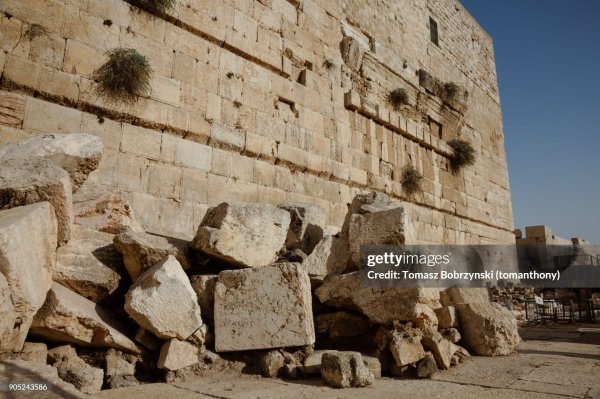
Temple Stones

The Photo shows stones from the Second Temple in Jerusalem thrown by the Romans who destroyed the city in the 1st century AD. Robinson’s Arch is visible above the Herodian street in the southwestern corner of the Temple Mount. It was named after scholar Edward Robinson who discovered it. The arch supported a large staircase which was buit by Herod the Great as part of the expansion of the Temple Mount. Ophel Archaeological Park. GPS: N31.77580°, E35.23594°.

Note on the recording: the recording from No one wants this that comes towards the end of this recording is garbled but you can hear the clear version below in the text.

It is not an exaggeration- though it may come as a surprise to some when I say that the Roman destruction of the Second Temple in 70AD was a seismic event – the shock waves from which continue to ricochet down the historical timeline. In the Jewish Revolt from 68-70AD, the Romans laid waste across the Jewish homeland in town and countryside – culminating in the catastrophe of the Temple’s destruction along with much of Jerusalem around it.

It’s interesting to speculate had the Temple continued as the national and religious center of Jewish life might the subsequent course of Jewish-Christian relations have followed a different trajectory? If the Jews had not been forced into diaspora by Roman devastation of town and countryside – becoming the perpetually resented other at the heart of Christian Europe – might the long and sorrowful history of antisemitism have been avoided?

Imagine, no antisemitism, no Holocaust, no need for the Zionist project and the creation of a Jewish state – no Nakba expulsion of Palestinians from their historic lands -no Jewish-Israeli Arab conflict – no Intifada – no Gaza or West Bank – no denial of Palestinian statehood through military occupation and illegal settlements. What if there had continued an evolution of Jewish life in the biblical homeland whatever the wider imperial superstructure of the region. What if no post-1914 British and French power grab – drawing impossible nation-state borderlines in the sand. Instead, imagine a collage of Jewish and Arab communities living side by side – enjoying the same rights and freedoms of religious and community expression in contrast with the drawing of sharp ethnic divisions between Jewish and Arab identities. As with all alternative visions of history, we can only dream.

For fledgling Christianity, the destruction of the Temple was also a seminal event reshaping early Christian memories of Jesus and redefining the subsequent development of post-Temple Jewish-Christian rivalries as the early Church and Rabbinic movements vied for supremacy in an increasingly hostile race for the heart and soul of post-Temple religious reconstruction.

For Mark, writing around 70AD, the destruction of the Temple is a contemporaneous event of such significance that surely Jesus must have prophetically predicted it 40 years before it came to pass. In service of the theological purpose of his narrative – Mark, therefore, puts words into Jesus’ mouth – establishing a long gospel tradition of projecting late 1st and 2nd-century Christian-Jewish tensions into Jesus’ relations with the Pharisees and other Jewish sects in the early 1st-century Jewish homeland.

In chapter 13, Mark presents Jesus after several days teaching his disciples in the Temple precincts. Mark records him leaving the Temple with his disciples – one of whom remarks on the massive stones in the Temple’s construction. Even with our contemporary engineering capabilities the construction of Herod’s great Second Temple is still awe-inspiring. Standing before the Wailing Wall we can still imagine the size of the original Temple Mount platform upon which the Muslim Dome of the Rock now stands. Jesus responds with a prophecy that not one stone shall remain upon another – for all will be thrown down. Mark makes no mention here of Jesus’ claim to rebuild the ruined Temple in three days. We need to wait for John to embellish his version of Mark’s story in 2:19 with this detail.

On the Mount of Olives facing the Temple Mount across the Kidron Valley, his disciples ask for clarification on when his prophecy of the Temple’s destruction will happen. Jesus avoids the direct question and begins to warn them about the dangers of mis and disinformation campaigns that will sow the seeds of confusion – seducing many and leading them astray by false claims of leadership in his name. He warns them not to be alarmed by news of conflict and rumors of wars – such will be necessary to herald a true vision capable of taking them into the future. But for the future to arrive it must begin in the painful stage of birthing that must first destroy the familiar patterns of life as they knew it.

Jesus in Mark 13 is presented as laying out his eschatological vision. Eschatology is theology of expectation that constructs a sweeping view of events that will mark the end of the present age in preparation for an end time. In chapter 13 Mark reminds the first Christians that Jesus’ conception of Messiahship begins not in a triumph in the present age but in a series of events of impending disaster culminating in his eventual triumphal coming again at the end of time as judge and savior of the whole world. But first, the kingdom of God must be born through a process marked by great convulsions and upheavals heralding the arrival of the end time.

When you hear of wars and rumors of wars, do not be alarmed; This must take place, but the end is still to come. For nation will rise against nation, and Kingdom against Kingdom; there will be earthquakes in various places; there will be famines. This is but the beginning of the birth pangs.

Christians throughout history have associated major convulsion and upheaval in the socio-political and economic fabric as heralding the imminence of the end time.  Yet for most of us whose lives have been lived in the peace and predictability of the post-1945 Pax Americana – an expectation of the end time has been confined to millenarian sects while the rest of us accepted that the world – as we experienced it – had now come of age  – marked by a time of social and scientific progress accompanied by the steady growth of economic prosperity.

Yet, we now awake to find ourselves in a world where war and rumor of wars disrupt our sleep. A world in which many are being led astray by the dark arts of dis and misinformation – perpetrated by foreign actors and aided and abetted by the charlatans of the political class who have no interest other than the accumulation of power beyond limit.

The last four years of the Biden Administration may well be seen in the rearview mirror of history as that last gasp of a world we grew up to expect. From now on things are going to be markedly different.

Last week Bishop Nicholas commented on the recent election results suggesting we don’t yet know what any of this means. Well, maybe?  What is clear is that a majority of voters voted for change. Motives for doing so seem mixed with no clear vision for what change will look like. It’s the time and tested response – of repeating failed choices in the hope of a different result.

As a scientist, Bishop Nicholas in essence reframed the gist of Jesus’ words in Mark 13 with the scientific observation of large systems transitioning from one stable phase to another. He commented that as it nears that point of change, fluctuations in a system become larger and more frequent. This is why water gets cloudy before it freezes or boils—the fluctuations signal that a significant change is coming. In our current political system, the jury’s still out on whether the direction of change is towards freezing or boiling.

Beyond endless analysis of what has now happened the more pressing question is – so how will we weather the convulsions and upheavals of the large socio-political paradigm change that is upon us?

Reading Mark 13 our attention is captured by the dire nature of Jesus predictions – because they mirror the instabilities we are now experiencing. Adding to the socio-political instabilities we should not fail to note instability in the largest system of all – the environment of the planet. Thus we are likely to miss the line where Jesus tells us not to be alarmed by the process that must take place – a process he identified as the beginning of the birth pangs. What are birth pangs other than the signal that new life is on the way?

In the Netflix romcom, Nobody Wants This – a sexy, youngish rabbi and his remarkably godless gentile girlfriend find themselves in a restaurant talking about the meaning of Shabbat. Listen

Buildings – and the systems they represent – may crumble – but that doesn’t matter – what matters is gathering with people we care about and who care for us. In the time that is upon us – solidarity, caring for one another in communities of solidarity and support – together sheltering within the protection of belonging – this has always been for Christians – and is now for us – the best survival strategy for enduring the birth pangs that will in the end result in the arrival of new birth.  This is Jesus’ message to us about the promises of God – and God is always faithful.

Today I will lick my wounds

A friend happened upon these words by Bob Martin. I don’t know who he is but his words captured my feelings on this dark day of the morning after.

Today, I Will Lick My Wounds
Bob Martin

Today, I will lick my wounds
and feel the deep ache of losing not just candidates,
but a way of life I thought I understood.
Everything feels distant, unfamiliar—
as though I’ve awoken in someone else’s country.
The urge to disappear presses down on me,
a heavy fog that whispers,
“Quit. Hibernate. Let the world move on without you.”

But I think of Frankl in the camps,
Mandela in his cell,
the Dalai Lama without a homeland,
Anne Frank dreaming of skies beyond her attic walls.
They refused to let the world steal their happiness,
refused to let suffering define their spirit.

I remind myself:
No decisions in this state of mind.
Just a breath,
then another.
Today, I rest and gather strength,
for tomorrow, I teach.

I have my practice—
a sanctuary built in the tolerance of discomfort,
and twelve bright souls,
who depend on me to rise.
For them, I will stand in front of the class,
share what I know,
and keep moving forward.

I will not let this darkness take more than it already has.
I will survive.
I will teach.
I will find, somehow, a way to be at peace
even when my country does not feel like my own.

The path is uncertain, but it is still mine to walk.

Justice Deferred

Image: The Book of Job, William Blake

In her sermon two weeks ago, Linda+ introduced us to the recent series of OT lessons from the Book of Job, saying that the much-used statement “Everything happens for a reason” is one of the five cruelest words in the English language to someone who is suffering—right up there with “It’s all in God’s plan.

I’ve coined the term fable morality for the popular attitude that luck – the avoidance of tragedy in our lives is a sign of God’s grace. Linda+ asked: where are the blessings and the grace of God for your neighbor who has lost everything? You get grace and blessings, and they don’t? What kind of God allows that? What kind of God would do that? She concluded her introduction with Welcome to the Book of Job.

Welcome indeed!

We are mostly familiar with the story of Job – a non-Israelite yet righteous man – whose faith in God is tested in severe adversity. Job is so righteous that God boasts about him in the heavenly council – holding him up as an example of human faithfulness arousing the angelic adversary – the satan’s invitation to enter into a small wager. Here we make a curious discovery – that the Lord God is a bit of a gambler who likes nothing better than a flutter on the forces of fate.

God seems to have allowed himself to be manipulated by the satan with the expectation of a safe bet. Expecting a quick an easy win – the Lord is utterly unprepared for what happens next. At first Job responds as God expects. Twice he refuses to curse the Lord. But then Job does something God didn’t expect – he seeks an explanation as to why his life has taken this calamitous turn. In doing so he appeals to the Lord’s justice as the better side of the divine nature.

Here lies the central theme in the story: Job continues to insist on his righteousness while refusing to acknowledge that the sorry turn of events in his life is the result of sin. Job demands an explanation from God on the basis that the Lord is a just god. In insisting on justice as an essential attribute of the Lord God’s identity, Job exposes God’s betrayal of God’s own better nature.

There’s an old joke among preachers concerning a marginal note in the sermon text that reads – argument weak here so shout and pound the pulpit. From the voice within the whirlwind, God now tries to deflect Job’s questions with a display of pulpit thumping designed to intimidate and silence Job. Pounding the divine pulpit, the Lord roars -who are you to question me? Can you do what I’ve done? Were you there to see my power at creation? Do you know more than I know?

But Job is not questioning God’s power. For Job, God is God not simply because God is all-powerful. God is God because justice is an essential and integral aspect of the divine nature without which God cannot be God.

God begins to realize the bind he finds himself in. He cannot respond to Job in terms of justice because confident of quick victory in his wager with the satan – he has allowed a manifest and brutal injustice to be perpetrated on Job. Thus, God draws the robe of the power around himself – blustering and stomping about in the hope that Job won’t notice that God is changing the subject. Job lies in abject suffering while God waxes lyrical about creating crocodiles and whales.

In Chapter 42:1-6 we have Job’s response. Unlike his earlier speeches in self-defense – Job’s final response is brief and concise. Most English language Bibles use the following translation.

I know that you can do all things and that no purpose of yours can be thwarted. I uttered what I did not understand, things too wonderful for me, which I did not know. I had heard of you by hearing of the ear, but now my eye sees you; therefore, I despise myself and repent in dust and ashes.

All’s well that ends well – in other words with the explicit warning – who are we – mere mortal beings – to question the Almighty? Repentance before the Lord even in the face of what seems inexplicable injustice is the only acceptable response.

However, this traditional interpretation makes no sense and does serious violence to the integrity of Job’s complaint. Jack Miles in his revolutionary book God: A Biography offers a very different approach to interpretation. Miles justifies this by demonstrating how the traditional interpretation relies on a repentance gloss on the original Hebrew introduced in the 2nd-century Greek translation in the Septuagint. After his long and passionate presentation of his case before the Lord – Miles questions why Job would suddenly abandon his cause at the very end.

Miles contends that when freed from the presumption of the later Greek repentance gloss – the inherent ambiguity of the Hebrew suggests a very different translation of 42:1-6.

[You] know that you can do all things and that no purpose of yours can be thwarted. [You say] who is this that hides counsel without knowledge? Therefore, I spoke more than I realized. [You say] Hear and I will speak, I will question you, and you declare to me. [Ahh], I had heard of you by hearsay (the words of my comforters) but now that my eyes have seen you I shudder with sorrow for mortal clay.

Miles suggests that this translation fits within the larger context of Job’s consistent refusal to back down in the face of God’s attempt to intimidate him. What seems to upset Job at this point is the realization that if God insists on deflecting questions of justice with displays of power– then all humanity is done for.

Job may have been reduced to silence but so has God been silenced by being brought face to face with the internal tension between his better and darker selves. The Lord now seeks to avoid facing his inner conflict by restoring Job’s fortunes. In the Lord’s time-honored behavior when he realizes he has gone too far – he makes double restitution without admitting culpability. Might we see in this a hidden expression of divine remorse?

Throughout the historical development of the Tanakh the Jewish scriptures struggle to reconcile the unfettered exercise of divine power with the constraint of divine justice. In other words, how can the split nature of the divine be understood – for the Lord God seems to have a dark as well as a light side to his identity, or in Job’s words the Lord gives, and the Lord takes away; yet blessed be the name of the Lord.  

In the Psalms, we find the main divine assertion – I am the Lord whose power is made manifest through justice. Earlier in the Torah, we find Abraham repeatedly appealing to God’s better nature – invoking the attribute of justice as a necessary curb on God’s darker power-driven impulses. In effect, this is the argument Job now uses with God. Like Abraham, Job reminds God of the human expectations for God to live up to his assertion that divine power is made manifest through justice.

Accordingly, Jewish tradition understands that justice is imperfect – guaranteed by God but also at the mercy of his darker impulses. Time and again the Tanakh witnesses God’s justice winning over his power impulses. But as Job reveals this struggle is sometimes touch and go.

The encounter between God and Job has reduced both to silence. After the book of Job, the Lord God never speaks again in the Tanakh. In all the books that follow – God is either absent with the focus being on human interaction or heard through human repetition of God’s historical statements quoted from earlier passages in the Torah or the prophets. God makes a fleeting appearance in the book of Daniel but as the very remote and silent Ancient of Days.

The book of Job leaves a somewhat bitter aftertaste in the mouth.  Yes, God restores Job’s fortunes and doubles his prosperity, and his better self eventually wins out over his darker impulses. But as Jack Miles notes – no amount of compensation can make up for Job’s loss of his previous family and servants – all merely the collateral damage flowing from the misjudged wager with the devil.

As for the Tanakh’s image of divine justice – well it’s mixed. In the books that follow Job, the simplistic fable morality – God rewards the good and punishes the bad – reasserts itself. We do find attempts to deal with unpredictability with the assertion that God will do neither good nor bad – somehow remaining detached and impartial. Only in the book of Job do we encounter a groping after a deeper and more paradoxical wisdom– that the lord will often do good but sometimes do bad. Justice is imperfect. From now on Job not only knows this about the Lord, but the Lord cannot escape knowing this about himself.

Remedy Against the Hardness of the Human Heart

In the current political climate women’s and children’s issues are spotlighted by an age-old paradox. On the one hand, the anti-choice political-religious agenda – with renewed energy seeks to impose a Kafkaesque level of government overreach into women’s reproductive lives threatening disastrous consequences for the integrity of medical professionals dedicated to women’s health. It’s ironic that this movement is championed by that part of our political and religious culture that has traditionally coined the slogan – keep the government out of our lives.

Yet, the paradox becomes more glaring when we note that the political and religious championing of the rights of the unborn is matched by a reluctance to legislate for the welfare and protection of the already born. Recent Republican refusal in the US Senate to extend the child credit is a sorry truth that for an electorate that practices a high degree of selective cognizance cannot be highlighted enough. Child-family credit is the single most effective instrument in dramatically reducing child poverty.

The political terrain of women’s and children’s welfare remains an area of fraught intersectionality. Anxieties about women’s reproductive rights meet head-on with accompanying white anxieties about race and class. The origin of American abortion prohibition has its roots in the murky history of white protestant racial anxieties in the face of late 19th-century immigration from southern and eastern Europe – anxieties that today find a voice in conspiracies of racial replacement.

It’s ironic that the strident claims of the religious right’s assertion that God and the Christian tradition abhors abortion find no support or evidence in the Judeo-Christian Scriptures which remain completely silent on the issue of abortion. In contrast, the diverse voices heard in the Scriptures are resoundingly loud and clear on issues of women’s and children’s welfare. They are similarly loud and clear about the obligation to welcome and protect the stranger. But the latter point is worthy of its own sermon.

As a case on point – Jesus’ teaching in Mark 10 should make us all wriggle with discomfort. How can we continue to claim to know the mind of God on contemporary reproductive issues about which Scripture remains consistently silent while ignoring the clearly articulated mind of God on the nature of the human relationship within marriage?

If Scripture is silent on contemporary issues of reproductive rights – justifying male control of female bodies – a general attitude nevertheless can be discerned hidden within Jesus’ debate with the Pharisees and his teaching to his disciples on divorce in Mark 10.

It’s not surprising that the debate about divorce centers on female adultery. Female adultery represents an attack on male control over female reproduction – because a wife’s adultery muddies the waters of legitimacy. A man needs to know that the children his wife bears are his and not someone else’s. Anxiety about legitimacy is code for the legal protection of intergenerational transmission of property rights – a cornerstone of patriarchal order.

Confronting this very male anxiety, Jesus messages in Mark 10 that adultery cuts both ways. It’s not just the wife’s adultery that counts for divorce, but the husband’s does as well. This is shocking news for both his Pharisee interlocutors and his faithful disciples. This is not what they want to hear.

Of interest to us is Jesus’ thoughts on the Mosaic writ of divorce as an accommodation for the hardness of the human heart. What does he mean by this? One reading of the writ is to see it as a recognition that men have a right to do what men want to do concerning their wives and children. But I think a better reading of what Jesus is getting at here is to recognize the Mosaic writ less as a permission for male bad behavior but as a protection for a woman by requiring her husband to publicly demonstrate the grounds for divorcing her. The writ protects what little rights a Hebrew wife might claim in the face of an unscrupulous husband’s attempt to cast her aside.

Mark is always in a hurry – he thinks nothing of abrupt and unexpected jumps in the narrative. One moment Jesus is addressing the question of divorce and then suddenly he’s talking about the welcome and protection of children. Although we note a rather abrupt and unskillful transition – Mark is showing his readers that the point to which Jesus is driving his argument firstly with the Pharisees and then with his disciples – is towards the recognition in a society where women and children had few rights and were easily the subjects of male abuse – that the protection and care for women and children is one of God’s primary concerns.

In his teaching on divorce, Jesus asserts the relationship between husband and wife is one of equals. Reflecting God’s covenant with humanity, Jesus asserts that marriage as a relationship of equals was God’s original intention for men and women in creation. When Jesus says: what God has joined together let no one separate, he is saying that God’s intention and the practice of divorce conflict. The Pharisees go away muttering to themselves, the disciples are rendered speechless, and Christians have squirmed on the hook of this teaching for nearly 2000 years.

Jesus understands the difference between divine intention and human experience. He is fully aware that God’s original intention for creation is continually frustrated by human failure. In this light, he sees the Mosaic writ of divorce as a pastoral and compassionate response to the reality of human failure. What he is not prepared to accept is the ossification of the Mosaic writ into a cruel legalism that favored husbands over wives – and was indeed an expression of hardness of heart. Jesus moves the conversation away from the legalistic debate among men concerning the justifiable grounds for divorcing their wives, into a different conversation – one that recognizes the tension between human fallibility and God’s intention for marriage as a partnership of equals – a reflection of God’s love for us in creation which as in all other areas of human response is found wanting.

So today, in the Episcopal Church, where do we find our theology of marriage and divorce? After a long debate in the 20th century, Anglican theology groped towards a position that seeks to hold in tension the original divine intention for marriage and the reality of human failure. In our tradition, the solution we arrived at after much soul searching is to reserve a right to remarriage in church after civil divorce to the bishop’s prerogative. In nearly all cases the decision of the bishop depends on the advice of the priest preparing the couple for remarriage.

In marriage preparation, Linda+ and I invite the divorced person (s) seeking remarriage to share their perception of the failure of a previous marriage. In their story, we listen for the echoes of sorrow. We hope to hear in their story a sense of loss – a loss of innocence – to hear the echo of the pain and disillusionment at finding failure where they had hoped for fulfillment and joy. It seems to me that no one who has been through a divorce emerges unscathed by the loss of their once innocent belief that when you make sacred promises everything should work out, and people should live happily thereafter.

Our question to the divorced person or persons is – in this process how has this experience of loss of innocence deepened your self-awareness to better equip you to have a more mature expectation of yourself to sustain your hopes for this new marriage relationship? This is a pastoral inquiry and on the strength of the response we request episcopal permission to remarry the couple into a new beginning. When the religious tradition prohibits divorce denying it as a potentially life-giving opportunity for new beginnings -the Church continues a legalistic-pharisaic hardness of heart that perpetuates trauma in family life – with historically speaking, women and children – the primary causalities.

As Anglican Christians in the Episcopal Church, we live in the tension where a fixed interpretation of Scripture and Tradition meets the changing reality of the lives we are actually living. This place of tension is where we expect to encounter God, meeting us not only in our successes but particularly in our failures. Into this tension – God comes looking for us.

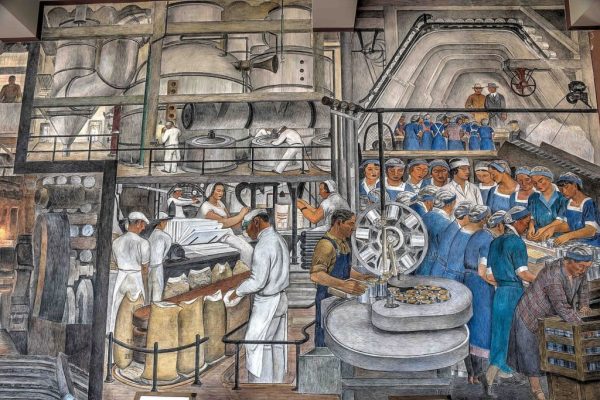
The Dignity of Labor

Picture taken from the murals in Coit Tower, SF depicting the idealism of the New Deal.

I look forward to Labor Day weekend. Who does not enjoy a 3-day break? However, because my day off is Monday, 3-day weekends are somewhat compromised for me. Yet, I rejoice in them because I know that many people I live and work with will enjoy three consecutive days of relaxation as summer ebbs into autumn.

The UK enjoys six 3-day or bank holiday weekends, two additional public holidays – Good Friday being one, and an average of 3 – 4 weeks of paid vacation leave a year. The average vacation leave in the US is 11 days a year. There’s an intuitive connection here to be fleshed out as it were – between American attitudes to paid leave, low pay, long hours, falling productivity, and a plethora of societal ills. These include increasing family and marital breakdown, rising tides of depression, suicide, and addiction, and rising civic strife. The American attitude towards work and recreation – indelibly shaped by the protestant work ethic and the immigrant experience is today something of a problem – with an adverse impact on the nation’s sense of well-being. Thus, current polls show that people remain pessimistic about their economic well-being despite record job creation, falling inflation, good economic growth prospects, and a booming stock market.

The Labor Day weekend is an important national observance. It is not only a well-needed three-day respite as summer ebbs into fall, but also a spotlight on current attitudes and practices that undermine American societal well-being.

How many of us know Labor Day’s origins? The US Department of Labor website tells us:

Labor Day, the first Monday in September, is a creation of the labor movement and is dedicated to the social and economic achievements of American workers. It constitutes a yearly national tribute to the contributions workers have made to the strength, prosperity, and well-being of our country.

A yearly national tribute to the contributions workers have made to the strength, prosperity, and well-being of our country. Really?

In 1993 on the 100th anniversary of organized labor in Rhode Island, Rhode Islanders were reminded of the establishment of the first Monday in September as a legal holiday. A direct result of the 1893 financial panic – following a previous decade of worker agitation the General Assembly, under the prodding of elected representatives from various mill towns, finally joined the bandwagon, and Governor D. Russell Brown signed the authorization.

Arriving in RI was a novel experience for me. Here I found the vestiges of an old Labor movement culture where certain unionized workers such as firemen, police, state employees, and teachers enjoyed privileged work protections and secure pensions that contrasted with the denial of these very privileges to the rest of the working population. Following its decline as an industrial powerhouse, Rhode Island’s failure to transform itself into a dynamic opportunities economy only fuels resentment as the tax burden to support the generous work privileges for the few falls on the many denied similar benefits. The economic plight of RI is bedeviled by an inward-looking parochialism summed up by the much-used phrase – I know a man. The Washington Bridge debacle demonstrates the consequences when the man you know is incompetent and seemingly unaccountable – not an unfamiliar story in this state.

Rerum Novarum (from its first two words, Latin for “of revolutionary change”, or Rights and Duties of Capital and Labor, is the encyclical issued by Pope Leo XIII on 15 May 1891. It was an open letter, requiring the hierarchy to address the condition of the working classes.

Rerum Novarum discussed the relationships and mutual duties between labor and capital, as well as government and citizenry. Of primary concern was the amelioration of The misery and wretchedness pressing so unjustly on the majority of the working class. It supported the rights of labor to form unions, rejected socialism and unrestricted capitalism while affirming the right to private property.

John Paul II on its 100th anniversary reaffirmed Rerum Novarum in Centesimus Annus which affirmed work as our individual commitment to something greater than our own self-interests – namely the greater good. If one flourishes at the expense of another’s languishing – then society fails.

The Law of Moses and the teaching of Jesus recognized that labor is the basis for all human flourishing because labor not only generates wealth but also bestows dignity on the human person. Today, we recognize three core psychological needs necessary for human flourishing: someone to love and be loved by, a safe place to live, and an activity that bestows dignity fostering a sense of meaning and purpose.

Furthermore, in the sabbath regulations, both the Law and Jesus recognized the necessity for a healthy work-life balance. The balanced relationship between work and leisure contributes to individual as well as societal well-being.

The US Conference of Catholic Bishops -the most politically conservative episcopal conference in the world, nevertheless cites 13 Biblical references in support of their affirmation that:

The economy must serve people, not the other way around. Work is more than a way to make a living; it is a form of continuing participation in God’s creation. If the dignity of work is to be protected, then the basic rights of workers must be respected–the right to productive work, to decent and fair wages, to the organization and joining of unions, to private property, and to economic initiative.

Marx defined capital as stored labor. The mere mention of Marx is enough to induce apoplexy in hard-right politicians and their supporters. It’s one of those curious paradoxes that those on the hard right – J.D Vance being the most current example – are flocking to the Catholic Church while holding economic views in sharp conflict with the social teaching of that Church. As over 100 years of Catholic social teaching asserts – to champion the rights of workers, to assert the dignity of labor, and to confront the abuses of labor at the hands of unrestrained capitalism is not Marxism – it’s Christianity!

The accumulation of obscene wealth by the few at the expense of the many whose labor generated it has clear ethical limits rooted in our deeper religious traditions of a just society. As we celebrate Labor Day on the first Monday in September 2024, we might do well to remember the mantra from the HBO series Game of Thrones – paraphrased as November’s coming!

A Living Eucharist

Bread is the staple food in all cultures where wheat is the staple grain. In such cultures bread becomes a symbol of divine generosity – an embodiment of God’s care and concern for human beings. Our own collective religious memory contains countless instances and references to bread as a sign of God’s presence, God’s blessing – God’s involvement in human affairs.

I promised last week to continue to explore Jesus’ riffing on the bread metaphor found in John 6 – and I know you have been waiting with bated breath for today.

I love the verb to riff. It has a street-cred vibe. Originally, a musical term for a repeated melodic phrase, forming an accompaniment for a soloist – riffing has also come to mean a new variation on or a different manifestation of an existing theme or idea. In his 6th chapter, John portrays Jesus’ riffing with gusto on the metaphor of bread. John records the grumbling of the crowds and the growing sense of alarm among the disciples as Jesus’ riffing on the metaphor of bread as spiritual food leads him to make some rather startling claims:

  1. I am the bread of life, come down from heaven.
  2. I am the bread of life, whoever comes to me will never go hungry.
  3. I am the living bread, and this bread is my body, which I will give for the life of the world.

The disciples sense of alarm goes through the roof when he tells the crowds:

  • Very truly, I tell you, unless you eat the flesh of the Son of Man and drink his blood, you have no life in you. This is the bread come down from heaven …. The one who eats this bread will live forever.

I’m put in mind of Flannery O’Connor’s wonderful line from her novel The River:

In the land of the nearly blind you need to draw really big caricatures.

For Jesus, bread is a metaphor for identity, his communion with God, and our communion with him – I am the bread that has come down from heaven – those who eat my flesh and drink my blood abide in me, and I in them.

As John reports, Jesus’ bread riffing becomes more and more controversial. His audience is a hungry one. After the feeding of the 5000, Jesus is aware that many are coming to hear him in the hope of a free meal. The crowds have little bandwidth for bread as spiritual food while their bellies remain empty and their grumbling grows louder. Rather than placating their growing dissatisfaction, Jesus ups the ante. Like members of the Trump campaign team, you can imagine his disciples frantically signaling to him to please dial it down – you’re losing the crowd. They will later privately complain to Jesus that his teaching is just too bizarre to follow.

Because bread is one of the most familiar metaphors of our Christian faith – our familiarity with Eucharistic imagery insulates us to the shock value of Jesus’ statements. We miss that Jesus is drawing some really big caricatures – which if taken seriously – have the potential to turn our comfortable worldview upside-down.

In the Lord’s Prayer the request Give us this day our daily bread becomes a metaphor for all of life’s basic needs. Daily bread is not only having something to eat but also somewhere to live, something meaningful to do that enhances our human dignity, someone to love and be loved by. Our difficulty is one of familiarity. How many times have we prayed the Lord’s Prayer? How many times have we participated in the Eucharist? Familiarity inures us to the radical implications of Jesus’ teaching. If we long for the bread from heaven that feeds our spiritual hunger, can we avoid ensuring that everyone – and not just the few – receives their daily bread? How long can we go on blithely receiving the Eucharistic bread from heaven without accepting that with it comes a responsibility to work for peace with justice in the world?

Every sermon reaches a pivotal point at which the preacher has to decide to take a left or right turn and follow one path rather than another. Here is this moment. The right fork leads me to focus on the internal dynamics of the Eucharist. To speak about the theology of the presence of Christ made real through the inbreathing of the Holy Spirit. That in taking, blessing, breaking, and receiving bread and wine – Christ becomes present to us within the boundaries of this material space and time i.e., this place, among these people, in this moment when time as past and future collapse into the enteral now of the present.

I would speak of the Eucharist as a double transformation event. Catholic theology focuses on the Holy Spirit’s transformation of bread broken and wine outpoured to become the vehicle for Christ’s sacramental presence among us in time and space. Our Anglican twist is not to deny the emphasis of Catholic theology but to recognize with equal emphasis that receiving is as important as blessing and breaking. Through receiving – draw near with faith and receive – we the gathered people of God become likewise transformed to constitute the Body of Christ in the world. As a double transformation event. – the elements of bread and wine become transformed – yet so too does the body of faithful receivers.

But if I had taken the left fork I would speak not of the internal dynamics of the Eucharist but of its direct effects as a political action in the world. After each celebration of the Eucharist, we hear the words of the dismissal – this Eucharist is ended – go in peace to love and serve the Lord. We are sent forth nourished by the bread from heaven to do justice, love mercy, and walk humbly with our God.

William Stringfellow one of our great Episcopal theologians of the 20th century and a native son of Rhode Island soil – ending his days on Block Island. He was an apostle of a deeply catholic spirituality rooted in the action of the Eucharist as social and political action in the world. In Keeper of the Word Stringfellow wrote of the Eucharist as a transcendent event, [encompassing] all that has already happened in this world from the beginning of time and prophesying all that is to come until the end of time. Here, Stringfellow is articulating the cosmic significance of the Eucharist as an action collapsing the flow of time – past and future folding into the present moment involving specific persons – gathered in an identifiable place – in the here and now of a particular moment.

For Stringfellow celebrating the Eucharist was a political event of social action. He summed up social action as being the characteristic style of life for human beings in this world.

In this manner, Stringfellow echoed an earlier 20th-century Anglican theologian and mystic, Evelyn Underhill in her poem Corpus Christi.

Come dear heart! The fields are white to harvest: come and see, as in a glass the timeless mystery of love, whereby we feed on God, our bread indeed. …Yea, I have understood how all things are one great oblation made: He on our altars, we on the world’s rood. Even as this corn, earth-born, we are snatched from the sod, reaped, ground to grist, crushed and tormented in the Mills of God, and offered at Life’s hands, a living Eucharist. 

Bread and Action

In Year 1 of the three-year lectionary, we are treated to some rip-roaring yarns in our OT readings from the Deuteronomic History as recorded in the books of Samuel and Kings. Again, these stories remind us that without a knowledge of history, we can only stumble around blind in the present.

These OT stories have a soap opera quality, and they function similarly. These stories of the societal machinations among ordinary Israelite folk cast a powerful spotlight on our contemporary societal machinations. It’s another OT book – Ecclesiastes that reminds us that what has been will be again, and what has been done will be done again; there is nothing new under the sun.

While our OT readings have offered ringside seats on ancient goings-on the gospel readings from John’s sixth chapter have been focused on Jesus’ perplexing and provocative bread metaphors. Jesus’ complex riff on bread metaphors is the unique characteristic of John 6. Consequently, the chapter forms the bedrock of Christian eucharistic understanding – of which I will say a little today but much more next week.

Two weeks ago, Kaley offered a reflection on the feeding of the 5000 as recorded by John. She began with a description of the nature of barley bread. I don’t know if I have ever eaten barley bread. Certainly, her description of its density and squishiness sounds very unappetizing to me. However, Kaley’s sermon got me thinking about bread.

As a child, I remember bread being delivered along with milk in glass bottles to the mailbox at the end of our drive in the early morning. My earliest memory is of bread that came as whole loaves in a waxed paper wrapper. It came in either white or brown. I remember when a third bread option became available – sliced. The arrival of the slicing machine in the bakery meant that in our house bread now came pre-sliced in a plastic wrapper. Pre-sliced bread was such a huge cultural achievement that it has found its way into the English language.  It’s the best thing since sliced bread – we say to describe something new or innovative.

I remember bread as the staple of my childhood, not as the specialty item to be savored by the denizens of Seven Stars Bakery. Bread was bread, white or brown, sliced or not – used as toast or to make a sandwich or a bread pudding –a great favorite of visits to my maternal grandmother.

I also remember a time when eating bread had little downside. Unlike the overly processed wheat that goes into modern commercial bread, the bread of my childhood was baked from minimally processed grain – the purity of which and the metabolism of youth allowed me to consume bread without regard to quantity or consequence. Alas, the slowing of my aging male body’s metabolism now means that for me bread has become chiefly identified as the source of unwanted carbs.  

Bread is the staple food in all cultures where wheat is the staple grain. In wheat-growing societies, dependence on bread as the staple food has led such societies to view bread as a symbol of divine generosity – an embodiment of God’s care and concern for human beings. Our own collective religious memory contains countless instances and references to bread as a sign of God’s presence, God’s blessing and involvement in human affairs.

Hence Jesus’ use of bread is not only a teaching metaphor for spiritual sustenance but a metaphor of connection with God – a metaphor for his unique relationship with God and through him our relationship with God.

We should recall that hunger was a commonplace experience for the masses of displaced peasantry that flocked to hear Jesus. 1st Century Palestine was undergoing an agrarian revolution with land being increasingly vested in powerful landowners who like corporate agribusiness in our own time – were intent on squeezing out the little guy – the peasant farmer – reducing him to the status of an itinerant day laborer. This is a story as old as time, and one alarmingly familiar to us as we view with a sense of increasing alarm the monopolistic trajectory of economic developments in our own day.

Jesus speaks to the crowds using a series of bread metaphors – two of which we hear in today’s gospel reading – I am the bread of life, I am the bread that came down from heaven. Interestingly, John records that this teaching didn’t go down well. It makes little sense to the crowds, and they begin to grumble – even scandalized to leave him.

Eventually, Jesus focuses his bread metaphor through the lens of collective memory – reminding the crowds of the mana – bread from heaven – that fed their ancestors in the desert. Perhaps if Jesus had read Abraham Maslow’s hierarchy of needs he might have realized that it’s a tall order telling people about spiritual bread as mystical nourishment when their bellies are empty.

Bread is one of the central metaphors of the Christian Faith. We pray: Give us this day our daily bread – extending bread as a metaphor for all of life’s basic needs. Daily bread encompasses not only something to eat, but also somewhere to live, something meaningful to do, and someone to love and be loved by. While we long for the bread from heaven that feeds our spiritual hunger, we have a spiritual imperative to ensure that there is enough to go around for everyone to receive their daily bread.

Paradoxically, we have the opposite problem to Jesus’ 1st-century hearers. To them the mention of bread reminded them of their hunger – bread to stave off starvation – they had little bandwidth for spiritual bread. Whereas we are all too comfortable with praying for the bread from heaven that feeds our spiritual hunger while ignoring or being complicit in systems that ensure that some have daily bread but not all.  

The great Dom Helda Camara, Liberation Theologian and bishop of the Brazilian diocese of Recife between 1964 and 1985 was a hero of the Liberation Theology Movement so disliked by John Paul II and his rottweiler – the then Cardinal Ratzinger. He asked the awkward question -why when he gives bread to the poor, they call him a saint but when he asks why the poor have no bread they call him a communist.

Our Christian faith costs us. Fulfilling our Christian responsibility to ensure that everyone has their daily bread – bread being used here as a metaphor for multiple poverties – will cost us in terms of the sharing of the resources we currently claim for ourselves.

In the Eucharist, Jesus gives himself as the bread from heaven that feeds the life of the world. This is not a heavenly world, but a real world in time and space. In the Eucharist when we celebrate the bread from heaven given for the life of the world we are also – in the same moment – making our ethical commitment to the life of this world.

The spiritual bread of the Eucharist cannot be separated from being also the physical bread of food and shelter – of love and life purpose – made available in the everyday world. The Eucharist as the spiritual bread of communion with God is also the physical bread of food and shelter – of love and life purpose made available in the everyday world.

Note my use of the verb made – made available – not just miraculously available. The daily bread of the Eucharist is made available through the process of our participation in worship – sending us out into the world for political action – by which I mean our commitment to service and witness to truth-telling. More about that next week.

True Greatness

Six momentous words capture David’s true greatness. What are they? Hold on, we’ll get to them.

The books of Samuel and Kings are the product of a huge editorial process of weaving together multiple oral traditions into an integrated narrative to tell the history of a nation. Like a loosely woven tapestry, within the grand narrative sweep, we find multiple storylines relating. Multiple threads comprise individual storylines. Isolate and pull on a particular thread reveals a story told from a different angle. The story of David and Bathsheba is a fine example.

In a Man’s Man – the title of my sermon before I left for vacation – I spoke about the love that bound David and Jonathan together till death did them part. I commented that on receiving news of Jonathan’s death – David’s lament proclaimed Jonathan’s love as surpassing that of women. I suggested we understand this statement as a cultural expression in a world where women while suitable as the bearers of children were not full persons but property. You don’t look to a piece of property for soul companionship.

If Jonathan was the love of David’s youth, Bathsheba was the love of his mid-life. For Bathsheba to be the object of David’s lust is not surprising. But to become his soul companion requires her transformation into a person in his eyes – a major achievement within the culture of their day.

In 2021 in a sermon titled The Perils of Getting What you Want I teased the particular thread in the story that relates to the power dynamic between David and Bathsheba. After the rise of the #MeToo movement – it seemed timely to explore the power dynamic at play between sexual victim and perpetrator.  Pulling on this thread in the story reveals Bathsheba as just another female victim of male sexual aggression -robbed of personal agency. Of course, the story is silent on the matter of Bathsheba’s own desire. The story of David and Bathsheba although couched as a significant love story – it’s primarily a story about David and the consequences of a sexual lust that drives him not only to steal another man’s wife but also to arrange for the husband’s assassination.

There’s an old Chinese curse – may you live in interesting times. We’re certainly living in interesting political times. What makes contemporary politics interesting is that once again within a decade we are poised on the knife edge of a momentous choice that will decide the future direction of the nation with profound implications for the Western alliance. Some say our democracy has grown old and listless leading many to pontificate that we are a culture in decline. We are all too close to events to know if this is so or not. However, the American Republic is being weighed on the scales – precariously poised between decency and weirdness.

The imagination of the American Republic draws heavily on an evocation of the Roman Republic which spanned an astonishing five centuries between 509 and 27 BCE. The last years of the Republic were marked by decades of civil strife that led to a sustained corruption of firstly, the electorate – marked by the degeneration of popular aspirations and values – secondly, the rule of law, and finally, the Senate – the core institution of republican government. The death blow to the Republic came swiftly. In 27 BCE the Roman Senate granted extraordinary powers to Julius Caesar’s appointed successor – elevating Octavian to the status of princeps civitatis – in other words, emperor. As a symbol of this dramatic development, Octavian took the new name of Augustus – he who was now above the law. On a show of hands in the Senate the Roman Republic was consigned to a footnote of history.

None of us can be in any doubt about the implications of the recent Supreme Court ruling on Presidential Immunity. This decision could be likened to the Roman Senate’s raising of Octavian to one who is above the law. With the publication of Project 2025, we have further evidence of a planned pathway that will sound the death knell of our republic and put us firmly on the road to the kind of autocracy to be expected in a second Trumpian term.

What might appear a strange diversion through contemporary politics via the Roman Republic provides the preamble or segue to my pulling on a different thread within the David and Bathsheba story.

David was a strong autocrat. He could be magnanimous but also brutal. He was a living example of how power corrupts, and absolute power corrupts absolutely. He’s the most successful of Israel’s kings ushering in a period known as the United Kingdom. But despite white Christian Nationalism’s more comic flight of fancy, David is far from the modern role model white evangelicals depict him as. In practice his rule was absolute. As we see from Uriah’s fate, he did not hesitate to orchestrate state-sponsored assassination of those who stood in his way.

Yet we need to note that Israel’s king may have been absolute in practice, but he remained in theory, God’s regent.  For by the terms of the covenant with the Lord, Israel had only one king and YHWH was his name. Alongside the monarchy’s growing centralization of political power, the office of the prophet emerged as the voice of opposition through which YHWH periodically reminded David and those who followed him – that despite appearances they were not unaccountable.

Enter Nathan into the David-Bathsheba storyline. Nathan appears to be the first after Samuel to exercise the counterbalancing authority of the prophet. With ingenuity, Nathan constructs a story that acts as a mirror to reveal to David the sober truth of how much his adultery with Bathsheba leading to the assassination of her husband has displeased the Lord. Nathan engineers the story to trap David into condemning himself out of his own mouth. The great David is reduced to stunned silence as Nathan reminds him of all the good things that the Lord has done for him before finally capping the litany off with – and if that had been too little, I would have added as much more.

David sits in stunned silence as Nathan passes YHWH’s judgment on his action. He pronounces that a sword of division and strife shall wreak havoc in David’s house and his line. Breaking his stunned silence David whispers six momentous words – I have sinned against the Lord.

In the verse following the ending of today’s portion of the story – Nathan tells David that because of his repentance, the Lord has put away his sin and as a result, he will not die. But the child of his adulterous union with Bathsheba will fall ill and die. We learn of David’s deep anguish as the child’s illness moves towards death.  His servants who had been in terror at the prospect of the child’s death now have to tell David the child has died. They expect the worst but are amazed as the king breaks his fast, dries his tears, washes his body, and changes his clothes before going into the Lord’s house to worship. There is no explosion of violent emotion, no ranting at the unfairness of things, no cursing of God. After his visit to the house of the Lord David returns home to his wife Bathsheba and consoles her. But the unfolding of the Lord’s judgment upon David’s house will continue through the events of family strife – rape and fratricide and periodic insurrection.

David is remembered as the greatest of Israel’s kings. His greatness lies not in his considerable political power or military success. His memory rests not on his prowess as a strong man. His greatness rests in his ultimate humility expressed in those momentous six words whispered to Nathan. David’s story is a reminder that even autocracies operate within a framework of the moral universe – a framework in which power is subject to ultimate truth and accountability sooner or later.

I have sinned against the Lord. Six momentous words expressing humility and repentance become the hallmark of a great leader – that is a leader who puts the interests of his people and his nation before his own attachment to power.

Blog at WordPress.com.

Up ↑