






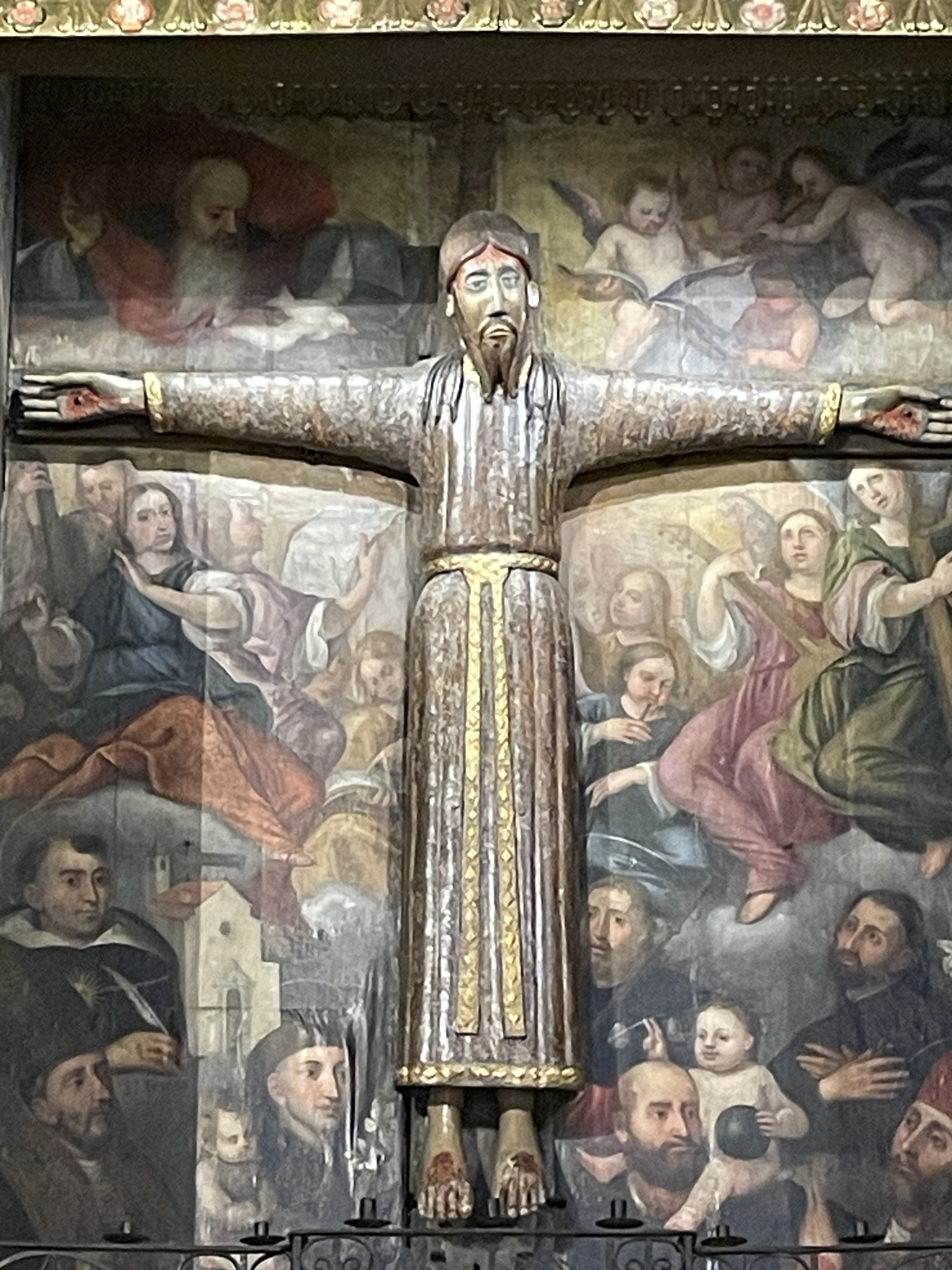
'relationalrealities' is the recognition human beings are designed to be in relationships. Relationality is the meaning of being made in the image of God who is by divine nature, relational – Lover, Beloved, and Love-sharer..
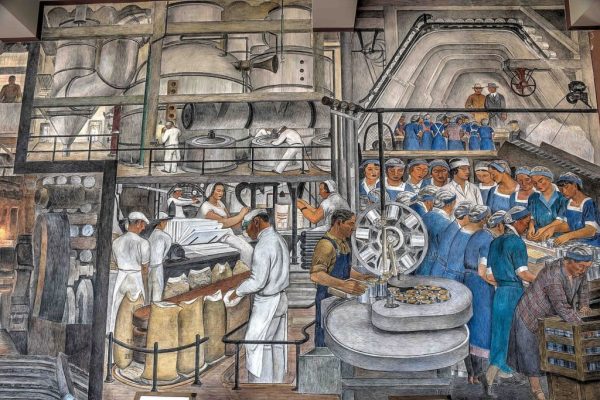
Picture taken from the murals in Coit Tower, SF depicting the idealism of the New Deal.
I look forward to Labor Day weekend. Who does not enjoy a 3-day break? However, because my day off is Monday, 3-day weekends are somewhat compromised for me. Yet, I rejoice in them because I know that many people I live and work with will enjoy three consecutive days of relaxation as summer ebbs into autumn.
The UK enjoys six 3-day or bank holiday weekends, two additional public holidays – Good Friday being one, and an average of 3 – 4 weeks of paid vacation leave a year. The average vacation leave in the US is 11 days a year. There’s an intuitive connection here to be fleshed out as it were – between American attitudes to paid leave, low pay, long hours, falling productivity, and a plethora of societal ills. These include increasing family and marital breakdown, rising tides of depression, suicide, and addiction, and rising civic strife. The American attitude towards work and recreation – indelibly shaped by the protestant work ethic and the immigrant experience is today something of a problem – with an adverse impact on the nation’s sense of well-being. Thus, current polls show that people remain pessimistic about their economic well-being despite record job creation, falling inflation, good economic growth prospects, and a booming stock market.
The Labor Day weekend is an important national observance. It is not only a well-needed three-day respite as summer ebbs into fall, but also a spotlight on current attitudes and practices that undermine American societal well-being.
How many of us know Labor Day’s origins? The US Department of Labor website tells us:
Labor Day, the first Monday in September, is a creation of the labor movement and is dedicated to the social and economic achievements of American workers. It constitutes a yearly national tribute to the contributions workers have made to the strength, prosperity, and well-being of our country.
A yearly national tribute to the contributions workers have made to the strength, prosperity, and well-being of our country. Really?
In 1993 on the 100th anniversary of organized labor in Rhode Island, Rhode Islanders were reminded of the establishment of the first Monday in September as a legal holiday. A direct result of the 1893 financial panic – following a previous decade of worker agitation the General Assembly, under the prodding of elected representatives from various mill towns, finally joined the bandwagon, and Governor D. Russell Brown signed the authorization.
Arriving in RI was a novel experience for me. Here I found the vestiges of an old Labor movement culture where certain unionized workers such as firemen, police, state employees, and teachers enjoyed privileged work protections and secure pensions that contrasted with the denial of these very privileges to the rest of the working population. Following its decline as an industrial powerhouse, Rhode Island’s failure to transform itself into a dynamic opportunities economy only fuels resentment as the tax burden to support the generous work privileges for the few falls on the many denied similar benefits. The economic plight of RI is bedeviled by an inward-looking parochialism summed up by the much-used phrase – I know a man. The Washington Bridge debacle demonstrates the consequences when the man you know is incompetent and seemingly unaccountable – not an unfamiliar story in this state.
Rerum Novarum (from its first two words, Latin for “of revolutionary change”, or Rights and Duties of Capital and Labor, is the encyclical issued by Pope Leo XIII on 15 May 1891. It was an open letter, requiring the hierarchy to address the condition of the working classes.
Rerum Novarum discussed the relationships and mutual duties between labor and capital, as well as government and citizenry. Of primary concern was the amelioration of The misery and wretchedness pressing so unjustly on the majority of the working class. It supported the rights of labor to form unions, rejected socialism and unrestricted capitalism while affirming the right to private property.
John Paul II on its 100th anniversary reaffirmed Rerum Novarum in Centesimus Annus which affirmed work as our individual commitment to something greater than our own self-interests – namely the greater good. If one flourishes at the expense of another’s languishing – then society fails.
The Law of Moses and the teaching of Jesus recognized that labor is the basis for all human flourishing because labor not only generates wealth but also bestows dignity on the human person. Today, we recognize three core psychological needs necessary for human flourishing: someone to love and be loved by, a safe place to live, and an activity that bestows dignity fostering a sense of meaning and purpose.
Furthermore, in the sabbath regulations, both the Law and Jesus recognized the necessity for a healthy work-life balance. The balanced relationship between work and leisure contributes to individual as well as societal well-being.
The US Conference of Catholic Bishops -the most politically conservative episcopal conference in the world, nevertheless cites 13 Biblical references in support of their affirmation that:
The economy must serve people, not the other way around. Work is more than a way to make a living; it is a form of continuing participation in God’s creation. If the dignity of work is to be protected, then the basic rights of workers must be respected–the right to productive work, to decent and fair wages, to the organization and joining of unions, to private property, and to economic initiative.
Marx defined capital as stored labor. The mere mention of Marx is enough to induce apoplexy in hard-right politicians and their supporters. It’s one of those curious paradoxes that those on the hard right – J.D Vance being the most current example – are flocking to the Catholic Church while holding economic views in sharp conflict with the social teaching of that Church. As over 100 years of Catholic social teaching asserts – to champion the rights of workers, to assert the dignity of labor, and to confront the abuses of labor at the hands of unrestrained capitalism is not Marxism – it’s Christianity!
The accumulation of obscene wealth by the few at the expense of the many whose labor generated it has clear ethical limits rooted in our deeper religious traditions of a just society. As we celebrate Labor Day on the first Monday in September 2024, we might do well to remember the mantra from the HBO series Game of Thrones – paraphrased as November’s coming!

Bread is the staple food in all cultures where wheat is the staple grain. In such cultures bread becomes a symbol of divine generosity – an embodiment of God’s care and concern for human beings. Our own collective religious memory contains countless instances and references to bread as a sign of God’s presence, God’s blessing – God’s involvement in human affairs.
I promised last week to continue to explore Jesus’ riffing on the bread metaphor found in John 6 – and I know you have been waiting with bated breath for today.
I love the verb to riff. It has a street-cred vibe. Originally, a musical term for a repeated melodic phrase, forming an accompaniment for a soloist – riffing has also come to mean a new variation on or a different manifestation of an existing theme or idea. In his 6th chapter, John portrays Jesus’ riffing with gusto on the metaphor of bread. John records the grumbling of the crowds and the growing sense of alarm among the disciples as Jesus’ riffing on the metaphor of bread as spiritual food leads him to make some rather startling claims:
The disciples sense of alarm goes through the roof when he tells the crowds:
I’m put in mind of Flannery O’Connor’s wonderful line from her novel The River:
In the land of the nearly blind you need to draw really big caricatures.
For Jesus, bread is a metaphor for identity, his communion with God, and our communion with him – I am the bread that has come down from heaven – those who eat my flesh and drink my blood abide in me, and I in them.
As John reports, Jesus’ bread riffing becomes more and more controversial. His audience is a hungry one. After the feeding of the 5000, Jesus is aware that many are coming to hear him in the hope of a free meal. The crowds have little bandwidth for bread as spiritual food while their bellies remain empty and their grumbling grows louder. Rather than placating their growing dissatisfaction, Jesus ups the ante. Like members of the Trump campaign team, you can imagine his disciples frantically signaling to him to please dial it down – you’re losing the crowd. They will later privately complain to Jesus that his teaching is just too bizarre to follow.
Because bread is one of the most familiar metaphors of our Christian faith – our familiarity with Eucharistic imagery insulates us to the shock value of Jesus’ statements. We miss that Jesus is drawing some really big caricatures – which if taken seriously – have the potential to turn our comfortable worldview upside-down.
In the Lord’s Prayer the request Give us this day our daily bread becomes a metaphor for all of life’s basic needs. Daily bread is not only having something to eat but also somewhere to live, something meaningful to do that enhances our human dignity, someone to love and be loved by. Our difficulty is one of familiarity. How many times have we prayed the Lord’s Prayer? How many times have we participated in the Eucharist? Familiarity inures us to the radical implications of Jesus’ teaching. If we long for the bread from heaven that feeds our spiritual hunger, can we avoid ensuring that everyone – and not just the few – receives their daily bread? How long can we go on blithely receiving the Eucharistic bread from heaven without accepting that with it comes a responsibility to work for peace with justice in the world?
Every sermon reaches a pivotal point at which the preacher has to decide to take a left or right turn and follow one path rather than another. Here is this moment. The right fork leads me to focus on the internal dynamics of the Eucharist. To speak about the theology of the presence of Christ made real through the inbreathing of the Holy Spirit. That in taking, blessing, breaking, and receiving bread and wine – Christ becomes present to us within the boundaries of this material space and time i.e., this place, among these people, in this moment when time as past and future collapse into the enteral now of the present.
I would speak of the Eucharist as a double transformation event. Catholic theology focuses on the Holy Spirit’s transformation of bread broken and wine outpoured to become the vehicle for Christ’s sacramental presence among us in time and space. Our Anglican twist is not to deny the emphasis of Catholic theology but to recognize with equal emphasis that receiving is as important as blessing and breaking. Through receiving – draw near with faith and receive – we the gathered people of God become likewise transformed to constitute the Body of Christ in the world. As a double transformation event. – the elements of bread and wine become transformed – yet so too does the body of faithful receivers.
But if I had taken the left fork I would speak not of the internal dynamics of the Eucharist but of its direct effects as a political action in the world. After each celebration of the Eucharist, we hear the words of the dismissal – this Eucharist is ended – go in peace to love and serve the Lord. We are sent forth nourished by the bread from heaven to do justice, love mercy, and walk humbly with our God.
William Stringfellow one of our great Episcopal theologians of the 20th century and a native son of Rhode Island soil – ending his days on Block Island. He was an apostle of a deeply catholic spirituality rooted in the action of the Eucharist as social and political action in the world. In Keeper of the Word Stringfellow wrote of the Eucharist as a transcendent event, [encompassing] all that has already happened in this world from the beginning of time and prophesying all that is to come until the end of time. Here, Stringfellow is articulating the cosmic significance of the Eucharist as an action collapsing the flow of time – past and future folding into the present moment involving specific persons – gathered in an identifiable place – in the here and now of a particular moment.
For Stringfellow celebrating the Eucharist was a political event of social action. He summed up social action as being the characteristic style of life for human beings in this world.
In this manner, Stringfellow echoed an earlier 20th-century Anglican theologian and mystic, Evelyn Underhill in her poem Corpus Christi.
Come dear heart! The fields are white to harvest: come and see, as in a glass the timeless mystery of love, whereby we feed on God, our bread indeed. …Yea, I have understood how all things are one great oblation made: He on our altars, we on the world’s rood. Even as this corn, earth-born, we are snatched from the sod, reaped, ground to grist, crushed and tormented in the Mills of God, and offered at Life’s hands, a living Eucharist.

In Year 1 of the three-year lectionary, we are treated to some rip-roaring yarns in our OT readings from the Deuteronomic History as recorded in the books of Samuel and Kings. Again, these stories remind us that without a knowledge of history, we can only stumble around blind in the present.
These OT stories have a soap opera quality, and they function similarly. These stories of the societal machinations among ordinary Israelite folk cast a powerful spotlight on our contemporary societal machinations. It’s another OT book – Ecclesiastes that reminds us that what has been will be again, and what has been done will be done again; there is nothing new under the sun.
While our OT readings have offered ringside seats on ancient goings-on the gospel readings from John’s sixth chapter have been focused on Jesus’ perplexing and provocative bread metaphors. Jesus’ complex riff on bread metaphors is the unique characteristic of John 6. Consequently, the chapter forms the bedrock of Christian eucharistic understanding – of which I will say a little today but much more next week.
Two weeks ago, Kaley offered a reflection on the feeding of the 5000 as recorded by John. She began with a description of the nature of barley bread. I don’t know if I have ever eaten barley bread. Certainly, her description of its density and squishiness sounds very unappetizing to me. However, Kaley’s sermon got me thinking about bread.
As a child, I remember bread being delivered along with milk in glass bottles to the mailbox at the end of our drive in the early morning. My earliest memory is of bread that came as whole loaves in a waxed paper wrapper. It came in either white or brown. I remember when a third bread option became available – sliced. The arrival of the slicing machine in the bakery meant that in our house bread now came pre-sliced in a plastic wrapper. Pre-sliced bread was such a huge cultural achievement that it has found its way into the English language. It’s the best thing since sliced bread – we say to describe something new or innovative.
I remember bread as the staple of my childhood, not as the specialty item to be savored by the denizens of Seven Stars Bakery. Bread was bread, white or brown, sliced or not – used as toast or to make a sandwich or a bread pudding –a great favorite of visits to my maternal grandmother.
I also remember a time when eating bread had little downside. Unlike the overly processed wheat that goes into modern commercial bread, the bread of my childhood was baked from minimally processed grain – the purity of which and the metabolism of youth allowed me to consume bread without regard to quantity or consequence. Alas, the slowing of my aging male body’s metabolism now means that for me bread has become chiefly identified as the source of unwanted carbs.
Bread is the staple food in all cultures where wheat is the staple grain. In wheat-growing societies, dependence on bread as the staple food has led such societies to view bread as a symbol of divine generosity – an embodiment of God’s care and concern for human beings. Our own collective religious memory contains countless instances and references to bread as a sign of God’s presence, God’s blessing and involvement in human affairs.
Hence Jesus’ use of bread is not only a teaching metaphor for spiritual sustenance but a metaphor of connection with God – a metaphor for his unique relationship with God and through him our relationship with God.
We should recall that hunger was a commonplace experience for the masses of displaced peasantry that flocked to hear Jesus. 1st Century Palestine was undergoing an agrarian revolution with land being increasingly vested in powerful landowners who like corporate agribusiness in our own time – were intent on squeezing out the little guy – the peasant farmer – reducing him to the status of an itinerant day laborer. This is a story as old as time, and one alarmingly familiar to us as we view with a sense of increasing alarm the monopolistic trajectory of economic developments in our own day.
Jesus speaks to the crowds using a series of bread metaphors – two of which we hear in today’s gospel reading – I am the bread of life, I am the bread that came down from heaven. Interestingly, John records that this teaching didn’t go down well. It makes little sense to the crowds, and they begin to grumble – even scandalized to leave him.
Eventually, Jesus focuses his bread metaphor through the lens of collective memory – reminding the crowds of the mana – bread from heaven – that fed their ancestors in the desert. Perhaps if Jesus had read Abraham Maslow’s hierarchy of needs he might have realized that it’s a tall order telling people about spiritual bread as mystical nourishment when their bellies are empty.
Bread is one of the central metaphors of the Christian Faith. We pray: Give us this day our daily bread – extending bread as a metaphor for all of life’s basic needs. Daily bread encompasses not only something to eat, but also somewhere to live, something meaningful to do, and someone to love and be loved by. While we long for the bread from heaven that feeds our spiritual hunger, we have a spiritual imperative to ensure that there is enough to go around for everyone to receive their daily bread.
Paradoxically, we have the opposite problem to Jesus’ 1st-century hearers. To them the mention of bread reminded them of their hunger – bread to stave off starvation – they had little bandwidth for spiritual bread. Whereas we are all too comfortable with praying for the bread from heaven that feeds our spiritual hunger while ignoring or being complicit in systems that ensure that some have daily bread but not all.
The great Dom Helda Camara, Liberation Theologian and bishop of the Brazilian diocese of Recife between 1964 and 1985 was a hero of the Liberation Theology Movement so disliked by John Paul II and his rottweiler – the then Cardinal Ratzinger. He asked the awkward question -why when he gives bread to the poor, they call him a saint but when he asks why the poor have no bread they call him a communist.
Our Christian faith costs us. Fulfilling our Christian responsibility to ensure that everyone has their daily bread – bread being used here as a metaphor for multiple poverties – will cost us in terms of the sharing of the resources we currently claim for ourselves.
In the Eucharist, Jesus gives himself as the bread from heaven that feeds the life of the world. This is not a heavenly world, but a real world in time and space. In the Eucharist when we celebrate the bread from heaven given for the life of the world we are also – in the same moment – making our ethical commitment to the life of this world.
The spiritual bread of the Eucharist cannot be separated from being also the physical bread of food and shelter – of love and life purpose – made available in the everyday world. The Eucharist as the spiritual bread of communion with God is also the physical bread of food and shelter – of love and life purpose made available in the everyday world.
Note my use of the verb made – made available – not just miraculously available. The daily bread of the Eucharist is made available through the process of our participation in worship – sending us out into the world for political action – by which I mean our commitment to service and witness to truth-telling. More about that next week.

Six momentous words capture David’s true greatness. What are they? Hold on, we’ll get to them.
The books of Samuel and Kings are the product of a huge editorial process of weaving together multiple oral traditions into an integrated narrative to tell the history of a nation. Like a loosely woven tapestry, within the grand narrative sweep, we find multiple storylines relating. Multiple threads comprise individual storylines. Isolate and pull on a particular thread reveals a story told from a different angle. The story of David and Bathsheba is a fine example.
In a Man’s Man – the title of my sermon before I left for vacation – I spoke about the love that bound David and Jonathan together till death did them part. I commented that on receiving news of Jonathan’s death – David’s lament proclaimed Jonathan’s love as surpassing that of women. I suggested we understand this statement as a cultural expression in a world where women while suitable as the bearers of children were not full persons but property. You don’t look to a piece of property for soul companionship.
If Jonathan was the love of David’s youth, Bathsheba was the love of his mid-life. For Bathsheba to be the object of David’s lust is not surprising. But to become his soul companion requires her transformation into a person in his eyes – a major achievement within the culture of their day.
In 2021 in a sermon titled The Perils of Getting What you Want I teased the particular thread in the story that relates to the power dynamic between David and Bathsheba. After the rise of the #MeToo movement – it seemed timely to explore the power dynamic at play between sexual victim and perpetrator. Pulling on this thread in the story reveals Bathsheba as just another female victim of male sexual aggression -robbed of personal agency. Of course, the story is silent on the matter of Bathsheba’s own desire. The story of David and Bathsheba although couched as a significant love story – it’s primarily a story about David and the consequences of a sexual lust that drives him not only to steal another man’s wife but also to arrange for the husband’s assassination.
There’s an old Chinese curse – may you live in interesting times. We’re certainly living in interesting political times. What makes contemporary politics interesting is that once again within a decade we are poised on the knife edge of a momentous choice that will decide the future direction of the nation with profound implications for the Western alliance. Some say our democracy has grown old and listless leading many to pontificate that we are a culture in decline. We are all too close to events to know if this is so or not. However, the American Republic is being weighed on the scales – precariously poised between decency and weirdness.
The imagination of the American Republic draws heavily on an evocation of the Roman Republic which spanned an astonishing five centuries between 509 and 27 BCE. The last years of the Republic were marked by decades of civil strife that led to a sustained corruption of firstly, the electorate – marked by the degeneration of popular aspirations and values – secondly, the rule of law, and finally, the Senate – the core institution of republican government. The death blow to the Republic came swiftly. In 27 BCE the Roman Senate granted extraordinary powers to Julius Caesar’s appointed successor – elevating Octavian to the status of princeps civitatis – in other words, emperor. As a symbol of this dramatic development, Octavian took the new name of Augustus – he who was now above the law. On a show of hands in the Senate the Roman Republic was consigned to a footnote of history.
None of us can be in any doubt about the implications of the recent Supreme Court ruling on Presidential Immunity. This decision could be likened to the Roman Senate’s raising of Octavian to one who is above the law. With the publication of Project 2025, we have further evidence of a planned pathway that will sound the death knell of our republic and put us firmly on the road to the kind of autocracy to be expected in a second Trumpian term.
What might appear a strange diversion through contemporary politics via the Roman Republic provides the preamble or segue to my pulling on a different thread within the David and Bathsheba story.
David was a strong autocrat. He could be magnanimous but also brutal. He was a living example of how power corrupts, and absolute power corrupts absolutely. He’s the most successful of Israel’s kings ushering in a period known as the United Kingdom. But despite white Christian Nationalism’s more comic flight of fancy, David is far from the modern role model white evangelicals depict him as. In practice his rule was absolute. As we see from Uriah’s fate, he did not hesitate to orchestrate state-sponsored assassination of those who stood in his way.
Yet we need to note that Israel’s king may have been absolute in practice, but he remained in theory, God’s regent. For by the terms of the covenant with the Lord, Israel had only one king and YHWH was his name. Alongside the monarchy’s growing centralization of political power, the office of the prophet emerged as the voice of opposition through which YHWH periodically reminded David and those who followed him – that despite appearances they were not unaccountable.
Enter Nathan into the David-Bathsheba storyline. Nathan appears to be the first after Samuel to exercise the counterbalancing authority of the prophet. With ingenuity, Nathan constructs a story that acts as a mirror to reveal to David the sober truth of how much his adultery with Bathsheba leading to the assassination of her husband has displeased the Lord. Nathan engineers the story to trap David into condemning himself out of his own mouth. The great David is reduced to stunned silence as Nathan reminds him of all the good things that the Lord has done for him before finally capping the litany off with – and if that had been too little, I would have added as much more.
David sits in stunned silence as Nathan passes YHWH’s judgment on his action. He pronounces that a sword of division and strife shall wreak havoc in David’s house and his line. Breaking his stunned silence David whispers six momentous words – I have sinned against the Lord.
In the verse following the ending of today’s portion of the story – Nathan tells David that because of his repentance, the Lord has put away his sin and as a result, he will not die. But the child of his adulterous union with Bathsheba will fall ill and die. We learn of David’s deep anguish as the child’s illness moves towards death. His servants who had been in terror at the prospect of the child’s death now have to tell David the child has died. They expect the worst but are amazed as the king breaks his fast, dries his tears, washes his body, and changes his clothes before going into the Lord’s house to worship. There is no explosion of violent emotion, no ranting at the unfairness of things, no cursing of God. After his visit to the house of the Lord David returns home to his wife Bathsheba and consoles her. But the unfolding of the Lord’s judgment upon David’s house will continue through the events of family strife – rape and fratricide and periodic insurrection.
David is remembered as the greatest of Israel’s kings. His greatness lies not in his considerable political power or military success. His memory rests not on his prowess as a strong man. His greatness rests in his ultimate humility expressed in those momentous six words whispered to Nathan. David’s story is a reminder that even autocracies operate within a framework of the moral universe – a framework in which power is subject to ultimate truth and accountability sooner or later.
I have sinned against the Lord. Six momentous words expressing humility and repentance become the hallmark of a great leader – that is a leader who puts the interests of his people and his nation before his own attachment to power.
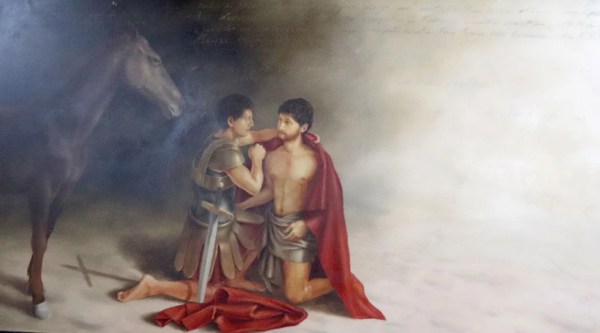
The purpose of history is less to explore the past than to illuminate the present. We value reading the Deuteronomic history – particularly 1st and 2nd Samuel, 1st and 2nd Kings for the way it casts a spotlight on issues of today.
The story so far. Having secretly anointed David as king, Samuel increasingly fades into the background as David emerges center stage. That David is now the real king remains a secret hiding in plain sight. Like most secrets hiding in plain sight, no one knows the secret while everyone recognizes that something has changed.
Last week’s OT lesson opened with David’s growing success on the battlefield. As David’s success grows – so Saul’s paranoia deepens. A moment of love at first sight threatens to complicate matters further.
Last week we heard that:
When David had finished speaking to Saul, the soul of Jonathan was bound to the soul of David, and Jonathan loved him as his own soul. Jonathan stripped himself of the robe he was wearing, and gave it to David, and his armor, and even his sword and his bow and his belt.
The process of intrapsychic resonance explains how two people become irresistibly drawn to one another across a crowded room before ever a word is spoken. This is a private moment of mutual intoxication – private that is until one of the parties walks up to the other and starts taking his clothes off. That’s the moment when others might notice something’s up.
Until death do us part is a phrase from the wedding service familiar to us. Even when used outside of the marriage ceremony it still implies a long-standing alliance or partnership between two people expected to last for their lifetime. The covenant between David and Jonathan is such a bond – forged between them until death will them part.
Today’s OT lesson opens with news of Jonathan and Saul’s deaths on Mt. Gilboa. As news reaches him, we witness the depths of David’s grief – as with the eloquence born only of grief’s devastation, David composes in the Song of the Bow – a love eulogy that he commands to be sung throughout Judah.
Your glory, O Israel, lies slain upon your high places! How the mighty have fallen. ….. Jonathan lies slain upon your high places. I am distressed for you, my brother Jonathan; greatly beloved were you to me; your love to me was wonderful, passing the love of women. How the mighty have fallen, and the weapons of war perished!
The synchronicity of reading the story of David and Jonathan as this year’s month-long international celebration of Pride winds down seems more than mere coincidence. For 21st-century ears, hearing the story of David and Jonathan spotlights two lines for contemporary inquiry.
The first line concerns issues of gender and sexual identity continuing to fuel our current culture wars raising the possibility of the question: was David and Jonathan’s love, homosexual?
In Pride month the temptation for some is to read the story of David and Jonathan in the vein of: ha, see, there were gay men in the Bible, after all. But being gay is not what this story is about. Homosexual identity – that is being homosexual is a modern concept that cannot be superimposed upon David and Jonathan who exist within their own psycho-cultural context. In other words, while there might have been a lot of sex between men in the ancient world – being gay was completely inconceivable.
By declaring that Jonathan’s love is a love beyond that of women – David is only acknowledging a cultural reality. While suitable as the bearers of children, women were inferior as persons because they were simply property. You don’t expect a piece of your property to be your soul companion. Consequently, in Israelite warrior culture, men sought one another to meet their emotional needs – whatever that may or may not have entailed in terms of sexual expression.
The second line of inquiry takes us in a different and more fruitful direction. Since the mid-20th century, anxiety about being homosexual has had a chilling effect on the dynamics of male friendship in Anglo-American culture. Before the 1950s we might be surprised to learn that despite the long history of anti-sodomy laws and periodic high-profile prosecutions, there was a wide latitude given for homosexual behavior because it remained simply an aberrant behavior largely hidden from the public eye.
From the late 1940s on – the older tolerance for homosexuality as a secretive and aberrant behavior among otherwise normal men is challenged by the promotion of homosexuality as a stable identity position along a continuum of human psycho-sexual development. The tragic paradox is that the growing recognition of a psychological theory of same-sex object choice – provoked a chilling effect on men’s capacity for emotional identification with one another within Anglo-American culture. It’s one thing to be a so-called normal person suspected of aberrant behavior. It’s quite another to be labeled as a homosexual.
The Church also jumped on the backlash bandwagon. In the new psychological explanation of homosexuality as a state of being, the Church found a new justification for the tradition’s ambivalence of being hostile to homosexual expression while at the same time remaining obsessed with it. What had always been regarded as aberrant (sinful) behavior subject to repentance, now becomes a state of disordered nature – giving rise to the invidious expression love the sinner but hate the sin.
The recent TV miniseries Fellow Travelers is a deeply moving serialization of the novel by Thomas Mallon – set at the height of the McCarthy witch-hunt for the practitioners of un-American activities. Alongside the rooting out of so-called communists in the Red Scare – in the Lavender Scare McCarthy aided by the infamous Roy Cohn – a closeted and repressed homosexual himself hunted persons who could be accused of being homosexual. Thousands of careers in government, academia, and entertainment were destroyed – driving many of the accused to suicide. In the spirit of the time being homosexual became an embodiment of the most un-American activity of all.
In men’s social formation just being emotionally sensitive became a source of considerable anxiety. Through injunctions such as boys don’t cry, don’t be a sissy, be a man – boys learned early on to equate emotional sensitivity with vulnerability. Who among men is the most vulnerable? The worst slur on the playground among boys became you’re a homo!
There’s a further paradox – that as societal acceptance of same-sexuality has greatly increased over the period from 1970 onwards – now resulting in the legal recognition and wider social acceptance of same-sex relations – men’s capacity for male friendship has continued to decline to the point today where many men report having few if any committed male friendships at all.
Equating male emotional sensitivity with signs of homosexuality has resulted not only in a chilling effect on men’s capacity to form male friendships but it’s also had knock-on effects on relations between the sexes.
By declaring that Jonathan’s love is a love beyond that of women – David is simply acknowledging that it is inconceivable that a woman could be an emotional partner equal to the degree that Jonathan was for him. This is in sharp contrast with the situation today – where the loss of men’s capacity to form male friendships has resulted in their wives becoming their primary and often exclusive source of emotional connection.
Avrum Weiss writing in the November 2021 Psychology Today notes the Saturday Night Live sketch titled “Man Park.” In the sketch, a young man waits anxiously for his partner to return from work. He has few if any friends and has had little social interaction all day. She listens, barely managing to feign interest in his data dump about the series of banal events of his day. As is often the case in heterosexual relationships, she reverts to the role of mommy, exhorting her partner to go outside and play with his friends. When he protests that he has no friends, she takes him by the hand as she would a little boy and walks him to the “Man Park” to play with the other men. The men approach each other awkwardly, unsure of how to make a friend, while the women patronizingly urge them on.
When I arrived in 2014, I observed the women of the parish easily creating experiences for mutual solidarity and support – enjoying the fruits of friendship with one another. Not so among the men. Except for a small selective group aptly named Band of Brothers, there was no wider-inclusive men’s group activity dedicated to the fostering of men’s friendship and emotional connection with one another.
This was a situation we have worked hard to change. With the aptly named Gander – as in the male goose – we have created an umbrella beneath which men’s lunch, writing, and reading-discussion groups now flourish – strengthening emotional solidarity between male group members. I recently noted with some satisfaction – that at a point of personal crisis, one man reached out for and received considerable emotional support from other group members. I see this as a fruit of men directly caring for one another – beyond the normal experience of men meeting only to talk about something other than the state of their emotional lives.
The story of David and Jonathan focuses a spotlight on contemporary men’s issues. Its message for us is not – ha, see, there were gay men in the Bible after all! The story of David and Jonathan highlights the contemporary problem of male isolation and loneliness – a problem with wider ramifications for the nature of relationships not only between men but between men and women in contemporary social life. It clarifies a need to create spaces for activities to facilitate men’s interests in one another. Spaces that facilitate men recognizing each other as emotional beings with emotional needs that can best be met in mutual friendship. At St Martin’s – among St Martin’s men, facing up to the tendency of men’s isolation is being thankfully, taken to heart.

Two weeks ago, Linda+ preached on the call of Samuel in which a key line reads – in those days the voice of the Lord was not often heard. This is a recognition by the Deuteronomist scribes – the collators and editors of the Samuel story – that in hearing God’s call Samuel becomes the first person since Moses to whom the Lord speaks directly. Samuel is a crucial transitional figure – presiding over an age of national transition in the Israelite evolution from a loose tribal confederation – where political power is highly devolved -towards a centralization of political power in a monarchical system.
Samuel is a figure linking the past but also prefiguring the future. He’s the priestly successor to Eli – custodian of the shrine at Shiloh. He is the last of the great Judges who since the days of Joshua had guided the Israelites in times of crisis. He is also the first of a new breed of prophets. After Samuel the office of prophet will become the significant counter – the Lord’s loyal opposition to the centralization of political power under the monarchy.
The story so far is -responding to the people’s clamor for a king, and with the Lord seemingly giving the green light to their request, Samuel has anointed Saul as the first king in Israel. But Saul is arrogant and easily gets above himself in the Lord’s eyes. On the pretext that Samuel had not arrived within the appointed time to perform an important sacrifice after a battle with the Philistines – Saul usurps the priestly role and offers the sacrifice himself. This is a serious trespass. Samuel arrives and in shock cries out to Saul – what have you done? The Lord is also not pleased and in rejecting Saul as unfit to continue to rule sends Samuel in search of a man after the Lord’s own heart to be king in Saul’s place.
Poor Samuel. Although originally opposed to the consecration of a king, he seems to have grown both fond of Saul and at the same time fearful of him. The OT reading for today finds Samuel moping. The Lord tells him to snap out of it and get on with the job.
Understandably, Samuel had been swayed in his original selection of Saul by Saul’s impressive warrior-like appearance – tall, handsome, dark-haired, and bearded, with shoulders and thighs of death. But Saul has a fragile ego. He’s a classic narcissist. Easily threatend and vindictive in response. Standing before the parade of Jesse’s sons – Samuel’s tastes in men have not changed as he ponders an acceptable Saul lookalike to replace him.
As Jesse’s sons’ parade before him – Samuel is constantly distracted by the Lord whispering in his ear – no, not this one, no not that one. After the seventh in the lineup had passed by and been rejected by the Lord, Samuel – somewhat at a loss turns to Jesse and asks if there is another son somewhere? Jesse says he has another son, but he is just a boy – out minding the sheep. David is brought before Samuel who finds the boy rather effeminate in appearance with a fresh, hairless, ruddy complexion, androgynously handsome with beautiful eyes – hardly king material in Samuel’s eyes.
But to Samuel’s astonishment, the Lord confirms this is the one. When Samuel takes a moment to make sure he has not misheard – the Lord becomes impatient. He commands Samuel to – rise and anoint him; for this is the one! Samuel takes the horn of oil and anoints David as king in the presence of his brothers. We are told the spirit of the Lord came mightily upon David from that day forward – which is propaganda code for the Deuteronomists’ approval of David – who in their eyes becomes the template for the good king -a man after the Lord’s own heart -. a template of kingship against which all subsequent kings will find approval but mostly be found wanting.
It’s a tricky situation that Samuel now finds himself in. No one outside David’s family knows that David has replaced Saul – certainly, Saul has no inkling and will not have for some time to come. Worried about blowback -Samuel thinks it wise to step out of the limelight for a while and retreats to his home at Ramah where he has founded a school for budding prophets.
There’s a deep irony running through Samuel’s story. He succeeds Eli as the priest at Shiloh because Eli‘s dynastic ambition has corrupted him to appoint his sons Hophni and Phineas – spoiled bad boys if ever there were. Here lies the tragic irony. Like Eli before him – Samuel – distracted by his own dynastic ambitions loses his moral compass in naming his own bad boy sons to succeed him. It’s important to note this in the mix of Samuel’s emotions when confronted with the people’s demand to sideline his sons and anoint a king instead to rule in their place.
Samuel is a good leader until he isn’t, which is how Nanette Sawyer puts it in writing in the recent edition of The Christian Century. She writes:
Samuel’s decision to appoint his sons as leaders and judges shines a light on his human fallibility. The people see it too, and they want out of this system of leadership based on judges who appoint their own greedy children to take over. When they got Samuel instead of Hophni and Phineas, maybe they thought they were done with that problem. But here it is, happening again.
Fatherhood is often a painful experience. For Samuel, his biological sons are not his only disappointment. As father to the nation, the people likewise disappoint him in wanting to replace the system he embodies with a king.
Oh, what a curse it is to be the son of a great father. The saga of the great man and his disappointing sons still has the power to grip our contemporary attention – as attested to by the Hunter Biden tragedy. As the sons of both the presidential contenders for 2024 demonstrate – though in very different ways – it’s a short trip from privilege to corruption for the children growing up in the shadow of the larger-than-life father.
Let we who have ears to hear listen closely! As in our own time, in the time of Samuel, the Israelites feel locked into a political system designed to resist change. Like us, they express a growing concern about the capacity of a devolved system of authority held together by a common rule of law to safeguard their future. Like us, in the face of multiple challenges to national life, they paradoxically demand to have a king who they fantasize will solve all their problems. The Israelites offer us a salutary warning against trading one set of problems for another – out of the frying pan into the fire as the old saying goes.
Samuel warns them of the cost of kingship to be paid in the indentured service of their sons and daughters; through the taxation of land and first fruits; in the arbitrary confiscation of land and the levying of a military draft. But the greatest cost will be paid in elevating a leader who like a contemporary Supreme Court Justice will enjoy complete unaccountability.
My throwaway comment about Supreme Court Justices’ unaccountability reminds us that the echoes of Samuel’s story and its political context reverberate through our own constitutional halls. And like the ancient Israelites, facing the challenges of uncertainty and change – we too seem to hanker for a strong charismatic leader – harboring the mistaken expectation that such a leader will care about us. The Israelites cry give us a king to make us great again. But the story of kings is that they make only themselves and their sycophants great at the expense of those they are raised over to serve. The historian Timothy Snyder with a reference to Putin’s Russia notes that the people do not flourish under a king. Only the king and the king’s loyalists flourish, and then only as long as they also benefit the king and the king’s power. Let we who have ears to hear listen closely!
Samuel at first bitterly opposes the request and complains to the Lord about how the people disrespect the Lord in even wanting a king to rule over them. Perhaps realizing that Samuel is more anxious for his own authority than the Lord’s – the Lord simply tells Samuel to do as the people ask. It seems even the Lord is not always right.
At the end of her article, Sawyer wryly comments: God’s story, our story, is a long one, and we are only in the middle of it. Now is a time to heed Samuel’s warnings. Now is a time to utilize all of our resources—our energy, intelligence, imagination, and love—to work toward God’s dreams for our world. That will be a world in which wealth is shared, justice is done, accountability is maintained, and the abundance and beauty of God’s creation are honored.
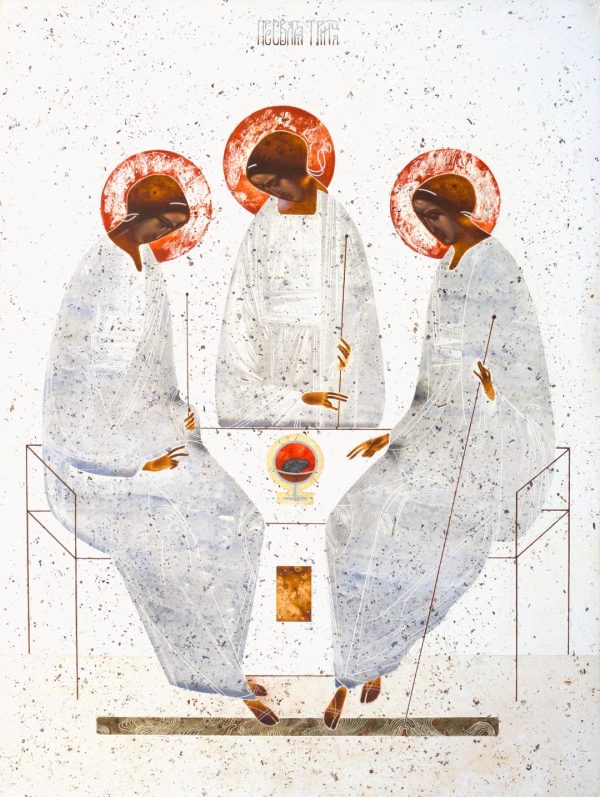
Image: Ivanka Demchuk Trinity in the style of Andrei Rublev
Our unique personhood sits within a much larger set of characteristics that we share with every other human being. Yet there is a kernel at the heart of these shared characteristics that marks us out as uniquely ourselves – as in – like no one else. How is individuality discovered?
There’s a commonly held view that individuality is innate. We come to discover who we are through an internal process of growing self-awareness. In other words, the unique sense of self is something we are born with and develops in step with the process of cognitive maturation.
In contrast, a psychologically informed view holds that personal identity is not innate but interactional. Personal identity develops through our interactions with others – interactions shaped by social and physical environmental factors.
So, bear with me for a moment as I develop a couple of seemingly unrelated strands, I assure you they will come together in a moment.
There is that old chestnut question: does a tree falling in the forest make a sound if there is no one to hear it fall? The short answer is no – its fall makes no sound. The complex answer is the tree’s fall causes pressure waves in the air around it. But these are not sounds until picked up by and transformed into sounds by the human ear.
As many of you know I have a background in Object Relations psychology which is a particular British offshoot of classical Psychoanalysis. Object Relations theory views human beings as primarily object or relationship-seeking. The infant instinctively seeks connection with its mother who represents a reliable and constant object. The infant suckling at the breast or the bottle comes to its first awareness of self through being reflected in the mother’s loving gaze.
The human equivalent of the tree falling with no one to hear its fall is the infant deprived over time of the experience of being seen – that is -reflected in the gaze of the mother. Such an infant will eventually die and we have a name for this – it’s called failure to thrive.
My psychology-psychotherapy formation led me – as a childless man – to the realization of what every mother experientially knows – that the infant catches the first intimations of selfhood in the interactional field of the mother’s loving gaze. The mother gazes at the infant. The infant gazes back- catching the first hints of its separateness – individuality – reflected in the mother’s face. I know of a young mother who as her child awakes from sleep whispers – Hello little one, I’m glad you’re back. I’ve missed you.
On Trinity Sunday what happens when we take my initial reflections on human identity development and view them through a trinitarian lens?
When it comes to the Trinity – the doctrine of three persons in one God – there is only one thing we need to remember. The Trinity was an experience of God long before it became a doctrine about God. In fact, the doctrine emerged only as a protection for the unique Christian experience of God.
For the early Christians, the Trinity as an everyday experience of God emerges in this way. As Jews, they believed in God the Creator, the God of their ancestors, the God of Abraham, and Moses. As followers of Jesus, they experienced a life-changing encounter with God through his ministry, death, and resurrection. After his departure following his resurrection, they were inflated in present-time with an experience of transformation from a dejected and lost band of leaderless followers into a community empowered with a revolutionary purpose. Under the guidance of the Spirit – which they associated with the Spirit of Jesus – they took up the work Jesus had begun. In these three distinct ways, they experienced the presence and power of God in their lives.
In the spiritual life of faith and practice, we are caught between two opposing pressures. On the one hand, we are compelled to try to rationalize our faith experience – capturing the invisible and intangible nature of spiritual experience in stories and formulae we can easily understand and repeat. Yet, on the other hand, we have a strong motivation to protect the mystery at the heart of religious experience from being reduced to the limits of our impoverished human imagination.
This tension between these motivations came to a head in 325 CE when the bishops – as the successors to the Apostles met together in council at a place called Nicaea – now the modern-day Turkish city of Iznik situated 139 KM southeast of Istanbul – then Constantinople. The council was torn by opposing factions. There were those who wanted to rationalize the mystery of the threefold Christian experience of God – to make it sensible to ordinary human comprehension within the laws of the physical universe. There were others who defended the essential mystery at the heart of Christian experience. Using the philosophy of the day -they put in place a protection for the mystery of God lying at the heart of Christian experience. This protection has come down to us in the Nicene Creed which we proclaim as the historic faith of the Church believed in all places and at all times.
Thus the Nicene Creed speaks of Jesus being of one substance with the Father, and of the Holy Spirit as proceeding from the Father through the Son. Confounding our expectations – nothing is explained and the meaning of the essential mystery is left open-ended. Although the Trinity expressed an experience of God long before it became a doctrine about God – at Nicaea – experience came under the protection of a doctrine that proclaimed God as a relational community of Father, Son, and Holy Spirit.
Today we hear these terms not as an attempt to gender the divine, but as an articulation of relationality at the heart of the divine nature. Following current sensitivities around gendered language some substitute Creator, Redeemer, and Sustainer for the traditional gendered terms. While theologically correct nevertheless these are terms denoting function, not relationship. Lover, Beloved, and Love-sharer is a better solution – making the point that it is relationship not gender that lies at the heart of the divine nature.
In 1410, an obscure Russian monk named Andrei Rublev depicted an icon of the Holy Trinity drawn from the Genesis story recording the visit to Abraham at the Oaks of Mamre by two angels. Rublev’s icon of the Trinity articulates a step change – a massive leap forward in the human capacity to imagine God – presenting the three distinct Christian experiences of God as a relational community of three persons – distinctively clothed – yet in every other way identical – sharing the same face – the same gaze. Each member beholds the other two simultaneously in a mutually loving gaze.
Rublev’s Trinity is more than a representation of the theology of God’s nature. It’s an expression of the Orthodox devotional tradition in which the Trinity lies at the heart of Christian devotion. Inspired and informed by this devotional tradition, Rublev presents God not as a solitary figure but God as a relational community.
We only come to truly see ourselves when we are caught in the experience of being seen. Coming to see through the experience of being seen is an essential characteristic of the infant-mother bond. Thus it should come as no surprise that seeing through the experience of being seen is an essential quality of the divine community. When we sit before the icon of the Trinity we are drawn into the mutuality of the divine gaze. It’s as if God seeing us says hello – welcome back, we’ve missed you.
Three folds of the cloth yet only one napkin is there,
Three joints in the finger, but still only one finger fair,
Three leaves of the shamrock, yet no more than one shamrock to wear,
Frost, snowflakes, and ice, all in water their origin share,
Three Persons in God: to one God alone we make our prayer. An Irish Celtic prayer to the Trinity.
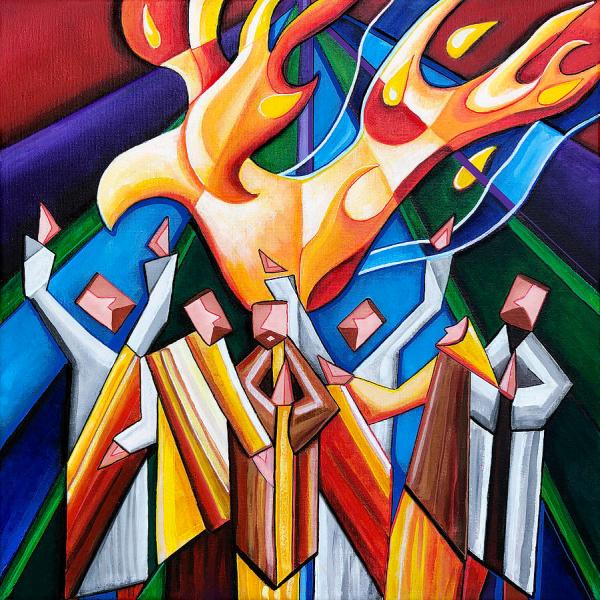
Image by Jennifer Allison
Everything is connected to everything else. The butterfly beats its wings in the New England woods provoking an invisible chain reaction resulting in a typhoon battering the Japanese coast. The magnitude of interconnection is truly mind-blowing. How so?
All that is ever seen is what Spirit causes, motivates, inspires, encourages, impels, triggers, stirs, provokes, stimulates, influences, or activates.
In his song Blowin’ in the Wind, the great Bob Dylan once more with a direct simplicity comes closest to articulating the mystery of Spirit: (https://www.youtube.com/watch?v=KpD26IoRLvA 1:27 -end)
Dylan asks
Yes, and how many years must a mountain exist
Before it is washed to the sea?
And how many years can some people exist
Before they're allowed to be free?
Yes, and how many times can a man turn his head
And pretend that he just doesn't see?

The answer, my friend, is blowin' in the wind
The answer is blowin' in the wind.
In this vein, let me try to give some descriptive theological shape to the Day of Pentecost – the arrival of which brings to a close the long biblical narrative that has been unfolding since Christmas, through Easter, ending here at Pentecost.
Pentecost – is Greek for the 50th day after Easter. On the Day of Pentecost the Spirit of the risen and ascended Christ – the Holy Spirit entered material time and space as a crucial participant in the on-going life of the creation.
John hints at Jesus’ gift of his spirit to his disciples in his farewell discourses – where in today’s gospel he tells them – If I do not go away, the Advocate will not come to you; but if I go, I will send it to you …. for when the Spirit of Truth comes, it will guide you into all truth.
It’s Luke, of course, who offers the graphic description of the event that overwhelmed Jesus’ followers on the Day of Pentecost. Luke’s chronological arrangement of the life and times of Jesus from birth to resurrection ends with his Ascension. In the sequel to his gospel, the Acts of the Apostles, Luke chronicles the life and times of the first followers of Jesus of Nazareth. Beginning with the event that transformed them from a dispirited rag-tag band of the dejected and the lost into an empowered, pneumatic community inflated by the power of the Spirit. Luke goes on to record in Acts how empowered by the Holy Spirit this pneumatic community begins to forge a distinctively revolutionary way of living. Pentecost marks the transfer of power from what had been the ministry of Jesus to the ministry of those who became initially known as the followers of The Way.
Being faithful Jews, these first followers of Jesus had gathered in Jerusalem for Shavuot – the other great pilgrim festival at which every Jew – especially those of the male variety was encouraged to come up to Jerusalem on the 50th day following Passover to commemorate the giving of the Torah by God to Moses. Luke paints a vivid technicolor picture of the events that overtook Jesus’ followers who were visited by a pyrotechnic eruption of wind, fire, and ecstatic utterance marking their pneumatic inflation with the Holy Spirit.
Among the multitude of pilgrims gathered for Shavuot from across the Jewish diaspora were Jews from Media, Elam, and as far away as Mesopotamia – from Cappadocia and a host of other cities in Asia Minor together with Egyptian, Libyan, and Arabian Jews, alongside local Judeans. All witnessed the clamor among a band of unruly Galilean peasants – hearing them shouting out in their own tongues while others of a more cynical mindset dismissed the rabble-rousers as drunk – not simply drunk, but drunk at nine o’clock in the morning. After all, what could you expect from a bunch of Galileans?
Last week I drew the metaphor of a conduit – a two-way traffic highway connecting the dimension of time and space with the spiritual dimension – each a dimension arranged in parallel. With the Ascension of Jesus, the direction of traffic moves from time and space to spiritual space as Jesus is received by God and reunited within the divine nature – not simply as a divine being but now clothed in the fulness of his humanity.
Following the reception of the humanity of Jesus- now perfected through suffering – into the divine nature, the traffic flow reverses as the divine spirit of Jesus is released to reenter time and space – becoming known as the Holy Spirit – who in the words of the Nicene Creed proceeds from the Father through the Son.
All that is ever seen is what Spirit causes, motivates, inspires, encourages, impels, triggers, stirs, provokes, stimulates, influences, or activates.
On the Day of Pentecost, the disciples of Jesus were set blaze – enraptured –hearts and minds ignited with passion. Drawing a more contemporary analogy, in his song, I’m on Fire Bruce Springsteen captures such a moment when he sings: (https://www.youtube.com/watch?v=1VxFS5-klfk 1.24 -end)
At night, I wake up with the sheets soakin’ wet and a freight train runnin’ through the middle of my head, only you - can cool my desire, oh,oh,oh, I’m on fire!
The Holy Spirit is the manifestation of God as the primal force animating from within and spanning between everything – an echo of the Genesis vision of the divine wind moving across the face of the void – calling structure and order out of chaos.
The Apostle Paul in chapter 8 of his letter to the Romans recaptures the grandeur of the Genesis vision – leading him to his arresting association of the Holy Spirit as the midwife of the Creation. He writes:
Know this, that the whole creation has been groaning in labor pains until now; and not only the creation, but we ourselves, who have the first fruits of the Spirit, groan inwardly while we wait for adoption, as part of the redemption of Creation.
Paul offers this extraordinary image of the Spirit birthing us in our weakness; like pre-linguistic newborns, the Spirit speaks for us in sighs too deep for words.
St Martin’s is a Spirit-filled community. This is not the way we normally think of ourselves for we are shaped by a cooler Anglican ethos that has traditionally been highly suspicious of too much enthusiasm. Our Spirit-fullness is revealed through our synergy of traditional Anglican worship with radical theological and social messaging – allowing us to explore, fashion, and present fresh perspectives on traditional articulations of theology and faith practice. In this we capture the revolutionary effect of the Spirit – directly addressing head-on, the challenges faced by us in the lives we are actually living. This can be a testing experience and gives the lie to the accusation that our Anglican way is an easy religion.
Following this liturgy – we will celebrate our Spirit-filled, magnetic community – a community drawing others to us. We are an attractive, warm, and welcoming community. We express a quiet spiritual empowerment. We exhibit revolutionary courage – confronting challenges to faith in a modern context while also risking new opportunities – as together we reach out for God’s invitation to work tirelessly for the healing of the world.
All that is ever seen is what Spirit causes, motivates, inspires, encourages, impels, triggers, stirs, provokes, stimulates, influences, or activates.
Or as Bob Dylan tells it –The answer my friends – is blowing in the wind – the answer is blowing in the wind. The life of Spirit is not subject to our manipulation or control – it’s not comprehensible to our grasping minds. The Spirit makes itself known through us when we allow ourselves to become available to its prompting to act under the furtherance of the divine plan for creation which always begins with a revolutionary refusal to accept that the way things are in the world is the way things have to be.

Picture: Chapel of the Ascension, Shrine of Our Lady of Walsingham, Norfolk, England
There is a rather ugly 1960s chapel at the Shrine of Our Lady of Walsingham – deep in the rural countryside of the county of Norfolk dedicated to the Ascension of our Lord. On entering the Chapel of the Ascension, one is greeted with a surreal experience. For in the center of the low ceiling is a gilded cloud ring plaster rosette from the center of which hang two bare feet – suspended in the air. Ostensibly belonging to Jesus with the rest of his body having already burst through the ceiling.
The celebration of the Ascension always occurs on a Thursday – the 40th day after the resurrection. Because Episcopalians rarely venture to church except on Sundays – the current custom is to celebrate the Ascension of the Lord on the Sunday following – which in 2024 also incongruously happens to be Mother’s Day.
Incidentally, I heard a funny quip recently referring to the Southern Baptist church calendar which comprises only four commemorations: Christmas, Easter, the 4th of July, and Mother’s Day. It goes without saying that while we shouldn’t pass up any opportunity to celebrate the importance of mothers and mothering in our lives, in the Episcopal Church, Mother’s Day is not part of the liturgical calendar.
Constructing stories and weaving narratives are the way we make sense of our experience of the world. The perennial question concerns the relationship between story and material experience – in other words, does weaving narratives – telling stories interpret and explain our material experience, or does the power of narrative – in the words of the French deconstructionist philosopher Michel Foucault – construct our experience – as in language creating the objects and meaning of which it speaks.
This tension surrounding the function and power of language is especially pertinent when it comes to religious-spiritual stories. Narrative Theology asserts that spiritual meaning lies not in the literal veracity of the events depicted – did they happen or not – but in the function of story by itself to construct and convey purposeful meaning across time. The question is not whether or not Bible stories depict actual happenings – but how they construct meaning and purpose that can be trusted to shape our living?
Spiritual stories recycle human imaginative memory. Clearly, Luke’s graphic account of Jesus’ Ascension borrows extensively from Elijah’s ascension recorded in the 2nd book of Kings. In like manner – as the mantle of Elijah fell upon the shoulders of Elisha – giving him a double portion of his master’s spirit, the double portion of Jesus’ Spirit clothes the disciples. The resonance is unmistakable.
In Luke’s chronology of events from Calvary to Pentecost, his story of the Ascension of Jesus forms a transition point bringing the earthly ministry of Jesus to a close to empower his followers with his spirit to become a community equipped to continue his work. The question underlying the Ascension event is not how, when, or if it happened, but what light does it shed on the question of what’s next?
The question of what’s next throws into sharp focus the choices to be made, the actions to be taken, and the directions to be followed.
In her sermon last week, Linda+ noted that love is not just about how we are to feel. It is about who we are called to be. Rather than asking: What does it mean to believe in God’s love – she posed the more significant question do we trust God’s love, do we surrender to it, will we let love transform us?
So here’s a question. How can we trust the meaning inherent in the story of the Ascension of Jesus even though most of us believe it as an event to be simply a construction of imagination?
One response is to substitute the traditional spatial metaphor of up and down for heaven and earth with a metaphor more suited to contemporary imagination – that of heaven and earth as side by side. The Ascension becomes the conduit connecting parallel dimensions. Through this conduit a two-way traffic flows between what we might call our space and God space.
The image of the Ascension of Jesus as a conduit for two-way traffic communicates two important insights. In his return to the God space, Jesus does not jettison his humanity like a suit of worn-out clothes – but carries the fullness of his humanity – perfected through suffering -to be received by God into the divine community. The words of the first collect for the Ascension capture this: that as we believe your only begotten Son our Lord Jesus Christ to have ascended into heaven, so we may also in heart and mind there ascend, and with him continually dwell. The we here is not us individually, but the entirety of our humanity which now constitutes an element within the divine nature.
In receiving the fullness of Jesus humanity into the divine nature, God releases the divine spirit of Jesus to make the return journey back into our space. This image is captured in the words of the second collect for the Ascension: our Savior Jesus Christ ascended far above all heavens that he might fill all things and to abide in his church until the end of time. The Ascension is the point where we, Christ’s mystical body on earth are prepared to become empowered to continue the work Jesus began.
The Ascended Christ bearing our perfected humanity is received into the heart of God – so that – as the book of Revelation poetically phrases it – the home of God now dwells among mortals. Now we come to the most extraordinary assertion of Christian faith – that from henceforth to be most fully human is to be most like God.
The Ascension of Jesus opens us to contemplate our participation in the what’s next in God’s work of renewing the creation -throwing into sharp focus the choices to be made, the actions to be taken, and the directions to be followed – when we tire of gazing heavenwards – that is.
 Relationalrealities