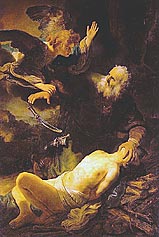
Sibling Rivalry

A sermon for Pentecost 6, Proper 10, Year A  from     The Rev. Linda Mackie Griggs                Genesis 25:19-34 &  Matthew 13:1-9, 18-23


Then Jacob gave Esau bread and lentil stew, and he ate and drank, and rose and went his way. Thus Esau despised his birthright.

Jacob roughly measures a handful of cumin seed and toasts it until fragrant. Then he grinds the seeds while garlic and onion turn golden in a little oil. As he adds and stirs in the orange-red lentils he is reminded of the color of his twin’s unruly hair. Last, he adds water and sets it all to simmer. I wonder what he was thinking about as he worked. I wonder if he was plotting against his brother as he made sure the seasonings were just as Esau liked them—enough to make him drool in anticipation. Oh Esau—what an easy mark.: See food, want food, get food. A man driven by his appetites more than by his brain. Unlike Jacob. His appetites are a little more, well, sophisticated. His sights are higher than the next meal.

The storyteller has left fertile space between the lines of this tale. It is as rich and flavorful as Jacob’s stew—each bite revealing different nuances and textures. This is another chapter in the saga of the Patriarchs–and Matriarchs–of the faith, and it incorporates a familiar archetype—the Trickster, known throughout cultures to sow mischief and create conflict. Though in Jacob’s case his role as Trickster actually eventually serves to cement his role as Patriarch of the People of God. Leaving us, not for the first or the last time, to question God’s choices in patriarchs.

This story also serves as etiology. It’s related to Myth—it’s a way of speculating as to why things happen in a certain way. For example, the writers of Genesis knew that there was longstanding enmity between the peoples of Edom and Israel. What might the source of that conflict be? Well, it’s because of God’s prophecy to Rebekah that two nations were at war in her womb and the elder would serve the younger. Jacob was later known as Israel, and Esau as Edom, which is Hebrew for red, hence the repeated reference to that color as connected to Esau.

Etiology is a major function of Hebrew Scriptures. It often engages the big existential questions of who we are as people of God and why we are the way we are—why we do some of the things we do as human beings. That’s not to say that the explanations provided are definitive, but they can at least shed light on the attitudes and perceptions of the people who wrote these stories. The storytellers of Genesis don’t shy away from the hard truths of human nature—the tribalism, the violence– not only are these things revealed in the actions of the people, but also in images of God that often tell us a great deal more about the nature of the writers—and us–than they do about the nature of God.

But the true beauty of these stories is how they resonate—how they find us wondering about Jacob and Esau, in spite of what we may know (or not) about myth and etiology. We wonder about them as individuals, not as archetypes. We find ourselves identifying, to some extent or another, with these brothers who evidently had, well, issues.

Each was favored of a different parent. Isaac especially loved the hairy older twin—a man’s man, a hunter. Jacob, born literally on the heel of Esau, was favored by his mother Rebekah. Like her mother-in-law Sarah before her, Rebekah will help God’s plans along by concocting a plot for Jacob to receive Isaac’s blessing. But that’s another story. (See Chapter 27.) At this point, we don’t know if Rebekah has encouraged Jacob to bilk Esau out of his birthright, or if Jacob just wants to goof on his brother for the heck of it.

It is no small thing, a birthright—to inherit the greatest share of the father’s flocks, herds and land. For Esau to ‘despise’ it as he does, for the sake of a bowl of stew (as tasty as it might be,) is an indicator that he isn’t too bright.

Listen to some of the language about Esau: The first came out red, all his body like a hairy mantle… and later, “Let me eat some of that red stuff, for I am famished!…I am about to die; of what use is a birthright to me?” 

The storyteller invites us to see Esau in a particular way: Unconventional in his appearance; as driven by basic appetites, and as a result prone to making life-altering decisions without considering consequences. He is an object of pity, at best.

He is, in the eyes of the storyteller, of Jacob, and of us, The Other in this tale.

Yet somehow he resonates, at least a little. We wonder about him, how he doesn’t fit the family mold. Perhaps our thoughts are drawn to those we know who are likewise unconventional, impulsive, possibly snakebit by their own questionable decisions. How often do we see Esau around us, or within us?

Esau is a man of appetites. How can we not see ourselves in this man who sees, wants and gets? We are a culture who has raised “see, want, get” to an art form. Did you catch the buzz about Amazon Prime Day? Last Tuesday, 30 hours of great deals for all Prime members—irresistible items that we can’t do without—I’ll bet you didn’t even know you needed an extra air compressor in your garage, did you? See, want, get: Esau is a man for our time.

And Jacob. His appetite was ambition, nurtured and encouraged by Rebekah as he sat at her knee day after day in the tent. Did she groom him to feel privileged, entitled to a birthright that didn’t actually belong to him, if only because he was born a few minutes too late? Was his appetite to fulfill God’s dream for him and for God’s people, or to be Number One for Jacob? See, want, get: another man for our time.

Jacob’s fate at this point in the saga remains to be seen. It will remain for us to read on.

Because Esau and Jacob’s story is just beginning with this passage. Jacob’s trickster ways will continue, but not without consequence. He will come face to face with his own deceptions, and even face to face (in a matter of speaking) with God. Esau, too, will find transformation, just as many of us do, by way of a bumpy road.

The saga of the Patriarchs and Matriarchs is disturbing because we keep coming face to face with our own flawed selves through the mirror of people, like Jacob, who we’ve been taught to admire, but on closer examination they fall way short. And the ones we pity—the Others, the Esaus—they may yet surprise us. But we continue to discover God’s grace through it all– that God chooses whom God chooses; the weak, the flawed, the unwise, the ambitious and the messed-up. And thanks be to God for that! Because none of us is the person we idealize ourselves to be. We’re all more Jacob and Esau than Jesus.

Jesus today draws our attention to soil, and it’s a helpful image here because the Hebrew Scriptures often help us, to examine our own interior landscape. It includes the rocky shallow ground of appetites and whims—see, want, get. There is thorny ground of willfulness and ambition, maybe even cruelty. But if we keep digging and tilling there is also the fertile soil of generosity, compassion, and holy listening. And God never stops sowing it with the seeds of forgiveness, challenge, vocation, and grace. With God’s help may it yield a hundredfold.

Loosening the Yoke

A sermon from the Rev. Linda Mackie-Griggs.


Matthew 11:16-19, 25-30                                       5 Pentecost, Year A (9 July 2017)

We have this dog. Bartlett. A rescue who came to us last November. He’s sweet and smart, and he’s very well behaved. Most of the time. Not long ago he and I were wrapping up our afternoon walk; he’d been pretty good and followed my directions well, which wasn’t a real surprise—he’s well trained and he knows the routine—we go the same route every day.

But this time something distracted him, and he totally lost it—took off running like a greyhound in another direction—he’s fast and he’s strong. I didn’t want him to go that way. I wanted him to go MY way. But he would have none of it. He ran, I pulled. I shouted. He kept running. I kept resisting. And I resisted face first into a tree.

Lying dazed on the ground, I heard a still, small voice speak to me:

Why didn’t you drop the stupid leash???”

That would have been the smart thing to do. But it was more important that I remain in control.Sometimes it’s like that with institutions. They go along a single path for a long time until something changes. The change is inexorable and powerful, and no matter how hard they yell and pull and resist, the change comes anyway. And if they don’t find a way to deal with it, they run face first into misery, or irrelevance, or extinction.

I’ve been hearing since seminary that the church is dying. Attendance is down; the culture is shifting, priorities are changing. It’s a huge topic in diocesan workshops and conversations, church publications, vestry meetings, staff meetings. Where are the packed Sunday school rooms? The overflowing offering plates? How are we going to keep the roof on? The changes we are seeing are pulling hard, and the mainline church—not just the Episcopal Church– is struggling to know how to respond. And one of the easiest responses is to just keep pulling on the leash; to keep things on the same track it has always been on. If we could just do things the way we used to back in the day, then everything would be okay. That way lies the tree.

The major generational and cultural shifts pulling on us are not going to stop shifting just because we resist them. Each generation has a set of core values and formative experiences that affect how they engage with the world and more specifically the church. The generations that built Mainline Protestantism in the 20th century have birthed wonderful and creative and different generations who have been formed by certain shared experiences–for example 9/11, Katrina, and I would argue the 2016 election–who see church differently. It’s simply not the central spiritual, formative, social focus for them that it has been for their parents and grandparents. That is not to say that they are not spiritual, or that they have not been formed ethically or morally or socially because I will argue ferociously that they have been—just not necessarily by the church.

The generations that built mainline Protestantism need to come to terms with the fact that the generations that followed them are not going to keep that edifice standing in the same form that we have known.

But that doesn’t mean the church is dying. We just need to consider dropping the leash. Theologian Phyllis Tickle, in her 2007 book, The Great Emergence argues that the Church goes through a period of major transformation about every 500 years. She called it a 500-year Rummage Sale. the most recent being the Protestant Reformation, which just celebrated its 500th birthday.

And sure enough, the ground is shifting beneath us. One sign of this shift came a number of years ago with the rise of the group describing themselves as ‘spiritual but not religious’. Almost immediately lines were drawn between those who felt that that was a cop-out and those who heard it instead as a wake-up call, or better still, an opportunity for growth and transformation. Those who heard the wake-up call wanted to understand what has brought the SBNR’s to the point of rejecting something that had been a mainstay of personal, family, and community life in this country for a very long time. And for many it still is. I’m not saying that the church as a worshiping, healing, serving community is not vitally important—God is still very busy calling people into ministry, both lay and ordained. God perseveres in finding a way to realize God’s Dream for Creation. But it is up to us to discern what new path God is trying to show us—not to throw the baby out with the bathwater, but to remember the roots and foundation of our call to be God’s People in the world.

What does discipleship look like to a church experiencing a 500-year rummage sale?

Jesus said to the crowd, “To what will I compare this generation? It is like children sitting in the marketplaces and calling to one another, ‘We played the flute for you, and you did not dance; we wailed, and you did not mourn.’ 

I always thought Jesus sounds like a classic grumpy old dude in this passage. But this is a serious critique of the blindness of the religious and cultural authorities of the time. The picturesque cries of the children are references to Jesus and to John the Baptist: “We played the flute for you…” refers to Jesus’ works of healing, his call to abundant life and the coming of the Reign of God. “We wailed…” refers to John’s call to repentance; to the necessary inner work of discipleship.

Jesus is saying that between himself and John, they can’t seem to catch a break. Jesus’ practice of dining with sinners has people calling him a drunkard, while John’s fasting has people saying he’s crazy. The blindness of the skeptics is such that the coming of the Kingdom meets with disapproval no matter what John and Jesus do.

But disapproval aside, this juxtaposition of Jesus and John is valuable because it shows us a two-layered model for discipleship, with each being crucial to the other. The inner work of repentance (both personal and institutional) is needed to ground us in humility and holy listening (The Benedictines call it obedience). This was the urgent call of John. The outer works that Jesus did, of mercy, compassion, and healing are vital to the inbreaking of the Kingdom of God. And these two; contemplation and action, are meant to be woven together in relationship. Spiritual practice grounds acts of caring. Effective discipleship requires both. Spiritual practice alone is hollow, and the acts of charity alone are simply, as Fr. Mark puts it, “good people doing what good people do.” Without prayerful grounding our acts of charity carry the risk of seeing ourselves as being in control; as the powerful bestowing bounty upon the powerless– as being in God’s place rather than in God’s service.

It’s a seductive thing. We feel good when we do nice things for others. There’s nothing wrong with that—with knowing the joy of servanthood. But the point of servant discipleship is not to feel good about ourselves. It’s not about us. Spiritually grounded service may actually put us in a place where we encounter our own vulnerability and woundedness. But our own vulnerability brought to our actions is the very best way to truly see others as siblings in Christ who have something to offer us in mutual lifegiving relationship.

To surrender to this concept is to find ourselves being led into unfamiliar territory, and it’s natural to resist that tugging of the Spirit. But what can happen if we follow that tugging—if we let the Spirit take the lead?

There is some wonderful creative ministry happening in this Diocese. There is a trend toward making church walls more porous—toward a clearer-eyed vision of our neighbors as coworkers in realizing God’s dream of abundance, justice and mercy. The Center for Reconciliation comes quickly to mind, taking on the delicate and difficult ministry of fostering understanding around issues of race. The Church Beyond the Walls is another unique initiative—a community of faith that turns upside-down the dynamics of feeding ministry and worship. Members of the community include those who are struggling and homeless who gather to worship and to offer hospitality to visitors and each other. Church Beyond the Walls is not just another feeding program. The model where people come from outside to make and pass out sandwiches is turned on its head—rather, those who wish to serve must first be served.

A third initiative is a little younger than these first two, but it is also the result of prayerful discernment and willingness to see through God’s eyes in new ways. Rhythms of Grace at Church of the Advent in Coventry is a special weekly Eucharist geared toward people with autism. Can you imagine an offertory of playing with a parachute? Rhythms of Grace is meeting an important need of families for whom conventional worship is a challenge, and it shows them in a visceral way that God’s love is creative and all-encompassing.

The Spirit is tugging St. Martin’s too. Our new initiative of incorporating a monthly fast on the 21st of each month is intended to focus on a spiritual practice that can undergird new and renewed ministries of advocacy and service around issues of hunger. It is through fasting that we can regularly renew our understanding that God, not we ourselves, is Source of all that we have.

And our pastoral ministry is feeling tugged in a new direction as well. We are currently pondering becoming part of Communities of Hope International; a Benedictine-inspired program for training lay chaplains. This is in response to an upsurge in energy on the Pastoral Care Team—a desire to do more to reach out to those in our community and neighborhood who are in need of healing and listening presence. Our monthly Healing Eucharist, beginning in September, will be part of that effort as well.

So the Spirit is tugging away and new things are germinating. Which is why I don’t believe for a minute that the Church is dying. Transformation? Yes. Death Spiral? Nope.

But we need to be ready to heed the Spirit’s tugging; to hear the cries of the children in the marketplace who call us to joyful compassionate action, firmly undergirded by the sometimes uncomfortable inner work that comes with regular spiritual practice—prayer, meditation, fasting, Bible reading.

“For my yoke is easy and my burden is light.” Jesus’ most important teachings are the ones that invert our expectations. The Church’s yoke, it could be argued, has become burdensome; weighed down by changing circumstances and a fierce desire to stay a course that is becoming unsustainable. New opportunities invite us that are found down paths that are at the same time both new and yet eternal. The Spirit calls us to live into our true vulnerable selves, to follow our passions, and to loosen the yoke of “but this is how we’ve always done it.”  Go ahead, let loose of the leash.


Unlikely Mirrors


God tested Abraham. He said to him “Abraham!” And he said, “Here I am’. He (GOD) said.   “ Take your son, your only son Isaac, whom you love, and go to the land of Moriah, andagr_01-01 offer him there as a burnt-offering on one of the mountains that I shall show you”.

So two questions arise. Why would God ask this of Abraham, and why would Abraham agree to such a request? After all, we have ample evidence from the story of Sodom and Gomorrah in Genesis 19 that when Abraham encountered a seemingly brutish and retaliatory streak in God by threatening retribution on all who had displeased him (thank goodness God didn’t have a cell phone), he was more than capable of reasoning God back into divine senses. So why didn’t Abraham, in this instance, reason with God?

He could easily have pointed out to God that this was an ill-judged idea. Why kill the next link in fulfillment of the promise that Abraham’s descendants will be as numerous as the stars in the sky? God’s request seems both short sighted and unbelievably cruel. As if to rub salt into the wound, God emphasizes that Isaac is Abraham’s only son and not only that, but God goes out of his way to remind Abraham if he needed any reminder that is, that Isaac is the son he loves.

We are given a clue as to God’s intention in the first line: God tested Abraham. Ah, so something becomes clearer. This was a test to see if Abraham loved God more than he loved Isaac. Can God be so insecure, so needy, so desperate to receive exclusive adulation and affirmation?

Last week Linda+ invited us into the Jewish practice of Midrash. Midrash is a process for interrogating the ancient Torah texts. The earliest Midrash commentaries seem to date from the 2nd Century AD, and this tells us that Midrash represents a development in Rabbinic Judaism’s attempt to humanize these ancient and sparse Torah texts, to mitigate their harshness in order to fit them to the experience of a contemporary time.

In the St Martin community, on this coming Monday, we arrive 43-days into The Bible Challenge – a 365-day program for reading the entire Bible. But this only begs the question: Why read the Bible in 21st Century America? Especially these sparse and harsh Torah texts that strike us as so alien to our understanding of God? This is an important question for Episcopalians who over the last 100 years have steadily jettisoned any personal discipline of Bible study. So let me offer responses to this crucial question. I want to identify two responses here.

Story shapes personal identity

Alasdair Macintyre in After Virtue notes:

I can only answer the question what am I to do?if I can answer the prior question, of what story or stories do I find myself a part?

Macintyre suggests here that identity is story shaped. We come to know ourselves through the stories we tell about ourselves as well as the stories that claim our ultimate allegiance. Such stories are responsible for shaping us. Small and mean selfish stories constrict our development beyond meeting our own self-interests. Large stories give us room to grow and change, they invite us into a more expansive vision of interpersonal and civic relationships and responsibilities.

The Biblical epic has always fundamentally shaped Jews and Christians. Judaism seems better at recognizing that stories are multifaceted in that they can be reframed and retold to bring out different emphases. Stories are continually being told and reheard in different ways. We are not shaped by the literal reading of these stories according to a strict dichotomy between true or false. We are shaped more through how we come to interpret their meaning. As Midrash reveals, meaning is a continually evolving process.

Story shapes community identity

The communitarian response to the question why read the Bible today is given greater clarity by Paul D Hanson in A Political History of the Bible in America comments:

To gain a solid footing for understanding the mixed legacy of American political history, it is necessary to turn to the more ancient epic from which the leaders of our nation, from colonial times to the present, and for better or for worse, derived justification for their actions. That epic is the Bible.

So on the weekend when we celebrate the founding of the nation, we are reminded that for Americans the Bible has occupied a more central role in our political process than might be true in other Western democracies. Our leaders and sections of society repeatedly appeal to the Bible in the civic space, and as Hanson notes for better or for worse. In that conversation it’s crucial for Episcopalians to stop ceding the high ground to those who would apply an anti-Midrash spin on interpretation, i.e. take the stories we encounter, especially in these very ancient and harsh Torah texts as literally true and able to speak uninterrupted to our modern context.

Scholars now believe that the Genesis stories were only written down, or at least, re-edited during the very late period of the captivity in Babylon some 1500 year after the time in which the stories are set. We might ask why is this?

Part of the answer lies in how nations respond at points of crisis. At a time of crisis when the very existence of the Jewish people was imperiled they revisited and recast their ancient stories of national manifest destiny. This is a process that we in contemporary America have a feeling for as we face into a crisis of national identity articulated through competing interpretations of our formational stories. The sacrifice of Isaac was a story that spoke about God’s deliverance for those who keep faith, those who in the face of adversity pass the test of trusting in the beneficence of God’s ultimate purpose.

In Bible Challenge group discussions, St. Martin’s folk, especially women among them seem to take great exception to these primitive stories that depict a nomadic society’s very tribal and patriarchal view of God. I encourage us to note our response of repugnance as our first visceral reaction in our engagement with these ancient texts. A visceral reaction, not intellectual insight is where textual engagement begins. But after this what next? Do we simply reject these texts as holding no potential for any meaning? Are we to retreat into our lofty 21st-century judgmentalism that proclaims loudly this is not our God or the God of Jesus?

This attitude blinds us to the contemporary relevance of many of these ancient myths, and so we too, need to develop our own Midrash for textual questioning. We must read these stories because they are where our God shaping story begins. It’s clear from our post-Jesus perspectives that both we and God have come a long way over the millennia. To know our place in the world through the story of which we are a part, we need to begin at the beginning of the relational epic that continues to evolve within historical time through the events of human history.

Genesis 22:1-14

What can we discover through a Midrash-style questioning of this text?

  1. Anthropologically, is this story an echo of a primitive pre-Israelite time when child sacrifice was practiced, which later becomes conflated and given an Israelite spiritual meaning as an event in the life of Abraham? Perhaps.
  2. Did God really command the sacrifice of Isaac, or did Abraham believe that was what God asked of him? Even if we exonerate God the point still remains that Abraham trusted in his experience of a God who had over and over again proved trustworthy. Why should he second-guess God now?
  3. Is this a story about the blindness of human devotion? Religious devotion has proved throughout history an effective instrument for practices and attitudes that flow from the hardness of the human heart. Did not Jesus confront and expose the way religious devotion became a mask, a facade concealing the cruelty of the human spirit?
  4. What’s the ultimate point of this story? At one level the story shocks us. But on closer reading, this story demonstrates that God is not the capricious tyrant we fear, for it is God who stays Abraham’s hand. The dénouement of the story reveals a God who will provide as long as we have the courage to trust.

As we sit in lofty judgment on Abraham and what seems to us to be a grotesque caricature of a narcissistically insecure God, we miss the point that this story shines a powerful searchlight upon us and our motivations. Whatever else this story might be about it reveals our collective collusion in systems that readily sacrifice the weak and the vulnerable while rewarding the strong and contemptuous.

Among that group of young men we refer to as the World War I poets, Wilfred Owen (1893-1918) chronicled through his poetry his experience alongside his brother soldiers fighting in the trenches. In The Parable of the Old Man and the Young, Owen uses the Genesis imagery of the sacrifice of Isaac as the basis for his ode of lamentation on the willingness of those who represent authority to sacrifice the flower of youth in pursuit of idols, i.e. ideologies and stories that displace our trust in God with something less than worthy of ultimate allegiance.

So Abram rose, and clave the wood, and went,
And took the fire with him, and a knife.
And as they sojourned both of them together,
Isaac the first-born spake and said,
My Father, Behold the preparations, fire and iron,
But where the lamb for this burnt-offering?
Then Abram bound the youth with belts and straps,
and builded parapets and trenches there,
And stretchèd forth the knife to slay his son.
When lo! an angel called him out of heaven,
Saying, Lay not thy hand upon the lad,
Neither do anything to him. Behold,
A ram, caught in a thicket by its horns;
Offer the Ram of Pride instead of him.
But the old man would not so, but slew his son,
And half the seed of Europe, one by one.

Our 21st-century vantage point is fundamentally shaped by the image of God refracted through the face, words, and actions of Jesus Christ. This lulls us into a false sense of superiority when we encounter the Genesis images of God, refracted as they are through the lens of a tribal, nomadic people subsisting on the precipitous knife-edge of survivability. And yet, these Israelites are our spiritual ancestors. We are among the children of the blessing God brought about through his covenant with Abraham. Thus on closer inspection, I believe the sacrifice of Isaac disturbs us because as Wilfred Owen found a voice to express – it is not God who is barbarous, it is we who continually affirm what is barbarous in the human spirit.

When lo! an angel called him out of heaven,
Saying, Lay not thy hand upon the lad,
Neither do anything to him. Behold,
A ram, caught in a thicket by its horns;
Offer the Ram of Pride instead of him.
But the old man would not so, but slew his son,
And half the seed of Europe, one by one.

Abraham was shaped by his encounter with a God to whom he gave the allegiance of complete trust. We may quibble over whether this was a good thing or not especially when it leads him to be prepared to follow through on an act of self-laceration. In the end, it was God who stayed his hand and delivered Isaac. Why God needed to test Abraham in this way, we cannot know. But what we can know is the contrast between God’s actions and ours in a society where trust in the beneficence of God has been displaced by lesser and more pernicious creeds that call for the sacrifice of many for the good of a few. The idolatry of ideology reveals itself in the promise of more and the delivery of less.

Wilfred Owen was killed on the day the Armistice was signed at the 11th hour, of the 11th day, of the 11th month, in 1918; a different sacrifice of sorts.

Families are Complicated

A sermon from the Rev. Linda Mackie Griggs for Pentecost 3, Proper 7 Year A                

Genesis 21: 8-21; Matthew 10:24-39

Families. Are. Complicated. I have yet to meet anyone who wouldn’t agree on this, and honestly , f someone told me that they had a perfect family I would wonder what they’d been smoking. The other day (on the way home from a visit to my family in Virginia), I heard someone on the radio comment that she couldn’t understand why some businesses advertise by saying, “We treat you like family.” Given the nature of most family dynamics, that should send most potential customers running in the other direction. But it doesn’t. Because the idea of family draws us even as it drives us nuts. But there you have it. It’s complicated.

And so it is with Hagar. Our first lesson this morning is a continuation of last week’s text from the Hebrew Bible, in which Sarah and Abraham become the proud parents of Isaac. But the Lectionary left out a chunk of the story. You see, after God promised that Sarah and Abraham would have a child, even at their advanced age,images-1 some time passed with no child, and Sarah began to panic–she ran out of patience. So she took matters into her own hands and said that Abraham should father a child with her Egyptian slave, Hagar.

And immediately things got, complicated. To make a long story short, Hagar, who as a slave had no choice in the matter, became pregnant by Abraham. Her relationship with Sarah soured (not surprising)—she became contemptuous of her mistress. Sarah in return became abusive of Hagar, and Hagar ran away. While in the wilderness God saw her, and told her to return to Sarah, but first announced to her that she would bear a son, Ishmael, and that he would be the progenitor of a great multitude of descendants. And in response, Hagar does something that no one else in the Bible does: She has the audacity to name God to God’s face; El-roi; “God who sees.”

Yet she is generally known only as the mother of Ishmael and then forgotten. She only appears two times in the Bible. (If you don’t count a reference to her in Paul’s letter to the Galatians.) Her story of slavery, abuse, rejection, and expulsion is a painful one. It is listed by theologian Phylis Trible as a “text of terror”. There is no way to whitewash it and still be a responsible reader of Scripture. There is always the temptation to avert our gaze from difficult episodes such as this. But if we did that we would be ignoring a substantial chunk of the Hebrew Scriptures. And we can’t do that, any more than we can avoid dealing with our own family dramas. This is the story of God’s family—the human family. And just as we need to find healthy ways of handling difficult relatives and dynamics, we can benefit from finding healthy ways of reading some pretty troublesome and disturbing stories in Scripture.

Which is one of the reasons the Jewish Bible study practice of Midrash is so helpful. This is an ancient tradition; a method of viewing scripture through the lens of questioning; of a conversational encounter, with God, with the writings of learned rabbis, and with each other. Midrash is a liberating tool that encourages wondering. We are encouraged to ask a crucial question: Where is God in this? The answers may be difficult, but with God’s help they can be fruitful and transforming.

So where to start a midrash exploration of Hagar’s story today? We see a woman who is doubly cursed: exiled from bondage, with no more than a little bread, water, and her child. In other words, she’s been cast out from frying pan into the fire. The story notes that Abraham is only distressed on his firstborn son’s behalf: As for any concern for the mother of Ishmael, he is simply following his wife’s instructions, “Cast out this slave woman with her son; for the son of this slave woman shall not inherit along with my son.” You see, Ishmael jeopardizes God’s Promise to Abraham: “Look toward heaven and count the stars, if you are able to count them…So shall your descendants be.”* That’s the promise. But Sarah, in her impatience with God, had waited long enough. She had taken matters into her own hands, but now, confronted with the mistake of her lack of trust in God’s promise, she has sought to rectify it by effectively declaring a death sentence for the child and his mother. Where is God in this???

And this is where the midrash comes in. Let’s wonder. Abram sent Hagar away. “And she wandered about in the wilderness of Beer-sheba.” I wonder what Hagar encountered in the wilderness? Since midrash actually encourages inter-scriptural exploration, we can look at other stories of wilderness wandering in the Bible. Certainly the Israelites wandered, and there is a wealth of stories of their journey and their attempts (not always successful) to be faithful to God. Jesus wandered for 40 days after his baptism, tempted by Satan. Both the Israelites and Jesus faced challenges and emerged equipped for the future. John the Baptist emerged from the wilderness as a prophet. What about Hagar? Was she changed somehow? Did she and Ishmael talk with each other? By all calculations Ishmael was actually an adolescent, not an infant, but Midrash texts speculate that he was quite ill, which was why she had to carry him. Was he even conscious, or could Ishmael sense Abraham’s and Sarah’s rejection of him? I wonder–what demons haunted Hagar in the wilderness? Powerlessness? Resentment? Guilt? Fear? Grief? Did she rage at the God she had so courageously named to God’s face? Did she shake her fist at “God Who Sees”, now apparently blind to her plight? Midrash bids us ask, Where does it hurt, Hagar?

We can continue to wonder and wander the scriptural wilderness: What if she and Ishmael weren’t totally alone? Perhaps they were shadowed by the angel that later called out to her. Perhaps the angel heard every word of fury, recrimination and second-guessing and absorbed it, comprehending her pain. Perhaps, just maybe, God’s silence wasn’t divine rejection after all, but divine listening. I asked a minute ago if Hagar was changed. Maybe not, but what if God was changed? What if God was moved as Hagar wandered and struggled and fed the last crumb and drop of water to her son? Imagine God watching and listening as Hagar, spent and out of resources, did the only thing she could do; lament. As testimony to her pain and rejection and in grief for the child she was certain would die, she lifted up her voice and wept. There is no truer, more authentic prayer than lament; it is the dark night of the soul. And the silent, listening God heard her cries and took pity on her. “What troubles you, Hagar?” Where does it hurt?

A midrash exploration of Hagar’s time in the Wilderness is a fruitful way to engage the text and to discover God’s presence between the lines. When we can do this with Scripture we can perhaps learn to do this in our own lives; to ask, “Where is God in this?” But it should by no means minimize or marginalize suffering—ours or anyone else’s. There is always a risk that assurance of God’s abiding presence becomes mere platitude or Facebook meme, which does a huge disservice to those who suffer. We are meant to gaze upon Hagar’s story and to grieve for and with her; to witness to her abuse, rejection and exile. We are even within our rights to question God. Midrash encourages it.

For example, the fact remains that as Hagar was sent packing God was silent. This is, after all, a story about the Promise, and as such it speaks a hard truth. God promised Abraham and Sarah a legacy of countless heirs, and their rejection and exile of Hagar assured that legacy. But I still struggle with any general assumption that what happened to Hagar was God’s will. I simply don’t believe that God wills human suffering, Promise or no Promise. God didn’t tell Sarah to violate God’s trust and take matters into her own hands; Sarah chose to do that. God didn’t exile Hagar and Ishmael; Abraham did. The fact is that people do stupid, mean, cruel and thoughtless things to each other, but that doesn’t mean that God wills it, then or now. Like it or not, this story reflects the very real frailty of the complicated human family, and our family story is all-too-guilty of projecting our own baggage and selfish motives on God rather than looking in the mirror.

I read something the other day that sums it up: “I screamed at God for the starving child until I saw the starving child was God screaming at me.”**

The good news is that God perseveres. We can trust that. God continues to work within the framework of the gift of free will and the resulting complications and chaos that accompany it. In our Gospel today Jesus alludes to the same idea when he says that he will set a man against his father, daughter against mother; that one’s foes will be part of one’s household. God’s call entails the risk that relationships will be disrupted. But that stress on relationships is because of humans’ choices about how they will respond to God’s invitation to new, transformed and abundant life. Jesus’ entire life and ministry was about reminding everyone, from Temple authorities to lepers, that God is the God of the outsider, the rejected. The Hagars. Jesus knew that what he proposed was not the status quo, and that can be difficult for those who are afraid to risk change and for those who, like Sarah and Abraham, struggled to trust that God’s promise would be steadfast; that God will not give up on God’s dream, no matter how many times and ways we are tempted to screw it up.

So we must be clear-eyed about the suffering and trials of Hagar. We can’t soften their impact, though we can witness to her lament and, through closer and imaginative reading, ask her where it hurts. In doing that, we gain a window on our own lives and the lives of our neighbors. Hagar’s suffering is redeemed through us; it calls us to see and hear her lament in the abused, rejected and marginalized of our time, and it further calls us to offer them God’s healing wherever we can, like a well of cool water in the harsh wilderness. And by God’s grace and with God’s help, that’s not really complicated at all.

*Genesis 5:15   images-1** –unknown

From Members to Disciples

In the E-news, I commented on the phrase every member ministry community. It requires the investment of each and every person to ensure our community continues to be fit for the purpose God calls us to be.

The New Testament has a simple word that encompasses every aspect of being fit for purpose. The word is disciple. I increasingly draw a distinction between two terms often used interchangeably – member and disciple. 

Members are concerned with supporting the organization to which they belong:

  • Members see themselves as supporting the clergy and others to whom they look to perform ministry.
  • The demands of membership are intentionally kept low so as not to discourage people from joining, and to encourage people to remain.
  • Members notoriously vote with their pocket books and ultimately with their feet, when they don’t get what they want or feel their specific needs are not being met.

Disciples see themselves as active participants in the Church’s ministry and not just supporters of the organization:

  • Disciples are invested in their relationship with God.
  • For them building a strong church is the most effective way of making a difference in the wider world with which they feel deeply involved.
  • Disciples practice lives of prayer, study, and reflection.
  • They experience deep gratitude for the good things they enjoy, seeing them not as things to own, but hold in trust.
  • Disciples express their sense of gratitude in generous lives of service.

The contours of discipleship vary from person to person because God not only calls us as we are as we are in the process of becoming. Our temperament, our gifts, our passions, and concerns are the lenses that illuminate God calls each of us to service in the world. We respond to our call through loving God and loving the people in whose company we live out our lives, moment-by-moment, day-by-day, one breath at a time.

When he saw the crowds, he had compassion for them, because they were harassed and helpless, like sheep without a shepherd.

Jesus could well have been addressing the current plight of our own experience. Most of us feel harassed by the pace of life and it’s increasing level of demands. Our ability to respond to the rapid pace of change and the level of demand is decreased by the seemingly unstoppable rise in our levels of anxiety. We are now sorely afraid in the world in which we find ourselves, and Americans, who enjoy higher levels of prosperity than any other nation, seem to be the most afraid of all.

Spiritual community offers release from both fear and a sense of futility because it provides a way for us to work together to become the change we long to experience in the world around us. Our community, however, is currently operating at the outer limits of our capacity, continuing to run a program that is too large for the pool of disciples on hand. We find ourselves in the situation Jesus describes in: the harvest is plentiful but the laborers are few.

Our continued high-level priority is to grow. I have outlined the ways in which the need for growth is currently being supported as together we become a more magnetic community; a community shaped to attract others who long to grow more in love with God and thus be equipped to make a greater difference in the world.

We have a job to do and I believe that at St Martin’s we have done it well in 2016-17. I firmly believe that only when we do our part is God enabled to do God’s part. So with all that we’re currently doing, and with the new directions that will undoubtedly open up in 2017-18, we must not neglect the second have of Jesus statement:

Then he [Jesus] said to his disciples: The harvest is plentiful, but the laborers are few; therefore ask the Lord of the harvest to send out laborers into his harvest. 

Jesus then called his disciples and sent them out. He sent them out in teams, two-by-two. It’s together that we become equipped for ministry in the world. There’s no such thing as a ministry of one.


Every Member Ministry


We arrive at our end of year story Sunday when we celebrate the achievements of our last program year. The success of our financial appeal this time last year has freed us this year to focus on a theme of giving thanks for the enlivened passions of the members of our various ministry teams. During the coffee hour, Laura Bartsch will present a slide show in which we will also recognize ministries and ministry leaders by name. In my overview here, I have not included the music or education ministries because I will speak more directly about these in the coffee hour presentation.

An organizational vision of ministry

In speaking of our achievements over the last program year I want to make the point that all our ministry activities align with the fruits of the RenewalWorks Program out of which three key priorities have emerged to guide our future direction of travel. These are:

  1. Embedding the Bible in community life,
  2. Getting people going,
  3. Developing the heart of the leader.

As part of our first core priority of embedding the Bible in community life, we completed the yearlong reading of The Story. This was at best, a mixed experience but it achieved its purpose of placing engagement with the Biblical narrative at the heart of our spiritual growth. Following Easter, we began to deepen this process as we embarked on The Bible Challenge – a 365-day program for reading the entire Bible. I view this initiative as a multi-year program because reading the Bible is a tough sell among Episcopalians. Thus it will take time for a commitment to daily Bible reading to become a priority for us.

The Bible Challenge will continue over the summer months and as we move into a new program year in September we will give particular emphasis to the formation of small discussion groups to provide venues for sharing our experience as a major element in strengthening our identity as disciples.

Embedding the Bible contributes to a deepening of our lives of spiritual practice. In addition to public morning prayer said in the Church, we have an active virtual Daily Office group whose members commit to saying the Daily Office at home in the knowledge that others are doing likewise. The Thursday Meditation Hour is a gateway for the spiritual but not religious folk. The big discovery for me is how the Meditation Hour seems to be offering a valuable space for traditional religious but not spiritual members who seem to relish exploring the hitherto mysteries of meditation.

Our second priority getting people moving covers the greater number of our ministries.

  • An example is the arrival of the Welcome Table at the back of the Church. Working with the greeters and ushers, and increasingly by ordinary members of the congregation without greeter portfolio, we are seeing a steady stream of new arrivals being welcomed and successfully incorporated into our community journey.
  • The Women’s Spirituality Group has continued from strength to strength and is a model for passion-led engagement that is building a robust experience of discipleship. This ministry has a wider ‘neighborhood’ aspect as another non-Sunday church gateway for involvement in the St Martin style of community life.
  • The Knitting Ministry has blossomed into a major nexus where fellowship interfaces with the crucial ministry of praying for healing. The Knitting Ministry neatly dovetails with the commitment of the members of the Pastoral Care Team who on a weekly basis serve in the liturgy as well as visit on average as many as 10 folk, either housebound or in supported living. The team also supports Linda+ in her monthly visits to Wingate and Bethany care facilities, and regular visits are also made to Laurelmead. Those who offer healing prayers on Sunday during Communion have also become more linked to the wider Pastoral Care Team Ministry.
  • The Hospitality Team continues its well-established ministry of food as a core aspect of our communal life. Hospitality Team members work tirelessly around the high points of celebration throughout the liturgical year. No other parish throws a party like our Hospitality Team and as one diocesan official commented, St Martin’s events are a style act!
  • The Thrifty Goose Ministry teams – Wednesday and Saturday – devote a great deal of time to their passion. The thrift shop and Cloak ministries represent important aspects of community outreach. However, the Thrifty Goose has the additional distinction of being a crucial revenue-generating ministry. Revenue generation has not traditionally been embraced as a ministry. We will need to change this attitude as our future will rely increasingly on our ability to use our resources in revenue-generating ways. As a consequence, a new Additional Revenue Think-tank has formed to address this particular area of increasing importance.
  • Outreach is an umbrella term that covers a variety of ministry initiatives. We have a grant-making group that distributes our outreach budget among applicants from the wider community. The Rector’s Discretionary account makes grants to a number of community organizations as well as responding to parishioners and others at points of crisis need. Each year folk work tirelessly to support the DCYF, St Mary’s Children Home, and Amos House appeals. Episcopal Charities, May Breakfast and Thanksgiving Lunch are key elements of our outreach as is the Epiphany Soup Kitchen as is the annual Good Friday Walk. As in the recent past, the men of the parish took responsibility for Shrove Tuesday, which this year morphed into a highly successful and outreach focused Mardi Gras celebration.
  • Worship infrastructure ministries cover Ushers, Greeters, Readers, Eucharist Ministers, Acolytes, and Altar and Flower Guilds. Most of these ministries are well supported, however, this program year we have struggled to maintain three acolyte teams, and going forward we will increasingly need to rely on adult acolyte support. The Altar Guild remains a ministry most in need of new volunteers. The Flower Guild continues under strong leadership.
  • The Memorial Garden Group continues its good work. This year we had a change in leadership in this ministry and Laura will refer to this in her presentation.
  • The Buildings and Property Committee has been greatly strengthened this past year. Working closely with our buildings supervisor, Gordon Partington, the committee has developed a rolling prioritized buildings maintenance program.

To many developing the heart of the leader may seem the most mysterious key priority. The word leader and leadership are interchangeable and this last year this priority has focused largely on developing leadership vision within the Vestry, and its all-important Finance subcommittee. Traditionally, the Vestry is charged with clear responsibilities for finance and buildings. Yet, today much more is needed from our lay leaders, and we have streamlined review and discussion of routine monthly matters and earmarked more time for spiritual reflection and leadership visioning. Currently, under the leadership of the Church Wardens, the Vestry is becoming a more inspirational leadership forum. Laura’s very competent meetings management has meant that I no longer feel the need to chair the Vestry, releasing me the spiritual leader to become more of a participant-observer.

Going forward, a key initiative, which I invite the Vestry to give more serious consideration and commitment to is the development of small group leadership skills as part of any plan to seed new small group structures in the parish.

More individuals are now stepping forward and showing a desire to take leadership on specific initiatives. An example of this was the Carol Sing before Christmas and the Mardi Gras party, both new initiatives resulting from individuals stepping forward to take leadership responsibility.

A theology of ministry

In the E-news, I commented on the phrase every member ministry community. It requires the investment of each and every person to ensure our community continues to be fit for the purpose God calls us to be.

The New Testament has a simple word that encompasses every aspect of being fit for purpose. The word is disciple. I increasingly draw a distinction between two terms often used interchangeably – member and disciple. 

Members are concerned with supporting the organization to which they belong:

  • Members see themselves as supporting the clergy and others to whom they look to perform ministry.
  • The demands of membership are intentionally kept low so as not to discourage people from joining, and to encourage people to remain.
  • Members notoriously vote with their pocket books and ultimately with their feet, when they don’t get what they want or feel their specific needs are not being met.

Disciples see themselves as active participants in the Church’s ministry and not just supporters of the organization:

  • Disciples are invested in their relationship with God.
  • For them building a strong church is the most effective way of making a difference in the wider world with which they feel deeply involved.
  • Disciples practice lives of prayer, study, and reflection.
  • They experience deep gratitude for the good things they enjoy, seeing them not as things to own, but hold in trust.
  • Disciples express their sense of gratitude in generous lives of service.

The contours of discipleship vary from person to person because God not only calls us as we are as we are in the process of becoming. Our temperament, our gifts, our passions, and concerns are the lenses that illuminate God calls each of us to service in the world. We respond to our call through loving God and loving the people in whose company we live out our lives, moment-by-moment, day-by-day, one breath at a time.

When he saw the crowds, he had compassion for them, because they were harassed and helpless, like sheep without a shepherd.

Jesus could well have been addressing the current plight of our own experience. Most of us feel harassed by the pace of life and it’s increasing level of demands. Our ability to respond to the rapid pace of change and the level of demand is decreased by the seeming unstoppable rise in our levels of anxiety. We are now sorely afraid in the world in which we find ourselves, and Americans, who enjoy higher levels of prosperity than any other nation, seem to be the most afraid of all.

Spiritual community offers release from both fear and a sense of futility, because it provides a way for us to work together to become the change we long to experience in the world around us. Our community however, is currently operating at the outer limits of our capacity, continuing to run a program that is too large for the pool of disciples on hand. We find ourselves in the situation Jesus describes in: the harvest is plentiful but the laborers are few.

Our continued high-level priority is to grow. I have outlined the ways in which the need for growth is currently being supported as together we become a more magnetic community; a community shaped to attract others who long to grow more in love with God and thus be equipped to make a greater difference in the world.

We have a job to do and we have done it well in 2016-17. I firmly believe that only when we do our part is God enabled to do God’s part. So with all that we’re currently doing, and with the new directions that will undoubtedly open up in 2017-18, we must not neglect the second have of Jesus statement:

Then he [Jesus] said to his disciples: The harvest is plentiful, but the laborers are few; therefore ask the Lord of the harvest to send out laborers into his harvest. 

Jesus then called his disciples and sent them out. He sent them out in teams, two-by-two. It’s together that we become equipped for ministry in the world. There’s no such thing as a ministry of one.


Three into One Does Go

 images.jpg

Three folds of the cloth yet only one napkin is there,
Three joints in the finger, but still only one finger fair,
Three leaves of the shamrock, 
yet no more than one shamrock to wear. Frost, snowflakes, and ice, all in water their origin share. Three Persons in God: to one God alone we make our prayer.

Ancient Irish poem to the Trinity                                                            

The Trinity emerging in historical experience.

For the first generation of Christians, their radical transformation on the Day of Pentecost was a confusing, yet exhilarating experience. They had an experience of God as the God of Abraham, Isaac, and Jacob – the Eternal One, creator of heaven and earth, whose dwelling place was far away. The Law had been given by God as a gift of his presence, yet in another way, it also emphasized God’s distance.

For the first Christians, their experience of Jesus posed something of a conundrum in relation to the God of their Fathers. As they had lived through the roller coaster of events and emotions of Holy Week, and Easter, they could not shake off their undeniable gut sense that in the life of Jesus, they had had an experience of God, no longer remote, but God as part of their everyday lives in the world.  Their hearts had been set ablaze by an experience of God face to face: living, breathing, walking, in whose gaze they discovered new selves and a new sense of God.

Then on the Day of Pentecost, a new and unexpected experience crashed in upon them as they encountered the living Spirit of Jesus. No longer Jesus the human person whom they had known as a part of their lives, but the dynamic power of Jesus now fully experienced from within. What really confronted all their hitherto expectations was their direct experience of God, no longer solitary, but dynamic, relational and communal.

The first generations of Christians lived out their new experience of God, it seems without too much controversy. As Luke in Acts reveals, they lived the life of dynamic, energetic, and empowered transformation. Yet, the New Testament nowhere describes God in the language of the Trinity. The first Christians didn’t need to think about the nature of their experience of God because they were too busy living it.

The Trinity solidified in doctrine

The doctrine of the Trinity as we have inherited it today is the result of a need that arose with the passing of time. In the early days of any movement, people just live out their experience of inspiration. But as movements grow up, they morph into institutions. Between the third and fifth centuries, the Church grew from a charismatic movement into a powerful institution, second only to the institution of the Empire, itself.

Institutions need to develop official policies to ensure consistency and conformity. For later generations, the conundrum at the heart of the Christian revelation of God became something less to be reconciled through living and more to be explained, protected, and defended. The Church of the first five centuries needed not so much to explain the nature of God as to protect the nature of Christ from being reduced to one of two simple assertions. Was he divine or human?

This question provoked two competing assertions. The first was that Jesus was God masquerading in human form. Being divine, Jesus was not genuinely human in any meaningful way that you and I are human. The second assertion was that Jesus was only a man, although a great man, nevertheless just a human being uniquely attuned with God in the sense of an avatar like Moses, or the Buddha, or the prophet Mohammed.

Yet the conundrum at the heart of the Christian experience was that Jesus was both divine and human, both natures existing simultaneously, yet independently. As an experience that you don’t think about but just live, the notion of Jesus as human and divine is not such a problem. When you begin to need to understand it, to protect and defend it from attack, you need a way to explain what on the face of it, seems absurd.

The doctrine of the Trinity evolves to protect the core mystery of God as experienced by Christians. In Jesus, the divine and the human might lie at polar ends of a continuum, but it is the same continuum. If to be human is to be most like God, then God must first have experienced being fully human.

I don’t think we can imagine the heat of controversy and accompanying violence out of which the doctrine of the Trinity was forged. As the bishops hotly debated the issues in council, their followers roaming the streets in armed bands settled the issues in rivers of blood.

The bishops, steeped in the philosophy of Aristotle applied the best thinking of the day to address the conundrum at the heart of the Christian experience. How can God who is one be also experienced in three distinct ways? The purpose of the Great Councils was never to explain the mystery of God, but to protect the Christian experience of the mystery of God’s divine nature from being reduced to only that which made sense viewed from the perspective of human logic. Good doctrine gives us enough certainty to be going on with while preserving the ultimate unknownness of God from domestication within the limitations of the collective human imagination. 

The Trinity reinterpreted within a contemporary experience

Each generation must interpret the Christian Tradition in ways that maintain continuity with what has gone before while, at the same time, speaks with the particular voice needed in the here and now.  Theology says less about God and more about our current state of awareness of God. Whereas once Aristotelian logic offered a vehicle for theological articulation, today, a psychologically informed understanding of human nature becomes one of our key vehicles for theologically expressing ourselves.

A psychologically informed view of being human reveals how our individual identities emerge through the processes of being in relationship with others. Identity is constructed relationally because who I think I am is to a very great degree shaped by my perception of the ways others experience me.

Being able to contemplate others as separate from our own thoughts is a crucial milestone in human development. As we behold another, we catch a glimpse of ourselves in the face of the other looking back at us. All of this is rooted in our earliest experience as infants. Increasing brain development during infancy allows us to gradually build up a sense of separate selfhood as we discover ourselves in our mother’s face. We catch from our mother her sense of us, communicated through her touch, the sound of her voice, and principally through her gazing back at us.

il_570xN.1058233088_2e9sAndrei Rublev’s archetypal depiction of the Trinity, from 1410, shows the Trinity as three identical persons sharing the same loving gaze.  His depiction shows God not as a singular entity but as a relational community. The figures are identical, reflecting the oneness of God, yet at the same time, each figure represents the separate and distinct ways in which Christian’s experience God.

Rublev shows God the creator on the left gazing at God the Son in the center and at God the Holy Spirit on the right. Son and Spirit each encounter themselves in the reflection of the Creator’s face as they mirror God’s gaze. For the identity of the Son and the Spirit are inseparable from the identity of the Creator. What the Councils of the early Church referred to as three persons being of one substance, we might rephrase as three expressions sharing one identity. 

Today, any serious exploration of the Trinity cannot be separated from the debate about gender. The Tradition of the Trinity ascribed masculine identities to the relational elements as Father, Son, and Holy Spirit. Despite the feminine noun for spirit in both Hebrew and Greek, even the Holy Spirit has been referred to as he. As 21st century Christians, we hear God’s voice more clearly in nongendered ways. The traditional ascription of Father, Son, and Holy Spirit is simply a by-product of patriarchal language and culture. Today we need to be sensitive to the fact that although Tradition has spoken in male terminology, the theological emphasis lies not in the gendered but in the relational nature of the names.

Understanding the relational nature of the patriarchal names, it then becomes possible to avoid the gendered terms and still retain the relational emphasis that binds the members of the Trinity into a unity. It’s common to hear Father, Son, and Holy Spirit referred to as creator, redeemer, and sanctifier. However, creator, redeemer, and sanctifier denote economy of function, not unity in relationship. I prefer to refer to God as Lover, Beloved, and Love-Sharer, thus emphasizing the relational quality within the community of God that commends itself so powerfully to us in a world where the presence or absence of being in relationship is the significant measure of meaning and a key indicator of our quality of life.

The Trinity as devotion

Can we recapture in our own time and place a devotional approach to the Trinity?History turns full circle. As it was for the first followers of Jesus living in a pre-Christendom world, so for us living in a post-post Christendom world. Like them, our faith is less and less about conforming to right belief and more and more about living lives of right practice.

At the center of my daily devotional practice sits an icon of the Trinity written in the style of Rublev by Laura Smith, an accomplished icon writer, living and working in Phoenix, Arizona. This icon was a farewell gift to me from Laura and the congregation of Trinity Cathedral. When I gaze at each identical figure seated around the three sides of a table, I observe their mutual gaze of intimate love. This intimation of loving intimacy evokes in me my yearning for God. I too, long to catch a glimpse of my greater-truer self as I  gaze upon and sit before the gaze of the members of the divine community.

Sitting before the icon of the Trinity I am reminded that my identity is constructed within me through the interplay of my relationships around me. I experience myself shaped and reshaped continually through the way I experience others looking back at me.

Participating in the mutual gaze of Rublev’s representation of the Holy Trinity invites me to reaffirm my personhood as the image of God. I am reminded that I belong to a community that is, albeit and imperfect one, nevertheless a reflection of the Divine Community. Fashioned to be a relational being, I discover my individual identity as a fruit of being in divine community.

Three folds of the cloth yet only one napkin is there,
Three joints in the finger, but still only one finger fair,
Three leaves of the shamrock, yet no more than one shamrock to wear,
Frost, snowflakes, and ice, all in water their origin share,
Three Persons in God: to one God alone we make our prayer.                                                                  

Spirit: Imaginings and Imperatives

Spirit Imaginings

images-1Picture if you can the moments following the Big Bang. Picture the intense concentration of matter and energy exploding outwards into the vacuum of space. Theologically, the uncreated source and first cause of all energy we name as God the Creator.

In your mind’s eye imagine the arresting image of dark, empty-formlessness covering an impenetrable deepness and the Spirit of God brooding over the dark emptiness of deep space. To my modern mind, this is an image of an organizing energy, an intentional energy that brings order out of chaos, creating form out of formlessness.

The Hebrew word used for Spirit is the feminine noun Ruach. It’s a surprise for many English speakers to realize that the Spirit of God carries the pronoun – she. The feminine principle evokes the images of bringing order out of chaos. Out of chaos, the universe is birthed- a process St. Paul in Romans imagines as the whole creation [which] has been groaning in labor pains until now.

Paul fashions this metaphor further as he tells us that as we too, have a part in the universe’s laboring. We groan, we pant, and we push driven by the hope of imminent new birth. In this state of travail, the Holy Spirit, like a midwife comes to our aid, brooding over our birthing of a new world.

For Luke, God’s Spirit brooding over the empty darkness of the deep at the beginning of creation now broods over the world a second time in a display of pyrotechnic, splendid, terror. For Luke, in this Pentecostal coming the Holy Spirit impregnates our DNA with God. Jesus has now ascended and God becomes built into our very nature empowering us to continue Jesus’ work as the agents for the coming of the kingdom.

*

Having seen the new Wonder Woman movie with my granddaughter Claire on Friday afternoon, I am reminded that Luke’s purpose is not to impress us with pyrotechnics like the latest blockbuster special effects. He wants to draw our attention, not to the manner of the Spirit’s descent, but to the effect upon humanity of the descent of the Spirit. The tongues of flame and the noise and rush of wind are metaphors for a new birth. At the Day of Pentecost the curse of Babel was lifted; difference no longer a scourge of division becomes the source for enrichment. Paul, in I Corinthians reminds us that in each of us, the Spirit takes appropriate expression so that our differences and diversity contribute to the building up of the whole.

Luke’s theological message is that for those born anew as members of the Church, it is no longer the business as usual of the old order;  a business based on discrimination, exclusion, and oppression of differences.

**

In the sonnet God’s Grandeur, the 19th century Jesuit poet Gerard Manley Hopkins, proclaims that:

The World is charged with the grandeur of God. 

It will flame out, like shining from shook foil; 

It gathers to a greatness, like the ooze of oil – Crushed.

Yet against the background of this optimistic proclamation, Hopkins questions why humanity is so reckless of God’s gift of creation: 

Why do men then now not reck his rod? (not recognize God’s rule?)

Generations have trod, have trod, have trod;

And all is seared with trade; bleared, smeared with toil and wears man’s smudge

and shares man’s smell:

The soil is bare now, nor can foot feel, being shod.

Spirit Imperatives

In 21st-century America the Holy Spirit broods over us still; birthing through us a new world order. If our commitment is not to the common ownership – from each according to ability, to each according to need – of the first Christian Communities, then it must be to the continual renewal of the ideal of the common good.

Among our politicians, lawyers and more latterly businessmen are overly-represented, producing a politics dominated by transactional thinking. This is not a phenomenon invented in the last four months. The early decades of the 21st-century have seen the complexities of society reduced by transactional thinking into a division between winners and losers. Transactional thinking corrodes our civic life to the point where now investment in long-term development is routinely sacrificed to short-term gain. Ideals degenerate into deals and the art of the deal has become the new way of being smart.

As a result, the disproportionate influences of transactional thinking produce a society where childcare, education, support of the elderly and infirm; where access to both legal representation and effective health care are all reduced to buying-power transactions.

Hopkins images our social relations: seared with trade, bleared, smeared, with toil wearing man’s smudge, sharing man’s smell. We have become a society where the differences of race, gender, and class most often translate into differentials of power and privilege. A society where access to the protections necessary for all in a thriving civic society are afforded the few but denied to the many.

We continue in our insensible stupor, failing to believe that climate change is not something that happens to other people, but is actually happening to us. Hopkins: The soil is bare now, nor can foot feel, being shod., gives us an image, of dangerous mental insulation in the face of the disavowed realities of lived experience.

***

The birth of the new Spirit-filled order comes as a challenge to the human propensity to distribute power, unequally. Luke’s vision of the Holy Spirit is of the anima – the feminine energy of new birth, embracing and celebrating the rich diversity of being human. Difference, no longer the scourge of division becomes the celebration of diversity as the Holy Spirit broods to birth the Kingdom among us.

The real point in Luke’s description of the Day of Pentecost lies not in the pyrotechnics of the Spirit’s arrival but in the transformation brought about in those gathered on the day. Lives were changed. A community of the fearful was transformed into a community of risk taking, radical living.

The question that should obsess us is not how to mimic early Christian social structure, but to ask what does the experience of transformed risk taking, radical living look like in our own time and place?

For many of us, a key agent for feeding personal transformation into the process for social change is our Christian faith. Yet, we have an expectation of the life of faith letting us off lightly. I believe this is what prevents us really taking this question seriously. We want to enjoy the comfort and sustenance of religion while expecting to escape largely unchanged by its radical imperatives.

We engage in acts of charity towards the less fortunate while failing to contend against systems that deprive whole communities of access to the fruits others of us expect to enjoy. We want to preserve our self-contained privacy from one another’s demands, and to be left untroubled to enjoy the fruits of our own material success, insulated by faith, carefully avoiding any imperative to change our worldview and shift our emphasis for our daily living.

God as Spirit is brooding over the abyss of the world continually calling forth order from chaos, creation from emptiness. At Pentecost God, as Spirit impregnated deep within the human DNA, filling the God-shaped space within us and the emptiness between us empowering us to now become co-creators with God in the healing of a broken world. I give way before the eloquence of Hopkins:

Rose WindowAnd for all this, nature is never spent;

There lives the dearest freshness deep down things;  

And though the last lights off the black West went

Oh, morning, at the brown brink eastward, springs –

Because the Holy Ghost over the bent World broods –

with warm breast and with ahhhhh! – bright wings

Vada Roseberry’s Creation Window, Trinity Cathedral, Phoenix, Arizona.
Listen to God’s Grandeur  Gerard Manley Hopkins


Waiting to Inhale

A sermon from the Rev Linda Mackie Griggs for the Sunday after the Ascension

For about two precious weeks each Spring, the scent of lilacs sweetens the air around my house. During that time I never miss the chance to stick my nose into a cluster of the blooms and take a big whiff. The key is to exhale, completely, so there’s nothing left in your lungs but anticipation. Then inhale—completely. Breathe it all in.

Bliss.

There’s something about finding that tiny point of emptiness before breathing in that makes the scent all the sweeter. Finding that point where you’re waiting to inhale.

Now, hold that thought.

“…as they were watching, he was lifted up, and a cloud took him out of their sight.”

Believe it or not, Luke, the author of Acts, wasn’t really concerned about physics. You might think that the focus would be upon this great upward movement of Jesus into the clouds. My mother (a post-Enlightenment woman if there ever was one) used to scoff and mumble about staring at the soles of Jesus’ feet, and if you google the Ascension you will find a number of interesting images. Actually , mom was in good company—there are theologians who find the whole episode to be a little embarrassing.* The Incarnation? No problem. Resurrection? We can handle that. Ascension? Please. Even laying physics aside, the very idea of God as being exclusively UP THERE no longer works, cosmologically or theologically. While we often still gesture upward when talking of God in heaven, most of us on reflection will acknowledge God as immanent—being all around and within Creation and not just above it.

imagesBut Luke was part of a world that believed in a three-tiered universe of Underworld, Earth, and Heaven. In the first century the idea that Jesus would ascend was not in the least bit out of the ordinary. Of course the Son of God would ascend and be exalted to God’s right hand. If you look more closely at Luke’s description of the disciples’ reaction, you see that they just gaze upward—they just watch him go. They don’t fall down in fear like, for example, the shepherds on that first Christmas. In the conventional wisdom of multiple cultures of the time, ascension was what happened to those who were especially favored by God or the gods. Hercules, Moses, Enoch, Elijah, even the Roman emperor Augustus were said to have ascended from earth into the heavens. If Jesus hadn’t ascended; now that would have been a surprise.

But to dwell on this argument is really beside the point; it’s the equivalent of standing and staring upward with our mouths hanging open long after Jesus is gone. The angels bid us to move along; nothing more to see here.

But just because we shift our gaze away from heavenly acrobatics doesn’t mean that this episode isn’t significant. The Ascension story is not as important for what the disciples saw as it is for the fundamental nature of the moment itself. It is in fact an existential moment in the life of the Body of Christ.

I have talked before about something I called the “liminal millisecond”—that fleeting yet infinitely deep moment of God’s time in which everything can change. And the fact is that liminal milliseconds happen all the time; it’s just that you can see some more clearly than others. Like now.

A liminal millisecond is a threshold between the past and the future, when (theoretically) virtually anything is possible. It is moment that often requires a decision: Who or what is God calling me to be now?

It was in such a moment—this Ascension—that we see the completion of Incarnation: When the two men (or angels) tell the disciples to stop looking upward, and when they return to Jerusalem, Luke’s focus shifts from Jesus in the world to the community in the world. What he shows us here is the singularity that will become, on Pentecost, the Body of Christ.

“You will receive power when the Holy Spirit has come upon you; and you will be my witnesses in Jerusalem, in all Judea and Samaria, to the ends of the earth.”

As usual, this was not the response the disciples expected when they asked if NOW Jesus was going to restore the kingdom. It wasn’t what they expected, but when has Jesus ever given them an answer they expected? But it was the answer they needed. This was not the time to revisit old expectations. This was a time to prepare for something new. The purpose of Jesus’ ascension was to make room for his promised gift of the Holy Spirit.

Waiting to inhale. Just like the lilacs.

What Luke describes here is that liminal millisecond when all is emptiness and anticipation. Waiting to inhale the Spirit.

The disciples, a couple of them perhaps reluctantly, turned toward Jerusalem and an uncharted future, equipped with each other and a promise from Jesus. They faced a world in pain and turmoil. A world of empty places just waiting to be filled with the Gospel.

So here we are, like the disciples, at a pivotal moment between Ascension and Pentecost, facing a world still in pain, still broken and begging for hope. Where do we find the empty places just waiting to be filled with the power of the Spirit?

The thing about emptiness is that it contains its own kind of fullness. On the one hand it can be filled with anxiety about an unknown future. This carries the risk of denial—a desire to dwell nostalgically on a (allegedly) simpler (and arguably rosier) past in order to avoid confronting the challenge of seeing things from new perspectives. That’s a form of gazing upward into the clouds. All we get is a crick in the neck. So what is the alternative? Instead of anxiety we can let the empty places that await us be sources of invitation, drawing us forward to new opportunities for formation and ministry.

For example: St. Martin’s was invited a few weeks ago to the 9th Annual Interfaith Poverty Conference, and those of us who attended were blessed to hear a bracing keynote by The Rev. Dr. James Forbes of Union Seminary calling us out as God’s “Dream Team” in the fight against poverty in Rhode Island. Conference attendees participated in workshops on immigration issues, minimum wage issues, racial and economic disparities in education and housing, and challenges faced by low-income seniors.

The facts presented were startling. 13.9%. That’s the percentage of people in poverty in Rhode Island in 2015; that’s 141,000 people, mostly people of color living in poverty. 19.4% of children- children—again, mostly youngsters of color, in poverty. And 9.2% of children living in extreme poverty between 2011 and 2015.   Almost one in ten? I have to confess something here. These figures shouldn’t have startled me. And they wouldn’t have, if I had been paying attention. These people are our neighbors. 

You may have heard (and if you haven’t, you have now…) that the Episcopal Church and the ELCA (Lutheran) Church have joined together in a call for fasting, prayer and advocacy on the 21st day of each month through the end of the 115th Congress to stimulate awareness and action in combating poverty in this country and throughout the world. Why the 21st of each month? Here’s another statistic: That’s when 90% of Supplemental Nutrition and Assistance Program benefits run out. For our neighbors. You do the math.

In our Gospel today we are reminded that God has given us to each other, that we may be one, as Jesus and God are one. And to be blind to our neighbors is to be blind to God’s call to oneness with all of God’s beloved; to commit to compassion, service and justice.

For those of us coming up for air in our first week of The Bible Challenge, there may still be at the back of our minds the lingering question of why we do this—what is the point of reading the Bible all the way through? Here’s a little more encouragement: Did you know that there are over 2000 references in the Bible to issues of the poor, wealth, poverty and social justice? Over 2000. As we engage more and more deeply every day with Scripture, I pray that it becomes not just an intellectual exercise or isolated spiritual discipline that we pick up once a day, like a set of free weights, and then lay aside until tomorrow. This work should be building our muscles to be fit for God’s purpose—the fulfilling of God’s dream of healing and reconciliation. We are not learning just to speak of the faith that is in us, but to live it, in how we engage with the world and with all of our neighbors.

This liminal moment in which we find ourselves as Pentecost approaches is an existential moment. Who are we? What are we becoming? As we wait to inhale the Spirit, filled with nothing but anticipation, may the God who surrounds and enfolds us draw our gaze, not upward, but into the eyes of our neighbor, because it is there that we will find Jesus.

*”Rudolf Bultmann in his essay The New Testament and Mythology: “We no longer believe in the three-storied universe which the creeds take for granted… No one who is old enough to think for himself supposes that God lives in a local heaven … And if this is so, the story of Christ’s … ascension into heaven is done with.”


Growing


In the lead up to beginning The Bible Challenge at St Martin’s, there are two key questions that will focus our attention as we go forward. Firstly, how do we approach the language of the Bible? Secondly, how are we to understand what we read there?

The Bible contains multiple literary genres and they can’t all be approached in the same way. For instance, the New Testament contains gospel, letter, historical, and apocryphal literary genres. They are not all nails for which the hammer is always the right tool.

Gospel language is narrative language. Stories unfold through parables, i.e. confrontational tales drawn from ordinary life. Gospel language is rich in metaphor and allegory, both devices hinting at meaning beyond the literal face meaning of the words used.

The N.T. letters use the language of instruction, guidance, and often condemnation. Yet here we find metaphor and allegory used to nudge us in the direction from what is, towards what should be.

Biblical historical writing, unlike modern history, is not an objective analysis of events but a highly constructive arrangement of events to communicate a clear theological meaning.

Apocryphal writing evokes the language of dreams as a response to unendurable suffering, made endurable by a vision of victory in the end.

St LukeActs 17:22-31 is an example of the historical genre. Luke is the historian of the early Church and in this sense, his history is very close to, if not is actual propaganda. His intention as a propagandist is two-fold. Firstly, he writes a history of the early years of the Church to commend Christianity to the wider pagan world of his time. His history is also intended for later generations of Christians, commending us to emulate in our lives the patterns of the first generation of Christians. Luke intends for us to read his history in order to develop a certain spiritual worldview.

A case study in reading history: Acts 17 

Paul had been cooling his heels in Athens for a few days after arriving from Borea, a town south of Thessalonica. It had been a tense time in Jerusalem during the recent council with the other Apostles. But at the council, Paul had won the argument. Gentile Christians did not have to submit to circumcision and the Jewish dietary codes.

Of course, he had known that Peter would eventually be won over; Peter, whose gregarious and generous personality led him to want to agree with everyone. But James? Paul had not been so sure that James, the leader of the conservative faction could have been persuaded. But in the end, James and the others had all agreed to give Paul a free hand in his mission among the gentiles. Buoyed up by his victory, Paul, accompanied by Silas and Timothy had set out immediately on a second missionary journey, swinging through the house church communities in Asia Minor and Greece.

Things had gone badly in Borea, however. There, Paul had encountered strong opposition from the Jews who came to hear him in the synagogue. It had been agreed with Silas and Timothy that Paul should hightail it out of town and go down to Athens and wait for them to join him there.

Paul had spent the last few days just ambling about splendid Athens with its many temples and impressive public buildings. He had never before found himself in such a sophisticated and cosmopolitan city and had been taken aback by the plethora of sects and cults all competing in a boisterous religious marketplace for custom among the curious Athenians. He had to admit he had found it all more than a little shocking. But yesterday, he had come across a temple dedicated to the unknown god. He had been a little amused at how these Athenians liked to hedge their bets. He realized that it really was true what they said about the Athenian insatiable craving for the latest novel idea and exotic practice.

Athens remained the center of learning and philosophy in the Classical World. Rather like the Great Britain of its day, Athens’ political and military power had long ago been usurped by an upstart new power centered at Rome. Yet, Rome still bowed before the hallowed Athenian Oxbridge[1] halls of learning.

This very morning Paul had found himself at the Areopagus, the rocky outcrop where the philosophical schools of Athens met to debate and dispute the pros and cons of various approaches to religion.

paulus_in_athens_header

He hadn’t intended to speak and no one was more surprised than he when the learned Stoic and Epicurean scholars invited him to address them on this new teaching that seemed so strange to their ears.

In such august company, he had begun by measuring his words; not his usual preaching tactic. He had praised his audience for the quality of their religious thought and identified his new teaching about God with the object of their worship at the shrine to the unknown god. They had recognized his reference to Epimenides, one of their great poets when he had described God as the one in whom we live, and move, and have our being. They had also recognized his reference when he told them that we are the offspring of God, the god they recognize in the unknown one.

Oh yes, things had been going well. They had applauded when he had launched into a blistering critique of the pagan idols all around the city. This sophisticated audience had no truck with the popular worship of gods of gold and stone. Had he not ridden the rising energy of the crowd, now emboldened to proclaim that hitherto God had overlooked times of human ignorance but now called all to repentance through the raising of his son Jesus from the dead.

Having arrived at the crux of his thesis he had been stopped in full flood by the deafening silence in that moment before the whole Areopagus had erupted into scoffing cries of ridicule. Stoics and Epicureans, who agreed on nothing, both scoffed this Hellenized Jew’s ludicrous claim of resurrection from the dead.

Amidst the cries of derision, a small group had come to him and said we will hear you again. Compared to the thousands added to the church day in and day out through Peter’s preaching this was small success. But Dionysius the Areopagite and a woman named Damaris, both seemingly important citizens had been among the small group who had been persuaded by his words. Yet, Paul was kicking himself because he had so easily forgotten that those who consider themselves wise by worldly standards have no need of God.

Reading Luke’s history in Acts is a different kind of experience from the metaphor-rich language of the gospel writers. Historical narrative is less impactful – less heart changing in the moment.

Luke’s historical narrative functions in the same way that we might go to a play. We don’t attend Shakespeare to dismiss his characters because of their lack of historical plausibility. Watching Lear or Macbeth on the stage, they become knowable to us because we are drawn into identifying with them.

There is a tendency in some circles to idealize the characters we encounter in the Bible. We read about Paul’s exploits and we imagine him to be a much better Christian than we can ever be. I don’t regard idealization ever to be very helpful. On the other hand identifying with Paul, allows us to see him as a human being struggling with life in the same way we struggle with life.

I have viewed Paul standing on the rock of the Areopagus through the lens of my own speculations. Paul’s dilemmas and his challenges are so familiar to me. Paul’s way of resolving them offers a model for how we might do the same. Our context differs from his in so many ways and yet across all historical contexts the experience of speaking faith into a faithless world is remarkably the same.

At this point, I could take the direction of drawing out the parallels between the challenges facing Paul in 1st century Athens and our challenges in 21st century America. Idolatry – the placing of a lesser object in the place of ultimate concerns, still abound as much now as it did then. Like then, so also now. How are we to speak our faith into our public lives, not for the purpose of telling other people how to live their lives, but because we long to give a good account of the hope that is within us? How do we share the good news with others who like us, are struggling, seeking, and searching for that something more to living? In the midst of a world of material preoccupation, the longing for that something more to living seems to elude us as never before.

Yet, I want to stay close to the questions I mentioned at the outset: how do we approach the language of the Bible, and how are we to understand what we read there?

I propose these as questions to guide us forward as on May 22nd we begin day 1 of The Bible Challenge. As we have moved closer to the date, the immensity of the challenge comes home to us more and more. Will we be up to it?

The answer will be at times yes we will. But at other times, our answer will be no we are not. The relentlessness of a 365-day reading program that doesn’t even let up for weekends will mean that there will be days, maybe even weeks when we are not up to it. The point will be – are we prepared to keep going or will we take this as a sign to give up?

Any discussion of reading Scirpture has to engage with the really big question. Why should we even consider reading the Bible?

Have you wondered why it is that in a community where most of us pride ourselves on our levels of education and skill amidst the sophistication of our ways of viewing the world, we seem prepared to remain as children in the life of faith, undereducated, unformed, the products of a spiritually arrested development – grappling to apply faith concepts learned as children to the adult complexity of the world? It’s a question to ponder.

To meet the demands of The Bible Challenge within the concept of life-long learning is the only way for us to grow up in our faith lives so that developmentally, our spiritual perspectives match the other aspects of our worldview.

As in all other areas of our lives, this will require commitment, dedication, and most of all perseverance in the face of the temptation to give up because we imagine reading Scripture is all too much for us, or worse, we don’t need it.

Paul’s life mission was to give a good account of the hope that was within him. This is our life mission also. This will require us to bring our faith life up to levels of emotional and intellectual maturity that characterize the way we live, and work, and have our being in all the other areas of our lives?

[1] A term conflating the names Oxford and Cambridge to refer to these centers of hallowed learning.

Blog at WordPress.com.

Up ↑