Spirit Imaginings
 Picture if you can the moments following the Big Bang. Picture the intense concentration of matter and energy exploding outwards into the vacuum of space. Theologically, the uncreated source and first cause of all energy we name as God the Creator.
In your mind’s eye imagine the arresting image of dark, empty-formlessness covering an impenetrable deepness and the Spirit of God brooding over the dark emptiness of deep space. To my modern mind, this is an image of an organizing energy, an intentional energy that brings order out of chaos, creating form out of formlessness.
The Hebrew word used for Spirit is the feminine noun Ruach. It’s a surprise for many English speakers to realize that the Spirit of God carries the pronoun – she. The feminine principle evokes the images of bringing order out of chaos. Out of chaos, the universe is birthed- a process St. Paul in Romans imagines as the whole creation [which] has been groaning in labor pains until now.
Paul fashions this metaphor further as he tells us that as we too, have a part in the universe’s laboring. We groan, we pant, and we push driven by the hope of imminent new birth. In this state of travail, the Holy Spirit, like a midwife comes to our aid, brooding over our birthing of a new world.
For Luke, God’s Spirit brooding over the empty darkness of the deep at the beginning of creation now broods over the world a second time in a display of pyrotechnic, splendid, terror. For Luke, in this Pentecostal coming the Holy Spirit impregnates our DNA with God. Jesus has now ascended and God becomes built into our very nature empowering us to continue Jesus’ work as the agents for the coming of the kingdom.
*
Having seen the new Wonder Woman movie with my granddaughter Claire on Friday afternoon, I am reminded that Luke’s purpose is not to impress us with pyrotechnics like the latest blockbuster special effects. He wants to draw our attention, not to the manner of the Spirit’s descent, but to the effect upon humanity of the descent of the Spirit. The tongues of flame and the noise and rush of wind are metaphors for a new birth. At the Day of Pentecost the curse of Babel was lifted; difference no longer a scourge of division becomes the source for enrichment. Paul, in I Corinthians reminds us that in each of us, the Spirit takes appropriate expression so that our differences and diversity contribute to the building up of the whole.
Luke’s theological message is that for those born anew as members of the Church, it is no longer the business as usual of the old order; a business based on discrimination, exclusion, and oppression of differences.
**
In the sonnet God’s Grandeur, the 19th century Jesuit poet Gerard Manley Hopkins, proclaims that:
The World is charged with the grandeur of God.
It will flame out, like shining from shook foil;
It gathers to a greatness, like the ooze of oil – Crushed.
Yet against the background of this optimistic proclamation, Hopkins questions why humanity is so reckless of God’s gift of creation:
Why do men then now not reck his rod? (not recognize God’s rule?)
Generations have trod, have trod, have trod;
And all is seared with trade; bleared, smeared with toil and wears man’s smudge
and shares man’s smell:
The soil is bare now, nor can foot feel, being shod.
Spirit Imperatives
In 21st-century America the Holy Spirit broods over us still; birthing through us a new world order. If our commitment is not to the common ownership – from each according to ability, to each according to need – of the first Christian Communities, then it must be to the continual renewal of the ideal of the common good.
Among our politicians, lawyers and more latterly businessmen are overly-represented, producing a politics dominated by transactional thinking. This is not a phenomenon invented in the last four months. The early decades of the 21st-century have seen the complexities of society reduced by transactional thinking into a division between winners and losers. Transactional thinking corrodes our civic life to the point where now investment in long-term development is routinely sacrificed to short-term gain. Ideals degenerate into deals and the art of the deal has become the new way of being smart.
As a result, the disproportionate influences of transactional thinking produce a society where childcare, education, support of the elderly and infirm; where access to both legal representation and effective health care are all reduced to buying-power transactions.
Hopkins images our social relations: seared with trade, bleared, smeared, with toil wearing man’s smudge, sharing man’s smell. We have become a society where the differences of race, gender, and class most often translate into differentials of power and privilege. A society where access to the protections necessary for all in a thriving civic society are afforded the few but denied to the many.
We continue in our insensible stupor, failing to believe that climate change is not something that happens to other people, but is actually happening to us. Hopkins: The soil is bare now, nor can foot feel, being shod., gives us an image, of dangerous mental insulation in the face of the disavowed realities of lived experience.
***
The birth of the new Spirit-filled order comes as a challenge to the human propensity to distribute power, unequally. Luke’s vision of the Holy Spirit is of the anima – the feminine energy of new birth, embracing and celebrating the rich diversity of being human. Difference, no longer the scourge of division becomes the celebration of diversity as the Holy Spirit broods to birth the Kingdom among us.
The real point in Luke’s description of the Day of Pentecost lies not in the pyrotechnics of the Spirit’s arrival but in the transformation brought about in those gathered on the day. Lives were changed. A community of the fearful was transformed into a community of risk taking, radical living.
The question that should obsess us is not how to mimic early Christian social structure, but to ask what does the experience of transformed risk taking, radical living look like in our own time and place?
For many of us, a key agent for feeding personal transformation into the process for social change is our Christian faith. Yet, we have an expectation of the life of faith letting us off lightly. I believe this is what prevents us really taking this question seriously. We want to enjoy the comfort and sustenance of religion while expecting to escape largely unchanged by its radical imperatives.
We engage in acts of charity towards the less fortunate while failing to contend against systems that deprive whole communities of access to the fruits others of us expect to enjoy. We want to preserve our self-contained privacy from one another’s demands, and to be left untroubled to enjoy the fruits of our own material success, insulated by faith, carefully avoiding any imperative to change our worldview and shift our emphasis for our daily living.
God as Spirit is brooding over the abyss of the world continually calling forth order from chaos, creation from emptiness. At Pentecost God, as Spirit impregnated deep within the human DNA, filling the God-shaped space within us and the emptiness between us empowering us to now become co-creators with God in the healing of a broken world. I give way before the eloquence of Hopkins:
 And for all this, nature is never spent;
There lives the dearest freshness deep down things;
And though the last lights off the black West went
Oh, morning, at the brown brink eastward, springs –
Because the Holy Ghost over the bent World broods –
with warm breast and with ahhhhh! – bright wings.
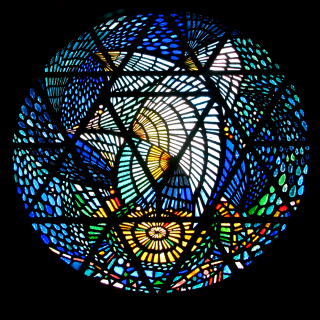
Vada Roseberry’s Creation Window, Trinity Cathedral, Phoenix, Arizona.
Listen to God’s Grandeur Gerard Manley Hopkins

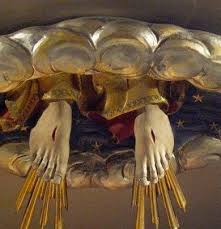 But Luke was part of a world that believed in a three-tiered universe of Underworld, Earth, and Heaven. In the first century the idea that Jesus would ascend was not in the least bit out of the ordinary. Of course the Son of God would ascend and be exalted to God’s right hand. If you look more closely at Luke’s description of the disciples’ reaction, you see that they just gaze upward—they just watch him go. They don’t fall down in fear like, for example, the shepherds on that first Christmas. In the conventional wisdom of multiple cultures of the time, ascension was what happened to those who were especially favored by God or the gods. Hercules, Moses, Enoch, Elijah, even the Roman emperor Augustus were said to have ascended from earth into the heavens. If Jesus hadn’t ascended; now that would have been a surprise.
 Acts 17:22-31 is an example of the historical genre. Luke is the historian of the early Church and in this sense, his history is very close to, if not is actual propaganda. His intention as a propagandist is two-fold. Firstly, he writes a history of the early years of the Church to commend Christianity to the wider pagan world of his time. His history is also intended for later generations of Christians, commending us to emulate in our lives the patterns of the first generation of Christians. Luke intends for us to read his history in order to develop a certain spiritual worldview.
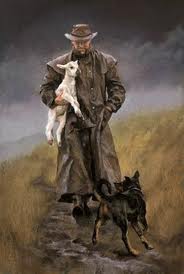 The Fourth Sunday after Easter conveys the arresting metaphor of