The backdrop
After the death of Solomon, largely due to the tyranny of his reign, David’s united Kingdom of Israel split into its northern and southern constituencies. The name Israel continued to designate the northern kingdom with its capital at Samaria. The southern kingdom took the name of the predominant tribe in the south – Judah, with Jerusalem as its capital. In 721 BCE, the Assyrian army captured Samaria and deported the king, nobility, and priesthood of the northern kingdom into captivity. This left only the poorest of the peasantry, who over time intermarried with the foreign peoples around them producing the racially mixed Samaritans we know about from Jesus’ day.
The destruction of the northern kingdom of Israel left the southern kingdom of Judah to fend for itself within the whirlwind of Middle Eastern politics. As today, in the time of the First Isaiah Middle Eastern politics were marked by rapidly shifting alliances between small vassal and proxy states caught up in the global tension between the two superpowers of the time- Egypt and Assyria. How little things change.
At the time of Samaria’s fall, two kings in Judah — Ahaz and his son Hezekiah ruled as co-regents. Judah had survived as a vassal state in an uneasy relationship with Assyria, an arrangement that afforded some security paid for through an annual tribute to the powerful empire.
In 715 BCE, following the death of Ahaz, Hezekiah became the sole regent of Judah and initiated widespread religious reforms, including the breaking of religious idols. He re-captured Philistine occupied lands in the Negev dessert. In the belief that Judah’s fortunes would fare better in an alliance with Egypt, Hezekiah took a stand against Assyria by refusing to pay the annual tribute. In response, Sennacherib attacked Judah, laying siege to Jerusalem.
It’s in this political context of crisis that the prophet known to us as First Isaiah warns Hezekiah of the disastrous consequences of this reckless foreign policy. With the Assyrians at the gates, he counsels Hezekiah to hold firm and return the future of Judah to the covenant relationship with YaHWeH. In the midst of this dangerous political situation Isaiah proclaims an extraordinary vision, not of doom and gloom, but of a future time when out of the ruined and burned stump of the once mighty Davidic kingdom there will spring a new shoot. The new shoot is a metaphorical allusion to the Messiah, the promised one who will rise up to restore the fortunes of Israel. In the midst of impending crisis and destruction, Isaiah’s prophecy is a dream of improbable things:
the wolf will lie down with the lamb, the leopard with the kid, the calf and lion and the fatling together, and a little child shall lead them.
Isaiah’s vision constitutes a resurfacing of something I think of as the transgenerational vision. This vision is deeply counterintuitive. Isaiah sees the Messiah coming not as a mighty warrior, but as a little child. It is not surprising that the early Christians understood this prophecy as a direct reference to Jesus’ birth and therefore, a powerful corroboration of their claim that Jesus was the promised one.
In Matthew’ s gospel, John the Baptizer emerges as a crucial figure within the unfolding of the transgenerational vision that identifies Jesus with Second Isaiah’s Suffering Servant. In conscious time and space, John is most popularly identified as the cousin of Jesus. In the trans-generational vision John is Elijah returned and emerges as Isaiah’s:
voice of one crying in the wilderness: prepare the way of the lord, make his paths straight!
Of vision
The transgenerational vision is one of hope and expectation weaving in and out of history. It surfaces in prophetic utterance, beginning with the First Isaiah (chapters 1-39) prophesying into the Assyrian crisis of the 720s BCE. The vision submerges to reemerge two centuries later in the voice of Second Isaiah (chapters 40-55) prophesying into the Babylonian crisis of the 580’sBCE. The transgenerational vision submerges once again only to reemerge a generation later in the voice of the Third Isaiah (chapters 56-66) addressing the struggles of the exiles returning from Babylon to rebuild Judah and Jerusalem.
It next resurfaces in Christ during the crisis of the Roman occupation in the 1st century CE. The transgenerational vision connects us to a past stretching back through the prophecies of Isaiah and the other major prophets of Israel, into the primal Genesis narratives of creation. It constitutes a resurfacing of future hope, echoing the vision of earlier generations but now anchored and given shape by the Incarnation and Resurrection of Jesus the Christ.
Of hope
Today, it’s fair to say that our world is facing into a new period of instability. The Middle East is ablaze. The European Project stumbles as one Western Democracy after another lurches to the right. Huge population migrations are on the move escaping war and poverty. Russia’s return to its old imperial dreams of expansion is a cause for concern and this nation is gripped by a growing tide of rage and fear as we face into a future we no longer feel in control of. We are assailed by the hectoring of one false prophet after another, and we cover our ears or if we have sense switch off the 24-hour cycle of opinion regurgitation masquerading as news.
Isaiah’s message to Hezekiah was to stop politicking solutions that only lead to a deepening spiral of crisis. Isaiah reminds the king that the only security lay in faithfulness to God. He exhorts the king to have the courage to trust the God who hears the cries of the people to bring them out of bondage – bondage in this instance to one failed policy after another. He offers the king a vision of God’s faithfulness and promise.
Prophetic voices for our own time
Paul Tillich was among the top three formative theologians in the decades following the Second World War. He noted that:
If we wait in hope and patience, the power of that for which we wait is already effective within us. Those who wait in an ultimate sense are not that far from that for which they wait.
Alice Miller, to my mind, one of the great psychologists of the 20th-century echoes Tillich’s words when she proclaimed:
We are who we have been waiting for.
Tillich and Miller are prophets of the Kingdom. Kingdom shaped expectations are recognized because they are always counterintuitive – seeming at the time improbable, even impossible. Counterintuitivity is the hallmark of moving beyond the limitations of world views imprisoned within the distortions of the status quo.
Tillich’s words point us to a quality of the transgenerational vision, namely the way it collapses the temporal boundaries of time and action, as in becoming the hope we are yet still waiting for – the kingdom of God is both now and not yet. The quality of future hope shapes the nature of our action in the present. As we find ourselves in a world increasingly soothed by the malignant doctrine that the ends justify the means, we need more than ever to recognize that the means which inspire the peoples’ hope and expectation will dictate the quality of the ends towards which they are led. Means and ends are related in the same way as the quality of fruit is related to the health of the tree that bears it. Playing on people’s fears, exciting their rage and hate for the other is like planting a diseased tree and expecting it to bear good fruit.
Isaiah’s prophecy is of a time when under the leadership of the most vulnerable and fragile of all God’s creatures – a nursing human child; John the Baptist’s proclamation is that the Kingdom comes with a fierce urgency, with no time to waste; the prophetic words of Paul Tillich and Alice Miller shed light on the dynamic between seeming improbable hope and the task of the present time.
Of waiting
I add a third to my two aforementioned prophets of the 20th Century, the poet T.S. Eliot. In 1937 Elliot visited the village of East Coker and subsequently named the second of his four Quartets East Coker.The poem discusses time and disorder within nature that is the result of humanity following only it’s own wisdom and not God. Leaders are described as materialistic and unable to understand reality. The only way for humanity to find salvation is through pursuing the divine by looking inwards and there in the discovery of our interconnections the image of God. In the third stanza of the poem Elliot brings a novel twist to the idea that in the act of hoping we reshape our current experience. He writes:
I said to my soul, be still, and wait without hope – For hope would be hope for the wrong thing; wait without love – For love would be love of the wrong thing; there is yet faith – But the faith and the love and the hope are all in the waiting.
Advent reminds us that so much expectation is actually the patience born of waiting. But waiting is not idleness. That for which we wait compels us to turn away from our hard-hearted complicity with injustice, and forge new pathways for the kingdom’s coming, one step and one breath at a time.

 Advent Sunday sees the gospel focus switch from Luke, our guide through Jesus’ ministry over these last 12 months to Matthew, who will be our guide over the coming year. Advent Sunday 2016 opens with Matthew 24:36-44. In this
  With the commemoration of




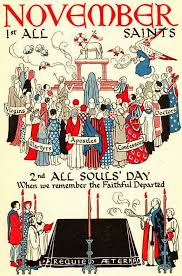 Everything in the universe is interconnected and interdependent, nothing is really forgotten. The Medieval Church understood this only too well in the grand panorama of a three-tiered universe comprised of the
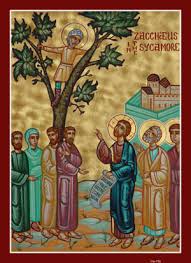 Had Zacchaeus been in that city council chamber he might have known what Kenny was going through. He knew what it was to be despised. He too was a government official; a tax collector for an occupying authority who made his money, and plenty of it, by cheating people. That’s the way it worked; as long as the Romans got their cut, anything else the tax collectors could squeeze out of people was theirs. That’s why Luke regularly refers to tax collectors and sinners in the same breath.
 In the parable of the tax collector and the Pharisee, we are invited into the pitfall of making moral judgments. Our 21st-century ears have been conditioned by the unrelenting drumbeat of anti-Semitism, the roots of which undoubtedly have been fed by a willful misinterpretation of the Gospels. Therefore, we are automatically predisposed against the self-righteousness of the Pharisee, and in so judging him commit the same error we condemn in him, i.e. that of self-righteousness.
 every Thursday. In it, I asked do we have the courage to allow ourselves to be touched by the generosity of God? Like Francis, to be touched by the generosity of God is to become a conduit for the flow of God’s generosity into our spiritually parched world? Individually, we may not match up to Francis. Yet, as a community, we can become opaque screens upon which God projects the change he longs for us to be. As Pope Francis seeks to do, we too must strive to emulate Francis’ in the face of the calculated hardness of the human heart. Do we have the courage to take such a risk?
 What distinguishes the Samaritan who returns to give thanks is that his whole perspective on life is radically transformed by his experience of gratitude. We don’t know about the other nine lepers who went off to show themselves to the priests. Yet, we detect a hint of something provisional about their healing. Jesus tells the Samaritan who returned to give thanks to God that his healing is the result of his faith,
  afflicts the body brings us no nearer to a healing of that which ails our hearts and souls.

 Relationalrealities