
I
The human race has a collective unconscious principally accessed through the vehicle of culture. Through culture, we gain access to the universal (common to all humanity) and the particular (located within the particularity of a culture) repositories of the collective unconscious. The word repository is a good one here.The collective unconscious houses the violent impulses of a society or culture. This is material too dangerous to allow free reign because the destructive nature of such collective unconscious material poses a threat to the stability of a civilized society.The collective unconscious is where a culture or society’s primal instincts, impulses, memories are banished through the mechanism of repression – a form of collective forgetting.
Because the mechanism of repression is a form of forgetting, we are easily lulled into a false assumption that what is forgotten has been deleted from our cultural experience. We are surprised when unconscious material resurfaces into the field of conscious awareness. Cultures and societies often imagine they have moved on from the memories of a more violent past. Like material we imagine has been deleted from the hard drive on a computer, the cultural violence of the past lurks out of sight and out of collective mind. On a computer hard drive deleted material simply awaits the right program to unlock its retrieval. In the case of a society or culture circumstances of uncertainty and conflict weaken the mechanism of repression; allowing the primitive phobias rooted in hatred and fear to re-emerge into the conscious awareness of the civic space.
The idea of a collective unconscious is one of Carl Jung’s important contributions to the field of depth psychology. Yet, the core idea of the unconscious is best summed up by a maxim of the great Sigmund Freud who said that what we can no longer remember we are destined to repeat.
II
I begin this reflection on the significance of the commemorations of All Saints- All Souls on November 1st and 2nd this year with this brief exploration of the workings of the collective unconscious because underneath the Christian carapace of All Saints and All Souls lie very ancient pagan spiritualities. Pagan spiritualities speak to a more primal level of collective experience. These continue to be represented to the modern American consciousness in the rituals of the Celtic Halloween and the Aztec Dia de los Muertos.
Celtic Halloween and the Aztec Dia de los Muertos represent an uncanny similarity. Each is historically and culturally distinct, completely unrelated to the other, yet, their similarity evidences the universal – transcultural – elements of the collective unconscious still very much in play. They both represent cultural responses to the fear of the power of Otherness – that which cannot be seen but remains strongly felt through its malignant influence upon everyday experience. The Halloween custom of disguise expresses our ancestors fear of death. They disguised themselves with costume, mask and face paint in an attempt to hide personal identity from the demons let loose at this time to roam the earth.
This All Saints-All Souls tide, we continue in the nightmare of dark collective and cultural forces reawakened and revitalized, demons of our collective past, which many of us naively believed had been deleted from the cultural hard drive. The endless cycles of an invasive news media communicate into our waking and sleeping the incontrovertible proof of the dark fears of Otherness let loose upon our civic landscape. Xenophobia, homophobia, racism, or misogyny, fears we thought we had become either liberated from or had at least made social and cultural progress against once again slip their chains in our collective unconscious to re-emerge into the conscious awareness of our shared civic/cultural conversations.
These collective phobias of Otherness never go away. They have never really been forgotten. Our only protection against them lies in a constant conscious remembering to avoid the ambush of unexpected repetition.
III
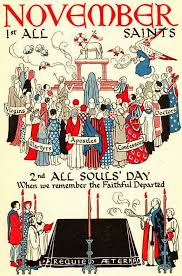 Everything in the universe is interconnected and interdependent, nothing is really forgotten. The Medieval Church understood this only too well in the grand panorama of a three-tiered universe comprised of the Church Militant here in earth, the Church Expectant – those having passed through death into a state of preparation for eventual entry into the third tier of the Church Triumphant – the saints in heaven who now worship night and day before the throne of the Lamb of God. Prayer as an expression of love and affection, of a sense of indissoluble interconnectedness and the ongoingness of relationship, flowed up and down along a two-lane highway connecting the tiers of the three-fold universe.
The 21st-century mind is not the medieval mind. Between them lie the vicissitudes of a process Charles Taylor has called disenchantment. For us the three-tiered universe is at best a wonderful metaphor that stimulates imagination, or is at worst a fairy story explanation, which having grown up, the Western mind is no longer in need of. Yet, at the heart of the three-tiered metaphor lies a profound understanding of the nature of interconnection communicating the indissolubility of relationship.
For many today, myself included, the medieval imaginary is now replaced by a quantum imaginary. The metaphors of web and network, particle and wave, and the structure of parallel dimensions provide the metaphors for interconnection and communication within a culturally syntonic (culturally compatible) expression of ancient realities.
IV
Descending from a cosmic panorama to the human dimension we encounter the central truth at the heart of All Saints and All Souls. All Saints is the only festival that can be transferred to a Sunday so as to take precedence over the celebration of Jesus’ resurrection. The reason for this is that spiritually and psychologically, All Saints-All Souls, link light and dark, white and black, joy and sorrow. These linked commemorations express the fundamental truth that for human beings death is an ambiguous experience.
All Saints expresses the truth that death is merely a biological event at a point along a continuum of life change. As the Eucharistic preface for the dead puts it – for to thy faithful people O Lord, life is changed but not ended, and when our mortal bodies lie in death, there is prepared for us a resting place, eternal in the heavens.
This expresses the belief that the life now and the life to come are interconnected by the ongoing nature of relationship continued and sustained through prayer. Thus in the saints, we rejoice with those who have been made complete in the love of God. We continue to request their spiritual concern and the support of their prayer so that the love of those who now worship from a nearer shore continues to strengthen us in our task to be the Church in the world.
Yet, unremitting cheerfulness in the face of death denies our wrenching experience of physical loss and separation from those we love but see no longer. Grief is the response to loss as we experience loved ones kidnapped by death. In the commemoration of All Souls, we give expression to this human dimension of death and although they do not need our commendation, we need to commend them to the mercy and love of God. For us, this is an expression of our continued sense of involvement with them. We ask their prayers and in return, we pray for them as they move into the next phase of a life that is eternal.
Therefore, since we are surrounded by such a great cloud of witnesses, let us throw off every encumbrance and the sin that so easily entangles, and let us run with endurance the race set out for us. Hebrews12:1

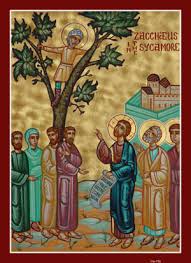 Had Zacchaeus been in that city council chamber he might have known what Kenny was going through. He knew what it was to be despised. He too was a government official; a tax collector for an occupying authority who made his money, and plenty of it, by cheating people. That’s the way it worked; as long as the Romans got their cut, anything else the tax collectors could squeeze out of people was theirs. That’s why Luke regularly refers to tax collectors and sinners in the same breath.
 In the parable of the tax collector and the Pharisee, we are invited into the pitfall of making moral judgments. Our 21st-century ears have been conditioned by the unrelenting drumbeat of anti-Semitism, the roots of which undoubtedly have been fed by a willful misinterpretation of the Gospels. Therefore, we are automatically predisposed against the self-righteousness of the Pharisee, and in so judging him commit the same error we condemn in him, i.e. that of self-righteousness.
 every Thursday. In it, I asked do we have the courage to allow ourselves to be touched by the generosity of God? Like Francis, to be touched by the generosity of God is to become a conduit for the flow of God’s generosity into our spiritually parched world? Individually, we may not match up to Francis. Yet, as a community, we can become opaque screens upon which God projects the change he longs for us to be. As Pope Francis seeks to do, we too must strive to emulate Francis’ in the face of the calculated hardness of the human heart. Do we have the courage to take such a risk?
 What distinguishes the Samaritan who returns to give thanks is that his whole perspective on life is radically transformed by his experience of gratitude. We don’t know about the other nine lepers who went off to show themselves to the priests. Yet, we detect a hint of something provisional about their healing. Jesus tells the Samaritan who returned to give thanks to God that his healing is the result of his faith,
  afflicts the body brings us no nearer to a healing of that which ails our hearts and souls.


 Personally, I have great difficulty thinking of time other than in the seeming watertight compartments of past, present, and future; time passing by minutes, hours, days, weeks, months and years etc.
 but of the arrival of the appointed time, the opportune moment. We speak of kairos moments to refer to the experience of something happening in a window of timeliness.
 Teleios means far-reaching, fulfillment, mature as in the end of time when the process that reveals itself only by painful step after painful step, is finally complete.
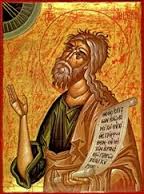 Chapter 32 of the book of the prophet Jeremiah ushers us into a scene in the guardhouse of the palace of Zedekiah, the last rag-tag and sorry king of Judah on the eve of the fall of Jerusalem to Nebuchadnezzar, king of Babylon in 587.
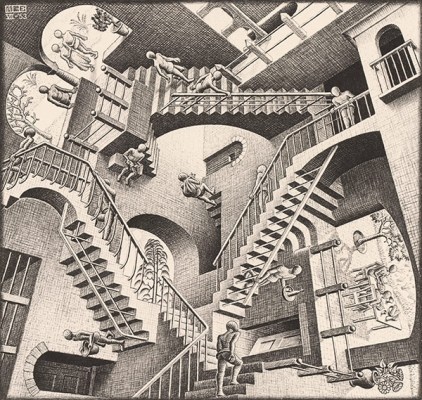 print of one of those staircases that endlessly seems to be going upstairs and downstairs at the same time. It is puzzling, and sometimes frustrating to wrap our minds around these twisty images.It can also be frustrating and puzzling, in contemporary consumer culture, to wrap our minds around a Kingdom vision that prioritizes a prodigal attitude toward money.
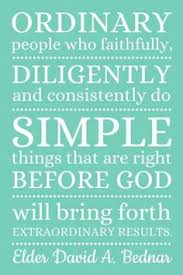 To be diligent means to exert constant and earnest effort to accomplish what is undertaken. Diligence requires a persistent exertion of body or mind. In my experience, diligence is a key quality displayed by women because diligence is a quality that is particular to the arena of everyday life.
 Around 55 AD, from prison, Paul wrote a short letter to his friend and wealthy supporter, Philemon. Philemon seems to have been the lynchpin in the Christian community in Colossae for it is in his house that the church meets – a fact that gives us an indication of Philemon’s social standing within the community.
