Memorial Day

Reflections on Luke 7:1-10

Luke gives us a story in chapter 7 that is so quintessentially his, even though it is Matthew, a writer with a very different theology of Jesus, who first records the story of Jesus, the Centurion, and his boy. This incident is quintessentially Luke because it is easy to see how it fits Luke’s wider project of presenting the Christian faith to the Gentile world.

Luke’s theology of Jesus is that of Paul’s. Paul is the boundary-crossing apostle, who takes the revelation of God in Jesus Christ beyond  the community of Jesus’ Jewish followers, into an active engagement with the wider, Gentile world. Luke’s contribution is to present the life of Jesus and the early Church seen through Paul’s theology within a coherent format that traverses the crevasses separating Christian, Jewish, and Gentile worlds.

The story of Jesus, the Centurion, and his boy is such a story. It has all the ingredients that normally would make it impossible for any meaningful engagement between the Jewish Jesus, the world of the Roman occupier, and Pan-Hellenic cultural norms.

The first element to note is how Luke uses both the Greek doulos -slave and  paid -boy to describe the Centurions servant. Paid is a term that in this context implies the possibility of the type of sexual relationship common between an older mentor and a younger protege and it is clear that this boy is no mere servant. Pederasty, while common in the Roman-Greek world was strongly condemned by the Jews with their patriarchal anxiety about homosexuality. There is no hint that Jesus seems concerned about this possibility.

Secondly, in communicating with Jesus, the Centurion uses the synagogue elders as his emissaries. This denotes an unusually friendly relationship between this Roman commander and a local Jewish community. These elders, who might usually have been hostile to Jesus seem keen to enlist his help in the service of a man they hold in high honor, to whom they clearly feel an obligation, having built their synagogue for them.

Thirdly, Jesus does not hesitate to set out in response to the request. Now something strange seems to happen. Does the Centurion change his mind? He now sends his friends to intercept Jesus and ask him not to come to the house. Is he conscious of the peril he is posing for Jesus in asking him to risk ritual contamination by entering the house of a Gentile: Lord do not trouble yourself for I am not worthy to have you come under my roof? In any case, again, there is no hint in Luke of Jesus being concerned about this.

Fourthly, Jesus expresses astonishment in the Centurion’s recognition of his authority – For I also am a man set under authority, with soldiers under me; and I say to one, ‘Go’, and he goes, and another,’Come’, and he comes …. Jesus exclaims that not even in Israel, i.e. among those which at this stage if his ministry Jesus understands himself to be called, has he seen faith like this.

For obvious reasons, most commentators gloss over the overtones of pederasty in this story. Most note the perplexing elements of the Jewish elders willingness to mediate and Jesus’ seeming willingness to risk ritual contamination. For many, the emphasis falls on this being a story about faith, the faith of the Centurion, who even though he is a pagan, and especially because he is a pagan, can be counted a righteous man in contrast to Jesus’s own people’s rejection of him. The piety of faith always provides a safe ground for interpretation.  

Crossing boundaries

Yet, the question for me concerns Luke’s possible purpose for presenting this story as he does? I believe Luke understands this story to reveal Jesus’ willingness to reach out and cross the boundaries that separate peoples and cultures. Inclusion is one of the key elements in Luke’s theology of Jesus. Luke is also a proponent of an early reconciliation between Christianity and Roman globalization. Under the umbrella of globalization and its agents, the Romans maintained relative stability between otherwise suspicious and hostile cultures, tribes, and nations. Rome was the last great agent of globalization in the ancient world.

Globalization only works when it is able to buy allegiance through ensuring prosperity and safety for its different constituent cultures. Initial periods of conquest and rule through fear don’t last unless the conquered come to see their self-interests reflected in the benefits of empire. The Pax-Romana ensured peace, stability, and economic prosperity among the polyglot cultures of the Mediterranean world.

A tension in early Christianity lies between its Jewish exclusivist and Gentile universalist movements. Luke is on the side of the latter. Hence, his story of Jesus, the Centurion, and his boy offers a powerful metaphor for his worldview, one in which Christianity is the ally of Rome, not its enemy.

Luke’s worldview predominates. The Jewish faction of Christianity dwindles and with the exclusion of Christians from newly emerging Rabbinic Judaism, the Gentile Mission becomes the only game in town. The Gentile Mission is so successful, the reconciliation between Christianity and Pax-Romana so complete, that Christendom eventually emerges to replace Roman power as the central globalizing influence.

Hearing the story in our context

On Memorial Day Weekend, amidst the events of an unfolding presidential election, how do we hear this story?

imagesThe origins of Memorial Day are complex and a number of places in both the Old South and North claim to be have been the location for the first Memorial Day. Memorial Day is the day when America has traditionally honored her war dead, beginning with the 600,000 plus dead of the Civil War. Memorial Day Weekend also marks the beginning of summer. This unfortunate coincidence results in most people celebrating the weekend, not as a commemoration of the war dead, but as the start of BBS (barbecue and beach season). At least at St Martin’s in Providence, we will be breaking out the black vestments (literally) for a solemn commemoration of the war dead on Sunday.

Is there a theme linking Luke’s gospel story and its worldview with Memorial Day and the unpredictable future we are now facing? I think there is. I detect the theme of the tension between globalization and tribalism.

The Civil War was a manifestation of a long-running resistance to the globalization embodied in the Constitution and its establishment of the Federal Government. There came a point when the forces of national globalization lost the allegiance, albeit reluctant from the beginning, of a section of the States that comprised the Union. Globalization became identified with the economic power of the manufacturing North. Fuelled by northern industrialization it became so serious a threat to the Southern slave-based economy that a section of States no longer felt their peace and prosperity protected within the movement for national globalization.

Throughout the 20th-Century, the forces of economic globalization became increasingly identified with US national interests, especially in the post-1945 development of a Pax-Americana. However, the hand-in-glove relationship between economic globalization and American self-interest has been unraveling for decades now. The US economy, now like every other world economy is a client state of international, economic globalization. The result of this is that increasingly large numbers of Americans no longer enjoy the benefits of a close alliance between transnational capital and the U.S. national interests. Whether we are industrial workers whose manufacturing jobs have gone off shore or middle-class people victimized by a financial industry that sees itself as its own business rather than as a support for the growth of business, we, the hurt and disillusioned are increasingly looking for the arrival of a new messiah to free us from our plight.

We now experience international, economic globalization as economic, exploitative, colonization. We should not be surprised when the old animosities of racism and gender oppression, now insidiously dressed up in the tribal clothes of States rights, resurface as expressions of tribal cultural responses to the failure of globalization to meet our needs. These dangerous genies, once released from their bottles are hard to put back, and we will all suffer the consequences.

In conclusion

Christianity when rooted in the values of the Gospel, can never support solutions that promote a regression to tribal mentalities that divide the world into a them-and-us worldview. However hard it might seem to see Luke’s story of Jesus, the Centurion, and his boy as providing us with badly needed answers, it is clear that it shows us the trajectory of Christian living based on Jesus’ own behavior in reaching out beyond the tribal boundaries that separated him from the Centurion. It shows the Centurion recognizing the commonality he shares with Jesus, for both are men in authority. It’s a story that celebrates the common experience and shared perspectives that reach across the boundaries of cultural, religious, and economic differences. It’s a key story in Luke’s promotion of Christianity as a reconciling and bridge building movement capable of changing the world.

There are key moments in history when Christians are judged by later generations as to whether they embraced the Gospel as an agent of resistance in the face of the resurgence of tyranny. I believe we are living in such a time, and will be so judged by our children and their children.

The Trinity – knowing ourselves in the gaze of another.


My old university chaplain used to scoff: Trinity Sunday – ridiculous! How can you celebrate a doctrine as if it’s an event? I remember at the time thinking this was a wise and incisive comment. Now, I just think he missed the point. Did you know that among Anglicans and Episcopalians, in particular, the dedication of Churches to the Holy Trinity far outnumber any other single dedication? This is a hidden indication that for us the concept of the Trinity, at least once upon a time, held a central place in our spiritual culture.

Every Sunday we say together the words of the Nicene Creed, which distill down to four concise statements:

We believe in God, maker of heaven and earth.

We believe in Jesus Christ, eternally begotten of the Father.

We believe in the Holy Spirit, the giver of life.

We believe in one holy catholic and apostolic Church.

Why does Christianity seem to complicate what for Jews and Muslims, our Abrahamic cousins, seems very straight forward – God is one and God is singular. Except on Trinity Sunday, most of the time I suspect that this is how most Christians also picture God. We still struggle with the appropriate pronoun for God; he or she? Yet, in the earliest chapters of Genesis we read of God self-referring as us and we. I will come back to that in a bit.

The doctrine of the Trinity as we have inherited it today is the result of a need in the Early Church, not so much to explain the nature of God as to protect the nature of Christ from being reduced to one of two simple assertions – divine or human. For the key question arises, if God is God, who and what is Christ?

There were two answers to this question. The first was that Jesus is God masquerading in human form. If he’s divine, Jesus is not genuinely human in any meaningful way that you and I are human. The second asserted that Jesus was only a man, although a great man, something today we refer to as an avatar. The prophet Mohammed, and the Buddha are avatars, great human beings who show the way to God in the case of Mohammed, and the cosmic order in the case of the Buddha.

The Christian experience is that Jesus was both divine and human, both natures existing simultaneously, yet independently. Why assert something that to all the world seemed absurd? The assertion may seem absurd, but it goes to the heart of the experience the Early Christians and Christians since continue to encounter. The divine and the human lie at opposite ends of a continuum. To be human is to be most like God. But this requires God to have experienced being really human, first.

Last week we celebrated the descent of the Holy Spirit on the Day of Pentecost. For the followers of Jesus, this is the point at which they locate a fundamental shift in their self-understanding and worldview. And so we say in the lines of the creed we believe in the Holy Spirit and the holy catholic and apostolic Church.

An interesting question

It’s interesting to speculate that without the Pentecost experience, would Christians have settled into a belief that Jesus was simply an avatar, a truly divinely inspired human being possessing a unique spiritual access to God? After all, this is what nearly happened.

Those who believed that Jesus was a highly evolved spiritual, human being were known as the Arians, nothing to do with white racial purity, but followers of a bishop called Arius. The joke about heresy is that it’s always more plausible than orthodoxy. The Arians were defeated at the Ecumenical Councils, but the plausibility of their view persists throughout history and today it’s probably true to say that many Christians are actually Arians. In the popularity of the cult of Jesus the really good man and my best buddy, Arianism is alive and kicking in contemporary America.

Yet, the Holy Spirit anointed the Church to become the continuance of Jesus’s ministry in the world. For the early followers of Jesus, this was not just an inspiring memory of Jesus but an inspirited experience of Jesus still being actively and instrumentally present in their live and their world.

The emergence of a doctrine

The doctrine of the Trinity emerges from the early Christian struggle to account for the fact that they experience three distinct modes of encounter with God. Firstly, as Jews, they believe in God the Creator, the God of their ancestors, of Abraham, Jacob, and Moses. Secondly, they experience a life-changing encounter with God in the ministry, death, and resurrection of Jesus. Thirdly, they encounter a source of empowerment that transforms them into being able to continue the work of the Lord, empowered through the indwelling of the Holy Spirit. They experienced three manifestations of something they knew to be the one true God.

The bishops meeting in the Ecumenical Councils came to articulate their experience of these three distinct kinds of encounter with God. They naturally used the philosophy of the day, that of Aristotle and his concepts of person and substance. Applying Aristotle to their experience of God in three contexts led them to understand God as three persons sharing a single, unified substance. So they came to speak of three persons in one God, not three Gods. The crucial point we need to accept is that their purpose was never to explain the mystery of God, but to protect the mystery of God’s divine nature from being reduced to only that which human logic can conceive of, i.e that which seems to be not absurd.

Perspective from the 21st Century

The demand in each generation is to interpret the Christian Tradition handed on to us from previous generations so that it empowers us to engage with life as it is lived, not as it was lived in an imagined previous golden age. For the Christians of the first four centuries, the currency of intellectual thought was Aristotle’s logic. Now the reality today is that few of us use Aristotelian logic to navigate our way through the complexities of life and faith in action. I know of some who regret this, but it is as it is. In the contemporary mindset, Aristotelian philosophy has been replaced by a psychological understanding of human nature. Whereas once Aristotelian logic offered a vehicle for theological articulation, today, depth and transpersonal psychology offering us new vehicles by which we can express ourselves, theologically.

There is a recognized psychological theory for how our individual identities emerge from our relationships with others. Our individual identity i.e. who I am – is constructed from our experience of intimate relationship with others. The person I experience myself being emerges from how I perceive others viewing me. I catch a glimpse of myself in the face of the other looking back at me.

From doctrine to experience

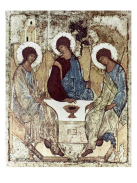
andrei--rublev-russian-icons--the-trinity_i-S-61-6179-4K11100ZDespite the popularity among Episcopalians to name our churches after the Holy Trinity, the Trinity in the catholic and protestant West has been largely reduced to a theological doctrine. The orthodox East provides an interesting counterpoint. In orthodox Christianity, the Trinity is a devotional focus. This can be most graphically demonstrated by Andrei Rublev’s archetypal depiction of the Trinity, written (icons are written not painted) in 1410. The Trinity is shown as three identical persons lovingly gazing upon one another. Rublev clearly has in his mind’s eye the visit to Abraham of the three angels at the Oak of Mamre. Yet, in the striking aspect of Rublev’s depiction of God the Holy Trinity, we catch the echo of the conversation we hear God having in Genesis, let us make humanity in our own image. God is not a singular entity, but a relational community.

When we put together the ancient echo in the Genesis record of God’s internal conversation with our current psychologically shaped experience of the fluidity of identity, we arrive at the theological realization that for us, in our period of history, God’s nature takes on a poignantly, relational quality.

Gender distractions

Today, any serious exploration of the Trinity requires us to address the debate about gender. The Tradition of the Trinity ascribed masculine identities to the relational elements Father, Son, and even the Holy Spirit is referred to as he. In our own period, it’s important to know that God is not gendered. The importance of the traditional male ascriptions to God lies not in their gendered but in their relational nature.

I have found a way to avoid the gendered terms and still retain the relational elements is to refer to God as Lover, Beloved, and Love-Sharer. It’s common to hear Father, Son, and Holy Spirit referred to as creator, redeemer, and sanctifier. However, the problem here is that these terms denote function, not relationship. It is the relational quality within the community of God that commends itself so powerfully to people living increasingly in a world where relationship, its presence or absence, is the measure of meaning and a key indicator of quality of life.

In conclusion

I don’t only believe in the Trinity as a doctrine, but I adore the Trinity as a focus for meaningful devotion. When I left Trinity Cathedral in Phoenix, I was given a precious gift, a new icon of the Trinity in the style of Rublev, written by Laura Smith, an accomplished icon writer and faithful member of Trinity’s congregation. When I gaze at each identical figure seated around the three sides of a table, I notice the way they are looking at one another. They gaze upon one another with expressions of intimate love.

Sitting before the icon of the Trinity I am reminded that my identity as a person is not constructed by me in isolation. I experience my identity as the result of the way I see others looking back at me. My identity is constructed through the interplay of my relationships. As I gaze upon the three figures of the Trinity, I am invited into a reaffirmation that I am a child of God because I belong to a community that reflects a relational God. I am a relational being and my health lies in my desire to seek my identity within relational connections with others. Only when we are fully in community together can we become an image of the unseen God, whom in the visibility of the Trinity we discover is not a solitary entity, but a relational community of love.

Three folds of the cloth yet only one napkin is there,
Three joints in the finger, but still only one finger fair,
Three leaves of the shamrock, yet no more than one shamrock to wear,
Frost, snowflakes, and ice, all in water their origin share,
Three Persons in God: to one God alone we make our prayer.
                                                                       An Irish Celtic prayer to the Trinity.

Pentecostal Imaginings

God and imagination

Some would tell us that God is the projection of human imagination. I think this is a basic misunderstanding. There is something philosophers recognize called a category mistake. A category mistake arises when something, an element or property of identity belonging to one category is assigned to another, different category. Thus, to equate God as the product of human imagination is to make such a category mistake.

It’s easy to do because while the existence of God is not the product of human imagination, our perception, and experience of of God comes to us only through the exercise of human imagination. If God is not a direct product of human imagination, imagination is required for God to take shape in our lives.

At St Martin’s in Providence, we have embarked on a community reading of the Bible in the form of something called The Story. On Sunday, May 15th, after celebrating the birth of the Christian people of God on the Day of Pentecost, an event recorded by Luke in Acts 2:1-11, we will gather in our adult forum to review and discuss our experience of having read chapters 4-6 in The Story. Chapters 4-6 cover the period from the Israelite’s exodus from Egypt, through the 40 years of wandering in the wastes of Sinai, to their arrival on the borders of Canaan, a land flowing with milk and honey promised by God.

Early Israelite imaginary

In our discussion of our reactions to reading The Story, we are beginning to be brave enough to speak openly of our dislike of the God presented in much of Genesis and Exodus. This is God, filtered through the imagination of a primitive, nomadic, warlike, tribal people. This is God portrayed in their own image, a ruthlessly jealous God, who when crossed responds with threats and actions of genocidal retribution. Yet, theirs is also a God who desires connection, a God capable of intimate relationship with Moses, a God who is responsive to the demands of relationship. God is amenable to Moses’s constant interceding not to destroy that which God also loves. We see in these pages a perception of God, who like the people God is attempting to preserve, struggles to walk the tightrope between the impulses of love and hatred, between the desire to preserve and the impulse to destroy when the object of love, disappoints.

Human experience of God is mediated through the structure of our imagination. In the pages of Genesis and Exodus, God emerges into an Israelite tribal imaginary. Our understanding of the events on the Day of Pentecost likewise permeate through the imaginations of the writers of the early Christian period. The imaginations of Paul, John and Luke communicate an experience of God at a point when Jewish thought is struggling to break out of a narrow xenophobic imaginary of God into a universalistic realization of the age-old dreams of the prophets.

The lectionary for Pentecost Sunday offers a multiplicity of choices including Genesis, the Palms, Paul’s letter to the Romans, Luke-Acts, and John’s gospel. For the first Christians, the Day of Pentecost recalls an experience of God, which they could only articulate through the images of the rushing sound of a mighty wind, the descent of flames of fire, and instantaneous translation. On the Day of Pentecost, the followers of Jesus had an experience of total transformation, which could only be articulated through metaphors of the human imagination.

Early Christian imaginaries

Any reference to Spirit – Holy Spirit has to be set against the first chapter of Genesis, which open upon a huge panorama: In the beginning, God created the heaven and the earth. And the earth was without form, and void; and darkness was upon the face of the deep. And the Spirit of God moved upon the face of the waters. The Hebrew word used for Spirit is the feminine noun Ruach. The Spirit of God is God self-identifying through the feminine principle for which she is the appropriate pronoun use.

In the 22nd verse in the 8th chapter of his letter to the Romans, Paul continues to mine the feminine principle within God as he depicts all of creation struggling in the travail of giving birth: for we know that the whole creation has been groaning in labor pains until now. Paul cements the feminine imagery intrinsic to God when he tells us that we too, continue in labor’s grip, groaning, panting, and pushing, driven by the hope of imminent new birth. In this state of travail, the Holy Spirit, like a midwife comes to our aid, supplying the strength we need to give birth to a new world.

For the Evangelist John, as Jesus bids farewell to those he has loved he tells them that: And I will ask the Father, and he will give you another Advocate, to be with you forever.  The Advocate will empower the disciples into an expanded imaginary of the love of God, enabling them to do even greater deeds than Jesus has performed.

The most popular image for the Day of Pentecost, the 50th day of the Resurrection, is given by the Evangelist Luke. Luke constructs a chronology of unfolding events from the resurrection, ascension, to the climactic moment in history when the Holy Spirit penetrates the created order. For Luke, the coming of the Holy Spirit marks the point of transition between the ministry of Jesus and its continuance in the life of the Church, now impregnated with God’s Holy Spirit.

Luke wants to draw our attention to the effects  of the interpenetration of human hearts with the Holy Spirit. The heat of fire, the sound, and rush of wind, a spontaneous understanding of the Spirit speaking to each in his or her own native tongue are metaphors for transformation. He juxtaposes these events with the story of the Tower of Babel in Genesis 11, where an older imaginary of God as jealous and somewhat insecure, fearful of human achievement needs to thwart human aspirations. God says: Come, let us go down and confuse their language so they will not understand each other.

On the day of Pentecost, all witness the descent of the Holy Spirit upon them, each hearing God speaking in their own language. The curse of Babel is lifted. Difference is no longer a source of division but of enrichment. Luke’s theological message is that for human society – born anew as the Church, it is no longer the business as usual of the old order.

God in a contemporary imaginary

In his poem God’s Grandeur the 19th century English Jesuit and poet Gerard Manley Hopkins proclaims that:

The World is charged with the grandeur of God. It will flame out, like shining from shook foil; It gathers to a greatness, like the ooze of oil – crushed.

Yet, against the background of this optimistic proclamation Hopkins questions why humanity is so reckless of God’s gift of creation: 

Why do men then now not reck his rod? Generations have trod, have trod, have trod;  And all is seared with trade; bleared, smeared with toil and wears man’s smudge and shares man’s smell: The soil is bare now, nor can foot feel, being shod.

Extending Hopkins’ inquiry, looking around us at the world in 2016, we see how easily human beings can be excited to fear the differences that lie between us?  Our labor pains are marked by the futility of war and the injustice of oppression in which generations have trod, have trod, have trod. We have become insensible to the feel of the earth, increasingly made barren beneath our shod feetOur social relations are mired: seared with trade, bleared, smeared, with toil sharing man’s smudge. 

We notice that we are not all the same. We notice the obvious differences between us expressed through gender, sexuality, race, culture, and class. Such differences become emblematic of the differentials of power, privilege, and access to the protection that difference affords to some and denies to others.

The birth of the new Spirit-filled order comes as a challenge to the human propensity to distribute power, unequally. Luke’s vision of the Holy Spirit is of the anima – the feminine principle of new birth embracing and celebrating the rich diversity of being human. Difference no longer needs to be the source of division but becomes a celebration of diversity as the Holy Spirit calms our fear.

From the perspective of 2016, on the Day of Pentecost, a contemporary imaginary of God comes to light. This is an inclusive and universal God. God embracing all kinds of diversity is continually coming true in Church communities of bewildering variety. Pentecost presents us with an image of God as Spirit now impregnated deep within the human DNA as that longed for God shaped space, or as Hopkins more poignantly says it:

And for all this, nature is never spent; There lives the dearest freshness deep down things;        Rose Window

And though the last lights off the black West went  Oh, morning, at the brown brink eastward, springs –
Because the Holy Ghost over the bent
World broods with warm breast and with ah! bright wings.

God’s Grandeur  Gerard Manley Hopkins S.J.

Vada Roseberry’s Creation Window, Trinity Cathedral, Phoenix

Sunday after the Ascension

images-1May 8th is a complex day. It’s the Sunday after the Ascension. It’s that in most churches, but at St Martin’s, it’s the day after Linda Mackie Grigg’s ordination as a priest, and the day of her first celebration of the Eucharist. It’s a baptism Sunday, and it’s also Mother’s Day. I intend to address Christ’s Ascension in the Adult Forum at 10.45 a.m. For those of you reading this only, I can refer you here to learn more on the theme. This now allows me to concentrate on the remaining three areas: Linda’s priesting, Mother’s Day, and baptism.

Linda’s ordination as a priest is not only a huge event in her life but also in the life of the community of St Martin, Providence. Over the last 18 months, we have witnessed a process that most parishes never directly experience. Since Linda took up the position as Director of Christian Formation, we have had the opportunity of experiencing what happens to a person as they grow, stage by stage into an ever-fuller expression of God’s call for them. Usually, this process of growing through the initial developmental stages preceding ordination as a priest is not so visible from a community’s viewpoint.

The difference with Linda is that she arrived fresh from seminary to take up her post heading Christian formation as a laywoman. During the time she has been among us we have been able to experience the changes in her as she has moved from laywoman into the transitional diaconate before emerging, like a swan, into the full expression of God’s intention for her as a priest.

I don’t mean to imply this journey is now complete. Linda’s ordination as priest reminds me of that famous utterance of Winston Churchill’s:

Now this is not the end. It is not even the beginning of the end. But it is, perhaps, the end of the beginning.

A little historical detour

The English Reformation was characterized by a long process of incremental change. Instead of the decisive break with the past that marked the Reformation elsewhere, in England reformation took place through an evolution of catholic structures under the influences of incresingly Protestant theology. As a result, Anglicanism came to be known as the middle way – via media.

After the death of Jesus, the Apostles represented the continuance of Jesus’ ministry in the world. They needed to focus on evangelism and so the internal care of the community was delegated to a group of ministers known as diaconoi – deacons or servants. As the Apostles died out either through martyrdom or natural causes they passed on their authority to new men who came to be known as overseers or supervisors, in Greek episcopoi, or in English bishops. As the Church continued to expand, instead of making more and more bishops, each bishop began to delegate some aspects of this authority to a new class of minister known as presbyters or elders.

The three-fold order of bishop, presbyter or priest, and deacon is the structure for ministry that we share with other Churches of the Apostolic Tradition, i.e. Roman Catholic, Old Catholic, Eastern Orthodox, and some Lutheran Traditions. In an overwhelmingly Roman Catholic State like Rhode Island, our use of the word priest to refer to the order of ministry Linda was yesterday ordained into can be a source of confusion, especially as the Episcopal Church is now home to a growing numbers raised in the Roman Church. The historic three-fold order is the same, the name is the same, but you simply have to spend only a little time in the Episcopal Church to intuit that the understanding of this ministry is somewhat different.

This difference in feel is an example of middle way understanding. In Roman Catholicism, the priest is set apart through the transmission of apostolic authority through the bishop to stand in the space between the baptized and God. As a mediator, he is both gatekeeper and custodian of the divine.

In Anglicanism the priest is likewise, set apart by the transmission of apostolic authority through the bishop, but not to stand between the baptized and God as a gatekeeper or mediator. For Episcopalians, the priest stands as one set-aside in order to represent to all the baptized a fuller realization of their vocation as a royal priesthood of all believers. Anglicanism really only recognizes one main category of ministry, that of the baptized. The threefold order of ministry is simply a grace-filled functionality for the benefit of the life of the Church.

Linda does not stand in a space between us – the baptized, and God. She continues to stand firmly on our side of the line, only now invested by us and graced by God to exercise a ministry of spiritual and sacramental leadership among us. 

Ordination is the end of the beginning of priestly ministry. It is not the completion of that ministry. Ordination confers authority through what we call the grace of orders. Authority and grace are the two elements that define a priest. So how does this all work?

A dynamic view of priesthood

We are already beginning to view Linda differently. We may not be aware of this happening, but it is happening. To get psychological for a moment, we now project a new set of expectations onto her. These expectations reflect that which we as a community, as well as individually, need Linda, as a priest to embody for us.

For Linda, she will begin to catch glimpses of her priestly identity through the way we begin to use her differently. She experiences this difference as we now bring a new set of expectations in our relationship with her, as a priest. We now look to her for qualities and capacities that we have hitherto not expected in our relationship to Linda as a deacon, or Linda as just herself.

As this is Mother’s Day, we can be reminded that we all come to know ourselves through experiencing ourselves reflected back in the eyes of our mother or principal caregiver. We first experience love through our mothers gaze. We glimpse our identity as we come to experience ourselves reflected in the eyes of our mother’s gaze. We first experience love through the shape of our mother’s facial gestures, the quality of her touch, the sound of her voice, the smell of her skin, the taste of her milk.

I use the feminine pronoun here because mothering has been traditionally a woman’s role. Traditionally, priesthood has been a man’s role. Yet, today, both priesthood and mothering are no longer gender specific roles. They are qualities of being that both men and women can possess. In the case of mothering, it’s the infant’s total dependency that triggers the qualities of mothering in his or her principal caregiver, whether this person be male or female. Likewise, priestliness is a quality triggered in the new priest as we – the baptized – come to see her or him as worthy of our trust. In both cases, infant and priest come to know themselves through the way they are known by others.

The grace of priestly ordination operates as a signal to the rest of the baptized that God is from now on working in a particular way through this person for the good of the whole body of the faithful. Through ordination, the new priest becomes recognized. So recognized, we have the opportunity to entrust them with our vulnerability. Through our trust in them, they catch glimpses of themselves as a channel for the loving acceptance of God, the grace of God flowing through them into the life of a community and into the lives of its members.

Anglicanism really only recognizes one main category of ministry, that of the baptized. May 8th is the day when Ione Rose is to be baptized. Through baptism, Ione Rose will become a member of the Body of Christ in this world. Through her baptism, Ione Rose joins the community in which Linda now begins her ministry as a priest. Our prayers today are that both Ione Rose and Linda will through God’s grace and our help grow into the fullness of the persons God is calling them to become.

From the collect for the ordination of a priest in the Book of Common Prayer:

O God of unchangeable power and eternal light: Look 
favorably on your whole Church, that wonderful and sacred 
mystery; by the effectual working of your providence, carry 
out in tranquillity the plan of salvation; let the whole world 
see and know that things which were cast down are being 
raised up, and things which had grown old are being made 
new, and that all things are being brought to their perfection 
by him through whom all things were made, your Son Jesus 
Christ our Lord; who lives and reigns with you, in the unity 
of the Holy Spirit, one God, for ever and ever. Amen.

Stories on the Threshold

Sermon for Easter 6 from the Rev. Linda Mackie Griggs


During this Easter season, the theme of Father Mark’s preaching has been that of Story—How the Great Story of creation and salvation relates to our story and our reading of The Story. So, building on that–sort of–; All I really need to know about reading the Bible, I learned from Sherlock Holmes. *

While that may not be quite the way my New Testament professor would put it, it does accurately describe an important way of engaging, and even wrestling, with Scripture. When reading a good mystery—my favorite kind of reading for relaxation—I enjoy watching the story unfold to its (hopefully) surprising conclusion; surprising because the author has invited me to look at things from a different perspective. Viewed through a new lens, the facts reorganize themselves into a different picture and I’m graced with an “aha!” moment: “Of course! NOW I see it!”

Of course, the purpose of reading Scripture isn’t to find the culprit in a crime, but to discover what God is saying to us, through this story, at this particular time. Engaging with a Scripture passage isn’t a one-time event. We are invited to come back to it over and over, and because life changes, our perspective changes, and we are invited to see it in a new way. This is a form of critical engagement that is vital to an effective and fruitful understanding of the great Story of God’s relationship with humanity and all of creation.

Take, for example, the three passages we have heard today. This particular time is the sixth Sunday of Easter. It is also the occasion of a baptism; so how nice that all three lessons are connected to water. In Acts, we encounter a conversion by a river. In John’s Revelation, we see a tree with healing leaves by the river of the water of Life. And in John’s Gospel Jesus heals a man by the Pool of Beth-zatha in Jerusalem.

Yes. All three share water in common. Undeniable. But a patient reading—that means reading a second and third time, offers a shift in perspective, and thus reveals that there’s something else happening here. Listen again: A conversion by a river. The tree of life beside the river of the water of life. A healing next to the pool of Beth-zatha.

It’s not just about the water. It’s where things happen in relation to it. By. Beside. Next to. These lessons all put us in liminal space.

“Liminal space” is a Seminary Phrase, probably because seminarians spend so much time there—in liminal space. It simultaneously connotes two things: both a threshold and being on the edge and/or the verge of things. When you think about it, ‘liminal space’ isn’t just for seminarians—it’s a place many if not all of us are familiar with at some point in our lives.

To be in liminal space is to be between; it is to be off-balance—almost off one foot before setting down the next—teetering between old and new, known and unknown. To be in liminal space is to find yourself with a choice. Forward, or backward. Remaining in the doorway is not a sustainable option.

Did Lydia know she was on the verge of something new? Nothing we know about her indicates that her life was at a tipping point; she was well-to-do enough to deal in purple cloth, which was a valuable commodity. She was evidently a free woman of independent means, possibly a widow since she had her own household. But something about hearing the Good News of Jesus Christ either beckoned from in front or nudged her from behind because there, at the edge of the water, she crossed a threshold into a transformed life in the Body of Christ.

What’s interesting is that you don’t always know you’re in liminal space until you’re faced with the fact of it; you just realize that something is about to change, and regardless of what you choose, life will not be the same again.

In a report on NPR a few weeks ago, I heard about a museum director in Ronneby, Sweden named Dagmar Norberg, who found herself at just such a liminal point.

She was walking beside the tracks at a train station on a cold November day last year when she observed a young man dressed only in a t-shirt, jeans, and tennis shoes. Thinking he was just some whippersnapper without the sense to dress properly, and being, as she says of herself, “now at that age where I can just say things,” she sternly exclaimed, “It’s winter!”

The young man didn’t ignore her; nor did he talk back. He simply replied politely, “I know, ma’am.”

Dagmar says, “That was the first time I heard Wali’s voice.” Perhaps it was his accent—the story doesn’t say– but she was prompted to look closer and realized that this young man was one of many Afghan refugees who had arrived in Sweden with little or nothing but the clothes on his back, certainly unprepared for a Scandinavian winter. She said that he was so stressed he was sweating in spite of the cold.

The young man, Waliullah Hafiz, was trained as an electrician and had been a successful businessman in Kabul before a severe beating at the hands of the Taliban drove him from his country.

Dagmar found herself on a threshold. As she put it, she could either go on with her life or help him. “I just knew I had this choice here and now,” she said, “and whatever I do will have consequences.”

This is where Jesus meets us; where the margins meet the thresholds in our lives; it is in this space where we are challenged; in this space where healing and grace can lurk both expectantly and unexpectedly.

Thanks to Dagmar’s help, Wali is now applying for asylum for himself and his family, he has a place to live and he is learning a new trade. He has found a new beginning because a stranger met him at the edge of the railroad tracks and the end of his rope, and walked with him through a threshold to a place of welcome and sanctuary.

The man at the Pool of Beth-zatha was on the edge in many ways; unable to walk, chronically ill for decades, he yearned to bathe in waters that had reputed healing powers. The pool was probably an artesian well that periodically moved and burbled as pressure equalized, and when this happened people believed that it was stirred by an angel’s wings. This was a marginal place in Jerusalem—a place of disease, infirmity, and desperation. Imagine the rush and the chaos to be first in the pool, the sense of despair as, once again, the man could not get there, lacking friends or family to help him.

This marginal place, filled with marginal people, was the kind of place where Jesus could often be found. And when he saw the man he asked a simple question: “Do you want to be made well?” The threshold; a future on tiptoe in the doorway.

“Stand up, take your mat, and walk. At once the man was made well.” The man wasn’t in the pool. His healing took place on the edge.

Lena Gates is on an edge too. I watched her last Sunday in the Stearns room, on the threshold of crawling—tottering on her belly like Supergirl, scooching and rolling her way toward mobility and a whole new world to explore (to her father’s mixed pride and dismay). And today she is about to be taken down the aisle to the water—the water of baptism, which will splash her head and welcome her as a beloved member of the Household of God. If we were Baptists we would dunk her right in and then back out to symbolize Christ’s death and rising to new life. But regardless of how we do it—dunking or sprinkling—the point is that Lena doesn’t stay in the water. She comes out of it, onto the proverbial shore—she has to because it is on the edge and in the margins where she needs to get to work as a member of the Body of Christ. She will grow up, and with God’s help live into her baptismal covenant to proclaim the Good News, to seek and serve Christ in all persons, and to respect the dignity of every human being.

Liminal space isn’t just the stuff of individual story. John’s Revelation shows us that liminal space is a characteristic of the Kingdom. The tree of life, with its healing and fruitfulness, are found beside the river. This is the Great Story; the story where liminal space is the nature of things. It’s who we are and what we are called to; a constant process of transformation as God beckons and nudges us, expectantly and sometimes unexpectedly, across the threshold into abundant life.

*With apologies to Robert Fulghum, author of All I Really Need to Know I Learned in Kindergarten

Enlarging the Single Story


In the adult forum last Sunday at St Martin’s we began to talk about the experience of our community reading of The Story. This is a re-editing of the Bible to accentuate the narrative flow that tells of the relationship between God and humanity, as recorded and interpreted within the Judeo-Christian experience.

The idea of there being the story is highly misleading. As we are beginning to discover from our reading together of The Story, there are in fact multiple stories. The Story, while trying to preserve the narrative flow achieves its purpose. However, there is a risk of an enterprise like The Story glossing over the fact that the Biblical record is not one story but a compilation of multiple stories, not always fitting together in a way that our modern attention demands. To make matters even more complex, there are not only multiple storylines but also multiple interpretations of the same storyline.

St Martin’s has embarked on a community reading of The Story as one of the fruits of a program for spiritual development called RenewalWorks. In our community reading of The Story we are starting on what will be a longer process of embedding the Bible into an unfolding of our story, as a parish, as a community.

As we gathered last Sunday in the adult forum, people began to have an opportunity to talk about how they felt about the storylines recorded in the Book of Genesis. Because The Story covers the whole of Genesis in three chapters, it glosses over huge chunks of the book in order to bring out the essential elements of the narrative flow. This device concentrates our minds. We experience not on a distanced dispassionate reading, but on an intimate feeling-full reading that confronts and leaves us feeling a range of emotions among them, shocked and angry.

The story begins well. Genesis, chapter 1 opens on a grand vista of creation with humanity as its crowning glory. Men and women seem equal and God seems to hint at the possibility of humanity being a reflection of divinity itself. But things thereafter seem to go pear shaped. From chapter 2 on, God increasingly is portrayed as authoritarian. In chapter 2, women are inferior and subservient to men. Events in the garden further stigmatize women. I was pleased to see that people were able to give vent to the visceral nature of the impact of this kind of portrayal, upon them. We then enter the saga cycles of the patriarchs, Abraham, Jacob, and Joseph, all who strike our modern sensibilities as morally compromised characters and far from the honest Joe’s of Sunday school fame.

Someone commented, why do we have to read this stuff? My answer is because we are storied beings and we are shaped by our faith-family narrative. We read this stuff because we need to know our faith-family history. But we need to know that this is where that narrative starts. It’s important to remember it’s not where it ends. It’s only where it starts. Like most things in life, it’s always helpful to start at the beginning.

I was delighted to see people struggling with their feelings and being honest with each other about how they felt. There was a level of engagement and excitement in the room that spoke volumes about the seriousness with which middle class, highly educated, professional Episcopalians like those at St Martin’s on Providence’s East Side are beginning to engage with the raw material of a shared faith journey. Don’t miss our next discussion installment of The Story’s chapters 4-6 on May 15th.

**

In his op-ed piece in the New York Times on April 19th, David Brooks spoke about the danger of a single story. He takes his title from his inspiration with the Nigerian writer Chimamanda Ngozi Adichie in her TED talk The danger of a single story. Brooks is concerned, and I believe rightly so, that the current political race to the White House is favoring candidates who are able to offer a single story to account for the state we are in as a nation. The difficulty for Clinton and Kasich is that unlike Trump, Cruz, and Sanders, their worldview is not comprised from a single explanatory narrative. We see how little appetite there is in the general population, at least at this point in the game, for anything that is not a single story explanation.

Single stories are seductive, but they also do grave violence to the multiple complexities of real life. The paradox of reading The Story is that we need to start somewhere, but the danger is we develop an overview of the flow of the narrative at the risk of reducing the history of salvation to a single storyline. Yet, to return to the point I made above, we need to start somewhere. Single storylines get us going. They are places from which to begin our explorative journeys. The problem is when the single storyline becomes the only explanatory narrative, leading us to an already predetermined endpoint along the pathway already well trod. What is needed are storylines that open, even jolt us onto new paths; ones forged through learning from the mistakes of the past instead of simply repeating them. It seems that at St Martin’s our experience of The Story is helping us to work through our realizations that God is not a single storyline, God is a complex multiplicity of storylines that offer the potential for us to set out on new paths.

***

At first sight, the compilers of the Lectionary seem to have taken leave of their senses in offering us on Easter 5 the same gospel verses that ended the one read on Maundy Thursday. I mean, get real, don’t they know the storyline has moved on since then? Between Maundy Thursday and Easter 5, an event called the resurrection has changed everything.

We are here being presented with a challenge to our assumption that the meaning of a story derives from its linear flow, i.e. it follows a straight line from beginning through its middle, to the end. Hearing John 13:31-35, which is the promise at the end of the story of the events at the Last Supper five weeks on from Easter reminds us that part of the complexity of life is the we are never in the same place twice. This means the same storyline opens to fresh meanings when we encounter it at a different time, a different location, i.e. now and not then.

On Maundy Thursday, we heard John narrating events at Last Supper. We listened to verses 31-35 but we didn’t really hear them. In 31-35 Jesus goes off into one of his enigmatic Johannine explanations of the nature of his true relationship with God – something about glory and who is glorified, and by whom.

When we hear the same story on the fifth Sunday after Easter, we do so now in the fuller knowledge of what Jesus actually means by the promise of becoming gloried. On Maundy Thursday, it’s a promise of something new, the outlines of which are still enshrouded in future mists. But when heard on Easter 5 it’s no longer in the future, it is now in the immediate past-present. In this location, we hear it not as a promise but a direct invitation to participate in the experience of new life.

****

The story of new life is what’s happening now. The hearing of the story is now. Now it is an invitation, if we can allow it to be, to not just believe in it, but to live it. Last Sunday at St Martin’s in the adult forum we had a particular experience of living it.

How so? We live the promise of new life when we take our God story seriously. We do this when we explore it, when we allow ourselves to be affected by it. We explore our God story when we feel angry, disillusioned, or repulsed, or inspired, attracted, encouraged, and moved through our engagement with it. Our story about God contains all these possibilities because it’s a narravtive with multiple storylines, multiple interpretations on each major storyline. It’s not a single story. I followed up Brooks’ reference to Chimamanda Ngozi Adichie. She ends her TED talk with these words:

Stories matter. Many stories matter. Stories have been used to dispossess and to malign, but stories can also be used to empower and to humanize. Stories can break the dignity of a people, but stories can also repair that broken dignity. The American writer Alice Walker wrote this about her Southern relatives who had moved to the North. She introduced them to a book about the Southern life that they had left behind. “They sat around, reading the book themselves, listening to me read the book, and a kind of paradise was regained.”

We are the stories we tell about ourselves. Our world takes on the qualities of the stories we tell about our experience in it. When we come to realize that there is not a single God story, but many stories of our human perception of God, we come to see that faith is not an accept all or reject all proposition. Elements in our God story can give us permission to dispossess, malign and scapegoat others. Mostly, however, our God story supports our desires to embrace, empower and humanize. In the story of raising Jesus from the dead, God invites us into a new story with wide-ranging implications for the way we can live our lives. Chimamanda Ngozi Adichie again:

I would like to end with this thought: That when we reject the single story, when we realize that there is never a single story about any place, we regain a kind of paradise.

To paraphrase a line from the second reading for Easter 5 from the dream of the Book of Revelation:

See the home of God is with humanity. God will dwell with us; we will be God’s peoples.

Storied Lives

It’s Saturday morning. All around me people are rising late, plans are being made for a day that does not involve work, perhaps sport with the kids, or a visit to the farmers market, or a long bike ride in the sunny cool of a New England spring day. My mood is partly resentful, party curious. Resentful, because my Saturday morning invariably finds me sitting at the computer screen instead of riding the bike I have yet to buy along the bike trail from Providence to Bristol or up into the Blackstone Valley. Alas for me, Saturday is sermon writing day and I am curious to see what stirrings the Spirit has in mind.

As yet, I don’t know. Which is why I am easing myself into something yet to be born through idling away in self-preoccupied reflection. No matter how hard I try, how much I read around the text in the days preceding Saturday morning’s arrival, I am never ready to write until this moment. Saying this kindles a feeling of acceptance. I look ahead to emergence of a story. Sermon as story, now there’s an idea to play with!

At St Martin’s, we have begun a community reading of The Story.  Some are clearly asking themselves, why?  My answer is because the perceived wisdom about a community’s spiritual deepening involves something called embedding the Bible. I think this might be a very good idea. The Story, is a rendition of the Bible with all the bits that divert attention away from the narrative flow, skipped over. The Story preserves the flow over time of the Judeo-Christian account of the human relationship with the divine. The Story is aptly named because there is always a narrative element in our self-understanding.

Despite this, there is a modern idea that our understanding of the world results from direct observation. But direct observation has to be put into a framework that gives rise to meaning. All such frameworks are narrative. Joining up so-called objective observation results in the weaving of explanatory narrative. This weaving of explanation is always an internal, psychological process that results in the telling of a story. We are the stories we tell, has become my oft-repeated mantra.

The opening chapter of Genesis begins an epic story. To our understanding of narrative, the flow of the story is often frustrating to follow. There are so many loopholes made by statements seemingly without explanation. It seems enough to simply assert that an improbable thing happened. It’s also a story many of us are not sure we like very much for many of the characters, including God, are not much to our liking.

From the opening grandeur of the first creation story in which humanity arrives as the crowning glory of creation, it goes downhill fast. Beginning with humanity being made no less than in the image of the divine community of creation, a piece of the creation seemingly intended by God to be not only self-reflective but reflective of divinity itself, the story descends from this lofty height into one in which human beings are reduced to being naughty children who need to be punished for being disobedient; so much for the equality of the divine image. It seems that being made in the image of the divine community has two inbuilt restrictions that contradict the original intention. Adam and Eve are free to romp around the garden of creation but the fruits of the trees of eternal life and the knowledge of good and evil are off limits. It seems there is a limit to how much God, who self-refers using the plural pronouns wants us to be like them.

Yet, for Christians and Jews, this is how the story starts. Talking with my neighbor Rabbi Voss-Altman from Temple Beth-El this past week, I was reminded how differently Jews and Christians hear our common story. And maybe that’s the point of story. A story shapes us not only through its construction and articulation but fundamentally through the way it is heard.

For Christians the story that begins with Genesis reaches its crescendo in the life, death, and resurrection of Jesus, whom we believe fits into the trans-generational story as the Christ or anointed one- the long awaited Messiah. This is the point at which the Christian and Jewish hearing of the story take different paths having reached a fork in the road. From here two new stories branch away from each other.

Sunday-by-Sunday, through the Lectionary we are given four selections from the overall story of salvation, each taken from a particular stage of the story. In the Old Testament and Psalm lessons (I deliberately use lesson rather than reading because we are intended to learn something) we have snippets from the Jewish stage of the story. In the New Testament lesson, we hear from the emerging Christian understanding of the story. In the Gospel, we are given a snippet from the story of the life of Jesus.

In John: 10,  John is telling part of the Jesus story intended for the ears of his community of Jewish Christians using the metaphor of the sheepfold. He writes in such as way as to offer his listeners a story that helps them understand the world they find themselves in. Being rejected by the authorities of the Second Temple, John’s community needs to find an explanation for their exclusion and persecution. They find it in the rejection of Jesus himself by the very same authorities. Later generations of Christians down into our own time have heard this story, not as John intended it, but as a justification for the development of anti-Semitism. So my question is how do we, a community now intent on the so-called embedding of the Bible as the foundation for a new phase of our spiritual deepening, hear this story?

In an age of rationalist reductionism the battle cry is: where’s the proof?  We live in a world where according to the rationalist point of view, we no longer have need of story. This viewpoint seems oblivious to the fact that a belief that humanity has now grown beyond the need for stories to explain the world is itself, a story.

We hear the Temple authorities asking Jesus to substantiate his claims, to our modern ears an absolutely reasonable request. Jesus could have responded with: you want proof, let me give you proof. Don’t you remember that when I was in X I was able to do Y? Don’t you remember when I was at M, I said C and do you recall what then happened, J was no longer blind? You don’t want to believe the evidence of your own eyes and ears. Look it’s no good me telling you anymore, because you have no intention of accepting who I am, so don’t fudge this by pretending that you are only seeking simple verification.

This part of the conversation is very familiar to our ears as we every day face the questions: is the story true if so how do we know it’s true – how can we convince others its true, because if we can do that then maybe we might really be able to believe its true ourselves?

These are not just the external questions that our rationalistic world asks us for proof of the truth of what we believe. Being shaped by the modern world, these are also our internal questions. Unless we reject out of hand the story of modernity – and some do –we have to struggle in the tension as people shaped by rationalism and yet, also the heirs of an older story, or at least wanting to be shaped by a different story.

The thing about story is that they are neither true nor false. I don’t mean that stories can’t embody truth or falsehood. I mean more that stories should be judged as effective or not effective. Does the story we live by help us understand the world and our role in it in ways that enhance our quality of experience? Or do they hamper us in this endeavor? Jesus continues to tell the Temple authorities that the only way they can be satisfied about him is if they stop asking for proof and come into relationship with him.

The Gospel stories are not unproblematic.  Many Christians still choose to hear Jesus’ response in John 10 as a validation of Christian exclusivism, i.e. you are either in the sheepfold or outside it, you are either one of the sheep or you are not. Trying to make sense of this as something to live by in the 21st-century, what I hear in this exchange is Jesus saying that his identity is not a matter of propositional truth, it’s a matter of relational truth. Jesus is repeating God’s invitation echoing down the ages: my people come into relationship with me and let us sit down together.

I said on Easter Day that resurrection is not something to be believed it is to be-lived. What I mean is that the Christian story is not propositional but relational, truth. It makes sense through the way it shapes our relational choices, i.e. who and what is important in our lives, what enriches our experience of life, through whom and how do we give back in life. The Christian story is not the only relational story. Billions of other lives are given meaning by other relational stories, some more complete than others, at least seemingly so from our own storied location. All we can say is that Jesus is our relational story. Our only claim is to be able to say that this is our story. Jesus is the religious story that brings new meaning and an ever-expanding depth into our lives.

Everyone needs a story to live by. The question is not which story is true, but which story makes us fruitful. Is it effectiveness in our lives? Can our Christian story bring us into a relationship with the divine dimension that guides and informs us in negotiating the complex relationships with the world around us? Through living out this story the choices we make and those we reject will determine the quality of our fruitfulness, i.e. determine how we make a difference for good in this world.

From Saul to Paul

I have always had ambivalent feelings about St Paul. As one reads the New Testament, Paul emerges as a contradictory figure if one believes the tradition which imputes him to be the author of 13 of the New Testament’s 27 book. Herein lies the problem. For if this is true, Paul clearly changed his mind a lot.

Ancient conventions dictated that disciples wrote in the name of their master. A number of letters in the New Testament once attributed to Paul’s own hand are clearly of a later date, reflecting later developments in church communities, now large and secure enough to concern themselves with matters of good order and hierarchies of authority. These are not the communities Paul writes for in the middle decades of the 1st-century.

Therefore, scholars now universally agree that Paul did not write First and Second Timothy, nor Titus or Hebrews. Many scholars question his direct authorship of Second Thessalonians, Colossians and Ephesians. This leaves seven undisputed letters: Romans, First and Second Corinthians, Philemon, Galatians, Philippians and First Thessalonians as displaying the characteristics of Paul’s own concerns. I want to cry out -would the real Paul please stand up.

Paul was once Saul. Saul was a man who had blood on his hands. Saul was the young man who was more than complicit in the stoning to death of Stephen, the first Christian martyr. Saul not only approved of Stephen’s death but held the cloaks of theimages-1 men who murdered Stephen; hard men consumed, like Saul with righteous indignation. Saul is the man who breathes fire and murder as he relentlessly pursues the followers of the Way, seeking out both men and women for imprisonment and in some cases death. History contains a sorry record of the results of righteous indignation masquerading as religious faith.

HeQi_039This Saul while traveling to Damascus has an encounter with Jesus that contains all the elements of the theophany that stopped Moses in his tracks before the burning bush. Saul is blinded by a divine light. He hears the voice of the Lord searing every fiber of his consciousness. Following his devastating encounter with the voice of the Lord, his companions pick him up off the ground and lead him, a man now helpless into the city. Here,  Saul spends a symbolic three days neither eating nor drinking and probably not sleeping either. His three days of blindness are symbolic of Jesus’ three days in the tomb. With the arrival of one Ananias, a messenger sent by the Lord, Saul arises and receives back his sight and much more through the anointing of the Holy Spirit.

A Damascus road experience has found its way into the language as an idiom for a 180-degree change in someone’s life or view of the world. After his experience on the road to Damascus, Saul has a kind of death, resurrection, and Penetcost experience rolled into one. Now he too can claim to have experienced the risen Lord. Like Peter and the other disciples he is changed, no longer a persecutor of the Church, but one of its apostles. Saul becomes Paul. 

During the 40 days of Lent, we walked with Jesus on his road to Jerusalem and the cross. Our human experience well acquaints us with grief and suffering, and so we have little difficulty identifying with Jesus on the road from Galilee to Jerusalem. Eastertide is a season that also lasts 40 days, but is for us a road less travelled. Resurrection is beyond the normal repertoire of our emotional experience. How can we emulate the transformation of the disciples into apostles? This is a process we are totally unfamiliar with because the road from the empty tomb is very much a road less travelled. How can what happened for the first followers of Jesus, happen for us?

And so, I breathe a sigh of relief that Lent and Easter are behind us as the temptation to return to business as usual takes hold. I know this feeling intimately, and it disturbs me because if it’s just to return to business as usual what has been the point of the spiritual effort I’ve made during Lent and Easter? I don’t want to return to business as usual. I’ve invested a lot and I long for some kind of change. After all is this not the promised result of the resurrection – new life, lived abundantly?

Luke describes this process of transformation through the narrative he weaves in The Acts of the Apostles. At times, his account smacks a little of Early Christian propaganda. Yet, behind the dramatic inflation lies the reality that lives were changed by the resurrection. New attitudes were embraced, and as in the case of Paul, a 180-degree change in worldview took place. Paul left behind the God of righteous anger and rage, the God who needs us to find an endless supply of scapegoats to carry our own unacknowledged guilt and fear – and encountered the God of acceptance and love.


I am struck by Jesus’s question to Saul. He asks not why do you not believe in me, but why are you persecuting me? Jesus questions not Saul’s faith but his action.  After Damascus, Paul is changed, his view of God and his sense of himself is utterly altered and he begins to live a different life.

Our experience of the world is articulated through the stories we tell, both to ourselves and to one another. We are shaped and our world is given meaning by their telling. This is a good and a bad thing, because if the story is a poor one, by which I mean it does not have enough room in it, we become constrained in our sense of identity and worldview. On the other hand, if the story is an expansive one, allowing us space to grow then our sense of self and view of the world expands to include more and more of what is needed.


The resurrection is an expansive story. It’s not a story to be believed or explained but to be lived. In living it, the resurrection story shapes the way we understand the nature of the world around us. So the question I ask myself is one I also put to you – how do we live the resurrection story?

What might some of the signs be of living into the resurrection story?

  • Do we believe that some objects are more special than others or that all objects are made holy through their use and debased by our misuse of them?
  • Do we believe that actions speak louder than words?
  • Do we accept that belonging precedes believing, or put another way believing flows from belonging?
  • Do we agree with Tertullian that one Christian is no Christian, meaning being Christian necessitates membership of the community that is Christian?
  • Are we committed to being present within the community when it gathers for worship to hear the Gospel message and to break the bread?
  • Can we live as those who genuinely respect the dignity of every other human being?

You can see these as a list of requirements to be fulfilled or as signs of God’s invitation to come into the promise of a new story. This is nothing short of an invitation to become:

  • the eyes that behold Christ in everyone we meet
  • the lips that speak nothing but the Gospel of love
  • the ears that hear the cries of the poor
  • the hands that reach out to others in need
  • and the feet that run to those who love us without stumbling

For some of us like Saul, being changed by an encounter with the risen Christ is a dramatic and devastating indictment on our former lives. Yet, for most of us, we encounter the risen Christ in the subtle opportunities for change amidst the routines of everyday life. We encounter the power of the resurrection story:

  • when we chose to be more courageous and less risk adverse
  • when we become more accepting and less judgmental of difference
  • when we face down our fears and cease being driven by them to seek others to blame

Today as we look at our world, among those who claim to speak for God it’s not hard to distinguish Saul’s voice from Paul’s. So many politicians and church people speak with the voice of Saul. This is the paranoid voice that demands the protection of religious liberty as the fig leaf for continuing to discriminate against LGBT people. This week Pope Francis confronted those among his brothers who would champion purity of doctrine heedless of the need for compassion in the face of human emotional and spiritual pain.

For Saul, persecution, imprisonment and murder were all necessary tools to protect an angry God not able to withstand the imagined trauma of human questioning. For Paul, all that was needed was the law of love made manifest in vulnerability. After his experience on the Damascus road, Paul knew that it was because of his vulnreability and weakness that God chose him to be the greatest apostle of the law of love.

Though I speak with the tongues of men and of angels, but have not love, I have become a sounding brass or a clanging cymbal. And though I have the gift of prophecy, and understand all mysteries and all knowledge, and though I have all faith, so that I could remove mountains, but have not love, I am nothing. And though I bestow all my goods to feed the poor, and though I give my body to be burned, but have not love, it profits me nothing.

Love suffers long and is kind; love does not envy; love does not parade itself, is not puffed up; does not behave rudely, does not seek its own, is not provoked, thinks no evil; does not rejoice in iniquity, but rejoices in the truth; bears all things, believes all things, hopes all things, endures all things.

Love never fails. But whether there are prophecies, they will fail; whether there are tongues, they will cease; whether there is knowledge, it will vanish away.  For we know in part and we prophesy in part. But when that which is perfect has come, then that which is in part will be done away.

Perhaps thinking of his former self, Paul says:

When I was a child, I spoke as a child, I understood as a child, I thought as a child; but when I became a man, I put away childish things. For now we see in a mirror, dimly, but then face to face. Now I know in part, but then I shall know just as I also am known.

 And now abide faith, hope, love, these three; but the greatest of these is love. First Corinthians 13 NKJV

Issues of Trust


Sermon for Low Sunday – Easter II from the Rev. Linda Mackie Griggs

In no way will I believe.

doubting-thomasyou wonder where Thomas was on the first Easter evening, when his friends had locked themselves away in fear? Was he simply the last to arrive by coincidence? Had he gone out to get some food for his grieving friends? Regardless, when he arrived and heard that Jesus had come and gone in his absence, his reaction was not tepid. In fact, the original Greek has been watered down in translation. He doesn’t just say, “…I will not believe,” he says, In no way will I believe. It’s as though he said it in underlined boldface italics.

What is the writer of John’s Gospel trying to tell us here? The conventional wisdom over the millennia is that Thomas doubts the Resurrection until he can see the proof in Jesus’ body. And people have staked out their territory on either side of the argument about whether or not Thomas got a bad rap for being a doubter. And it’s a good topic for pondering and exploration—the value, or risk, of doubt and question in a life of faith.

But perhaps something else is going on here; something hinted at by the emphatic quality of Thomas’s response to his friends’ news of the Resurrection. In no way will I believe.

The Gospel of John was the latest of the four canonical gospels to be written; in the late 1st- and early 2nd centuries. It was probably written and edited over time not just by someone named John, who may have been John the disciple, but by others of his community; which is why we sometimes hear of the “Johannine School”—(that’s your new phrase for the day.)

The Johannine project was all about identity; specifically two forms of identity. The first was the identity of the Christ. This gospel is where we find the first evidence of the theology of Jesus and God as the same and coeternal, that is, Jesus and God existed from the beginning and together, Father and Son. We hear this in Jesus’ farewell discourses at the Last Supper, where he says, “I am in the Father and the Father is in me…” In the same passage Jesus also speaks of sending of the Holy Spirit, just as in today’s story where he breathes on the disciples and says, “Receive the Holy Spirit.” So it is John’s Gospel where we see major stirrings of the identity of Christ as part of the Trinity. This is the theology that we see codified in our creeds. So it was very important that the hearers of this Gospel understand Who Jesus Was: The Word. The Christ. The Son of God, with God and in God; human and divine.

The second priority for John’s Gospel is the identity of the community, and that’s our main focus today. Jesus’ Great Commandment was to love one another. This was a signature point behind the washing of the disciples’ feet and the mandate to wash the feet of others; and in Jesus’ last words to his mother and the Beloved Disciple as he hung on the cross; “Behold your mother—behold your son.” Jesus gave them to each other as family, indicating that family extends beyond blood ties. Our love of Christ bonds us in Beloved Community. Those ties are important—vital to the spread of the Good News and the realization of God’s Dream.

And what does all of this have to do with our friend Thomas?

Consider what has happened within his circle of friends. One of their number turned Jesus in to the authorities for trial and crucifixion. The heartbreak and despair of Jesus’ death was compounded by the knowledge that it was brought on by betrayal. Betrayal of Jesus. Betrayal of trust. Is it any wonder that Thomas, who wasn’t fortunate enough to see the resurrected Jesus, disbelieved the testimony of the others that he was alive? His trust, and that of the disciples, had been broken by Judas, and the wound was raw. Why in the world should he trust his friends with such a crazy story, of a risen Jesus who comes through locked doors and offers his wounds as proof? Seriously?

In no way will I believe! Does he shout it? Pound his fist on the table?

The issue here isn’t Thomas’s faith in Jesus—it’s Thomas’s trust in his friends. When Jesus comes a second time to the locked room and invites Thomas to touch his hands and side, Thomas doesn’t do it. He doesn’t need to. He instantly registers Jesus’ presence and identity with a simple declaration, “My Lord and my God,” no further argument. But. The damage in the community of disciples has been done; first by Judas, who violated trust, and then by Thomas, who, once burned, refused to believe the word of his friends. This is a cycle of broken trust that threatens the Beloved Community. And this is the lesson that John offers us when Jesus says, “Blessed are they who have not seen and yet come to believe.” It is not just an admonition to the post-Resurrection Christians who were not around to see the Risen Jesus; although of course that’s part of it. But it is also a warning to the community that the Great Commandment to Love One Another is woven throughout with the importance of trust; to be trustworthy and to trust one another. A community that lacks this vital ingredient is wounded from the start.

People and institutions violate our trust. This is a tragic fact of human nature. I’ll wager that everyone here can name a time when we have felt betrayed, or have violated someone’s trust in us. It hurts a relationship, and healing is often a tremendous challenge. Sadly it is also in our nature to attribute human qualities to God. Hence, if humans and institutions can fail us, then God can too, right? Well, no… But. Admit it; at least for some of us there does seem to be a disconnect between faith in God, and trust in God. Even though they are defined almost exactly the same, even to the point of using the word trust to define faith and faith to define trust. It may seem to be a distinction without a difference, but to me it does seem possible to have complete faith in God’s overarching power and presence while at the same time not trusting that God is still at work with us and within us. Especially in instances when we feel that our trust has been violated.

This may have to do with the concept of time. Our chronological time demands that things happen how we want and when we want them, while God’s time is broader, more fluid, and the ways in which God does work just don’t conform to our expectations of how and when things should turn out. (I like to say that God doesn’t follow instructions well.)

And so our trust falters. When we are called to be patient–to wait and trust that God is still at work in our lives, we can become disillusioned. Because we’ve been burned before by our fellow humans—by our community–somewhere deep down we feel that God will burn us too.

Thomas’s story is a cautionary tale. His outburst of mistrust was rooted in the tomb, in the darkness of fear and disillusionment. John points us to Thomas, not so we can impugn his faith in God, but so we can let him teach us. Let Thomas’s story teach us that our encounters with darkness and betrayal need not define us or those around us. Let it teach us that our faith and our trust in God can be one, as Jesus and the Father are one. Let it teach us that our calling—our identity– as people of the Resurrection is one rooted firmly in the light of the Risen Christ.

Blessed are those who have not seen, and yet have come to believe.


Love Trumps

Today we celebrate the resurrection of Jesus Christ from the dead. Herein lies an unusually complex problem for our modern scientific-technological mindset. What is the resurrection? What did or didn’t happen? If it did happen how, when, and where, did it happen? The Biblical accounts seem inconclusive from our modern perspective.

John does not tell us how the resurrection happened – only that it happened. In Acts: 10, Luke tells us how the effects of the resurrection changed Peter to tell a new story about the inclusivity of God’s love. The first Christians didn’t so much believe the resurrection as much as they experienced it and became transformed into a community of change agents. In short, the resurrection was a conclusion the first Christians drew from their lived experience.

Can you believe this story? Take a moment to ponder your answer in the privacy of your own thoughts. Our emphasis on the verb believe or it’s opposite, not believe seems to me to go to the heart of why the resurrection of Jesus from the dead is an unusually complex problem for us. A popular view of religion is that it gives answers. The reason many reject religion is because faith poses many more questions than it answers.

In our community, those of you who know Fla Lewis will know that Fla has a mischievous sense of humor. This last week, through the post came a Peanuts cartoon. I knew it was from Fla because who else? Fla knows that I need to lighten up a bit. In the cartoon a conversation between Lucy and Linus is taking place as follows:

Lucy: I have a lot of questions about life, and I’m not getting any answers!

Linus: Looks at her blankly

Lucy: I want some real honest to goodness answers….

Linus and Lucy now gaze into the near distance

Lucy: I don’t want a lot of opinions … I want answers!

Linus: Would true or false be all right?

Stories

I remind the community at St Martin’s that we humans are storied beings. However, when we hear the word story we think of something less than true, something made up. Because we are conditioned to think that hard description is the only language that conveys truth. Stories are what we tell children when they are too young to comprehend rational scientific- technological descriptive language. When I use the word story I am describing truth-plus. Stories convey the multilayered complexity of the meaning of life.

Our stories are our attempts to make sense of the world. Our identities are constructed through the quality of our stories. The bigger the story, the more room it offers for a sense of self within an expanded experience of the world. The smaller the story, the more constrained our experience becomes. 21st century scientific- technological realism is a very small story indeed. Without a necessary component of transcendence, it offers so little room for a big vision of humanity.

If you don’t believe me just look at how the popular imagination today is dominated by stories of the supernatural, superhero sagas infused with magical realism. It seems that when it comes to religion especially of the WASP variety, the supernatural or theologically speaking, the transcendent is no longer tolerated. Here in lies the root of our disaffection. Technological progress always offers more than it delivers, i.e. alone it does not seem to make us happy or contented.

Each time we hear a story new challenges confront, new meanings emerge, new understandings dawn for us because we are never in the same place twice. In story, meaning is never fixed, it is always fluid, constantly morphing. If we really listen to our stories, storylines change because either the story is never told the same way twice, or if it is, as, in the case of the Gospel record it is never heard in the same way twice because we are never in the same place twice.

I thought this year I would look back of my Easter Day sermons of the last few years in the hope that maybe I could retread the tire as it were. What I discovered was that despite the sheer brilliance of my previous Easter Day sermons, that was then, and this is now. Today is 2016, I hear John’s account of the events at dawn, three days after the death of Jesus, not as I heard it in 2000, nor as I heard it in 2014, or 2015. I hear it from where I stand in 2016, a new context, a new location, no longer then, but here, and now. Even when compared to this time last year, today the world looks and feels to be a very different place. It is astonishing, what a difference a year makes.

There is a particular poignancy to John’s account of the resurrection as we listen to it from within the current American context of political and social polarization. Today’s discriminatory political rhetoric, which only a year ago seemed if not exactly unthinkable was certainly publically unsayable, is now loudly and proudly trumpeted openly as certain politicians struggle to trump each another with even more incendiary claims. Like Lucy, many of us are seeking answers –real honest to goodness answers  We seem ready to accept simplistic true or more often, false answers that offer the illusion of solutions to the things we most fear. As we grasp after real honest to goodness answers we fail to notice the violence taking root in our hearts.

This story

We receive the story of Jesus’ death and resurrection in 2016 in a world in which the threat of global terrorism is today more real than before. In the face of an escalating environmental catastrophe, strident voices of denial attempt to mislead us with the age-old sorry tale of humans putting the short-term profit motive before that of our long-term survival.

The resurrection is an epic story. The resurrection is the big story of the Christian people. From within the Christian perspective, we believe that this is the tipping point event in the history in our relationship with God. In raising Jesus from the dead, God has done a new thing after which everything is changed. In 2016, we hear this story on the cusp of a new tipping point in the political and environmental stability not only of our own nation but of the world.

Our attitude towards change is paradoxical. A kind of back to the future mentality often grips us. We fear and resist change, preferring to retread old tires with threadbare answers, while at the same time we long for some kind of change, any kind of change to break the seedy cycle of business as usual[1].

The first Christians, those who came at dawn on the third day after the death of Jesus on the cross didn’t worry about whether they could believe the seeming impossible evidence of their own eyes. In fact, we can see, reading between the lines, that they didn’t believe in the impossible any more than we do. In time, they came to understand God’s raising of Jesus to new life because they experienced a profound transformation in the way they lived their lives.

The first Christians deliberately chose to use the word resurrection to describe this experience in their lives. For 1st century Jews, this word did not mean what we think it might mean, i.e. a supernatural experience – spiritual life after death. For them, it had a clear meaning. It meant the experience of a return to physical life, after life after death[2]. Like our discovery of dark matter, they came to believe it not because they could see or measure it, but because they felt its effect upon them.

The first Christians became transformed people no longer afraid, no longer looking for scapegoats to carry their fear.

Lucy would not have had much time for resurrection because like most important things in life it cannot be understood through the prism of yes/no answers. Resurrection is not primarily a belief that is either true or false. Resurrection is an experience in living. To borrow a term familiar to card players resurrection is an action through which love trumps violence, love trumps hatred, love trumps fear. Love encourages us to resist the easy answers of true or false; answers peddled by the hard men of this world, concealed behind the seductive masks of their firm certainties.

Our story

In 2016, as I listen to this story of events at dawn, three days after the crucifixion of Jesus, the key question comes down to this. Do I have the courage to let this story empower and transform my living? On my own, I’m one person and my doubts are huge and the answer is – I am not so sure. Yet, my doubt evaporates when I consider that I am part of a community that owes its origins to this story, a community of solidarity shaped by this story, a community that because of this story keeps faith with those who otherwise inevitably will become the scapegoats for my fear.

We are the stories we tell ourselves about ourselves. Our reality is constructed from the stories we tell each other about how we see the world. Resurrection is our story of the promise of transformation. If we are brave enough, it transforms us to become together, the change we long to see1490Bergognonedetailb

[1] People are hurting and are desperate to see some change, even if all they can only conceive of is in the form of a reversion to old solutions that have failed us in the past.

[2] A comment the biblical scholar and Anglican bishop N.T. Wright is fond of using.

Blog at WordPress.com.

Up ↑