Race: the current lightening rod for otherness

Two reflections on race

I. Following Easter this year, Al and I took the inside of a week to visit friends in Washington DC. Our friend John is an inveterate day-tripper to places of interest. On one of the days, he had organized a visit to the not commonly known National Building Museum. One of the museum’s permanent exhibits explores examples of innovative and ground breaking town planning projects in a number of US cities; selected as representing bold experiments in community living.

One such project integrated young professional and low-income housing within the same community. The exhibit recorded young professional and low-income residents speaking about the experience of living in an integrated community. Despite a commitment by members of both sets of residents to invest in the success of the experiment, each spoke of tensions resulting from the very different ways each group used the public space.

For the predominantly low-income black families, the common space of the street and the parks provided the venue for social gathering. For the liberally minded, mostly white young professionals, this use of the public space amounted to loitering. They feared and were intimidated by their neighbors differently minded use of the public space, fearing in their neighbor’s exuberant and often noisy outdoor social gatherings the potential for trouble-making. The low-income residents experienced their white neighbor’s anxieties, which often resulted in the calling of the police, as racially motivated attempts to control them.

Communities and individuals tend to stereotype difference. We are acutely aware of this as we experience the world around us during this electoral season. Especially remembering the racial violence of the last week, we see the anxieties about race in particular, surfacing and exhibiting a violent quality we associate with the evils of a more racist past we like to tell ourselves is long gone.

kadir-nelson-the-new-yorker-cover-july-11-2016II. I was particularly struck by the power of the cover of this week’s New Yorker. The New Yorker covers always communicate a complex truth with an ambiguity of suggestion that is open to multiple interpretations.

This week the cover depicted a tall, handsomely physiqued young black man, carrying his son on his shoulders. He is accompanied by two very  pretty daughters, the younger one contentedly eating an ice cream while walking at his side along a white sandy beach. It’s a scene of family summer vacation. It’s a picture of any young American father and his children at the beach, instantly relatable to as if their race is but another one of a number of attractive things about them.

But it’s a picture that is out of time and out of place given current events and larger social trends. Maybe this is its point! It’s a picture of a shared human commonality capable of transcending divisions of class, race, and skin color. I mention class here because it’s essentially a picture of a family free of the trappings of the normal projections of race as a socio-economic class indicator of poverty and crime-ridden community. Instead here, the inference is of an  American dream affluence that enables this black family to enjoy the kind of summer vacation at the beach, normally associated with middle-class, white, family summers.

Gospel reflection

Tribal and communal assumptions

Luke’s Gospel was written to commend early Christianity to the Greco-Roman world. His writing has a universal social appeal that especially speaks to us today because it paints a picture of God as being compassionately concerned with the plight of the vulnerable and outcast. Thus it’s no accident that the two most well-known of all of the parables of Jesus – The Prodigal Son and The Good Samaritan only occur in Luke’s Gospel. These parables remain, even in a predominantly secular society, the archetypes for forgiveness, inclusion, and good neighborliness.

On the 8th Sunday after Pentecost much will be written and even more preached about the meaning of the parable of The Good Samaritan. The historical reasons for the animosity between Jews and Samaritans will be explored. It’s a parable that plays with the tensions of tribal community stereotypes of otherness.

My visit to the National Building Museum shows the sorry truth that even with the best intentions in the world it is difficult to embrace racial and cultural differences. The parable of The Good Samaritan reminds us that it’s not the radically different cultures on the other side of the world that it’s hardest to tolerate, but the nearby neighbor whose skin color, language, rituals, values, ancestry, history, and customs are different from one’s own. 

The New Yorker Magazine shows that skin color or race is not really the issue so much as the socio-economics of class and how these play out in images and experiences. The parable of the Good Samaritan confronts the hearer with our assumptions rooted in tribal community stereotypes of otherness.

As if we needed any reminding, we have just lived through another dreadful week when deadly police violence against black men has now triggered a backlash of racially motivated violence targeting otherwise innocent, white police officers. I am in agreement when the President who speaking from the Nato Summit noted:

What I can say is that all of us as Americans should be troubled by these shootings because these are not isolated incidents. They’re symptomatic of a broader set of racial disparities that exist in our criminal justice system.

Few now fail to recognize the criminal justice system and especially its law and order enforcement agencies are where our national failure to come to terms with the wound of racism upon our collective consciousness becomes most sharply focused. Race is not only a historical and culturally unresolved issue. It represents a key indicator of current economic inequality. Race acts as a lightening rod for societal anxiety, injustice, and oppression.

Personal-interpersonal assumptions

The core question in the parable fo the Good Samaritan concerns who is my neighbor? Christians in many churches throughout the land will be exhorted to follow the example of the Good Samaritan as if it’s a morality parable about being good rather than addressing the thorny issue of our responsibilities to our neighbor. Because in a society where the increasingly violent forces of polarization leave none of us unscathed, we want to sharply restrict the range of this question.

Today we seem to be just as guilty as those to whom 200 years ago John Wesley issued a warning against the danger of:

contracting our hearts into an insensibility for all the human race to but a small number whose sentiments and practices are so much our own that our love towards them is but self-love reflected.

So much of the fear that prevents us reaching out across the spaces that divide us is because it’s safer to confine our love to those like us; a kind of self-referencing love masquerading as love of another.

Limiting the concept of who constitutes our neighbor while convincing ourselves that we are good, decent people may be understandable, but the Christian life is not about being good. Being good is simply self-referencing not God referencing. I know this may seem to many to be a fine distinction but it is one of crucial importance.  In a world where secular humanitarian impulses are showing signs of chronic fatigue, the Christian witness needs to be more deeply rooted than in our own notions of being good, being decent.

The only way I can overcome my fear of the other is to be compelled by my desire to love God and to open myself to encounter my gratitude to God expressed in a generosity of spirit towards another.

Two ways of reading

It seems to me there are two ways to read the parable of The Good Samaritan. We can take a traditional reading and see the parable as an exhortation to copy the behavior of the Good Samaritan.This is to treat it as a morality play about personal goodness. But this leaves open the question for me of – do I possess that amount of good will, that level of altruistic motivation, that amount of personal generosity towards others? The answer is that when I measure my motivations and actions against this standard of behavior, I fall far short. It’s not that I don’t care, it’s that I think I can avoid becoming involved.

An alternative reading is to see this as a parable of God’s own nature. My actions towards others are rooted not in my own ability or willingness to be good, but in the recognition that the God whom I desire to love, is that good! My actions towards others emerge from my gratitude for the generosity God shows towards me because there but for the grace of God, go I.

We do not love others from our own easily exhaustible reservoir of self-love. We can only love others when we first recognize that it is God’s love for us, and our experience of God’s inexhaustible reservoir of love that inevitably compels us into a concerned involvement with and for one to another.

Let us renounce that bigotry and party zeal which would contract our hearts into an insensibility for all the human race to but a small number whose sentiments and practices are so much our own, that our love to them is but self-love reflected. With an honest openness of mind let us always remember that kindred between man and man, and cultivate that happy instinct whereby, in the original constitution of our nature, God has strongly bound us to each other. John Wesley


A Profusion of Thoughts on the 4th of July Weekend

On the 4th of July Weekend, the last thing I feel inspired to do is write a sermon for Sunday. The prospect of a less than half full Church, and the general atmosphere of weekend enjoyment and celebration sap me of any will towards inspired utterance.

I notice that I have a number of fragmentary associations coursing through the neural pathways in my brain, leading to seemingly unrelated thoughts about the 4th of July, current politics, and the readings for the 7th Sunday after Pentecost.

One neural pathway

Some of the difficulties we currently experience in engaging in civic discourse reflect the fact that a conversation across the social divides – political, racial, religious – is now a conversation of the deaf. It’s easy to point to those others and see how deaf they are to one’s own point of view. Yet, temperamentally tolerant types like me, experience real difficulty in the current environment of seriously listening to any account of the world that does not accord with my own worldview. We are all the victims, each of us falling under the sway of the zeitgeist, i.e. popular mood of the time – a mood of fear and suspicion.

In the Western World, it seems to me we are witnessing an increasing attack upon our systems of representative democracy. In the US, we frequently hear politicians defend inaction in the name of letting the people speak. The Senate will not meet, let alone enter into confirmation hearings for candidates proposed to fill Supreme Court vacancies on the pretext of waiting for an opportunity to let the people speak through the presidential election. This constitutes a serious attack on the institutions of representative government.

The UK has undermined the structures of its representative democracy. The Cameron government has gambled and lost its risky wager. In an attempt to secure its own political advantage it allowed a referendum on the UK’s membership of the EU. Let the people speak is a dangerous slogan in the hands of a political class increasingly clinging to electoral power through inflaming and exploiting public anxieties.

The Founding Fathers were not democrats- with a small d. They not only feared autocracy, they also feared democracy, knowing full well the dangers of mob rule. They knew the popular will was something most vulnerable to manipulation and exploitation. Consequently, the Founding Fathers were republicans – with a small r. The republic is one form of representative democracy. Parliamentary democracy is another.

The American and British systems of representative democracy both evolved as lessons learned from the horrors of the French Revolution, an event that ushered in a century of civic bloodletting and European war. In the face of the threat to liberty from an imperial autocracy, the Declaration of Independence celebrated on the glorious Fourth, embodies the Founders refusal to abdicate their historic liberties enshrined in English Common law.  Yet, just over a decade later, the writing and ratification of the Constitution embodied the Founders response to the threat to national unity from populist democracy. The Articles of Confederation championed the partisan interests of each of the States against one another, undermining the collective and national interests of the new nation.

Following the Brexit referendum, we see the British political party system in serious turmoil.There now is a very serious threat to the uity of the United Kingdom. It’s a good and hallowed political principle that has served Western Democracies well – that the government governs with the consent of a majority of the governed. As we can see all too clearly from the current British political scene, it’s quite another experience when the government governs at the dictate of a slim majority of the governed.

Another neural pathway

Tribalism is a stage of social evolution characterised by small ethnic, social, or religious units, each firmly believing that God is on their side. The notion that God is on our side is one of the most pernicious examples of idolatry. Any notion of our god replaces the God with a culturally, or politically constructed, idol.

There is a view that sees the development of our Western Society as a linear evolutionary process in which successive social, cultural and political developments and organisational states replace previous social, cultural, and political stages of organisation. Thus, mutually hostile tribal groups eventually coalesce to form larger ethnic, religious, or culturally based confederations. These larger units after a period of time coalesce into empires. Empires eventually regress at points of crisis into their constituent, homogenous cultural, ethnic, or religious units to become nation states. Nation states ususally represent ethnic, cultural, or religious identifications. As with earlier tribal units, after a period of renewed mutual rivalry and hostility, neigboring nations coalesce back towards wider collaborative collectives. The driver for coalescence at each stage of evolution is perceived self-interest leading to a sustained experience of collective self-interest, i.e. we gain more through coopertaing than we do through fighting.

Another view is that this evolutionary process is far from linear and more holarchical, as in holographic. Each part of a hologram perfectly reflects every other part. Concepts of linear or hierarchical development rest on the notion that successive stages of organisation replace and leave behind previous ones. By contrast, holarchical development sees successive organizational stages as embracing and including previous ones. Nothing is left behind, nothing completely forgotten. Every previous rung on the evolutionary ladder still remains within the successive stages of development, every ready to reassert itself when evolutionary momentum reaches a crisis point. Crisis points have the potential to reverse evolutionary momentum and developmental direction. Successive stages collapse and regress back into previous states of organisation.

images-1The American experience is of 13 communities that for 200 years identifed as colonies within the British Empire. Increasing political and economic pressures led on the 4th of July in 1776 to the Declaration of Independence, triggering an armed insurrection in defense of historic liberties dating back to the Magna Carter. During the war for independence, the 13 colonies were forced to coalesce around new, mutual identification as a fledgling American Nation. The new nation emerged through victory into a collective of sovereign states volunteering, in as far as their self-interests allowed, to coalesce within a loose confederation based on shared cultural, political and economic history. In 1787 these sovereign states elected to cede sovereignty via a written Constitution to a federal structure with a central government. 1789 is the point at which we can really speak about an American Republic as we now understand it.

Today, under the crisis pressures of economic globalization, the fears generated by the rise of militant religion, and mass population migration the US suffers a paralysis of representative governmental institutions allowing earlier ‘tribal interests’ to reemerge as the voice-s (for there are several tribes) of popular discontent. The EU, which developmentally is in the stage between a confederal and federal structure, struggles to face the same pressures affecting the US. The difference though is that it’s not the tribal voices within a single nation but the national voices within a confederation of nation states that gives voice to popular discontent. The British are simply the first to be offered the mechanism of referendum to express the rise of populist, xenophobic sentiments, and because of the failure of the Cameron government’s calculation, they are likely to be the last.

Yet another neural pathway

The readings for the 7th Sunday after Pentecost cover the historical span from 800-850BC to 70 AD. Three readings, one from the Second Book of the Kings, one from Paul’s letter to the Galatians, and one from Luke’s Gospel all express the tension between tribal and universal visions of God.

It’s Naaman, the commander of the Syrian army and vanquisher of Israel to whom God gives healing. Paul proclaims to the Galatians that neither Jewish circumcision nor Gentile uncircumcision counts for anything when compared to the new creation God offers to everyone through Christ. And Luke records Jesus sending out of the 70(2) disciples to the towns of Galilee. 70(2) is a number that signifies the 70 gentile nations of the ancient world.

Matthew tells the same story but he records Jesus sending his disciples only to the lost of the House of Israel. Luke’s account dramatically and characteristically presents Jesus sending his disciples out with an open invitation of salvation to anyone – Jew and Gentile- who welcomes his disciples because they recognise that the Kingdom of God has come near to them.

For me, the challenge is always to apply the universality of God to my experience of the world. I am deepely commited to this in principle, but the rub is applying it in situations where annimosity and fear shape my encounters and reactions. I long to be able to cease seeing the world in dualistic, oppositional terms? Isn’t it true that most human beings simply want the same thing: somewhere to safely live, someone to love and to be loved by, something to do that brings a sense of self-worth and contributes towards the greater good. We come to fear one another when we believe that there is not enough of these basics to go around.

What if there is no their god or my god, but only our God, and the reality that the Kingdom of God has come near to us. What then? Maybe something like this. I invite you to visit this link, either here or on our FaceBook site.

Filling in the Gaps

A sermon from The Rev. Linda Griggs: 2 Kings 2: 1-2, 6-14 and Luke 9:51-62

From Midrash to Gospel:

“No one who puts a hand to the plow and looks back is fit for the Kingdom of God.”

We have been hearing in recent weeks about the way the imagination helps us to construct a picture of God. The imagination also helps us to ‘fill in the gaps’ as we engage with a Bible passage—to see how the Spirit speaks to us through the text as we wonder what is going on between the lines. This is a version of the ancient tradition of commentary that the Jewish household knows as midrash. Midrash at its core understands that inspiration in Scripture doesn’t just come in the writing—it also comes in the reading and pondering.

So in the spirit of midrash, we enter the world of Elijah and Elisha, wherein there are many gaps to pique our interest.

Apparently, Elijah and Elisha go way back, though Kings make only two references to them when they are together; one is in today’s passage, in which Elijah ascends, and then a few chapters earlier when they meet each other for the first time. In that episode in First Kings God tells Elijah to anoint Elisha son of Shaphat of Abel-meholah as prophet in his place. So Elijah seeks out Elisha and finds him…at the plow, toiling along behind a brace of oxen. In what seems a strange way of introducing himself, Elijah throws his mantle over Elisha and keeps on walking without saying a word. (Take a second to picture this.) Elisha may or may not have found it surprising to have someone’s cloak tossed on him in the middle of a field, but apparently he knows an invitation when he sees one, and goes running eagerly after Elijah, saying, “Let me kiss my father and my mother, and then I will follow you.” Elijah gives him permission to go back but bids him be mindful of his call. And Elisha shows every evidence of understanding the implications: He promptly slaughters the oxen, cooks them over a fire made from the yoke used to guide them, feeds his community, and heads off with Elijah without a backward glance: “Then he set out and followed Elijah, and became his servant.” Elijah’s invitation transformed Elisha from farmer into prophet’s servant in the space of a breath. He (somewhat) literally burned his past to move into an unknown future.

And that is the last we hear of this pair—as a pair—for several chapters. There is some speculation that the separate Elisha and Elijah story cycles might have pertained to a single figure, not two, but at some point in the various tellings it became important to show them in relationship. It is an invitation to imagine. How did they get along? Was Elijah grumpy in the mornings? Did Elisha ask too many stupid questions? Where did they go and what did they talk about in their travels?

Interestingly the lesson we heard today also leaves gaps; the Lectionary leaves out a few verses so that we miss the fact that Elijah stops three times—before Bethel, Jericho, and the Jordan and asks Elisha to stay behind, and each time Elisha refuses. More important, today’s passage leaves out the fact that other prophets twice say to Elisha, “Do you know that today the Lord will take your master away from you?” And Elisha says, ”Yes, I know; be silent.” So he knows. But he doesn’t want to talk about it. Is he in denial? Is he unwilling to confront his master? The tension builds as the journey continues.

After Elijah uses his rolled-up mantle to channel Moses and the pair crosses the mmiraculously partedJordan, Elijah asks what he can do for Elisha, and Elisha requests a double share of his master’s spirit. This is a traditional way of saying that he would like to succeed Elijah as a son, no longer as just his servant. Elijah leaves the matter in God’s hands. And in response God affirms Elisha’s request, granting him a dramatic vision of his master being carried away in a flaming maelstrom. As the mantle of Elijah falls upon Elisha once again, he cries, “Father! Father! The chariots of Israel and its horsemen!” In a flash of both boundless joy, and plunging sorrow, Elisha receives his new identity as son and prophet of the divine Word, even as Elijah leaves him, alone and bereft by the Jordan, tearing his own garment in his grief.

I always want to take a breath after this scene, just to absorb the visceral and emotional impact. But we aren’t given a minute. Elisha takes up the mantle and speaks. And here again, we can only imagine. Is he angry as he demands, “Where is the Lord, the God of Elijah?”, slamming the rolled up mantle on the water? Or is he grateful and confident in his new-found role as Prophet?

Perhaps it’s something between the two, as conflicting emotions continue to whirl inside of him. Because it is here that we can see the crux of the story; we see what happens at the intersection of love and loss. This is the place where Elisha assumes his identity. It’s where he finds his vocation.

Now. Hear again the disturbing words of Jesus in this new context: “Foxes have holes and birds have nests…Let the dead bury their dead…No one who puts his hand to the plow and looks back…” Luke’s comparison of the Gospel passage to Elijah is deliberate, as we see references in both stories to an approaching ascension, and as we see both Elijah and Jesus journey a bit, then stop, then journey again. Both Jesus and Elijah are intent upon their destiny. And as we listen to Jesus alluding to the great prophets we can see that Jesus is not just being randomly cruel in challenging his would-be followers. He needs them to understand that God has always asked for a realignment of priorities and that now matters are coming to a head as he sets his face toward Jerusalem. Those who would follow will need to redefine their notions of home and family, even life and death, as they take on the mantle of discipleship. Elijah and Elisha knew it, and that is why Luke draws the connection. Great love and great loss. Vocation and transformation.

I love the fact that one of the most visible symbols of St. Martin’s is a cloak. Basically, it is the same as a mantle. Certainly, the cloak is a symbol of our parish’s identity of service and compassion in the tradition of St. Martin of Tours. In the context of today’s scripture I invite you to imagine an expanded vision of our cloak—to imagine St. Martin’s mantle resting upon each of us. Imagine it enfolding us in our vocation as kingdom dreamers, standing in the intersection where Elisha stood and where Jesus calls; in that place where loss and brokenness meet the love and compassion of God. Imagine joyfully and prayerfully bearing that mantle in a world that is in desperate need of some countercultural Christian hope; Imagine that mantle empowering us as a community of healing and wholeness that is articulated in all of our relationships and in everything we do, within and outside of these walls.

Admittedly it’s a broad and challenging invitation. What exactly will this mantle look like? How will it fit? God is leaving it to our imagination to weave and tailor it.

And it’s up to us to fill in the gaps

The Sound of Sheer Silence

There is a pre-modern view of religion as something existing outside time and place. According to this view religion, like the US Constitution originates in a timelessness free of the taint of culture and history.

All human experience is formed within the context of culture. Even prophets and Founding Fathers are products of their culture. For the last three weeks, we have been following the comings and goings in a period of the prophet Elijah’s life during which, he is hounded by Ahab, King of Israel, and his pathologically narcissistic wife, Jezebel. Last week I wrote about Jezebel and Ahab’s narcissism and you can see my detailed exposition here.

Elijah is very much a man of his culture. His contest with the prophets of Baal recorded in 1 Kings 18 gives us a view of a very acculturated religious conflict. There is much in this story that offends our sensibilities, especially our sense of God. The very images of God can only be articulated through the use of human imagination. Human imagination is to some extent limited by expectations. Expectations are very much shaped by culture.

As we have been following events in the life of Elijah in the first book of the Kings, so too, we have been following the Apostle Paul as he writes to the Christians in Anatolia in his Letter to the Galatians. Like Elijah, Paul is definitely a man of his times, formed and molded by his cultural location as a Pharisee Jew of the Hellenic-Roman, Jewish diaspora. Like Elijah, we have ambivalent and ambiguous responses to Paul. We find his fierce zealotry a little disconcerting. Yet we soar with his eloquence when he writes of faith, hope and love.

Traditional confusion over which of the thirteen letters ascribed to Paul are from his actual hand has created a disconcertingly contradictory impression of him. How does Paul view slavery, the role of women, the exercise of authority, relations between Jews and Gentiles? He takes a particular line in one letter. Then he espouses the very opposite, in another.

The thirteen Pauline letters span a period from the mid 1st to the mid 2nd centuries AD. Over this period of time culture and attitudes change in a more conservative and conventional direction as the early Christian communities become more established. Yet, each later letter, written beyond the span of Paul’s possible lifetime, claims the authority of his personal authorship. The later the writing, the more it appears Paul supports slavery, the subjection of women to male authority, and an increasingly ferocious attitude to the Jews as others.

Despite both Elijah and Paul being men of their time and culture, their stature as prophet and apostle rests on their startling encounters with God. These encounters take them completely beyond the cultural imaginary of their time and place. They are both mystics in whom a deep personal encounter with the divine stimulates a leap of imagination that propels them beyond the familiar, opening them and us to new vistas and new directions of travel for the human experience of God. To borrow Karl Popper’s scientific concept of threshold experience, God is revealed in a moment when the known gives way to the yet-to-become-known, changing all that we know in the process.

Elijah

Hello darkness, my old friend
I’ve come to talk with you again
Because a vision softly creeping
Left its seeds while I was sleeping
And the vision that was planted in my brain
Still remains within the sound of silence

After his latest bruising encounter with Ahab in 1 Kings 21, Elijah flees from Jezebel’s threats. He journeys into the desert and he is on a knife edge between life and death. He shelters under a tree and waits for death to arrive through thirst and hunger. God sustains him with necessary food and water and Elijah sets out on the highly symbolic journey to Horeb, the mountain of God, the place of Moses’ encounter with God. He spends the night in a cave where he tells God of his sense of failure, loneliness, and isolation. God tells him to stand on the mountain and wait.

imagesWhat happens next is a threshold moment; Elijah’s startling leap of imagination to behold God, not in the dramatic events of nature: wind, earthquake and fire, but: in the sound of sheer silence. God speaking through the sheer silence is not a culturally conditioned expectation for Elijah and his time; a time when God was expected to grandly display his power employing as much noise and pyrotechnics as possible. So it’s a leap of imagination for Elijah to perceive God speaking through the sheer silence. This is a huge leap forward in the Hebrew imaginary of God.

Hello darkness, my old friend
I’ve come to talk with you again
Because a vision softly creeping
Left its seeds while I was sleeping
And the vision that was planted in my brain
Still remains within the sound of silence

God again asks him: what are you doing here? Poor Elijah simply repeats his mantra of woe and God tells him: Go, return on your way to the wilderness of Damascus.  And he goes. 

Paul

In restless dreams I walked alone
Narrow streets of cobblestone
‘Neath the halo of a street lamp
I turned my collar to the cold and damp

When my eyes were stabbed
By the flash of a neon light
That split the night
And touched the sound of silence

Paul displays a similar capacity to be open to a threshold experience in the Popper sense of meaning. Much of Paul’s letter to the Galatians rehearses complex arguments that zoom way above my pay grade. Paul does not hold back. At times in this letter, he gives way to words of fierce denunciation as he tries to map out what it means to be clothed in Christ. Paul has to find ways to write about this that are both culturally familiar enough to the Galatians to be heard and understood by them. Yet, at the same time he is also opening up a completely new direction of understanding for them. In his denunciations, we hear Paul the Pharisee, whose old cultural traits are being put to new use in his incarnation as a follower of Christ.

Paul’s conversion on the Damascus Road is a threshold experience, not only for him but also for the development and direction of the Christian message. Nothing is the same Conversion_Paulafter, yet, at many levels, Paul continues to be who he is, a Hellenic, Pharisee Jew, now a clothed in Christ. Yet, the consequences of his threshold experience suddenly make themselves known.

In the midst of his complex argument, Paul’s eyes are stabbed by the flash of a neon light. He writes: There is no longer Jew or Greek, there is no longer slave or free, there is no longer male and female; for all of you are one in Christ Jesus. Here, we see a profound leap of imagination from what is known and familiar to the yet to-become-known of God, crashing into Paul’s imagination.

From somewhere deep inside Paul, from the place of sheer silence, he articulates a revolutionary vision of God. It’s revolutionary in that it focuses not on delineating difference – a common religious activity, but in asserting and affirming commonality. He is diffusing the key binary polarities that divide people in his world and at his time.

For us to truly appreciate the revolution in Paul’s cultural imaginary that takes him well beyond the boundaried imagination of his time and place we might translate these as follows:

  • no longer Jew or Greek – no longer us or them
  • no longer slave or free – no longer exploiter and exploited
  • no longer male and female – no longer divide by gender specifics but embracing the complementariness of masculine and feminine into a variety of combinations within the spectrum of what it means to be human

A curious aside

It’s worth noting that two of the binary polarities Paul separates with the conjunction or. In the last binary polarity – male/female he uses the conjunction and. Why? Jew or Greek, slave or free are polar alternatives. In contrast, male and female are complements. In Genesis, God does not say: let us make male or female, but let us make male and female.  You can’t have men without women or women without men. They are one entity; they both constitute what it means to be human. Translated into our developmental understanding of human nature, to be human is to comprise the principles of both the masculine and feminine.


As I write, my imagination signals a connection to the Simon and Garfunkel song The Sound of Silence. The words of this song could so easily be those of Elijah’s standing upon Horeb, the mountain of God, or Paul’s mind-meld with God the issues in his immemorial-timeless statement in Galatians 3.

And in the naked light I saw
Ten thousand people, maybe more
People talking without speaking
People hearing without listening

These two verses direct my attention to the sound of sheer silence out of which, the message of the prophets is written on subway walls and tenement halls, i.e. in unlooked for places.

In the paradox of the sound of sheer silence, we encounter God in the depth of the divine mystery. We too are shaped and bounded by our experience of culture, a culture within which the Simon and Garfunkel lyrics stimulate a leap in our contemporary imaginary.

Us

And the people bowed and prayed
To the neon God they made
And the sign flashed out its warning
And the words that it was forming

And the sign said,
“The words of the prophets
Are written on the subway walls
And tenement halls.”
And whispered in the sound of silence

Contemporary culture invites us to seek God in the slick soundbites of our lives, where our commitment is circumscribed by the daunting prospect of an hour a week given to the worship of God. Where we long for an experience of community that we are too overscheduled to commit to building.

For many, God is believable only to the extent to which the divine can be explained or explained away. In our noisy and stridently over-stimulated world; a world in which competing voices clamor, shout, threaten, and cajole for our attention, I wonder what might await us if we were to enter into the God of mystery, here in the pregnant spaces of imagination that open uninitiated within us to behold God in the sound of sheer silence?

The Sound of Silence Simon and Garfunkel


Jezebel!

Reflection on an early memory

I remember as a child, long before I could read, gazing at the pictures in an illustrated Bible that I think probably belonged to my grandparents. This is the first book I can remember. I used to carry it around with me and long before I could read the words in it I understood the stories conveyed through my imagining of the pictures.

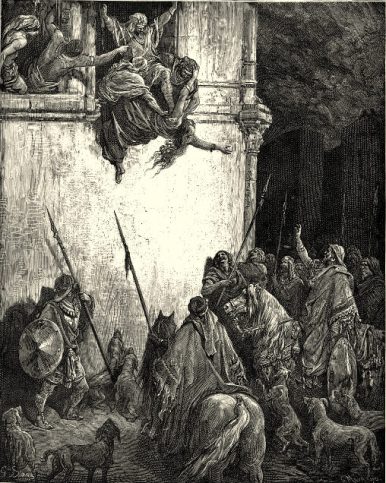
There’s a name so very rich in associations from my childhood encounter with the illustrated Bible. Although, not knowing the story at the time, I still remember my horrid The_Death_of_Jezebelfascination at gazing at a black and white drawing of a woman being thrown out of a window to an awaiting crowd of men and excited-looking dogs. I must have asked someone, probably my grandmother, who was this woman being thrown from the upstairs window? I learned her name was Jezebel. To this day, the very mention of her name brings back with vivid accuracy this simple pen and ink drawing.
Early memories are the strongest. The vinyl disc is a great analogy for the way that early childhood impressions of the world form deep grooves in the earliest anatomical part of the brain connected with the function of memory. Here is the seat of instinctual responses alongside which our earliest sense and internal fantasy experiences of the world are etched. This heady cocktail of instinct and early sense experience etched in deep grooves of early memory, exercise often unconsciously, an influence over the rest of our lives.

A further reflection from childhood

The social and cultural world of my family was not one in which Churchgoing was a regular practice. Nevertheless, all the adults I knew assumed themselves to be Christian simply because they never imagined one could be anything else. This was a world of nominal Christianity, which while not shaped by actual belief or practice, was nevertheless peopled with Biblical character types. Jezebel was a popular Biblical character type frequently used to refer to any woman whose behavior raised a sense of moral indignation. To be called a Jezebel was an insult drawn from the cultural embedding of the story from 1 Kings 21. The utterance of the name is inseparable from associations and memories of it being used by both my grandmothers and to a lesser extent, my mother.

Reflection on the text

Ahab is a sorry excuse for a king. He is a very sorry excuse for a man. He is depicted as a man suffering from what we today recognize as narcissistic personality disorder, a condition that much afflicts those with a drive for power. Narcissism is an essential element for each of us in our emotional makeup. Personality disorder is a way of talking about someone with a severe character defect that impairs their capacity for mutuality – the give and take of relating that happens when two people give each other space to be themselves.

There are two main types of this condition, which I will refer to as dependent or aggressive. Both kinds of narcissistic disturbance make it difficult to tolerate the frustration of experiencing another’s separateness. The aggressive narcissist experiences other’s independence of mind and action as a deeply threatening personal affront or even attack. They respond viciously, going for the jugular. We recognize that this is often a characteristic of those who seek power because power blurs the distinction between self and others – others become simply extensions of our ability to impose our will. The other person is merely an extension or a pawn in the pursuit of one’s own desires. The character Frank Underwood from Netflix’s House of Cards demonstrates this personality type, well. There are others from real life politics that could also be mentioned here.

In this story from 1 Kings – Jezebel conveys an aggressive narcissist profile while Ahab seems to be of the more dependent type. Faced with Naboth’s refusal to sell his land to him, Ahab withdraws into depressed isolation. Ahab’s type needs the ruthless aggression of a Jezebel and in this instance, she does not disappoint him.

Naboth’s refusal to sell his patrimony reflects an understanding among Israelites that the land is only on lease from God, and that what we might call the freehold of land is vested in God’s ownership. God gave the Israelites their land in trust, to care and be responsible for. Part of that spirit of responsibility was neither to sell one’s own land nor confiscate unjustly, the land of another. Ahab is king in Israel, and as the king, he is simply God’s husbandman for just and good government. Alas, probably spurred on by his Sidonian (read non-Jewish) wife, Ahab seems to take his cue from the playbook of the Canaanite kings whose lands surround his. In short, he is weak and so needs his ruthless wife to do his dirty work for him.

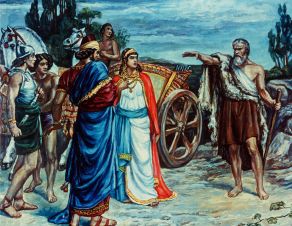
Enter Elijah, the man of God. In the preceding chapters of 1 King’s Elijah is continually on the move in remote regions in an attempt to elude the long arm of the king and his wife. He has hidden in caves, sought temporary shelter and sustenance with an impoverished widow. He feels rejected, isolated and alone, exclaiming earlier in chapter 18 that he alone is the only one left as a prophet in Israel. Yet, God does not let him hide away. The word of 1280px-Jezabel-and-Ahab-Meeting-Elijah-in-Naboth-s-Vineyardthe Lord comes to him telling him to go down to meet King Ahab and say to him: Thus says the Lord: In the place where dogs licked up the blood of Naboth, dogs will also lick up your blood. Elijah suddenly appears on the road Ahab is taking from his winter place to Naboth’s vineyard. His appearance on the road surprises the king who exclaims: Have you found me, O my enemy? And Elijah simply replies: I have found you. He then proceeds to proclaim God’s judgment upon Ahab and his house. For in Elijah’s words, Ahab has: sold [himself] to do what is evil in the sight of the Lord.

Reflection from the here and now

In the parish, I encourage Lectio Divina as a group spiritual practice. In short, Lectio Divina is a way of reflecting on a passage of scripture in the belief that through it God is seeking to draw our attention to something we need to address in the present moment of time – say five to seven days. As I meditated on this passage from 1 Kings 21 the words sold yourself lept from the page, penetrating deep into my imagination. Sold yourself – I began to wonder what have I sold myself to do as a justification for an action or attitude? This is an uncomfortable question.

I continually find that the thing I sell myself to repeatedly is fear. Fear convinces me that:

  • Scarcity is the only reality, and so I become risk adverse to acts and attitudes of generosity and hospitality that lead me to an encounter with the reality of abundance.
  • That difference is an attack upon my personal integrity – my freedom of conscience, my own self-interest, and so I become intolerant and through intolerance, I collude with justifications for discrimination.
  • That no good deed goes unpunished and so I shrink back from concerned involvement and solidarity with those who need my help.
  • I sell myself to fear and I become timid and afraid and pull back from action and attitudes requiring courage and commitment to hope – a lack of faith in that which is still in the process of becoming known in the future.

I sell myself to a hundred and one different fears in every moment of my day and night. If this is true for me individually, then what does it mean when as a community, as a society, as a culture we sell ourselves to fear? This results in:

  • The degeneration of the quality and capacity for civic engagement.
  • The impossibility of informed debate.
  • The economic exploitation of ordinary people in the face of enormous wealth confiscation by the few.
  • The resurgence of racist, misogynist, and discriminatory phobias of many kinds, once again rising to stalk our streets and corridors of power.
  • The passive acceptance of disordered narcissism as a quality to be admired at best and tolerated at worst in our politicians, who pander to and stoke our fear, ensuring that our rage remains misdirected, aimed not at inequalities in work, housing, education, and healthcare, the legitimate sources of our rage, but at Latino’s, Muslims, foreigners, immigrants, Jews, Catholics, Protestants, Blacks, Women, Men, Gays and the Transgendered; all neatly stereotyped and scapegoated. 

Soon, only a few brave voices are left to cry out against the doing of what is evil in the sight of the Lord.

In ancient Israel, all sections of society were bound by a covenant with God. The social justice aspects of the covenant were spelled out clearly in terms of mutual responsibility. This was a world in which wealth and power could not be severed from responsibility. Attempts to do so brought God’s judgment articulated through the voice of the prophet. I am left wondering what his equivalent might be today?

We live in a more democratic age when it’s not the voice of an individual, but the consensus of the community that speaks truth to power -Elijah as the voice of community conscience. David Brooks wrote this last week:

The larger culture itself needs to be revived in four distinct ways: We need to be more communal in an age that’s overly individualistic; we need to be more morally minded in an age that’s overly utilitarian; we need to be more spiritually literate in an age that’s overly materialistic; and we need to be more emotionally intelligent in an age that is overly cognitive.

Brooks argues for a reinjection of soul into our physical and social lives so that: 

We’d understand that citizenship is a covenant, too, and we have a duty to feel connected to those who disagree with us.

That’s the nub of the rub between Ahab, Jezebel, and Elijah. Brook’s conclusion is that we are more than utility-maximising individuals, we are love and connection seeking individuals who find in community the possibilities for loving and being loved.

A core task of communities is to arouse and educate the loves, to widen and deepen the opportunities for love and to appraise people by how well and what they love.

Jesus is our guide on what and how to love well. He loves and accepts the love of the woman – (a Jezebel, not in the personality disordered sense, but in the sense of the word as my grandmothers would have used it), who crashes the dinner party to express her unfettered love for him as told to us by Luke in the Gospel reading.

Long before I knew how to read the words in my illustrated Bible, I knew how to imagine the pictures. I wish I had seen the picture of the exchange between the woman and Jesus at the dinner party at the home of Simon the Pharisee reported in Luke in 7:36-8:3. If I had, maybe this too, alongside the imagining of Jezebel being thrown to her death would have given me, at this crucially formative stage, a more rounded picture of the world.

Two Men, One God – Semon for Pentcost 3


A sermon from the Rev, Linda Mackie Griggs. A user-friendly warning, because of a recording error the audio on this sermon includes the whole of the Eucharist service.Due to an error in recording, there is no accompanying audio for this sermon.


…Jesus gave him to his mother.

These six words describe a simple gesture; made the more so because it is in such contrast with the ones before—Jesus touches a ritually impure bier, or coffin, of a dead man, and then brings him back to life. But these six words are Luke’s emphatic punctuation—a mic drop of sorts, to the entire episode, sealing a connection between Jesus and the prophet Elijah, who healed the widow’s son at Zarephath and then “gave him to his mother.”

This thread of connection between Jesus and the period of salvation history that Luke called “The Law and the Prophets” was crucial to his account of Jesus’ life, and identity as Messiah. Luke shows how the Jewish community in Jesus’ time came to understand him in the context of their own scriptures—their own Story of who they were. Those who would become followers of Jesus would do so as they perceived that his actions and words fulfilled a narrative of their identity as God’s Chosen. Those who would not follow him would find these connections to be dubious, and even blasphemous.

A major part of Luke’s Gospel project is to radically expand the definition of God’s Chosen beyond the boundaries of Israel and the Jewish community, but first, he needs to root Jesus in the rich tradition of Hebrew scripture.

Reading the Luke account of Jesus’ healing of the widow’s son together with the Elijah story in First Kings has led me to ponder how we read the Old Testament in our Christian context. Actually, the term “Old Testament” is symptomatic of a biblical perspective that has been common since the second century. It’s the point of view that holds that the sole purpose of the Old Testament was to foreshadow the New Testament, period. According to this perspective, without the New, the Old is not worth the time it takes to read it.

This is a potentially risky proposition because it effectively sidelines the Hebrew Bible’s role in Christian canon of scripture. For example, what if we see the story of the Passover and the origin of the celebratory Seder meal, not as the great story of God’s prodigious compassion for his people in freeing them from bondage in Egypt, but as simply the foreshadowing the Last Supper? Look at what we miss–we miss out on the full 3-D perspective of what it has been to be God’s people from the very beginning. And from such a narrow perspective it is a slippery slope to sidelining the Jewish household altogether. When we are seduced by the idea that Hebrew Scriptures have been superseded, even rendered obsolete, by the Gospel, it’s not too difficult to conceive of how the Jewish people may come to be seen as obsolete as well—and you can see where that has led us.

I talked about this with Rabbi Howard VVoss-Altmana couple of months ago. We discussed the fact that we as Christians often miss an opportunity to mine the riches of Hebrew Scriptures if we don’t take some time to try to see them from the point of view of the people by and for whom they were first written. If we’re not careful it’s as though our laser focus on Jesus blurs and diminishes the earlier tradition that nourished him in the first place. Thus we tend to see Elijah’s stories simply as the wild and wooly adventures of a wonder worker—to see him as more of an action hero than a prophet of the Most High God. So what if we look more deeply—to try to imagine what the Jewish community of Jesus’ time might have seen in the accounts of Elijah’s escapades—not just a charismatic miracle worker but also one who brings the powerful, healing and sustaining word of the One God to His people?

Elijah is woven deep into Jewish culture and worship—evoked regularly in Sabbath, Seder and circumcision rituals. He was a prophet to the Northern Kingdom of Isreal-Samaria in the time of his nemesis Ahab, a king “…who did evil in the sight of the Lord more than all who were before him.” Elijah was traditionally thought to be the precursor of the Messiah, which is why Jesus compares John the Baptist to Elijah in Luke’s Gospel. In the series of Elijah stories that we are hearing in First Kings during the first weeks of the Pentecost season, Elijah rails against Ahab and the peoples’ worship of Baal, even entering into a contest with the priests of Baal in a dramatic episode that we heard about last week. (You may remember; the bulls, the fire, the taunting… 1 Kings 18:20-39) Later God speaks through Elijah to Ahab, declaring a drought through the land (fitting since Baal was reputed to be the god of thunder and rain.)

So just prior to the story that we hear today Elijah flees to the wilderness, where he is miraculously fed by ravens, and then God sends him to a poor widow in Zarephath, in the region of Sidon. Sidon is significant for two reasons; first because Ahab’s wife, Jezebel was a Sidonian, and also because it is outside of Judea. The prophet has been sent to the margins; to an outsider of another tribe, and not one with which he is friendly.

Elijah is the prophetic word in the form of a wild man from beyond the borders—demanding hospitality from a desperately hungry widow and her son. She is vulnerable, with virtually nothing to offer, yet she shares her meager fare, and a generous God feeds all three of them “for many days.”

Yet God is not finished. Elijah abides for a time with the little family, and the son falls ill unto death. The widow feels that she is being punished somehow—has she courted danger by hosting the prophet under her roof? Elijah fiercely confronts God on her behalf, demanding justice for his host who has offered him hospitality and kindness. Elijah demands that God show mercy on this woman who has taken the risk of welcoming the divine word into her home.

God hears Elijah and responds with compassion. The boy lives.

And Elijah …gave him to his mother.

The God that Elijah declares to God’s people, not only to the stiff-necked people of Israel, but to the people beyond her borders, is a God of deep generosity and compassion—a God who hears the cries of the hungry and the grieving, who abides with the widow and orphan and shows mercy on them. This is a life-affirming God for whom love can defeat death.

Once we can begin to understand more about Elijah and what he represented, we can have an even more vivid sense of the impact that Jesus’ evocation of Elijah through a simple gesture would have on people. When Luke compares Jesus’ actions to those of Elijah he isn’t evoking the image of an action-hero. He’s reminding us of nothing less than the very identity of the God of Israel—and of all people. A God of love, compassion and sustaining grace.

…Jesus gave him to his mother.

The Hebrew Scriptures stand on their own, and the Gospel is rooted, and nourished by them even as they nourish their own tradition into full bloom right alongside ours. The relationship between the Elijah stories and the Gospel shows us, not a God and a people superseded by the Incarnation but an even richer, deeper view of the Gospel’s power to transform. We have a deeper, richer view of God’s radical witness and invitation from the beginning of creation—seeing the firmly-rooted prophetic word that has always, not just since the birth of Jesus, abided on the margins and called all of God’s people to lives of compassion and mercy. This is the tradition that Jesus claimed as he gave the young man to his mother. This is the tradition that shocked the people around him, not just a thread of connection but an electric current of recognition:

Now I know that you are a man of God, and that the word of the Lord in your mouth is truth.”

Memorial Day

Reflections on Luke 7:1-10

Luke gives us a story in chapter 7 that is so quintessentially his, even though it is Matthew, a writer with a very different theology of Jesus, who first records the story of Jesus, the Centurion, and his boy. This incident is quintessentially Luke because it is easy to see how it fits Luke’s wider project of presenting the Christian faith to the Gentile world.

Luke’s theology of Jesus is that of Paul’s. Paul is the boundary-crossing apostle, who takes the revelation of God in Jesus Christ beyond  the community of Jesus’ Jewish followers, into an active engagement with the wider, Gentile world. Luke’s contribution is to present the life of Jesus and the early Church seen through Paul’s theology within a coherent format that traverses the crevasses separating Christian, Jewish, and Gentile worlds.

The story of Jesus, the Centurion, and his boy is such a story. It has all the ingredients that normally would make it impossible for any meaningful engagement between the Jewish Jesus, the world of the Roman occupier, and Pan-Hellenic cultural norms.

The first element to note is how Luke uses both the Greek doulos -slave and  paid -boy to describe the Centurions servant. Paid is a term that in this context implies the possibility of the type of sexual relationship common between an older mentor and a younger protege and it is clear that this boy is no mere servant. Pederasty, while common in the Roman-Greek world was strongly condemned by the Jews with their patriarchal anxiety about homosexuality. There is no hint that Jesus seems concerned about this possibility.

Secondly, in communicating with Jesus, the Centurion uses the synagogue elders as his emissaries. This denotes an unusually friendly relationship between this Roman commander and a local Jewish community. These elders, who might usually have been hostile to Jesus seem keen to enlist his help in the service of a man they hold in high honor, to whom they clearly feel an obligation, having built their synagogue for them.

Thirdly, Jesus does not hesitate to set out in response to the request. Now something strange seems to happen. Does the Centurion change his mind? He now sends his friends to intercept Jesus and ask him not to come to the house. Is he conscious of the peril he is posing for Jesus in asking him to risk ritual contamination by entering the house of a Gentile: Lord do not trouble yourself for I am not worthy to have you come under my roof? In any case, again, there is no hint in Luke of Jesus being concerned about this.

Fourthly, Jesus expresses astonishment in the Centurion’s recognition of his authority – For I also am a man set under authority, with soldiers under me; and I say to one, ‘Go’, and he goes, and another,’Come’, and he comes …. Jesus exclaims that not even in Israel, i.e. among those which at this stage if his ministry Jesus understands himself to be called, has he seen faith like this.

For obvious reasons, most commentators gloss over the overtones of pederasty in this story. Most note the perplexing elements of the Jewish elders willingness to mediate and Jesus’ seeming willingness to risk ritual contamination. For many, the emphasis falls on this being a story about faith, the faith of the Centurion, who even though he is a pagan, and especially because he is a pagan, can be counted a righteous man in contrast to Jesus’s own people’s rejection of him. The piety of faith always provides a safe ground for interpretation.  

Crossing boundaries

Yet, the question for me concerns Luke’s possible purpose for presenting this story as he does? I believe Luke understands this story to reveal Jesus’ willingness to reach out and cross the boundaries that separate peoples and cultures. Inclusion is one of the key elements in Luke’s theology of Jesus. Luke is also a proponent of an early reconciliation between Christianity and Roman globalization. Under the umbrella of globalization and its agents, the Romans maintained relative stability between otherwise suspicious and hostile cultures, tribes, and nations. Rome was the last great agent of globalization in the ancient world.

Globalization only works when it is able to buy allegiance through ensuring prosperity and safety for its different constituent cultures. Initial periods of conquest and rule through fear don’t last unless the conquered come to see their self-interests reflected in the benefits of empire. The Pax-Romana ensured peace, stability, and economic prosperity among the polyglot cultures of the Mediterranean world.

A tension in early Christianity lies between its Jewish exclusivist and Gentile universalist movements. Luke is on the side of the latter. Hence, his story of Jesus, the Centurion, and his boy offers a powerful metaphor for his worldview, one in which Christianity is the ally of Rome, not its enemy.

Luke’s worldview predominates. The Jewish faction of Christianity dwindles and with the exclusion of Christians from newly emerging Rabbinic Judaism, the Gentile Mission becomes the only game in town. The Gentile Mission is so successful, the reconciliation between Christianity and Pax-Romana so complete, that Christendom eventually emerges to replace Roman power as the central globalizing influence.

Hearing the story in our context

On Memorial Day Weekend, amidst the events of an unfolding presidential election, how do we hear this story?

imagesThe origins of Memorial Day are complex and a number of places in both the Old South and North claim to be have been the location for the first Memorial Day. Memorial Day is the day when America has traditionally honored her war dead, beginning with the 600,000 plus dead of the Civil War. Memorial Day Weekend also marks the beginning of summer. This unfortunate coincidence results in most people celebrating the weekend, not as a commemoration of the war dead, but as the start of BBS (barbecue and beach season). At least at St Martin’s in Providence, we will be breaking out the black vestments (literally) for a solemn commemoration of the war dead on Sunday.

Is there a theme linking Luke’s gospel story and its worldview with Memorial Day and the unpredictable future we are now facing? I think there is. I detect the theme of the tension between globalization and tribalism.

The Civil War was a manifestation of a long-running resistance to the globalization embodied in the Constitution and its establishment of the Federal Government. There came a point when the forces of national globalization lost the allegiance, albeit reluctant from the beginning, of a section of the States that comprised the Union. Globalization became identified with the economic power of the manufacturing North. Fuelled by northern industrialization it became so serious a threat to the Southern slave-based economy that a section of States no longer felt their peace and prosperity protected within the movement for national globalization.

Throughout the 20th-Century, the forces of economic globalization became increasingly identified with US national interests, especially in the post-1945 development of a Pax-Americana. However, the hand-in-glove relationship between economic globalization and American self-interest has been unraveling for decades now. The US economy, now like every other world economy is a client state of international, economic globalization. The result of this is that increasingly large numbers of Americans no longer enjoy the benefits of a close alliance between transnational capital and the U.S. national interests. Whether we are industrial workers whose manufacturing jobs have gone off shore or middle-class people victimized by a financial industry that sees itself as its own business rather than as a support for the growth of business, we, the hurt and disillusioned are increasingly looking for the arrival of a new messiah to free us from our plight.

We now experience international, economic globalization as economic, exploitative, colonization. We should not be surprised when the old animosities of racism and gender oppression, now insidiously dressed up in the tribal clothes of States rights, resurface as expressions of tribal cultural responses to the failure of globalization to meet our needs. These dangerous genies, once released from their bottles are hard to put back, and we will all suffer the consequences.

In conclusion

Christianity when rooted in the values of the Gospel, can never support solutions that promote a regression to tribal mentalities that divide the world into a them-and-us worldview. However hard it might seem to see Luke’s story of Jesus, the Centurion, and his boy as providing us with badly needed answers, it is clear that it shows us the trajectory of Christian living based on Jesus’ own behavior in reaching out beyond the tribal boundaries that separated him from the Centurion. It shows the Centurion recognizing the commonality he shares with Jesus, for both are men in authority. It’s a story that celebrates the common experience and shared perspectives that reach across the boundaries of cultural, religious, and economic differences. It’s a key story in Luke’s promotion of Christianity as a reconciling and bridge building movement capable of changing the world.

There are key moments in history when Christians are judged by later generations as to whether they embraced the Gospel as an agent of resistance in the face of the resurgence of tyranny. I believe we are living in such a time, and will be so judged by our children and their children.

The Trinity – knowing ourselves in the gaze of another.


My old university chaplain used to scoff: Trinity Sunday – ridiculous! How can you celebrate a doctrine as if it’s an event? I remember at the time thinking this was a wise and incisive comment. Now, I just think he missed the point. Did you know that among Anglicans and Episcopalians, in particular, the dedication of Churches to the Holy Trinity far outnumber any other single dedication? This is a hidden indication that for us the concept of the Trinity, at least once upon a time, held a central place in our spiritual culture.

Every Sunday we say together the words of the Nicene Creed, which distill down to four concise statements:

We believe in God, maker of heaven and earth.

We believe in Jesus Christ, eternally begotten of the Father.

We believe in the Holy Spirit, the giver of life.

We believe in one holy catholic and apostolic Church.

Why does Christianity seem to complicate what for Jews and Muslims, our Abrahamic cousins, seems very straight forward – God is one and God is singular. Except on Trinity Sunday, most of the time I suspect that this is how most Christians also picture God. We still struggle with the appropriate pronoun for God; he or she? Yet, in the earliest chapters of Genesis we read of God self-referring as us and we. I will come back to that in a bit.

The doctrine of the Trinity as we have inherited it today is the result of a need in the Early Church, not so much to explain the nature of God as to protect the nature of Christ from being reduced to one of two simple assertions – divine or human. For the key question arises, if God is God, who and what is Christ?

There were two answers to this question. The first was that Jesus is God masquerading in human form. If he’s divine, Jesus is not genuinely human in any meaningful way that you and I are human. The second asserted that Jesus was only a man, although a great man, something today we refer to as an avatar. The prophet Mohammed, and the Buddha are avatars, great human beings who show the way to God in the case of Mohammed, and the cosmic order in the case of the Buddha.

The Christian experience is that Jesus was both divine and human, both natures existing simultaneously, yet independently. Why assert something that to all the world seemed absurd? The assertion may seem absurd, but it goes to the heart of the experience the Early Christians and Christians since continue to encounter. The divine and the human lie at opposite ends of a continuum. To be human is to be most like God. But this requires God to have experienced being really human, first.

Last week we celebrated the descent of the Holy Spirit on the Day of Pentecost. For the followers of Jesus, this is the point at which they locate a fundamental shift in their self-understanding and worldview. And so we say in the lines of the creed we believe in the Holy Spirit and the holy catholic and apostolic Church.

An interesting question

It’s interesting to speculate that without the Pentecost experience, would Christians have settled into a belief that Jesus was simply an avatar, a truly divinely inspired human being possessing a unique spiritual access to God? After all, this is what nearly happened.

Those who believed that Jesus was a highly evolved spiritual, human being were known as the Arians, nothing to do with white racial purity, but followers of a bishop called Arius. The joke about heresy is that it’s always more plausible than orthodoxy. The Arians were defeated at the Ecumenical Councils, but the plausibility of their view persists throughout history and today it’s probably true to say that many Christians are actually Arians. In the popularity of the cult of Jesus the really good man and my best buddy, Arianism is alive and kicking in contemporary America.

Yet, the Holy Spirit anointed the Church to become the continuance of Jesus’s ministry in the world. For the early followers of Jesus, this was not just an inspiring memory of Jesus but an inspirited experience of Jesus still being actively and instrumentally present in their live and their world.

The emergence of a doctrine

The doctrine of the Trinity emerges from the early Christian struggle to account for the fact that they experience three distinct modes of encounter with God. Firstly, as Jews, they believe in God the Creator, the God of their ancestors, of Abraham, Jacob, and Moses. Secondly, they experience a life-changing encounter with God in the ministry, death, and resurrection of Jesus. Thirdly, they encounter a source of empowerment that transforms them into being able to continue the work of the Lord, empowered through the indwelling of the Holy Spirit. They experienced three manifestations of something they knew to be the one true God.

The bishops meeting in the Ecumenical Councils came to articulate their experience of these three distinct kinds of encounter with God. They naturally used the philosophy of the day, that of Aristotle and his concepts of person and substance. Applying Aristotle to their experience of God in three contexts led them to understand God as three persons sharing a single, unified substance. So they came to speak of three persons in one God, not three Gods. The crucial point we need to accept is that their purpose was never to explain the mystery of God, but to protect the mystery of God’s divine nature from being reduced to only that which human logic can conceive of, i.e that which seems to be not absurd.

Perspective from the 21st Century

The demand in each generation is to interpret the Christian Tradition handed on to us from previous generations so that it empowers us to engage with life as it is lived, not as it was lived in an imagined previous golden age. For the Christians of the first four centuries, the currency of intellectual thought was Aristotle’s logic. Now the reality today is that few of us use Aristotelian logic to navigate our way through the complexities of life and faith in action. I know of some who regret this, but it is as it is. In the contemporary mindset, Aristotelian philosophy has been replaced by a psychological understanding of human nature. Whereas once Aristotelian logic offered a vehicle for theological articulation, today, depth and transpersonal psychology offering us new vehicles by which we can express ourselves, theologically.

There is a recognized psychological theory for how our individual identities emerge from our relationships with others. Our individual identity i.e. who I am – is constructed from our experience of intimate relationship with others. The person I experience myself being emerges from how I perceive others viewing me. I catch a glimpse of myself in the face of the other looking back at me.

From doctrine to experience

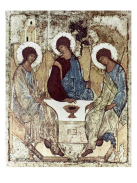
andrei--rublev-russian-icons--the-trinity_i-S-61-6179-4K11100ZDespite the popularity among Episcopalians to name our churches after the Holy Trinity, the Trinity in the catholic and protestant West has been largely reduced to a theological doctrine. The orthodox East provides an interesting counterpoint. In orthodox Christianity, the Trinity is a devotional focus. This can be most graphically demonstrated by Andrei Rublev’s archetypal depiction of the Trinity, written (icons are written not painted) in 1410. The Trinity is shown as three identical persons lovingly gazing upon one another. Rublev clearly has in his mind’s eye the visit to Abraham of the three angels at the Oak of Mamre. Yet, in the striking aspect of Rublev’s depiction of God the Holy Trinity, we catch the echo of the conversation we hear God having in Genesis, let us make humanity in our own image. God is not a singular entity, but a relational community.

When we put together the ancient echo in the Genesis record of God’s internal conversation with our current psychologically shaped experience of the fluidity of identity, we arrive at the theological realization that for us, in our period of history, God’s nature takes on a poignantly, relational quality.

Gender distractions

Today, any serious exploration of the Trinity requires us to address the debate about gender. The Tradition of the Trinity ascribed masculine identities to the relational elements Father, Son, and even the Holy Spirit is referred to as he. In our own period, it’s important to know that God is not gendered. The importance of the traditional male ascriptions to God lies not in their gendered but in their relational nature.

I have found a way to avoid the gendered terms and still retain the relational elements is to refer to God as Lover, Beloved, and Love-Sharer. It’s common to hear Father, Son, and Holy Spirit referred to as creator, redeemer, and sanctifier. However, the problem here is that these terms denote function, not relationship. It is the relational quality within the community of God that commends itself so powerfully to people living increasingly in a world where relationship, its presence or absence, is the measure of meaning and a key indicator of quality of life.

In conclusion

I don’t only believe in the Trinity as a doctrine, but I adore the Trinity as a focus for meaningful devotion. When I left Trinity Cathedral in Phoenix, I was given a precious gift, a new icon of the Trinity in the style of Rublev, written by Laura Smith, an accomplished icon writer and faithful member of Trinity’s congregation. When I gaze at each identical figure seated around the three sides of a table, I notice the way they are looking at one another. They gaze upon one another with expressions of intimate love.

Sitting before the icon of the Trinity I am reminded that my identity as a person is not constructed by me in isolation. I experience my identity as the result of the way I see others looking back at me. My identity is constructed through the interplay of my relationships. As I gaze upon the three figures of the Trinity, I am invited into a reaffirmation that I am a child of God because I belong to a community that reflects a relational God. I am a relational being and my health lies in my desire to seek my identity within relational connections with others. Only when we are fully in community together can we become an image of the unseen God, whom in the visibility of the Trinity we discover is not a solitary entity, but a relational community of love.

Three folds of the cloth yet only one napkin is there,
Three joints in the finger, but still only one finger fair,
Three leaves of the shamrock, yet no more than one shamrock to wear,
Frost, snowflakes, and ice, all in water their origin share,
Three Persons in God: to one God alone we make our prayer.
                                                                       An Irish Celtic prayer to the Trinity.

Pentecostal Imaginings

God and imagination

Some would tell us that God is the projection of human imagination. I think this is a basic misunderstanding. There is something philosophers recognize called a category mistake. A category mistake arises when something, an element or property of identity belonging to one category is assigned to another, different category. Thus, to equate God as the product of human imagination is to make such a category mistake.

It’s easy to do because while the existence of God is not the product of human imagination, our perception, and experience of of God comes to us only through the exercise of human imagination. If God is not a direct product of human imagination, imagination is required for God to take shape in our lives.

At St Martin’s in Providence, we have embarked on a community reading of the Bible in the form of something called The Story. On Sunday, May 15th, after celebrating the birth of the Christian people of God on the Day of Pentecost, an event recorded by Luke in Acts 2:1-11, we will gather in our adult forum to review and discuss our experience of having read chapters 4-6 in The Story. Chapters 4-6 cover the period from the Israelite’s exodus from Egypt, through the 40 years of wandering in the wastes of Sinai, to their arrival on the borders of Canaan, a land flowing with milk and honey promised by God.

Early Israelite imaginary

In our discussion of our reactions to reading The Story, we are beginning to be brave enough to speak openly of our dislike of the God presented in much of Genesis and Exodus. This is God, filtered through the imagination of a primitive, nomadic, warlike, tribal people. This is God portrayed in their own image, a ruthlessly jealous God, who when crossed responds with threats and actions of genocidal retribution. Yet, theirs is also a God who desires connection, a God capable of intimate relationship with Moses, a God who is responsive to the demands of relationship. God is amenable to Moses’s constant interceding not to destroy that which God also loves. We see in these pages a perception of God, who like the people God is attempting to preserve, struggles to walk the tightrope between the impulses of love and hatred, between the desire to preserve and the impulse to destroy when the object of love, disappoints.

Human experience of God is mediated through the structure of our imagination. In the pages of Genesis and Exodus, God emerges into an Israelite tribal imaginary. Our understanding of the events on the Day of Pentecost likewise permeate through the imaginations of the writers of the early Christian period. The imaginations of Paul, John and Luke communicate an experience of God at a point when Jewish thought is struggling to break out of a narrow xenophobic imaginary of God into a universalistic realization of the age-old dreams of the prophets.

The lectionary for Pentecost Sunday offers a multiplicity of choices including Genesis, the Palms, Paul’s letter to the Romans, Luke-Acts, and John’s gospel. For the first Christians, the Day of Pentecost recalls an experience of God, which they could only articulate through the images of the rushing sound of a mighty wind, the descent of flames of fire, and instantaneous translation. On the Day of Pentecost, the followers of Jesus had an experience of total transformation, which could only be articulated through metaphors of the human imagination.

Early Christian imaginaries

Any reference to Spirit – Holy Spirit has to be set against the first chapter of Genesis, which open upon a huge panorama: In the beginning, God created the heaven and the earth. And the earth was without form, and void; and darkness was upon the face of the deep. And the Spirit of God moved upon the face of the waters. The Hebrew word used for Spirit is the feminine noun Ruach. The Spirit of God is God self-identifying through the feminine principle for which she is the appropriate pronoun use.

In the 22nd verse in the 8th chapter of his letter to the Romans, Paul continues to mine the feminine principle within God as he depicts all of creation struggling in the travail of giving birth: for we know that the whole creation has been groaning in labor pains until now. Paul cements the feminine imagery intrinsic to God when he tells us that we too, continue in labor’s grip, groaning, panting, and pushing, driven by the hope of imminent new birth. In this state of travail, the Holy Spirit, like a midwife comes to our aid, supplying the strength we need to give birth to a new world.

For the Evangelist John, as Jesus bids farewell to those he has loved he tells them that: And I will ask the Father, and he will give you another Advocate, to be with you forever.  The Advocate will empower the disciples into an expanded imaginary of the love of God, enabling them to do even greater deeds than Jesus has performed.

The most popular image for the Day of Pentecost, the 50th day of the Resurrection, is given by the Evangelist Luke. Luke constructs a chronology of unfolding events from the resurrection, ascension, to the climactic moment in history when the Holy Spirit penetrates the created order. For Luke, the coming of the Holy Spirit marks the point of transition between the ministry of Jesus and its continuance in the life of the Church, now impregnated with God’s Holy Spirit.

Luke wants to draw our attention to the effects  of the interpenetration of human hearts with the Holy Spirit. The heat of fire, the sound, and rush of wind, a spontaneous understanding of the Spirit speaking to each in his or her own native tongue are metaphors for transformation. He juxtaposes these events with the story of the Tower of Babel in Genesis 11, where an older imaginary of God as jealous and somewhat insecure, fearful of human achievement needs to thwart human aspirations. God says: Come, let us go down and confuse their language so they will not understand each other.

On the day of Pentecost, all witness the descent of the Holy Spirit upon them, each hearing God speaking in their own language. The curse of Babel is lifted. Difference is no longer a source of division but of enrichment. Luke’s theological message is that for human society – born anew as the Church, it is no longer the business as usual of the old order.

God in a contemporary imaginary

In his poem God’s Grandeur the 19th century English Jesuit and poet Gerard Manley Hopkins proclaims that:

The World is charged with the grandeur of God. It will flame out, like shining from shook foil; It gathers to a greatness, like the ooze of oil – crushed.

Yet, against the background of this optimistic proclamation Hopkins questions why humanity is so reckless of God’s gift of creation: 

Why do men then now not reck his rod? Generations have trod, have trod, have trod;  And all is seared with trade; bleared, smeared with toil and wears man’s smudge and shares man’s smell: The soil is bare now, nor can foot feel, being shod.

Extending Hopkins’ inquiry, looking around us at the world in 2016, we see how easily human beings can be excited to fear the differences that lie between us?  Our labor pains are marked by the futility of war and the injustice of oppression in which generations have trod, have trod, have trod. We have become insensible to the feel of the earth, increasingly made barren beneath our shod feetOur social relations are mired: seared with trade, bleared, smeared, with toil sharing man’s smudge. 

We notice that we are not all the same. We notice the obvious differences between us expressed through gender, sexuality, race, culture, and class. Such differences become emblematic of the differentials of power, privilege, and access to the protection that difference affords to some and denies to others.

The birth of the new Spirit-filled order comes as a challenge to the human propensity to distribute power, unequally. Luke’s vision of the Holy Spirit is of the anima – the feminine principle of new birth embracing and celebrating the rich diversity of being human. Difference no longer needs to be the source of division but becomes a celebration of diversity as the Holy Spirit calms our fear.

From the perspective of 2016, on the Day of Pentecost, a contemporary imaginary of God comes to light. This is an inclusive and universal God. God embracing all kinds of diversity is continually coming true in Church communities of bewildering variety. Pentecost presents us with an image of God as Spirit now impregnated deep within the human DNA as that longed for God shaped space, or as Hopkins more poignantly says it:

And for all this, nature is never spent; There lives the dearest freshness deep down things;        Rose Window

And though the last lights off the black West went  Oh, morning, at the brown brink eastward, springs –
Because the Holy Ghost over the bent
World broods with warm breast and with ah! bright wings.

God’s Grandeur  Gerard Manley Hopkins S.J.

Vada Roseberry’s Creation Window, Trinity Cathedral, Phoenix

Sunday after the Ascension

images-1May 8th is a complex day. It’s the Sunday after the Ascension. It’s that in most churches, but at St Martin’s, it’s the day after Linda Mackie Grigg’s ordination as a priest, and the day of her first celebration of the Eucharist. It’s a baptism Sunday, and it’s also Mother’s Day. I intend to address Christ’s Ascension in the Adult Forum at 10.45 a.m. For those of you reading this only, I can refer you here to learn more on the theme. This now allows me to concentrate on the remaining three areas: Linda’s priesting, Mother’s Day, and baptism.

Linda’s ordination as a priest is not only a huge event in her life but also in the life of the community of St Martin, Providence. Over the last 18 months, we have witnessed a process that most parishes never directly experience. Since Linda took up the position as Director of Christian Formation, we have had the opportunity of experiencing what happens to a person as they grow, stage by stage into an ever-fuller expression of God’s call for them. Usually, this process of growing through the initial developmental stages preceding ordination as a priest is not so visible from a community’s viewpoint.

The difference with Linda is that she arrived fresh from seminary to take up her post heading Christian formation as a laywoman. During the time she has been among us we have been able to experience the changes in her as she has moved from laywoman into the transitional diaconate before emerging, like a swan, into the full expression of God’s intention for her as a priest.

I don’t mean to imply this journey is now complete. Linda’s ordination as priest reminds me of that famous utterance of Winston Churchill’s:

Now this is not the end. It is not even the beginning of the end. But it is, perhaps, the end of the beginning.

A little historical detour

The English Reformation was characterized by a long process of incremental change. Instead of the decisive break with the past that marked the Reformation elsewhere, in England reformation took place through an evolution of catholic structures under the influences of incresingly Protestant theology. As a result, Anglicanism came to be known as the middle way – via media.

After the death of Jesus, the Apostles represented the continuance of Jesus’ ministry in the world. They needed to focus on evangelism and so the internal care of the community was delegated to a group of ministers known as diaconoi – deacons or servants. As the Apostles died out either through martyrdom or natural causes they passed on their authority to new men who came to be known as overseers or supervisors, in Greek episcopoi, or in English bishops. As the Church continued to expand, instead of making more and more bishops, each bishop began to delegate some aspects of this authority to a new class of minister known as presbyters or elders.

The three-fold order of bishop, presbyter or priest, and deacon is the structure for ministry that we share with other Churches of the Apostolic Tradition, i.e. Roman Catholic, Old Catholic, Eastern Orthodox, and some Lutheran Traditions. In an overwhelmingly Roman Catholic State like Rhode Island, our use of the word priest to refer to the order of ministry Linda was yesterday ordained into can be a source of confusion, especially as the Episcopal Church is now home to a growing numbers raised in the Roman Church. The historic three-fold order is the same, the name is the same, but you simply have to spend only a little time in the Episcopal Church to intuit that the understanding of this ministry is somewhat different.

This difference in feel is an example of middle way understanding. In Roman Catholicism, the priest is set apart through the transmission of apostolic authority through the bishop to stand in the space between the baptized and God. As a mediator, he is both gatekeeper and custodian of the divine.

In Anglicanism the priest is likewise, set apart by the transmission of apostolic authority through the bishop, but not to stand between the baptized and God as a gatekeeper or mediator. For Episcopalians, the priest stands as one set-aside in order to represent to all the baptized a fuller realization of their vocation as a royal priesthood of all believers. Anglicanism really only recognizes one main category of ministry, that of the baptized. The threefold order of ministry is simply a grace-filled functionality for the benefit of the life of the Church.

Linda does not stand in a space between us – the baptized, and God. She continues to stand firmly on our side of the line, only now invested by us and graced by God to exercise a ministry of spiritual and sacramental leadership among us. 

Ordination is the end of the beginning of priestly ministry. It is not the completion of that ministry. Ordination confers authority through what we call the grace of orders. Authority and grace are the two elements that define a priest. So how does this all work?

A dynamic view of priesthood

We are already beginning to view Linda differently. We may not be aware of this happening, but it is happening. To get psychological for a moment, we now project a new set of expectations onto her. These expectations reflect that which we as a community, as well as individually, need Linda, as a priest to embody for us.

For Linda, she will begin to catch glimpses of her priestly identity through the way we begin to use her differently. She experiences this difference as we now bring a new set of expectations in our relationship with her, as a priest. We now look to her for qualities and capacities that we have hitherto not expected in our relationship to Linda as a deacon, or Linda as just herself.

As this is Mother’s Day, we can be reminded that we all come to know ourselves through experiencing ourselves reflected back in the eyes of our mother or principal caregiver. We first experience love through our mothers gaze. We glimpse our identity as we come to experience ourselves reflected in the eyes of our mother’s gaze. We first experience love through the shape of our mother’s facial gestures, the quality of her touch, the sound of her voice, the smell of her skin, the taste of her milk.

I use the feminine pronoun here because mothering has been traditionally a woman’s role. Traditionally, priesthood has been a man’s role. Yet, today, both priesthood and mothering are no longer gender specific roles. They are qualities of being that both men and women can possess. In the case of mothering, it’s the infant’s total dependency that triggers the qualities of mothering in his or her principal caregiver, whether this person be male or female. Likewise, priestliness is a quality triggered in the new priest as we – the baptized – come to see her or him as worthy of our trust. In both cases, infant and priest come to know themselves through the way they are known by others.

The grace of priestly ordination operates as a signal to the rest of the baptized that God is from now on working in a particular way through this person for the good of the whole body of the faithful. Through ordination, the new priest becomes recognized. So recognized, we have the opportunity to entrust them with our vulnerability. Through our trust in them, they catch glimpses of themselves as a channel for the loving acceptance of God, the grace of God flowing through them into the life of a community and into the lives of its members.

Anglicanism really only recognizes one main category of ministry, that of the baptized. May 8th is the day when Ione Rose is to be baptized. Through baptism, Ione Rose will become a member of the Body of Christ in this world. Through her baptism, Ione Rose joins the community in which Linda now begins her ministry as a priest. Our prayers today are that both Ione Rose and Linda will through God’s grace and our help grow into the fullness of the persons God is calling them to become.

From the collect for the ordination of a priest in the Book of Common Prayer:

O God of unchangeable power and eternal light: Look 
favorably on your whole Church, that wonderful and sacred 
mystery; by the effectual working of your providence, carry 
out in tranquillity the plan of salvation; let the whole world 
see and know that things which were cast down are being 
raised up, and things which had grown old are being made 
new, and that all things are being brought to their perfection 
by him through whom all things were made, your Son Jesus 
Christ our Lord; who lives and reigns with you, in the unity 
of the Holy Spirit, one God, for ever and ever. Amen.

Blog at WordPress.com.

Up ↑