Because They Hear My Voice


In the 12th-century, St Bernard of Clairvaux, founder of the great Cistercian reform of Benedictine life described Holy Scripture as: 

a vast sea in which a lamb can paddle and an elephant can swim.

When it comes to our encounter with the Bible through a regular practice of reading Holy Scripture, most of us will be lambs paddling. Yet maybe some of us if not already elephants swimming the depths will be encouraged to grow in that direction.

In 2015 St Martin’s engaged with a process called RenewalWorks. Our first strategic priority emerging from this engagement became and remains embedding the Bible in parish life. This is a tough sell because Episcopalians have come to share the Liberal Protestant dis-identification with the importance of reading the Bible.

Our dis-identifcation takes two forms. The fruits of 150 years of what’s known as Biblical Criticism has left us feeling that the Bible is for experts, scholars, and clergy trained to be able to unpack the sitz im leben,  which simply means the ability to interpret the text guided by the historical, cultural, and theological settings in which the text was originally written. This has led to a propensity among Episcopalians to encounter the Bible through the lens of commentary. Thus learning about rather than engaging with the text keeps us in our detached comfort zone.

The second form of dis-identificaiton from the reading of Scripture resides in the attitude that the Bible no longer belongs to us because it has been appropriated by them – them – being a reference to the fundamentalists. We not only find literal interpretation uninteresting, but we deeply reject many of the social and theological attitudes such an approach fosters.

Yet our Anglican Tradition speaks in the imagery of the three-legged stool in which Scripture, Tradition, and Reason are held in a mutual tension of equal relationship. We still honor Scripture, but we now only hear it within the context of worship. Outside of the formality of liturgy, we attempt to sit on a two-legged stool of Tradition and Reason. Straddling a two-legged stool requires considerable acrobatic dexterity.

St Martin’s is a community where few of us find it possible to accept faith as a matter of unquestioning obedience to the literal interpretation of words on a page. We are a community where faith depicted as an allegiance to a major life shaping narrative now finds deeper resonance and is taking root. Many of us enjoy the way meaning is conveyed through language that is complex, and nuanced. We are beginning to understand the way story shapes us individually and communally. We believe that metaphor more effectively conveys truth-plus, and that truth is poorly conveyed when limited to the face value of the words on the page.

****

The language of the Bible is such that meaning is conveyed imaginatively. Meaning is fluid and open-ended able to speak to the challenges encountered in our lived experience. Stimulated by the power of curiosity we are encouraged to explore beyond the simple meaning of words on the page. A rich appreciation of metaphor allows us to echo the words of the prophet Jeremiah[1]:

When your words came, I ate them; they were my joy and my heart’s delight, for I bear your name, Lord God Almighty.

Approaching the text for Easter 4 can we discover our experience revealed as truth-plus through the way text uses of metaphor and poetic figures of speech?

****

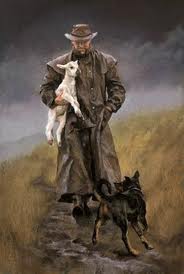
imgresThe Fourth Sunday after Easter conveys the arresting metaphor of The Good Shepherd conveyed through the powerful imagery of the 23rd Psalm and John 10. In 2015 when I last preached on these texts I drew upon what for preachers can become a clichéd contrast between biblical and contemporary images of shepherding. However, coming from a country where sheep outnumber people by 40-1, I am very familiar with the contemporary experience of shepherding sheep.

In 2015 I spoke about my nephew Hamish who on his sheep station in The Lord of the Rings high country of N.Z’s. South Island, shepherds his Marino sheep either from the seat of an ATV or the saddle of a horse, depending on the terrain. In response to a complex set of whistles and verbal commands from Hamish, his dogs dive and dart among the sheep barking and nipping at their heals. With his dogs, he drives his sheep before him in the direction he wants them to go. Hamish and his dogs, together with all New Zealanders regard sheep as animals gifted by the Creator with a double dose of stupidity.

How often our human relationship with God is depicted as a version of modern New Zealand sheep herding; God in the rear driving us on with the dogs of guilt barking in our ears and fear nipping at our heals. Yet, contrast the words of Psalm 23 in which God is the shepherd and we the sheep. God as the Good Shepherd does not drive us before him, setting his dogs upon us whose bark frightens us, and whose teeth nip us into line. Instead, he leads us beside still waters so that we may lie down in green pastures. Even through the valley of death, he accompanies us so that we need not fear any harm befalling us. His rod and staff are not symbols of discipline and control, but of protection and comfort. The Biblical image of sheep is one of cherished objects upon which the shepherd lavishes love and concern.

Again, a contrast between sheep and people reveals that it is not sheep who are created with a double dose of stupidity. Jesus, teaching in poetic metaphors discovers again and again that it’s the human beings that fail to hear his voice. The biblical image draws a distinction between the sheep who hear his voice and the people who are deaf to his voice. Hearing in this sense is a metaphor for knowing, for recognition. 

In John 10 Jesus uses a number of figures of speech centered on the notion of the sheepfold. He speaks of robbers, identified as those who do not enter the sheepfold by the gate. His metaphor for the entrance shimmers between images of gate and gatekeeper before Jesus finally identifies himself as the gate. Jesus is not some arbitrary gatekeeper but with his body becomes the gate across the entrance of the sheepfold, so that those who seek to enter to do us harm must first encounter him.

In response to hearing his voice, the sheep come and go, responsive to the shepherd’s voice, in pursuit of the green pasture. The mention of green pasture is a metaphor for life lived to the full takes us full circle back to the imagery of Psalm 23.

****

As lambs paddling on the edge of a vast sea of Scripture we begin to hear in the imagery of the Good Shepherd’s voice our own experience of the world as a place of both safety and danger. Both in Psalm 23 and John 10 danger surrounds the green pasture and still waters. Beyond the safety of the sheepfold lies the valley of death where we risk being catapulted to the precipitous heights of the illusion of self-sufficiency or cast down to the depths of isolation and despair.

As elephants swimming beyond the safety of the shore we face the prospect of no longer living in a place of security, but with a trust in God’s leadership –we swim heeding the sound of God’s voice as we follow with confidence and trust into the more turbulent waters of life’s sea.

But how can we know God’s voice when we have not learned to hear it? The narrative of faith provides a safe space within which our lives can be shaped in the direction of living with confidence and courage. Yet the shepherd does not keep the sheep penned up in the fold. He leads them out, but they can only follow if they follow secure of being able to recognize the sound of his voice.

As we count down the days until we launch The Bible Challenge to guide the next phase of our deepening engagement with Scripture on May 21st -22nd, I would like us to understand that rather than ceding control of the Bible to either scholars or literalists, we recommit ourselves to an older and more venerable tradition of engaging with Scripture through concepts of story rich with imagination stimulated by poetic figures of speech.

The ancient tradition of reading the Bible shared by Benedict and Bernard, that reads text through the images of allegory and metaphor invites us to a similar kind of engagement with reading the Bible. Despite the great distances of time, place and mindset separating us from Bernard of Clairvaux, John the Evangelist, the prophet Jeremiah, and the psalmist of the 23 Psalm, we share the experience of being shaped by the power of a poetic imagination whose rich language of allegory and metaphor opening our ears to recognise the distinctiveness of God’s voice among the cacophony of competing, false voices in the world. We may remain lambs paddling on the shores of the great Scriptural sea so long as like lambs we come to recognize the Shepherd’s voice.


[1] Jeremiah 15:16 New International Version


What things?

A sermon for Easter 3 from the Rev Linda Mackie Griggs, assisting priest, St Martin’s Providence: Luke 24: 13-35

There are places in the Holy Land where it is possible to feel that you’re walking where Jesus walked. The shore of the Sea of Galilee. The Temple Mount in Jerusalem. A garden near the Mount of Olives. But not the Road to Emmaus; at least not for me. Its precise location is debated and claimed by various localities in the area, so one knows from the outset that the exact Road these days is a matter of speculation. Still, a girl can hope, right? So we got on a bus. And took a multi-lane highway (already inauspicious) leading out of Jerusalem to a gravel parking lot, next to a ruin of a Byzantine church, and a gift shop. Sigh. Not exactly a place of picturesque transcendence where one can contemplate the disciples’ encounter with the Risen Lord. Even MY imagination couldn’t summon it up through the diesel fumes and the sounds of nearby traffic. I had so wanted my own personal Road to Emmaus Experience. But I was disappointed.

In retrospect that’s not such a bad thing. Because the story of the Road to Emmaus begins with disappointment and dashed hopes. “We had hoped…” The disciples had had a vision of who Jesus was supposed to be, in spite of his pointed assertions throughout his ministry that their expectation of an earthly liberator was unfounded. And Good Friday was the end of their hopes of political influence. Even the surprising news of an empty tomb wasn’t enough to open their eyes to the reality of the Resurrection. It took an encounter with a Stranger on the road to show them the foundation of what it is to be People of the Resurrection.

The first hint of this foundation is seen in a single question posed by the Stranger to the two disciples trudging down the road on the evening of that first Easter day. Cleopas grumbles, “Are you the only stranger in Jerusalem who does not know the things that have taken place there in these days?” And Jesus says simply, “What things?”

“What things?” This phrase has been described as the beginning of pastoral ministry. Jesus has come upon two friends who are obviously in a state of anxiety and distress, and he walks with them, asks them a simple question, and then waits. And when they begin to speak, with their words sometimes tumbling over one another’s, he listens. And then, because he’s Jesus and not a licensed pastoral counselor, he teaches. But first, he listens, and that is the key point here: The disciples’ very first experience with the Risen Christ is with his willingness to walk with them and to hear what they have to say. This is a crucial aspect of any meaningful relationship. And it is not a coincidence.

“When he was at the table with them, he took bread, blessed and broke it, and gave it to them. Then their eyes were opened…” Table fellowship is one of the most significant characteristics of community and family relationship. The breaking of bread is the beginning of the Jewish family meal, particularly on the Sabbath; each person takes part of the bread as it is blessed. So here Jesus becomes known to his companions in an activity that not only commemorates what he did at the Last Supper, but, for anyone who had not been present in the Upper Room on the night of his arrest, the breaking of bread would still be emblematic of the relationship of family members to one another and to God.

“…And they recognized him; and he vanished from their sight.”

I have always pictured this scene in a particular way: Jesus is seated between his companions and they are focused on him as he breaks the bread. And then as he vanishes they are left looking…at one another.

This is also not a coincidence. First, he walks with them and listens. And then he breaks bread with them. Then he leaves them with each other, and within the hour they returned to the rest of their friends. To their community.

Think about it. There are too many examples to name of how often Jesus shows or speaks of the importance of relationship. During his ministry he refers to himself as shepherd, as vine—both forms of relationship. And on the cross he gives his mother and the Beloved Disciple to one another in a new family: “Woman, behold your son…behold your mother.” And after he rises from the dead he sends Mary; “Go, and tell the others…” Later he tells Peter, “Feed my sheep.”

Relationship: The basic building block of Christian Hope and of what it is to be People of the Resurrection. There is a temptation to dismiss this as simplistic. But basic is not the same as simplistic. Basic is fundamental.

What was Jesus’ lowest, most wrenching moment on the cross? “My God, my God, why have you forsaken me?” Forsaken. Alone. Out of relationship. This is not a coincidence. When we speak of our Trinitarian God—Father, Son and Holy Spirit, or as Lover, Beloved, and Love-Sharer—we are referencing a God who is, by definition, relationship. And we are made in that image. Jesus’ life and ministry was all about showing us that the Dream of God is first and foremost about reconciliation—reconnecting with our fundamental nature and the fundamental nature of all Creation—and that is right relationship.

What is the basis of modern psychotherapy? The healing of relationship. What is the basis of spiritual direction? Spiritual friendship—two people who agree to listen for and discern God’s voice together. What is crucial to the building of resilience in children who have experienced traumatic loss? According to a recent New York Times op-ed, strong loving relationships that name and face grief together. All of these are examples of how people can seek healing and wholeness in a society threatened by isolation; an isolation that is fed largely by the myth of self-reliance; by the fallacy that needing help is a moral failure.

We treat the myth of self-reliance as foundational and weakness as marginal when in fact it is weakness and vulnerability that can lead us, if we will let them, into deeper knowledge of our foundational interdependence; into deeper relationship with each other, God, and Creation. After all it was Jesus at his most vulnerable who exhibited the profound strength of love to forgive every hurt, to meet us in our suffering and shattered hopes, and to render powerless that which would isolate and forsake us. And having done that, he gave us to each other in the breaking of the bread.

So what does that mean for us? What does it look like to be People of the Resurrection? That was the question in the back of my mind as I drove home from church on Easter Sunday. And that is when I heard, on an NPR storytelling program, about The Council of Dads.

In his story author Bruce Feiler told of receiving a devastating diagnosis of a rare form of bone cancer. His life was turned upside down—all of his hopes and expectations thrown out the window. His greatest concern was that his three-year-old twin daughters would grow up without a father—he wouldn’t get to teach them to ride a two-wheeler, to schlep their belongings to their dorm rooms, to walk them down the aisle. It was an overwhelming disappointment. In times like these there is a temptation to close ranks emotionally; to try to muscle through a crisis—to give in to the myth of self-reliance. But rather than shutting himself off he chose another path; he decided instead to seek out the men that he had known in his life who had shaped his identity. He decided to convene The Council of Dads.

The Council of Dads were chosen for the gifts that they could offer to Feiler’s daughters—gifts of bravery, curiosity, adventure, perseverance. Each member of the Council agreed to be there for the girls in the event of their friend’s death, and immediately began doting on them. And, since they were from different parts of Feiler’s life and were strangers to each other, now they got to know one another.

And it changed all of them. Feiler muses, “Something in our culture conspires against friendship…We have our work, we have our family, but friends keep getting pushed aside…[The Council of Dads] had built a bridge and allowed us to invite our friends into the thing that means the most to us, and that is our family.”

Relationship. What does it look like to be People of the Resurrection? Look around you. You never know who you’ll meet on the road.

Let Him Easter in Us

Sermon for the Second Sunday of Easter from John P. Reardon, a former Roman Catholic priest, currently in the process of recognition of priestly orders in the Episcopal Church.

We all turn to stories to find narratives to explain our lives to us, to give us some way of making sense of our what has happened to us and to our world and what we hope for the future. Stories have structures. There are tragedies and comedies. There are formulas for “buddy movies” and romances and spy thrillers. There is a Marxist narrative of class struggle. The modernist tale of inevitable progress. Then, there is the Theater of the Absurd, in which plots make no sense.

In J.R.R. Tolkein’s Lord of the Rings Trilogy, the hobbits Sam and Frodo try to decipher the meaning of their own narrative. “I wonder what sort of tale we’ve fallen into?” Sam asks Frodo. Frodo replies, “I wonder. But I don’t know. And that’s the way of a real tale. Take anyone that you’re fond of. You may know, or guess, what kind of a tale it is, happy-ending or sad-ending, but the people in it don’t know. And you don’t want them to.”

As we turn to Scripture, which contains the story that is the guidepost for Christians, we find the disciples of Jesus at a point of confusion. All their hopes have been dashed with the execution of Jesus. They live in fear that they may be next to feel the wrath of Jesus’ enemies. Then, they begin to get intimations of a possibility beyond what they could have conceived, that the death of this Jesus they had followed was planned, and that the same Jesus who had died now lived in a new and very different way, turning the apparent meaning of his death upside down. Each of them had to decide, “Do I believe?”

We are happy to sing the songs of Easter and to speak the comforting words of everlasting life. We want to believe. But do we? This is not the story we are used to. In the story we would tell, events would unfold as they do in romantic comedies and James Bond movies—there is a development, a crisis, all is nearly loss, and then loss is averted at the last minute and all is turned into victory and a happy ending. Jesus wouldn’t be crucified. He might come close, but some last intervention would stop it from happening and the tables would be turned in favor of Jesus and his followers. Obviously, that is not what happened. The story ended badly. Belief in the resurrection of Jesus requires us to step outside the bounds of our predictable story.   The narrative ends. There is sadness. The curtain goes down and the audience goes home. It is only several days later that a new narrative develops that swallows up the former one and gives it new meaning.

Dare we trust in that broader and deeper narrative put in place by the resurrection of Jesus? We all say we do. In private, I wonder how sure we are. Perhaps we all have moments when we sense, in the words of Shakespeare, that life is merely “a tale told by an idiot, full of sound and fury, signifying nothing.” I’m reminded of a cartoon I once saw in which an Anglican priest arrives in heaven. Walking across a crowd to meet Jesus, he cries out, “Well, well! Who’d have believed it?” The name “Thomas” means “twin.” Twinship implies two individuals who are alike in every way, yet are individual and different. Perhaps there is both a believer and an unbeliever inside all of us. That may be inevitable for, as Frodo observes, people don’t get to choose the kind of narrative in which they find themselves. Like the great masters of suspicion of modernity—Freud, Marx, and Feuerbach—Thomas may have hesitated to place faith in something that he so desperately wanted to be true that he could not be sure he was not creating the story he wanted instead of facing the one in which he actually found himself. He wanted to see and touch the nail marks and the hole in Jesus’ side, to know that what he was seeing was in fact the same Jesus of Nazareth he knew and who had been put to death.

But when given the opportunity, Thomas only looked. He did not touch. Instead, he leapt to faith, going beyond the realization of the resurrection’s first witnesses to proclaim the divinity of Christ, crying out, “My Lord and My God!” Jesus then proclaims that those who have not seen and yet believe are blessed indeed.

The First Letter of Peter addresses early Christians who share with us the reality of never having seen Jesus in the flesh. “Although you have not seen him, you love him; and even though you do not see him now, you believe in him and rejoice with an indescribable and glorious joy, for you are receiving the outcome of your faith, the salvation of your souls.” We do not have full knowledge, only faith, a hint that the Christian story explains the data of our lives more thoroughly and convincingly than any other. We are already receiving the outcome of our faith, the salvation of our souls. We can taste the reality of that salvation when we are able to turn away from selfishness and start over, when we are able to forgive and to seek forgiveness, when we come to care more deeply about the fate of our world even when to do so costs us our sense of innocence, when we see addiction overcome and suffering endured nobly. All these instances are perhaps ways we can look at the glorified wounds of the Risen Jesus. We know the wounds. We also know that faith makes new life possible. The more we live out of the faith that the Gospel is true, the more, in fact, it comes true for us, even now, even in the darkness of our own lives and of our world. We can believe in Easter because we can, in fact, touch and feel it at work in ourselves and in others.

The first light of Easter is in our grasp. I would like to close with a prayer composed by the poet Gerard Manley Hopkins in his masterpiece, “The Wreck of the Deutschland.” It is a poem written in memory of five Franciscan nuns being deported from Germany who perished alongside with many of their shipmates when their vessel, the Deutschland, ran aground onto a shoal at the mouth of the Thames in December 1875. In this poem, Hopkins wrestles with the brutality of death in freezing winds and waters on a harsh winter’s night and tries to place those images in dialogue with the sovereign and gracious presence of Christ in all things. He writes of one of the sisters standing and calling out to Christ in a spirit of complete trust and acceptance that he is with her even in circumstances that would feel like abandonment. She does not expect to be rescued or to survive. But she confidently awaits her Lord’s embrace in the midst of his apparent absence. I suggest that we make our own the prayer in which Hopkins turns to this sister for intercession:

Dame, at our door

Drowned and among our shoals,

Remember us in the roads, the heaven-haven of the Reward:

Our King back, Oh, upon english souls!

Let him easter in us, be a dayspring to the

dimness of us, be a crimson-cresseted

east,

More brightening her, rare-dear Britain,

as his reign rolls,

Pride, rose, prince, hero of us, high-priest,

Our heart’s charity’s hearth’s fire, our

thoughts’ chivalry’s throng’s Lord.

Amen.


Easter Thoughts

1490Bergognonedetailb

Easter Day remains one of only two days in the year when it’s possible to catch an echo of the way things used to be as far as church-going is concerned. St Martin’s will be fairly full at 8 o’clock and full to capacity at the 10 o’clock.

Among those attending will be core members of the congregation. These are the regular Sunday worshippers, those also known to the treasurer – which is quaint Episcopal speak for regular financial supporters. Among others moved to attend church on Easter Day will be people visiting friends and family for Easter, and the members of greater St Martins’; those with historical connections with the church, along with those living nearby.

In an increasingly nonchurch-going society, and in a region which ranks with the Pacific North West as the least church-going in the country, I for one am delighted to see the Christmas and Easter congregations swell, yet this also poses a dilemma for the preacher. What needs to be said on such occasions that will not simply confirm conventional default expectations?

I assume that among those moved to come to Church this Easter will be those for whom the music of the Anglican Tradition is the draw. For others, it’s one of two times a year when the atmosphere in an Episcopal Church approaches the experience of a crowd buzz. For some, it’s the importance of renewing past echoes of childhood as a time when church – or more probably church school or youth group remains a good memory. What I do not assume however is that many moved to come to Easter services will have come with an expectation of hearing anything remotely useful – in equipping them to face up to the very real challenges of life as we encounter them in the early decades of the 21st-century.

***

In the 19th and 20th-centuries, Christianity placed increasing emphasis on the content of belief. The crucial thing was that you believed the right things and not the wrong things. Thus believing the right things was meant to guarantee that you did the right things and not the wrong things. More often for Episcopalians, this equation went the other way around. Doing the right things and not the wrong things evidenced that you believed the right things and not the wrong things. The thing is, that most of us no longer think in this way. 

The language we encounter in church expresses a mindset – representative of a world in which God was an inseparable part of the material universe. God was experienced in very real ways; in places, through objects and people, inhabiting the very spaces between us. God, alive and present within the experience of time and space, was never absent from our sensory and imaginative experience of this world where miracles held meaning. The resurrection of Jesus was regarded as just such an event, i.e. a miracle.

Then the Enlightenment happened and Western civilization became increasingly shaped by rational materialism. Rational materialism, with its increasing dependence on the physical sciences to come up with a theory of everything paradoxically locked God out of the material universe. God became merely an echo of the original watchmaker who long ago departed from the scene leaving humanity center stage, struggling with the responsibility to tend the machinery of the creation. Having become a rather cold and unimaginative space this mechanical universe was no longer a place of mystery and miracles.

Shaped by this worldview, we no longer expect to bump into God as we go about our business in the material world. God, in so far as God remains a meaningful concept for any of us, is now predominantly a personal experience. The mystical-spiritual, the metaphysical-poetic, has now receded from the material world into the non-material domain of the personal imagination. As a consequence, resurrection understood as a miracle – by which our prescientific forebears meant something more than real, a kind of truth plus, has become downgraded into a subjective experience, something the rationalistic mind regards as infinitely less than objectively real.

In our post-Enlightenment experience of the world, people are either alive or dead. They don’t die and then come back to life. The binary alternative of life or death appears to us to be a natural law of the universe. This Newtonian view of the universe takes its name from the great 17th-century English philosopher, Sir Isaac Newton. St Martin’s even has a window dedicated to him.

Newtonian physics still reflect our experience of the way the universe works. Yet, a new and seemingly mysterious view of the universe is revealed to us by Quantum Mechanics. In the Quantam universe objects behave differently and much of the behavior of subatomic bodies remains a mystery to us. For instance in the Quantum universe elements exist in a super-positional state. Energy is both wave and particle simultaneously. That is until the act of observation determines energy as one or the other, wave or particle for the sake of observational measurement.

In the resurrection, might Jesus have existed within the tomb in a super-positional state, with being alive or being dead as the two alternatives that become determined only in the act of observation? The act of observation, i.e. the experience of the disciples on this third day after the crucifixion determined that Jesus was alive. What’s most strange about their conclusion is that they observed him alive even though they had witnessed his death only two days previously.

For those of you who get really excited by the application of Quantum Theory to spiritual experience, I fear I am about to disappoint you. This is not the direction in which I wish to take the discussion about the resurrection – at least not this year – although as someone who invariably has to preach every Easter Day I will keep my options open for the future.

My point is that we have a growing awareness of a multilayered universe – even of the possibility of multiple parallel universes. That which Enlightenment thought regarded as impossible may actually be possible after all. The watchmaker may be more than the ghost in the machine, affecting material reality in ways that strict Enlightenment thought is unable to conceive of.

***

The way I want to approach the mystery that is Jesus’ resurrection is to understand it as a narrative event. I fear that those who attend St Martin’s regularly will be getting sick and tired of me telling them that humans are storied beings. We build meaning by constructing and sharing stories whose function is to articulate our experience of the world around us. Our perception of reality is always conveyed through language and the narrative organization of language. In other words, stories are all we have.

Now there are different kinds of stories. There are big stories that offer us lots of room to grow and realize our fullest potential. Then there are small stories that confine our imaginations and constrain the quality of our experience. What can make life confusing is that without always being aware of the fact, we draw on multiple stories that often conflict with one another, running simultaneously along different narrative tracks to make sense of our lives. The gift of truly big stories lies in their ability to synthesize the many smaller and cconflicting stories that compete for our attention.

The first Christians had an experience at the empty tomb that gave rise to the creation of the big story we call Easter. This is a story about the triumph of life over death, not just literal life over death but all the figurative iterations of the triumph of flourishing over failing to thrive, of victory over defeat, of light over dark.

The big story of Easter is a later chapter in the epic story of the Exodus Passover – a story about the experience of liberation from bondage, not just liberation from the literal slavery in Egypt but from all the iterations of bondage to all false illusions and fake idols.

The Easter story is not a small story of optimism. Optimism and its active application of positive thinking are modern small stories that seek to organize our experience around concepts like personal satisfaction, happiness, fulfillment, self-improvement, achievement measured in terms of material success. Optimism is the longing that things will continue to be on the up-and-up.

When events take a downward turn, optimism crashes and burns to be replaced by pessimism. The Easter story is a story of hope. Hope is not an expectation that things will continue to go well. It is the expectation that something new is happening, something that is beyond our ability to generate or create. This new thing intervenes and comes about through the correct alignment of our hopes and actions, refining expectations and reinterpreting experience in the direction of greater clarity of vision and a deeper realization of purpose.

Was Christ raised from the dead on the third day after his physical death on the cross? For many who cling to materialist stories – small stories that lock out the transformative power of God from our here and now experience, the answer is no. Yet if the answer is yes, the yes is not dependant on being able to explain the mechanics that underpin the event. The yes, articulates our desire to be shaped by a greater story than the one we are able to imagine for ourselves. When we let ourselves become molded by a story that liberates from illusions created by the be-devil-ments in our lives- the small, impoverishing, life denying stories we cling to, we come into relationship with a story capable of reorganizing our perceptions of the universe and how it functions.

The disciples on the first day of the week experienced the power of a new and larger story than they had hitherto known. They could not explain it, but they felt it and they created a large story that reframed their worldview so as to be able to articulate an experience of transformation. They were not transformed as isolated autonomous individuals. They became transformed through their participation in a community that was being transformed.

***

I don’t fully understand why many of you are here today, doing something that is, given the rest of the Sunday’s of your year, uncharacteristic. May I suggest that you may not know either why you are here today. Not knowing matters less than you might think. What matters is that you are. I invite you to take this more seriously than you otherwise might.

We live in a world where the old certainties based on shared stories are collapsing to be replaced by uncertainty and a fearful fragmentation fed by many small and viciously self-serving stories. I believe that the big story of Easter is something that helps us better navigate our way forward in a world where the very notion of true and false seems now contested – up for grabs. Human beings cannot thrive in such a world. Becoming transformed by the big story of Easter empowers us to offer alternatives through holding together into the face of prevailing trends.

At St Martin’s we are working to become a community that is more and more fit for God’s purpose, which we understand as becoming transformed as together we journey deeper into the mystery God’s vision for our jaded world hungry for the promise of new life. We are a community that increasingly believes that our work is to be agents for transformation in the world around us. We know this is possible only if we work together. One of the insights of the Easter story is that God primarily addresses us through our participation in communities where solidarity rather than individualism guides our values settings.

We are a community on a journey and we are strengthened on that journey every time someone new joins with us. To those of you who find yourselves in Church on Easter Day, I strongly suggest that you consider being there as an indication of your search for a story big enough to revolutionize your longing for deeper meaning and purpose in your life. If this is so, I believe you have come to the right place. Come back, taste and see.

Palm Sunday & Holy Week Address to the St Martin’s Community in Providence, RI

images

He had come to celebrate the Passover. Having traveled from Bethany, Jesus entered Jerusalem through one of its eastern gates to wild acclaim from the crowds that greeted him by stripping the fronds from the palm trees lining the road.

The waving of palms was a gesture that tells us something of popular expectations for Jesus. Some 160 years before the triumphant Judas Maccabeus led his victorious partisans into the Temple, bearing palm branches with which they cleansed and rededicated it after the defilement by the Syrian tyrant, Antiochus Epiphanies. The waving of palm branches reveals something of the expectations of Jesus as another liberator, who in the mold of Judas Maccabeus had come to free them from the hated Roman occupation.

At the same time as Jesus was entering from the East, another triumphal entry procession wound its way into the city from the West. The Roman Procurator, Pontius Pilate, at the head of his Roman Legion had also come up to Jerusalem for the Passover.

Pilate did not live in Jerusalem. He chose to avoid the city’s ancient warrens seething with civil and religious discontent. Pilate and his Roman administration preferred the sea breezes and Mar A Largo conveniences of Herod the Great’s former capital at Caesarea Maritima, now the administrative center of the Roman occupation of Judea.

Pilate hated and feared the crowds of Jerusalem most especially during the Passover celebrations. But he had to come up to the city on his once a year visit with a show of preemptive force in order to forestall the potential for insurrection during the flashpoint of the Passover. A wise move, for the crowds that hailed Jesus, were in insurrection mood.

Holy Week commemorates the events beginning on Palm Sunday of Jesus’ last week in Jerusalem before the Passover. Three narratives or storylines intersect and clash with alarming result as Pilate, the crowds, and Jesus all become caught up in an escalation of events none could control. The storyline of worldly oppression and political violence intersects with a storyline of populist resistance and nationalist longing for liberation at whatever cost. Both confront the third storyline which concerns the next installment in the epic narrative of God’s love and vision for the world.

Events take an unexpected turn and rapidly spiral seemingly out of control, culminating on the eve of the Passover with Jesus celebrating the Last Supper with his disciples, followed by arrest, mock trial, and crucifixion the following day.

On Maundy Thursday we will gather to celebrate Jesus’ Last Supper during which he washed his disciple’s feet, mandated (maundy) them to love one another, before instituting the Eucharist by establishing a lasting association between the Passover bread and wine and his body and blood soon to be broken and shed on the cross.

Holy Week is the week during which we accompany Jesus on the way of his passion. For some of us, this can be an intensely personal experience as our own experiences of loss and suffering – our passion surfaces in identification with that of Jesus. For most of us, however, the nature of our Holy Week experience is less personal and more communal. We journey with Jesus as part of a community that journeys to the cross bearing within us not only our individual maladies and sufferings, but the maladies and sufferings of the world around us.

Liturgy is a form of dramatic reenactment through which as a community, we are transported into sacred time. In ordinary time and space, we remember. In sacred time we become participants in the timeless events that engulf Jesus.

By timeless, I mean that liturgy is more than ordinary remembering, it is remaking again the past in the present. Liturgy ushers us into a dimension called sacred time where the temporal divisions of past, present, and future blend together in the eternal now. In sacred time we become participants with Jesus – as if we too are part of his band of disciples during that eventful last week:

  • Like them at his Last Supper, we experience the uncomfortable intimacy symbolized in his washing our feet.
  • With them, we share in the breaking and sharing of Jesus’ Passover bread and drink from his Passover cup.
  • With the disciples, we accompany Jesus to the Garden of Gethsemane and with them witness his arrest, trial, and crucifixion.
  • Over the following 15 hours of Thursday evening and into the Friday we call Good, we follow as part of the band of his disciples viewing with dismay and from a safe distance, the unfolding of frightening events.

On Good Friday, in addition to the two liturgies of Stations of the Cross at noon and the Solemn Liturgy of Good Friday at 7 pm, we also keep another tradition; one of action and solidarity in memory of Jesus with the current state of our world. In the Good Friday Walk, we join other Christians’ en-route to the State House for a public marking of this day. The Good Friday Walk is not an action taking place in sacred time but in the here and now. It is an action of solidarity that looks in two directions; towards solidarity with Jesus, and at the same time solidarity for the alleviation of hunger among God’s sons and daughters, our sisters and brothers. I hope that many of you will find time for both forms of participation on the Friday we call Good.

At the end of the Solemn Liturgy on the evening of Good Friday, we sing a hymn based on Jesus final words from the cross – it is finished. With the death of Jesus on the cross, the old order dies as Jesus begins his journey into hell where he vanquishes the ancient hold of evil over world. We mark Jesus’ descent into the realm of the dead on Saturday. On Saturday evening we gather in the waning twilight to celebrate the ancient liturgy of the Easter Vigil. Here in dramatic and timeless actions:

  • we kindle the new fire and welcome the new Light of Christ into the world.
  • we listen to highlights from the long epic story of our communal relationship with God
  • we renew our baptismal covenant and welcome the newly baptized into the Church
  • we celebrate with joyful noise the resurrection followed by an Easter party with champagne and chocolate.

On Easter Day we continue, joined by many from our wider community and beyond who are drawn to celebrate with us the resurrection – the new chapter in the epic narrative of God’s promise of new life.

Our memory fails us if we think of Jesus’ resurrection only in terms of “then” and not also in terms of “now.” We are not re-enacting Jesus’ resurrection; we are reappropriating Jesus’ resurrection power.-Br. Curtis Almquist SSJE

Visit our full Holy Week and Easter schedule here.

Seven of Seven


John the Evangelist tells the best stories! True, he does have a propensity to put long and theologically complex speeches into the mouth of Jesus that easily tax the attention span of the modern listener. Yet even in his set-piece discourses, John gives Jesus some pretty arresting sound bites, e.g. servants are not greater than their master, nor are messengers greater than the one who sent them is a good one for today’s political class to heed. Or, by this everyone will know that you are my disciples if you love one another.

Nevertheless, John’s whole understanding of Jesus unfolds within the framework of seven stories commonly referred to as signs of the kingdom[1]. These are undoubtedly among the best stories in the New Testament.

The story of the raising of Lazarus is the seventh in the series of seven signs. As with all John’s stories, it is complex and multilayered. The Raising of Lazarus constitutes a kind of prologue to the events that begin to spiral, culminating over the course of a Thursday night and Friday morning, two weeks from now.

***

Roberto Assagioli, the founder of Psychosynthesis was an early disciple of the great Sigmund Freud. However, Freud was notoriously cantankerous and brooked no disagreement from his disciples. Consequently, like Jung, Assagioli eventually parted company with Freud over Freud’s discounting of the spiritual component in human development.

I mention Assagioli because of a method of listening he advocated that employs something called bi-focal vision to distinguish personal psychoemotional elements from spiritual transpersonal ones within and individual’s life story. Bi-focal vision tracks two distinct elements that are nevertheless interconnected and intertwined in ways that create the confusion and conflict that brings a person into therapy in the first place.

Applying Assagioli’s concept to a text rather than a person, the use of bi-focal attention allows us to separate out the way John weaves a transpersonal -theological meta-narrative, i.e. an overarching inclusive story about salvation, into what is also a story of love, loss, and recovery at a human-relational level.

The story so far

Jesus, with his disciples, received a message from the sisters of Lazarus that their brother is ill and dying. Jesus greets the news with what appears to be detached disregard, saying Lazarus is not going to die, rather that what is happening to him is an opportunity to glorify God. He then delays setting out for Lazarus, Martha, and Mary’s home in Bethany by two whole days. In the meantime, Lazarus does die and is interred in his tomb. On the fourth day, Jesus nonchalantly declares that now Lazarus has died it’s time to visit his friends in Bethany, situated in Judea about a day’s walk from Jerusalem. His decision fills his disciples with dismay for Judea is now a very dangerous place for Jesus to go. Last time he was there he narrowly escaped being stoned to death. Nevertheless, they all set-off and as Jesus nears Bethany, first Martha, having been looking out for his approach rushes out to greet him. Likewise a little later Mary, when Martha tells her (privately) of Jesus’ arrival also goes out to greet him. Despite his seemingly enigmatic delay in coming, Jesus, now in a state of some emotional distress, is taken to the tomb and calls Lazarus to awaken and come out. To the amazement of most of the onlookers, Lazarus emerges still wrapped in his winding sheet.

***

When we apply bi-focal attention to this story, we can begin to see that there are two narrative strands flowing simultaneously,  throughout. This is a theological story about God and at the same time it is also a human relational drama. One strand is transpersonal in that it transcends individual experience, while the other is deeply personal.

We’ve already noted that the disciples are puzzled by Jesus’ response to the news of Lazarus’ imminent death. Instead of rushing off to Bethany he simply says that Lazarus’ plight is not one that will lead to his death but is an opportunity for the glory of God. At the human-relational level, this seems a callous response. However, here we have in John’s story the first indication of the transpersonal-theological motive of the glorification of God. But then Jesus immediately throws his disciples off the theological scent by mollifying their human fears in declaring that Lazarus merely sleeps, so no need to be alarmed.

The next puzzlement lies in the contrast between the two encounters Jesus has, first with Martha, and then her sister, Mary. Incidentally, we know both these women independently of John’s account. Both Martha and Mary appear in Luke 10:38-42, from which we learn that Martha is the active, doer, always on the go, while Mary is the contemplative one. John does not mention their Lucan biographies because like us, his hearers would already know them, and it’s no surprise that while Mary is being comforted indoors, Martha is out, pacing the road on the look out for Jesus’ approach.

Both sisters greet Jesus with identical words: Lord, if you had been here my brother Lazarus would not have died. We puzzle over how Jesus’ response to the sisters could not be more different. In his response to Martha, we see Jesus responding in theological focus. In response to what is in effect Martha’s rebuke – really Jesus, how could you not have come at once for now Lazarus is dead! he subjects her to an examination of her belief in the resurrection. I have to say that this is not evidence of a very good pastoral manner here. He then identifies the resurrection with himself leading Martha to proclaim: Yes Lord, I believe that you are the Messiah, the Son of God, the one who is coming into the world. 

In the theological strand within John’s story, Jesus understands the death of Lazarus as an opportunity, not for sorrow, but so that God might be glorified in the presence of the bystanders who come to believe. The absence of concern and anxiety can be explained because the outcome is already preordained, so no need to worry. Bi-focal attention allows us to see how John presents the encounter between Jesus and Martha at the level of the theological significance of Lazarus’ death.

By contrast, Jesus response to Mary who greets Jesus with exactly the same words as her sister has used, reveals Jesus now identifying with the human-relational level and thus he is profoundly overcome by grief and sorrow. John describes Jesus being greatly disturbed in spirit and deeply moved. The result is that Jesus too begins to weep with Mary. Bi-focal attention allows us to see John now presenting Lazarus’ death at the human dimension of a relationship of love and loss. Nowhere else, does Jesus appear more vulnerable and human than in his response to Mary, and together both now weeping, they go to the tomb of friend and brother.

It is at the tomb, we begin to see for the first time how the transpersonal-theological and human-relational strands come together because both are actually about relationship. Standing, publically weeping over the death of his friend Jesus now invokes his transpersonal relationship with God: so that they [the onlookers] may believe that you sent me! Lazarus come forth, is not only an expression of deep human compassion but is also a public proclamation of God’s glory.

***

John now tells us that many of the bystanders came to believe when at Jesus’ command they see Lazarus emerge still encased in his death shroud. It’s here that the Lectionary ends the story. But by ending the story here we are in danger of missing the larger point John is making in this story. This is not an all’s well that ends well, story.

For John, the raising of Lazarus is the turning point at which there is no escape from the path to the cross. When we read on in the text we learn that as well as some of the onlookers coming to faith others reject the theological message of salvation and go off to conspire with the Temple authorities. On hearing of events at the tomb of Lazarus, the authorities now have the evidence they need and vow to put Jesus to death; justifying their decision in terms of the murky politics of national security. Don’t let anyone convince you that the cross is not a political act. 

***

The raising of Lazarus is not a premonition of the resurrection, a kind of trial demonstration. Lazarus’ emergence from his tomb is simply resuscitation. Lazarus is returned to life for the somewhat limited purpose of glorying God in the presence of some of the bystanders. It is not to set up a happily ever after ending. For in the act of glorifying God, Jesus drives others of those who witness his action into the arms of the authorities, setting in motion the very resolve that will end in his arrest and death. Lazarus’ return to life is a limited time offer only and ensures that at some future date he will die again.

The theological point for John is that what begins in resuscitation will end in resurrection. If you want to know what the difference between the two is, you will need to tune in on Easter Day. You will only comprehend the difference, having first traveled the way of his Passion – liturgically speaking – with Jesus. In the meantime we pray:

Almighty God, whose most dear Son went not up to joy before he suffered pain, and entered not into glory before he was crucified: Mercifully grant that we, walking in the way of the cross, may find it no other than the way of life and peace; through Jesus Christ your Son our Lord. 

[1] The seven signs of the kingdom are:

  1. Changing water into wineat Cana in John 2:1-11 – “the first of the signs”
  2. Healing the royal official’s sonin Capernaum in John 4:46-54
  3. Healing the paralytic at Bethesdain John 5:1-15
  4. Feeding the 5000in John 6:5-14
  5. Jesus walking on waterin John 6:16-24
  6. Healing the man blind from birthin John 9:1-7
  7. Theraising of Lazarus in John 11:1-45


“We’re Not Blind! …. are we?”

John 9:1-41  A sermon from The Rev. Linda Mackie Griggs, Assistant Priest, St Martin’s Providence

imagesWe have here a story of a man who has had a transforming encounter with Jesus; a man whose story of God’s love and compassion is so compelling that he can’t help but share it. A man whose story is the cause of curiosity, wonder, and consternation all at once. A man who was cast out by his community of fellowship. A man who knew Jesus’ presence with him even in a moment of rejection and vulnerability, and worshiped him.

That man was the writer of the Gospel of John. His community of Jewish Christians was expelled from their synagogue because of their belief in Jesus as Messiah and Son of God, and this painful rupture in all likelihood influenced this narrative of a man cast out because he refused to disavow Jesus as the source of his healing.

So we have a story within a story; both of them about communities in points of transition and how they respond to the prospect of change.

I’ve always loved this passage because of its energy; a kind of theatricality that catches the listener up in a swirl of question and accusation, a cast of thousands (sort of) and a back-and-forth dialogue worthy of The West Wing.

And at the quiet gravitational center of it all; a blind man and a Messiah. One thing I do know; that though I was blind, now I see. This statement is a simple narrative of transformation. The man, whose name is unknown, doesn’t need to embellish; he just speaks his truth while neighbors, Pharisees, and parents talk past him, flailing about for more answers than he can provide, nor does he care to, really. Perhaps he has enough to deal with as he negotiates his way in a world now flooded with light and color; a world in which the Dream of God has come intimately close. He is, through the application of dirt, spit, and water, a new creation.

So he asserts his new identity though the cost is high; he is expelled from his synagogue. And yet Jesus, who, you will note, is only actually in this drama at the beginning and at the end, though his presence is felt throughout—Jesus seeks the man out and reveals his own identity:

Do you believe in the Son of Man?” He answered, “And who is he, sir? Tell me, so that I may believe in him.” Jesus said to him, “You have seen him, and the one speaking with you is he.” He said, “Lord, I believe.

For the writer of John’s gospel, this was personal. The energetic images make real a moment of conversion and its initially chaotic aftermath. The perseverance of the man who has been healed, the confrontation with the community, the pain of rejection and the moment of worship are related by a storyteller who is deeply invested in what he is telling.

…I was blind, now I see. A simple statement of identities; an old one transformed into a new one. And the Gospel writer has incorporated it into Great Story: In the beginning was the Word, and the Word was with God, and the Word was God. The Great Story of God’s love for creation is woven of smaller stories like this, of encounters with the Word made flesh; a tapestry of God’s Dream unfolding before our eyes.

And what gives this tapestry its vividness and dimension is its authenticity. There is not only the joy of healing in this encounter with Jesus, there is also the spiritual blindness and deafness of a community, and the pain of rejection—human frailty and vulnerability on full display. And this is important because it is frailty that teaches us the most about ourselves and who we are called to be as children of God and disciples of Jesus.

Notice the interaction of the man who had been born blind and his interlocutors. Question after question are launched at him, but does anyone really seem to be listening? The Pharisees are focused on violation of the Sabbath and whether the healer was a sinner. The man’s parents, rather than being overjoyed at their son’s healing, would rather be anywhere than being questioned by the authorities on the unusual way in which the healing had occurred. The neighbors are curious, but they either talk about him rather than to him or they keep asking the same question over and over: How did this happen? Where’s the guy who did it? And he keeps telling his simple story: …I was blind, now I see.

It’s like a feedback loop that they can’t escape. See, the thing about stories is that they are a two-way street. We’ve talked a lot about Story here at St. Martin’s, in part because storytelling is the connective tissue of the Body of Christ. But we haven’t talked much about what is fundamental to making a story truly effective. It must have a teller, obviously. But it isn’t a story until it has a listener—someone to attend to it. And the quality of the listening is as crucial as the narrative itself because it is only then that we have meaning, within the community.

So at the end of the story, when Jesus talks about blindness, he’s also talking about deafness—whatever dulling of senses has come to insulate us from fully encountering the truth of another. “Surely we are not blind, are we?”, the people say to Jesus. Well, actually, yes, you are, he says. As long as your own agenda keeps you from seeing, hearing, truly knowing the fullness of what is in front of you, yes, you are blind. And your blindness and deafness are distorting the story that someone is trying to tell you; they are obscuring the signs of new life that he is trying to show you.

The first-century community of John’s Gospel and the 21st-centurymainline church both share the experiences of enormous change and transition. An encounter with something new and untested tends to raise the adrenalin level so that we perceive threat where there might just as easily be opportunity. And when that happens it is vital to resist the temptation to retreat into nostalgia—a kind of blindness–and instead stop, breathe, and attend to what is in front of us.

Let the teller tell the story

In our Lenten Program this year this is what we are doing. In the course of our dinner discussions we have the opportunity to tell stories about our journey of faith and to listen to each other. We are learning to articulate our faith in a way that is magnetic to others—attracting them to a community that seeks—and very much needs–to grow. And the corollary to the telling of each story is that we also learn to attend to it—to see the identity of the teller as beloved of God who can offer a story of his or her own. Because we are not just called to name and claim our own identity as followers of Jesus; we are called to see Jesus in others. And that carries with it the risk that comes from true listening; the risk of change.

To truly listen to someone is to be open to the possibility that what you hear will change you. As the community of the man born blind learned, that is a scary proposition.

If the neighbors, parents, and religious authorities in this story had set their anxious questions aside they might have glimpsed the Dream of God becoming manifest right in front of them. They thought they were listening, but they weren’t. What they were doing was listening in order to change someone, rather than taking the risk that the listening would change them.

Last Saturday I had a humbling experience. I was involved in the annual Diocesan Learn & Lead workshop, which this year tackled the topic of generational differences and what they mean for the church. As I look back on it, the committee’s biggest concern as we planned the day was to gain understanding of what we perceived as “that shy, elusive creature, the Millennial.” Our committee made a special effort to invite Millennials– young people born between 1982 and 1999 because we felt that it was important that we not be talking about them in their absence.

So instead we talked about them in their presence. We had made the mistake of not asking a member of the Millennial generation to lead the discussion of a video presentation. So instead of observing an informative back-and-forth dialogue between generations I watched in some consternation as Baby Boomers began to opine about Millennials in the third person even though seven of them (they were totally outnumbered) were sitting right there. The opinions about them swirled through the air for several minutes until one young woman was finally able to get to the microphone and say, If you would like to know more about us, we’d be delighted to tell you, if you would ask us. Thanks be to God this was greeted with widespread applause.

But it was during lunch that the real grace happened. As the rest of the conference attendees moved around them a couple of older folks and five of the young people took their sandwiches and sat in a circle on the floor. At that quiet gravitational center, the young folks talked. They talked about their frustration at being treated as the automatic go-to people for social networking and technology when their gifts, talents and interests are vastly more diverse than that. They talked about their frustration at being assumed to be too young to take things on when they are more than fully capable of developing and running successful programs; They told of their childhood experiences of church and faith; about their desire for community with their friends, and their desire to have their questions about spirituality and religion truly heard and not dismissed. As one person said with an ironic smile, If I may generalize about Millennials, we all hate being generalized.

And as the hour and the conversation went on, I noticed a number of people quietly gathering around the little group. This time, instead of opining, they listened. I think I was not the only one who felt humbled in the presence of the vulnerability and wisdom of these young people.

I was blind, but now I see. Now I could see, not generalized “Millennials”, but individual story tellers with names: Mike, and Christopher, and Patrick, and Kenny and Frank.

That’s all anyone really wants, isn’t it? Regardless of age and wherever we meet. To be truly seen; to be known as a child of God with both strengths and vulnerabilities. Our challenge as a community focused on Jesus—because that is, after all, what we are—is to be that quiet gravitational center for others—that place where they not only encounter Jesus, but where they show Jesus to us, so that we all may be transformed.


The Greatest Story Ever Told

Stating the dilemma 

images-1I am the rector – which is Episcopal speak for senior priest-pastor of a church where many faithful people are perplexed about how and in what to believe. Given our formation and experience in the modern world, we are a highly educated, middle-class congregation, both attributes that seem to only add complexity to our perplexities concerning faith.

For many of us, the metaphysical image of an enchanted universe in which God is actively present within the material structure of time and space seems improbable to our disenchanted, rationalistic minds. What we seem clearer about is the social action bit – we understand about being good people doing what good people do. Yet, is this really enough to sustain a robust and dynamic faith in this brave new world of ours?

Many of us feel an affection for the parish community rooted in memories of former times when family and community jelled together in a seamless whole. Some of us are new or newer seekers, attracted by the messages heard from the Sunday pulpit or read in the online sermon blog relationalrealities.com.

The Anglican approach of sitting in the tension where Tradition meets Modern Family is attractive to people fed up with easy answers to complex questions. However, this approach is not for everyone. We are keenly aware of our greying, we know that the biggest challenge facing us is the need to grow in order to maintain our historic witness. We are warm and welcoming and committed to social action, yet our worship life, which lies at the heart of our self-definition, is complex and not instantly user-friendly.

Nevertheless, it is the human dimension of community life that holds many of us still in place, despite our perplexities and complexities about what it means to be a Christian in the modern world.

How are we to find a good account of the hope that is within us for ourselves, let alone give it to those who are searching? 

I came across this paragraph in a wonderful piece: Why nothing seems to get people back to Church in which Erik Parker challenges the notion that the way to attract Millennials (outsiders) is to emphasize the community – social networking aspect of church life. He tellingly notes:

Now, imagine someone is looking for a church. They are looking for a church with a commitment to following Jesus at its core and they show up at a social commitment church. It would be like showing up for a soccer team that stopped playing soccer years ago, and who instead gathers for coffee and donuts with friends and family. But this gathering of people still call themselves a soccer team. Now imagine members of that “soccer team” wring their hands week after week over the fact that no one wants to join the team to clean up coffee and pick up the donuts. You can see why soccer players looking for a team wouldn’t join. You can see why many members of the team left a long time ago.

Our future lies in being a community that offers an experience of being part of what Presiding Bishop, Michael Curry calls the Jesus Movement. I know it sounds kind of glib, but it focuses attention on the core nature of Christian community. The actual playing of soccer is not an historical artifact for something called a soccer team. It is the sole justification for existing. Likewise, being disciples of Jesus is not an historical artifact for a Christian community – an optional bolt on for a minority of those who are so minded.

In my community, we are less perplexed by the question – in whom can we believe? Jesus is a magnetic figure. The gospel message of hope over despair is a compelling one. Given what I have said about our levels of education and intellectual sophistication, the real question we stumble over concerns the how of belief.

How are we to find a good account of the hope that is within us to give to ourselves, let alone give to those who are searching?

Faith

Last week I preached on the call of Abraham, the first of the Hebrew Patriarchs. This Sunday we hear of an incident at the waters of Meribah involving Moses, the first of the Hebrew prophets. These are two chapters from the greatest story ever told, to quote from the imagestitle of that old Hollywood blockbuster. The greatest story ever told is a story that is technically an epic. Epic and myth are both a variety of story. But whereas myth is a story that exists outside temporal time – i.e. it is always the same and forever unchanging, an epic is an unfolding story that develops and changes within time. Epic is a story embedded in history, playing out within time through its impact on the lives of individuals and communities. The greatest story ever told is an epic story. Abraham and Moses are major footnotes in this epic story; a story that for Christians culminates with Jesus.

Abraham, Moses, and Jesus demonstrate lives of faith, modeling within their particular contexts day-to-day experience of what living in covenant with God looks like. In John’s Gospel, we eavesdrop on an encounter between Jesus and the woman at the well that models how we too are called to challenge the limitations of social convention in order to reveal something completely new[1].

We talk of having faith as if it’s a noun, a commodity we either possess or don’t. I don’t understand what having faith as a commodity I can have more or less of this looks like. I do understand what keeping faith as a verb means. Keeping faith helps me deal with what comes at me day-by-day. Keeping faith is not like telling myself that ten impossible things are true before breakfast every day. Keeping faith is letting my life be shaped by the greatest story of faith. The greatest story ever told, my current catchphrase for the Biblical epic is such a story and it must be at the center of our lives if we are to be followers of Jesus.

Story

We are storied beings because stories shape and guide our lives. Stories make sense of the world and ourselves in it. One pervasive story shaping our lives in the 21st century is the materialist story of the individual deal maker, who through the exercise of power grabs material success. We are shaped by the story of the autonomous individual who beholden to no one else pulls him or herself up by their own bootstraps. There is a corresponding story that shapes those who don’t match up to this story; a story of losers or victims. Competing stories have different consequences not only for those in them but for wider society. It’s not difficult to see the consequences of competing stories playing out around us.

The congress is currently struggling with competing stories about the role of health care for American Society. One story shapes us as a society in which health care is a right of all citizens and as such becomes an inclusive instrument for social good. This story competes with another story that sees health care as the private concern of individual citizens, the outworking of personal responsibility and personal choice. In this instance, in trying to decide which story to give allegiance to, as Christians we need to ask how does each story on health care fare when judged by the consistent priorities and demands of the greatest story ever told?  We then need to repeat this analysis with respect to the other stories – stories of race, gender, sexuality, power and powerlessness, in short, the many other stories that shape our lives.

Relationship

The greatest story ever told has one central recurring theme that translates human experience in a variety of contexts that could not be more different from one another. It is the story of covenanted relationship. Covenant is a form of relationship that binds separate persons together in mutual partnership. The covenant made between Abraham and God is renewed between God and Moses and uniquely reaffirmed in the covenant between God and Jesus. The interesting thing about covenant relationships is that they not only serve the interests of the partners but exist for the fulfillment of a higher purpose.

This last week in the New York Times David Brooks wrote of the human dimension of covenanted relationships:

People in a covenant try to love the other in a way that brings out their loveliness. They hope that through this service they’ll become a slightly less selfish version of themselves…. Love is realistically a stronger force than self-interest. Detached calculation in such matters is self-strangulating. The deepest joy sneaks in the back door when you are surrendering to some sacred promise. 

Will the story of covenanted relationship provide the good account of the hope that is within us to give to ourselves, and most importantly of all to those who are searching?

[1] We see the dynamics of this played out in the encounter between Jesus and the Samaritan woman; in the way she comes her eyes become open to seeing him contrasting with the continued cultural blindness of his disciples.

  1. The encounter with the woman at the well occurs within the context of the historical dispute between Jews and Samaritans about the location of God’s dwelling place, whether here on the Samaritan Mt. Gerizim or at Jerusalem and reflects the sad legacy of division following the destruction of the Northern Kingdom of Israel some 700 years earlier.
  2. Using living water as a metaphor for faith Jesus offers a new vision of a world freed from the disputes of history and geography.
  3. This sign story offers a radically new vision of gender relations in which Jesus speaks directly to a woman in public to whom he is not related. He addresses her as woman not sister – implying a level of equality between them contradicting the gender hierarchy of his society.
  4. Water also becomes the metaphor for inclusion. The living water that Jesus offers cannot be polluted by racial or religious differences. It can be drawn by anyone, and shared with everyone without distinction.
  5. Liberated from the blinders of history, religion, race, and gender, the woman is led to make the first proclamation of Jesus as messiah from the lips not from an insider, i.e. one Jesus’ Jewish disciples, but from the despised Samaritan outsider. Foreigners have a way of comprehending the truth first.
  6. The shock and horror of the disciples on returning to find what has been taking place between Jesus and the woman simply reinforces the radical nature of this exchange. Faced with Jesus radical departure from strict religious, racial and social conventions they instantly reject the possibility of discovering something new. This is what insiders do. When their worldview is challenged they quickly foreclose on possibility and retreat into the blindness of conventional expectations.

Go and I will Show you


Bernard Malamud along with Saul Bellow and Philip Roth was a prominent Jewish writer in the middle of the 20-century. Last week I quoted from his novel- The Natural –in which he writes: we have two lives … the life we learn with and the life we live after that. Faith is what moves us from the life we learn with into the life after that.

We approach a major turning point at Genesis, chapter 12 with the introduction of the man who comes to be known as Abraham, the father of nations whose descendants, Jewish, Christian, and Muslim have become as numerous as the stars in the heavens. Abraham’s story is a story of the journey from the life learned with to the life after that, a journey taken by the quintessential person of faith.

clipart abraham god calling himGenesis 1-11 reveal that the story between God and humanity has not gone so well. If God learns from past mistakes with the introduction of Abraham we see God developing a new strategy. In singling out Abraham, God shows that for the foreseeable future it’s the personal relationship touch that will make all the difference. God’s choice of Abraham shows us that God seems to choose unusual candidates for this kind of partnership. Abraham and his wife Sarah are already beyond childbearing age; odd candidates for the father and mother of a new nation. In the choice of Abraham, we come to see God’s desire clearly. God and Abraham develop a relationship that is startling in its portrayal of God as intimate and personal.

Historical data

Genesis 12:1-4 opens with God identifying Abraham, known at this point by his earlier name of Abram with the request to 

Go from your country and your kindred and your father’s house to the land I will show you.

haran_mapSomewhere between 2000 and 1800 BCE, Abram, with his father Terah and their extended clan migrates from the Chaldean city of Ur-Kasdim, finally arriving at Harran, a town located in southeast Turkey. Although we don’t know the reason for this clan migration, this type of moving around is a feature of herding societies, often in response to changing climatic and grazing conditions. Abraham subsequently moves around the region between Harran and the Nile delta in response to drought and famine events. It’s only when Sarah dies that Abraham makes his first purchase of land at Machpelah near modern day Hebron. Here he buries Sarah in the Caves of the Patriarchs where later he himself as well as Isaac and Rebecca, Jacob and Leah, are laid to rest. Rachel, Jacob’s principal wife is missing for she is buried in Ramah, north of Bethlehem. The purchase at Hebron is the first actual indication of the land that God promises Abraham and his posterity.

As a result of the explosion in archeological excavation following the collapse of the Ottoman Empire after the First World War, scholars came to believe that the Patriarchs were the personification of tribal units that eventually coalesced into what comes to be known more generally by Abraham’s clan name of Hapiru or Hebrews.

The story of the relationship between God and Abraham is the first story cycle in a series of story cycles that comprise the rest of Genesis. Abraham is remembered as the first of the Patriarchs, a title that descends from father to son through the story cycles of Isaac, Jacob, and Joseph; Joseph being the last of the Patriarchs, and with his story cycle the book of Genesis draws to its close.

Coloring in the outlines

Genesis describes the major events between Abraham’s leaving Ur until his death at the age of 147. The Biblical narrative is rather spare in that it speaks in the language of external events, i.e. he went here, where this happened, and he then did that and this, then happenedso on and so forth. We are fortunate in that we live in a period of time when the archeological data has greatly expanded our knowledge of the historical context for the Age of the Patriarchs’. Interesting and helpful though this is, we receive the story of Abraham and God as a story about faith, love, obedience, and responsibility. As a story of faith, it acts upon us as we color the external, historical events with an internal, imaginative meaning.

In Abraham God enjoys the kind of relationship immediately recognizable to our 21st-century sensibilities. It’s more than a typical Biblical transactional relationship. It’s a relationship, which from our more psychological perspective is truly reciprocal in a modern relational sense.

God finds in Abraham the quality of connection originally hoped for in Adam and Eve. But as the subsequent events in the Garden of Eden reveal, this was not to be. Like the partners in a true relationship, God and Abraham are each capable of deeply affecting the experience of the other. God commands and Abraham obeys and so far this is not so startlingly different from what has gone before. Yet, in the developing narrative about their relationship, we discover something quite new in the way Abraham and God relate to each other. Abraham claims the authority conferred by relationship to confront and challenge God. Abraham engineers the changing of God’s mind with God conceding to Abraham, time and again. In Abraham, God finds a willing partner, who will also be responsible and faithful in a relationship that becomes the foundational template for covenant as the key expression of a relational theology.

Faith is what moves us from the life we learn with into the life after that. Abraham’s story is a story of the journey from one life to the next taken by the quintessential person of faith.

The God of Abraham’s faith

In our Lent program titled Going Deeper, we are exploring our engagement with faith as a public expression of our baptismal covenant that makes us accountable to God to work together for the renewal of the world.

Like Abraham, we don’t necessarily begin this collaboration with a completed sense or understanding of God. Like him, we continually discover the reality of who this God is, as we go along. Drawing on our tradition’s transgenerational experience of God as the fruit of the relationship between God and Abraham, we are led to our own generational –individual encounter with God.

Location, location, location – but where?

Christians, traditionally have believed in a metaphysical dimension in which God exists objectively, i.e. independently of our subjective experience or non-experience. We tend to no longer share an enchanted perception of this objective God’s physical location in places, objects, and people. We are by and large no longer super-naturally minded outside the genres of entertainment. The entertainment industry’s focus on the supernatural indicates that there is, nevertheless an unrequited need in us that our spiritual lives now seem unable to meet.

We are an intensely, relationally-seeking people. For some, this experience is a directly apprehended mystical experience but for most of us, and Episcopalians tend to fall into this category, God communicates through the sacramental story. The sacramental story is by its very nature a participatory story through which God becomes present and active in our lives and the events of our history. As we participate in this sacramental story we become shaped by it through worship and action. Sunday by Sunday and on the days in between we affirm our accountability to God, playing our role in the renewal of creation.

God told Abraham:

Go from your country and your kindred and your father’s house to the land I will show you.

For Christians, the covenant God made with Abraham comes to a complete fulfillment in the death and resurrection of Jesus. This is our transformational story through which God is now telling us:

Go from the life you learn with into the life after that – the new life I will show you!

The life after that

In Ashes and the Phoenix, Forward Movement’s  book of daily meditations which I commend to you this Lent, in the reflection for the Saturday after Ash Wednesday Porter Taylor, former Bishop of Western North Carolina cites Bernard Malamud’s novel The Natural in which Malamud writes: We have two lives … the life we learn with and the life we live after that. Suffering is what brings us towards happiness. However, Bishop Taylor suggests the difficulty these words pose for modern Americans. He writes: American culture presupposes that the goal of life is to be immune from suffering. 

In a time and culture when choices multiply exponentially, we are people who believe that personal satisfaction is the goal of a life well lived. Temptation offers us the illusion of freedom from living within limits.

How easily Satan in the form of a ruthlessly individualistic culture tricks us into believing we can replace God at the center of our lives with the pursuit of myriad idols that demand our worship in return for the promise of individual fulfillment, and personal success.

We have two lives … the life we learn with and the life we live after that.

Matthew describes Jesus after his baptism full of the Holy Spirit being led out into the wilderness for forty days. He tells us that during this time Jesus fasted and describes in detail a series of temptations that Satan presents to the increasingly famished Jesus.

Matthew’s description of the temptations Satan presents Jesus with have become allegories for the temptations that trick us into believing that:

  • If we are hungry, why not eat, even if it is at the risk of exploiting our privilege?
  • As we navigate our way through a complex world of shades of gray, why not enjoy power and privilege when offered, becoming implicated in systems that compromise our desire to have God at the center of all we do.
  • Why not give in to hubris – excessive pride and self-confidence, believing we will always be in control?

We have two lives -Matthew’s description of Satan’s temptations all center on an invitation to misuse power, privilege, and position in a desperate attempt to cling to the life we learn with – i.e. staying only within the parameters of our illusion that we are actually in control.

We have two lives, from the life we learn with to the life we live after that is a journey through our wilderness places. The wilderness places in our lives are not places of great suffering or and dramatic privation. They are places of boredom, frustration; places made barren because of their sheer mind numbing ordinariness. We long for more dramatic and interesting vistas. Yet, spiritually, the journey starts in the places where we most experience limitation.

Like it or not, we do not, in fact, thrive in the context of endless possibilities. As all good parents know it’s only when necessary boundaries are held firmly, that the space within becomes a safe place for our children’s experimentation and growth. Limitation forces us back into the space where our lives are actually lived and impels us toward the kind of creative adaptation that is the fruit of living within limitations.

The spiritual practices we are invited to consider in Lent offer ways to live into a deeper life with God at our center. Couched in the language and imagery of the 16th century these practices need some decoding for our modern ear:

  • Fasting is the practice of varying the patterns of our consumption and use of food and alcohol so that eating and not eating become physically felt sensations, reminding us of our desire for God to be at our center and not an optional extra.
  • Repentance is the experience of being sorry. How easy is it for us to feel sorrow, to be saddened and humbled by what we have done or said? Repentance is when we face our need for grace, the grace that will transform us into being better than we have been, of doing better than we have done.
  • Sitting with Scripture is making time for an encounter with the conversation that God is seeking to invite us into instead of endlessly talking to ourselves.
  • Prayer is simply showing up before God and reaching out in our loneliness for an experience of greater intimacy with God, and with those around us.
  • Self-denial is the capacity to behold another’s presence before we act, to hear another before we speak, to develop the kind of self-awareness that makes room for another.
  • Alms giving is the outward expression of our discovery of gratitude at the core of our lives. For where your treasure is there your heart will be also Matt 6:21

We have two lives. Lent is a boundaried period of time set between Ash Wednesday and Easter Day. Why not see this as a safe space within which to try out living into your second life. Beyond the life we have learned with, lies the life of possibility – to be lived after that.

Blog at WordPress.com.

Up ↑