How you begin a story matters. For example, in a time long ago, in a galaxy far, far away– but such a beginning takes us into the wrong story. Let me try again. Now, what is it? Ah – here it is – to boldly go where no one has gone before – still the wrong story. What about – once upon a time there was – no, no, no, this won’t do either.
Let’s try again.
In the beginning was the Word… and the Word was with God, the Word was God. Through the Word all things came into being …
What has come into being was life… and this life was the light of the world.
The light shines in the darkness, and the darkness did not overcome it.
Now that feels right.
We are fortunate that the New Testament provides more than one doorway into the mysterious story of the Incarnation, the term we use for the event in which God wishes to become recognizable in the world as a human being acting through human agency.
On Christmas Eve, we come to hear the good news of our Savior’s birth. In some churches, it will be enough to bathe worshippers in a warm bath of a manger scene nostalgia, of shepherds, angels, and, eventually, wise men. In others, however, something edgier will be offered – capable of speaking the good news of our Savior’s birth into the pain and chaos of the world in these times.
Yet, John begins: “In the beginning was the Word.”
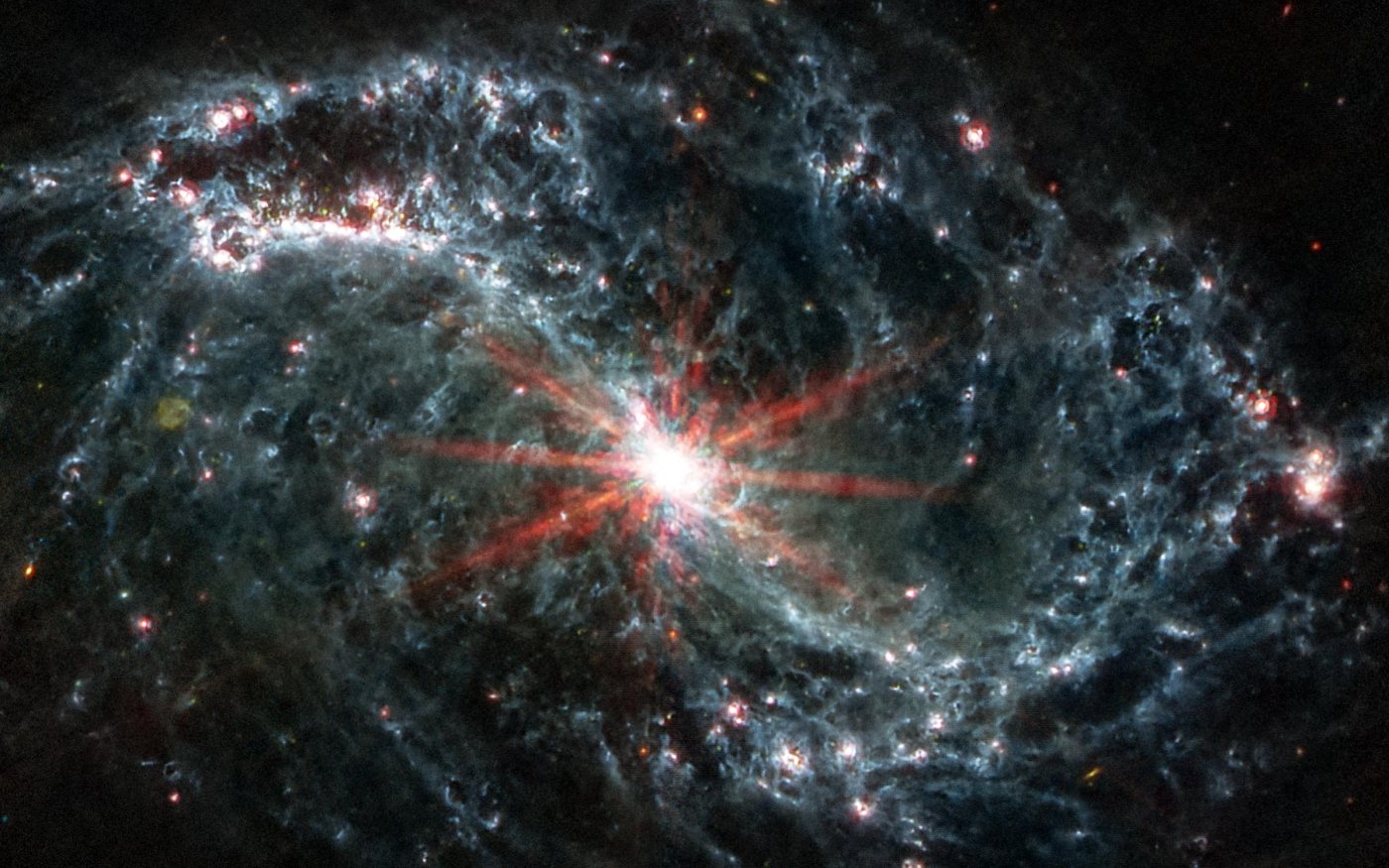
Using the phrase “In the beginning,” John echoes the opening verses of Genesis, which, like a cinerama, opens onto a wide screen filled with a deep darkness, with the only sound – the ghostly haunting sound of the divine wind sweeping across the face of the dark.
Then, suddenly, a pinpoint of light appears.
A flicker at the heart of the darkness of the deep.
A pinpoint of light expanding at phenomenal speed -piercing the darkness—bringing order out of chaos, life out of light.
In the phrase: In the beginning… John takes us back to before Bethlehem, before shepherds, angels, and mangers; before wise men, before an infanticidal king; before flight into refugee exile.
John takes us back to the moment of the Big Bang, when all that exists emerged from within the self-contained life force we know as the Creator or the Prime Mover.
Genesis pictures the emergence of a single point of light breaking open the deep darkness. John has a word for that light. He calls it the Logos, which literally means “that which speaks forth God.”
In English, we translate logos as the Word. The Word is the communicative life of God.
The Word is God speaking into the void—speaking order, organizing structure, creating meaning. The Word is the light of divine life, shining out from the heart of the darkness.
And here John makes his crucial point: he identifies Jesus as the very Word of God, speaking forth into the darkness of the primeval void as light shining in the darkness. Of this light, John tells us the darkness is powerless to overcome.
Listen again to his opening lines:
At Creation, the Word spoke forth the light of life into a formless universe. In the Incarnation, that same Word spoke forth the divine self into a human life.
The Word became flesh and now dwells among us, full of grace and truth.
Let’s pause.
Let this settle in you.
On this Christmas Eve, we come seeking comfort and solace—a brief respite from the world’s tribulations. We find comfort in familiar memories of Christmas past.
In 1849, the Reverend Edmund Sears, a New England Unitarian minister, wrote the poem It Came Upon a Midnight Clear.
What’s striking is that Sears doesn’t situate Christ’s birth in its ancient context of the stable scene.
He situates the birth of Jesus in the turmoil of his own day, turmoil weighing on his heart.
He pictures a moment of solemn stillness amid the world’s cacophony, as humanity strains to hear the angels’ song of peace, always at risk of being drowned out by the noise of human strife.
Speaking of the angels’ voice, Sears delivers his prophetic line:
Yet with the woes of sin and strife
The world has suffered long;
And man, at war with man, hears not the love-song which they bring;
O hush the noise, ye men of strife,
And hear the angels sing.
How contemporary that sounds to us.
We celebrate Christmas this year amidst rancor and bitterness here at home. All around us, the fabric of the Republic – its laws, its Constitution, its government frays under the assault of authoritarian forces.
And abroad against the backdrop of heart-rending violence in Ukraine, in the Holy Land, we behold that Bethlehem itself—once a symbol of holy joy—stands darkened in protest and grief amidst the unspeakable settler violence being unleashed against Palestinian farms and villages in the West Bank. Bethlehem is darkened in mourning for the destruction of Gaza and the dreadful plight of its people.
Sami Awad of Nonviolence International put it succinctly:
What Bethlehem offers today is not reassurance, but clarity. People here are celebrating not because the “war in Gaza” is over or we are ignoring our reality but because it is what we have left in our resilience.
To meet the challenges and seize the opportunities in our world, we must first find the right story – with the right beginning. We must situate the birth of our Savior in the context of our present lives, as the story of the light of life penetrating the deepest reaches of the darkness that enshrouds us. So that, like the people of Bethlehem, our celebration, rather than ignoring reality, flows from the source of our resilience.
The French saying captures the irony: Plus ça change, plus c’est la même chose.
The more things change, the more they remain the same, or as ordinary Frenchmen and women today say, no matter who you vote for, the government still gets in.
So many of us feel pulled toward despair by the course of world events. And into that despair, John’s Prologue speaks the word we most need to hear.
Here is the most startling truth of Christmas that in the human life of Jesus, the divine Word, the divine light, takes flesh and blood to dwell among us, full of grace and truth.
And here is the challenge:
John tells us not whether this light is real, but whether we choose to recognize it or not.
Forget belief for a moment and focus on the exercise of choice. Do we choose to allow the light of life to shape our lives? Coming back to belief, it’s not whether this happened as described, but whether we give this story the power to remake us.
And this is what requires courage.
Courage to believe in the face of everything that whispers despair.
Many of us feel as though we’ve fallen into the primordial deep—
where the darkness is thick and the sound of hope feels faint.
In such moments, how easily we forget the central truth:
Darkness is not the enemy of the light. Darkness is the fuel the light consumes to shine even brighter.
This is the defiance of Christian hope.
No matter how dark things become…
no matter how relentless the headlines…
darkness cannot extinguish the light.
For:
The light shines in the darkness, and the darkness will never overcome it.
Renewed by that hope, we have work to do.
The work of aligning ourselves with God’s ongoing restoration of creation.
The work of preparing the world to receive Christ’s eventual return in glory – the Advent metaphor for the completion of God’s dream in the full restoration of creation.
How do we begin?
We begin with cherishing the light that burns within each of us.
By sharing that light.
By pooling our individual lights until they become a radiance strong enough to push back the encroaching shadows around us.
Given the state of the world, perhaps “merry” isn’t the word that fits this Christmas.
But resilient, hope-filled might be.
Hope-filled, because the light still shines.
Hope-filled, because the Word has taken flesh.
Hope-filled, because the darkness will never overcome us.
Amen.
 Relationalrealities
Thanks for the reminder that in the beginning the Word was, is and is to be.