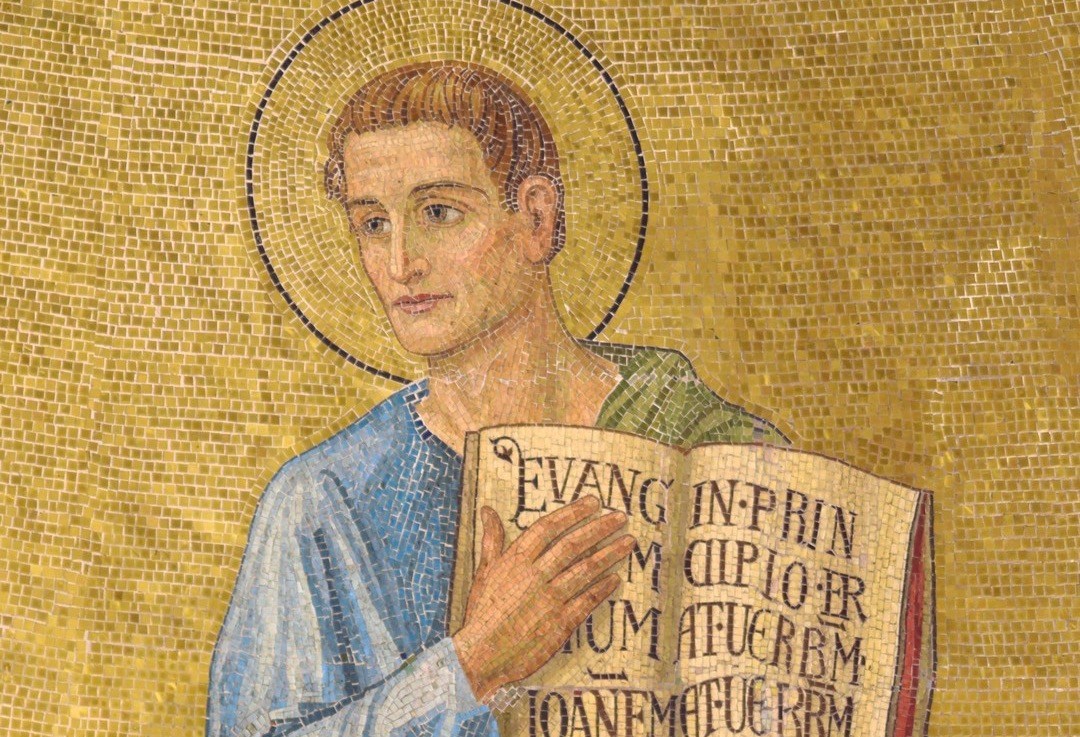
There is much that is confusing in John’s Gospel. In his opening chapter, John the Evangelist focuses on John, elsewhere known as the Baptist, as a witness to the messiah. But there’s also another John lurking in the background – John the Beloved Disciple of Jesus, whom Tradition has associated with John the Evangelist. Despite the Tradition, it’s clear that John the Evangelist is not John the Beloved Disciple. The Evangelist is writing in the 120’s, a period beyond the normal lifespan of the Beloved Disciple. So, John the Evangelist is someone who stands in the tradition of the Beloved Disciple, who, as a young man, probably knew him personally.
John’s gospel opens on the majestic panorama painted in the Prologue before plunging us into the opening moments in Jesus’ earthly ministry. The evangelist known as John fills this opening chapter and the whole of his gospel with word allusions and metaphors indicating the mysterious connections between Jesus and the fulfilment of Old Testament expectations of the Messiah.
We can tie ourselves in knots trying to decipher what these allusions and metaphors meant to the Evangelist John and his community. But so much of John remains mysterious.
For instance, John uses the metaphor of the Lamb of God. Taken in the context and period in which he is writing, this is a peculiar metaphor for Jesus. The practice of Temple animal sacrifice is, by this time, but a distant memory. Yet John’s metaphors are arresting, and in chapter one we have two on display – Lamb of God and God the Son – titles for Jesus that deeply resonated as they eventually entered the mainstream of orthodox Christology, i.e., the branch of theology that relates to the identity and nature of Jesus. Seeing as believing is the major theme in John’s gospel. First-hand seeing is not necessary, believing through hearsay, i.e., the words of another, is enough.
Chapter one is a story set over three days. On day one, the Jewish elders come to interrogate John (the Baptist), during which he identifies Jesus as the messiah because of what he has seen and can bear witness to. Day two, John’s out and about with two of his disciples – one of whom is Andrew, the brother of Simon Peter. When Jesus walks by, and John points him out as the Lamb of God, curiosity gets the better of Andrew and his unnamed companion, who follow Jesus, asking him where he is staying. Jesus replies come and see.
Andrew then recruits his brother, Simon. In the section following this passage on the next day, day three, Jesus journeys to Galilee, where he encounters Philip, who then recruits his friend, Nathaniel (Bartholomew), and tells him he has seen the messiah.
John is showing his readers how discipleship happens and how it works. One person’s curiosity discovers Jesus. This discovery is then shared with a friend and they both begin to follow Jesus.
Jesus and his new disciples are now in position on day three for the first of John’s great signs – the wedding at Cana of Galilee, opening chapter two. John is not telling his readers about the call of the first disciples as much as he is showing them how discipleship works. First – we notice, then – we become curious, leading us to ask – then we have the opportunity to respond or not, to Jesus’ invitation to come and see. We then tell our friends what we’ve found and invite them to join us.
John’s Gospel is a gospel for our own age precisely because John the Evangelist addresses a mixed community in tension, a ragbag of different constituencies.
- There are the former disciples of John the Baptist, hence the Evangelist’s emphasis on the initial role of John (the Baptist) in the first chapter.
- There is a strong contingent of Samaritans, as evidenced by the story in chapter four, where the Samaritan woman he encounters at the well is the first to recognize Jesus’ true identity.
- There are gentile spiritual seekers. Later, in 12:21, we read that some Greeks come and ask Philip: please sir, we want to see Jesus.
- There are Jews who have openly split with the synagogue.
- There are Jews who still faithfully attend the synagogue but also secretly hang out with John’s ragbag Christian community on Sundays.
John’s task is to speak to the inner tensions in a community composed of factions, each with its own slightly different history and take on Jesus, all seeking to hold together amid the backdrop of unremitting hostility from the Jewish authorities, as represented by the emergence of rabbinic Judaism. This unremitting hostility from the newly emerging rabbinic movement is why John appears to us to project hostility back to those he continually refers to as the Jews.
John’s ragbag community manages to hold together during his lifetime. But after his death, another John, John of Patmos, writer of the epistles of John, bears witness to the internal tensions and eventual breakup of the Johannine Community in the middle decades of the 2nd century. Members of the Johannine community, known to us as the Gnostics, easily challenged the cohesion of a community with no recognized leader.
The Johannie community had a flat hierarchy. It seems to have no recognized leaders apart from the guidance of the Evangelist, who lived on in his gospel. For instance, John never mentions the teaching authority of the apostles as the community leaders so evident elsewhere in the New Testament. Everyone is simply a disciple. All disciples are equal, sitting under the tutelage of the Holy Spirit. There are no sacraments, no doctrine, only the willingness to be led by the Holy Spirit on the way of love.
Jesus’ invitation is to come and see. But see what? Come and see a community characterized by the love its members have for one another. Now there’s a rare and seemingly unworkable thing!
A community known as the Beloved Community was a radical experiment based on Jesus’ Golden Rule in chapter 13:35, love one another, for by this the world will know them as his disciples. A radical and noble experiment in community, yet one predictably destined to fail.
Can we hear an echo of John’s beloved community in our Anglican, tolerant, and inclusive understanding of Christian community? Surely this is a difficult yet precious witness. Something unique to offer amidst the civic strife of 2026 in a nation torn asunder by so many bitterly held divisions.
The former Presiding Bishop, The Most Rev. Michael Curry, exhorted us with John’s message to invite a renewal that flows from reframing ourselves as the contemporary Jesus Movement, a modern-day Johannine community embarked on the Way of Love involving seven practices that require us to turn, pause, listen, and make a choice to follow or not to follow Jesus.
- Learn – through reflecting on Scripture each day, esp. on Jesus life and teachings.
- Pray – dwell intentionally with God daily.
- Worship – gather in community weekly to thank, praise and dwell with God.
- Bless- share our faith unselfishly – one might suggest unselfconsciously- in order to give and serve.
- Go- cross boundaries, listen deeply and live like Jesus.
- Rest -receive the gift of God’s grace, peace, and restoration.
The Way of Love is a contemporary Johannine project that flows naturally from our Anglican love for John’s Gospel. For like John’s Beloved Community, we have some experience of holding together internal tensions within a framework that cherishes right relationship over right belief. Communities that stress the right belief are vulnerable to becoming oppressive. Communities where right relationship is stressed require no agreement, only tolerant acceptance of one another’s differences negotiated by love.
Our only obligation is to come and see! The question is, are we open and willing to see what the Spirit of Jesus longs to show us?
 Relationalrealities
Leave a comment