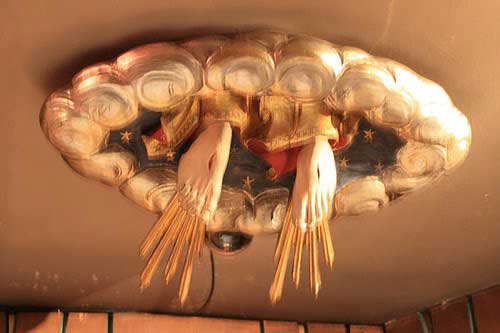
Image from the Chapel of the Ascension at Walsingham, England.
I want to begin with a small detour familiar to many of you from previous Ascension Day sermons from me. Nestled in the lush, if rather damp, countryside of the county of Norfolk lies the Shrine of Our Lady of Walsingham.
Next door to the Shrine Church the Chapel of the Ascension, built in the dispiriting modern style of the 1960’s, the style that festooned the US with hideous A-Frame churches, nevertheless has one most astonishing feature. On entering the chapel one’s attention is immediately drawn to the ceiling where two feet dangle at the center of a rosette of gilded clouds punctuated by lightening forks representing the only remaining part of Jesus’ body still visible after one imagines him squeezing through the gilded rosette into heaven on the other side of the ceiling. Those of you participating via the livestream will be privileged to this truly baroque sight – all the more astonishing because of the chapel’s otherwise plain sheetrock walls and ceiling.
The Ascension, which today is treated as a rather non-event. Always occurring on the 40th Thursday after the Resurrection – to accommodate the reality that most Episcopalians rarely venture to church except on Sundays – the current custom is to celebrate the Ascension of the Lord on the Sunday following. It’s Luke who gives us the most vivid narration of the Ascension scene.
If constructing stories and weaving narratives are the ways we make sense of our experiences in the world, what is the nature of the relationship between story and material experience? In other words, do narratives – our human need for stories simply interpret and explain our material experience, or do narratives construct our material experience through the power of language to bring to awareness the objects and meanings of which it speaks.
This tension surrounding the function and power of language is especially pertinent when it comes to religious-spiritual stories. Narrative Theology asserts that spiritual meaning lies not in the literal veracity of the events depicted – did they happen or not – but in the function of story to construct and convey purposeful meaning and truth- and here it’s helpful to paraphrase the late biblical scholar, Marcus Borg who used to say that the Bible contained many true stories – and some of them actually, happened.
Does a story construct meaning and purpose that we can trust as a source of understanding of the divine which enriches and empowers us to live our best lives?
Spiritual stories recycle elements from human imaginative memory. Clearly, Luke’s graphic account of Jesus’ ascension borrows extensively from Elijah’s ascension in a chariot of fire buoyed upwards by heavenly steeds amidst billowing clouds that obscure heaven from earthly sight. In like manner – as the mantle of Elijah fell upon the shoulders of Elisha – giving him a double portion of his master’s spirit, the double portion of Jesus’ spirit falls upon his disciples -clothing them in preparation to take up the work Jesus had begun.
The resonance between the two ascension stories is unmistakable. Now skeptics will say – ah-hah, so you admit that Luke copied an earlier story that is a feat of imagination to start with. Well yes, I’m happy to admit this, because both stories function not as eyewitness accounts of actual events but as ways of making sense of a meaning and truth capable of changing lives and altering the trajectory of history. By the way – even eyewitness accounts of actual events are never photographic but interpretations – colored by the contents of individual memory. The problem in crime solving is that no two people will recall the same event in the same way.
In Luke’s chronology of events from Calvary to Pentecost, his story of the Ascension of Jesus forms a transition point bringing the earthly ministry of Jesus to a close to prepare his followers for what was to come next. The question underlying the Ascension event is not how, when, or if it happened, but what light does it shed on the question of what next?
Can we trust the meaning inherent in the story of the Ascension of Jesus, even though most of us accept it to be, as all stories are, a construction of imagination? By focusing the stories meaning on the question what next – this becomes a story sharply focusing the choices to be made, the actions to be taken, and the directions to be followed that transform our perceptions of the world and our role in living our best lives by furthering the work Jesus began.
By substituting the traditional heaven and earth spatial metaphor of up and down for one more suited to contemporary imagination – that of heaven and earth as side by side – the Ascension becomes a story of a conduit event linking our space and divine space.
The two essential points in the Ascension story now come into focus.
In his return to the divine space, Jesus does not jettison his humanity like a suit of worn-out clothes – but carries the fullness of his humanity – perfected through suffering, death, and resurrection – to be received by God – incorporating the essence of humanity into the divine nature. The first collect for the Ascension captures this: that as we believe your only begotten Son our Lord Jesus Christ to have ascended into heaven, so we may also in heart and mind there ascend, and with him continually dwell. The we here is not us individually, but the essence of our humanity which now constitutes an element within the divine nature.
In receiving the gift of Jesus humanity perfected through suffering, death, and resurrection the gift of the divine spirit of Jesus is released to make the return journey back into our space – or as the second collect for the Ascension captures it: our Savior Jesus Christ ascended far above all heavens that he might fill all things and to abide in his church until the end of time.
As Jesus ascends, we become Christ’s mystical body on earth – now prepared and empowered as the Church for the continuance of the work Jesus began.
The Ascended Christ bearing our perfected humanity is received into the heart of God so that henceforth, in the imagery of the book of Revelation, the home of God is to be found not above in the clouds but here on the earth among mortals. Now we come to the most extraordinary assertion of Christian faith – that from henceforth to be most fully human is to be most like God.
As the disciples gawk stupefied after the Lord’s disappearing feet, they are told to stop looking upwards. In other words, there is nothing to be found up there. Instead, we need to look around us for signs of God’s continued presence in our world through the power of the Holy Spirit.
The Ascension of Jesus begs the question of what is next in God’s work of renewing the creation. Such a question throws into sharp focus the stories we give allegiance to that for good or ill will dictate the choices we make, the actions we take, or refuse to take – setting the direction we follow either towards or away from a fuller participation in God’s dream for creation – when we tire that is of gazing heavenwards.
 Relationalrealities
Leave a comment