Yesterday, many of us stood together, lost in the throng of the No-Kings Rally that had wound its way through central Providence from the State House before returning to gather for the rally on the State House lawn. There is something mysterious about crowds. Perhaps you took part in other No-Kings Rallies across the State. Some 3,000 rallies took place in communities across the country. At the time of writing, it’s still too early to know the total attendance count.
Even more participated online, drawing encouragement in the knowledge that across our state and nation, our fellow citizens were rallying in nonviolent protest against the current Administration’s perilous direction of travel at home and now abroad.
To be part of a crowd can feel exhilarating—a release from the burdens of isolation and helplessness that so often define our individual lives. In a crowd, we taste a heady solidarity. As participants and even as observers from a distance, we feel ourselves caught up in something larger than ourselves. The energy of shared purpose lifts us to find a collective voice.
At their best, crowds become living expressions of our deepest longings—for justice, for belonging, for change—and they can generate bonds that endure long after we return to the routines of daily life.
And yet, there is something deeply unsettling about crowds. For the same energy that unites can also overwhelm. The line between common purpose and collective manipulation is thinner than we like to admit. History—and our own very current experience reminds us how easily a skillful voice can harness a crowd’s energy, amplifying fear, awakening buried grievances, and directing them toward destructive ends.
Crowds are not simply gatherings of people. They are carriers of contended storylines.
What matters is not only that we gather, but which storyline we see ourselves standing in. For crowds give voice to shared cultural memories and contested narratives shaping how we see the world. And those narratives are not neutral in their effect. They can enlarge us—or diminish us. They can open possibilities—or close them down. In that sense, crowds are profoundly fickle because the multiple stories that move through them are in constant contention.
In truth, all we have are the storylines we tell—about the world, about one another, and about ourselves. As narrative creatures, we make meaning through story. We discover purpose through the narratives we inhabit. And we now know—what earlier generations intuited—that stories do not simply describe reality; they create and shape it. They influence what we believe, how we feel, and ultimately how we act.
Which means the real question is never whether we are part of a storyline. But which storyline is claiming us? Because once we give ourselves to a storyline, it begins to shape our perception, command our loyalty, and direct our actions.
In a world saturated with competing narratives—some expansive and life-giving, others narrow and corrosive—the challenge is to discern between good and bad storylines. Storylines are akin to Jesus proverbial tree parable. You judge them by the quality of the fruit they bear.
This feels like a distinctly modern problem, with the proliferation of information, misinformation, and competing versions of reality amplified in the echo chambers of the Internet, further complicating our confusion over which storyline to choose.
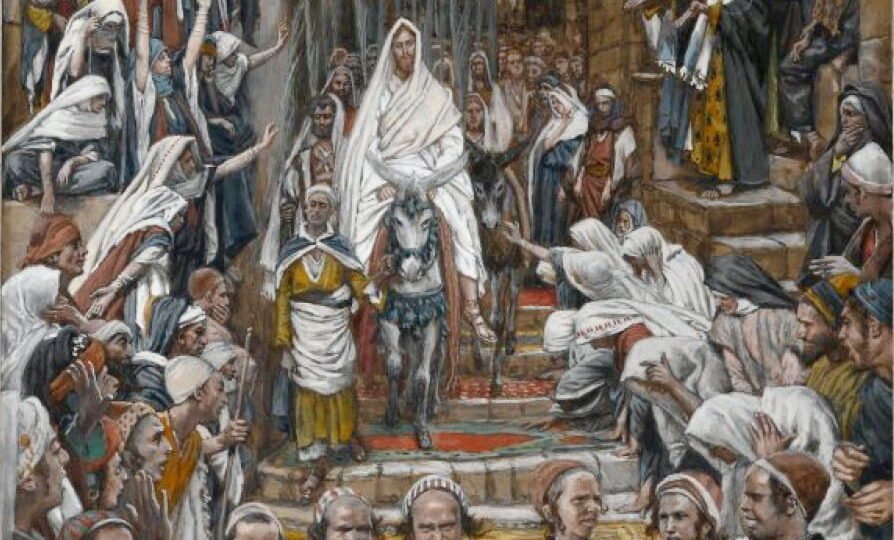
But this is not a new problem. It is, in fact, the problem exposed at the heart of our commemoration of the events of Palm Sunday. Because on that day, the streets and alleys of Jerusalem rang out with the shout of the Passover crowds pouring into the city, tripling the city’s normal population, transforming the city into a cauldron of bubbling religious, political, and populist passions. Passover was not a quiet festival. As the commemoration of national liberation from bondage, Passover, for a nation under the heel of occupation, was a volatile and dangerous.
At this Passover, three conflicting storylines are in play.
Pontius Pilate’s entry into Jerusalem represents the first storyline of Empire. Travelling from his administrative base on the coast at Cesaria Maritima, the Roman Procurator (the equivalent of a District Commissioner in some tale from the British Raj), entered from the west, carrying the full power of the empire. His procession is a display of dominance—the unmistakable message that peace will be maintained by force if necessary. Rome tells a very clear story: order comes through power; peace comes through domination. Violence is the coinage of government.
Simultaneously, another procession enters the city from the east – inspiring in the crowds with a second storyline of populist longing. No war horse. No military escort. Just a borrowed colt. No display of force—only a fragile, almost absurd vulnerability. Cloaks are thrown on the road. Branches are waved in a powerful expression of Jewish collective memory. Voices cry out, “Hosanna!” “Blessed is the one who comes in the name of the Lord!” In the collective mind of the crowd, Jesus has become caught up in their messianic expectations in the storyline of liberation.
Two storylines: one of empire and the demonstration of power, the other a story of popular longing for liberation and the restoration of past glory. This is the story of a people who remember Egypt, who remember exile, who remember a promise delayed. And in Jesus, they glimpse the possibility that this story is reaching its fulfillment.
But here is where it becomes unsettling. Because the crowd is actually inhabiting the wrong storyline. All too late, they will realize this, and their hope will turn to frustrated rage.
Like Jerusalem’s crowds, it’s a rude awakening to find ourselves inhabiting the wrong storyline.
Crowds are fickle, susceptible to being carried along by whatever story is most compelling in the moment.
Like the Passover crowds, when Jesus refuses to align with the storyline we are inhabiting, our mood darkens. The same voices that cry “Hosanna” will, in a matter of days, be replaced by voices crying “Crucify him.” How easily we too reject the Jesus of the gospels with a Jesus reconfigured in our own violent and rageful image.
Like the crowds praising Jesus as he entered the Holy City, we enthusiastically hail our next political savior until that is, – he or she no longer is.
We long to do the courageous thing – until that is, the moment when we don’t.
Palm Sunday is not simply a scene from the past. It is a mirror for our present. Because we, too, are always standing within competing storylines.
We, too, are drawn toward narratives that promise security, identity, and protection. Unfulfilled expectations render us vulnerable to storylines that stir our fears – eclipsing those that awaken our hopes.
And so, the question that confronts us this morning is not whether we would have joined the crowd. Of course, we would have. The question is: which storyline would we have identified with in the crowd’s cry? This question forces us to examine the storyline that is claiming us now.
Because Jesus does not simply enter Jerusalem. He enters the human story—and offers a radically different way of telling it that is not always to our liking.
In the week leading up to Passover, we see, with hindsight, the lethal intersection of competing storylines – of imperial domination and political violence, and of populist resistance and longing for national liberation. – both confronted by a radically new storyline of God’s love and vision for the world. This clash of storylines results in a chain of events taking an unexpected turn – rapidly spiraling out of everyone’s control.
Today, on Palm Sunday, we stand at the threshold of the most sacred week of the Christian year. From the waving of palms to the stark silence of the cross, we are invited not simply to remember, but to enter—fully and intentionally—into the final days of Jesus’ life.
This will be my last Easter as Rector at St Martin’s, and a final opportunity to remind us that as Episcopalians, we are a liturgical people. We do not stand at a distance from these events as observers. Through the vehicle of liturgy, we participate in a holy drama—a sacred reenactment that carries us, step by step, through the unfolding story of Holy Week, whose liturgies are not merely symbolic; they are formative. They shape us as disciples by drawing us into the heart of the mystery.
Holy Week begins with the paradox of Palm Sunday: celebration and foreboding held together. But it is in the days that follow that the drama deepens.
On Maundy Thursday, we gather in the upper room. We witness Jesus at table, offering bread and wine, kneeling to wash the feet of his disciples, and commanding them to love one another. From there, we move with him into the shadows of Gethsemane—into the loneliness, the watching, and the waiting.
And then comes Good Friday—a day unlike any other. A day of stark honesty about suffering, betrayal, and the cost of love.
These liturgies ask something of us. They ask for our presence – not simply attendance. They demand our participation. To walk the way. To keep the Watch. To allow this story to shape our own. For it is only by walking through this story that we come to the great turning-point of Easter Day—with its promise of new life for a world thirsting for redemption.
Like the crowds praising Jesus as he entered the Holy City, we enthusiastically hail our next political savior until that is, – he or she no longer is.
We long to do the courageous thing – until that is, the moment when we don’t.
History does not exactly repeat itself, but it certainly rhymes.
 Relationalrealities
Leave a comment