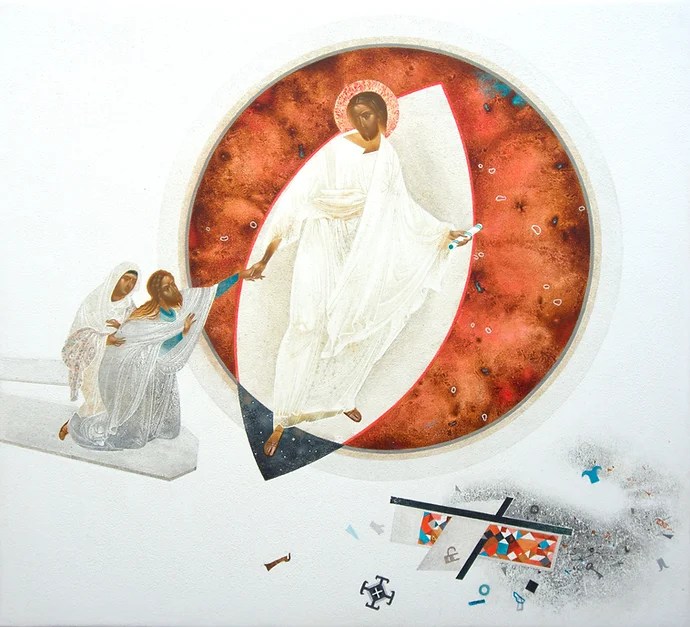
Image: Icon of the Resurrection by the Ukrainian icon writer Ivanka Demchuk.
We live in a time when competing stories about who we are—and whose lives matter—press in on us from every direction. Perhaps that is why the question of which story we inhabit has never felt more urgent.
Those of us who might be described as more than a little nerdy when it comes to theology tend to gravitate toward particular ways of framing it. My own inclination is toward a narrative theological perspective.
Narrative theology begins with a simple observation: human beings are storytelling creatures. We make sense of our lives—and our world—through the stories we construct to interpret our experience. Viewed through this lens, the Bible is not a single, flat account of divine truth, but a long and complex composition in which human writers, across time, attempt to give an account of God’s dynamic engagement within the flow of human history. These stories always emerge from and speak to particular contexts—cultural, spiritual, economic, and political. (See my Palm Sunday sermon, Contested Storylines.)
What is striking is that the biblical tradition makes no attempt to iron out the tensions between these storylines. Critics often point to this as a weakness, even a disqualification of Scripture’s authority. Yet I would argue that this is precisely its strength. The Bible reflects the complexity of human experience of God rather than reducing it to a single, controlled narrative. After all, there is always more than one way to tell a story, because the story lives in the voice of the one who tells it.
From the beginning of Holy Week, the trajectory toward the cross carries a sense of inevitability. When Jesus rides into Jerusalem, he is propelled by a new story—God’s story—of universal redemption. Yet the crowds who greet him remain shaped by an older story, one rooted in ethnic longing and the hope for national restoration. They are looking for a Messiah who will secure their future by freeing them from foreign domination.
These competing expectations—universal redemption and selective national liberation—are bound to clash. And both, in different ways, inevitably collide with a third storyline: that of empire, which maintains its version of peace through violence and order through domination. As the week unfolds, this collision becomes unavoidable, carrying Jesus toward his death on the cross.
By the third day after his burial, the tomb is discovered empty. From this moment, we can discern two resurrection storylines emerging. They tell, in essence, the same story—but lead us toward very different conclusions.
The first is the one we know by heart. It moves swiftly from Good Friday to Easter morning—from execution to resurrection. A man is killed, his body taken down, wrapped, and sealed in a tomb. On the third day, the tomb is found empty.
It is a story that unfolds quickly—almost too quickly.
And just as quickly, we move on. The flowers fade, the cupcakes are eaten, and the Easter chocolate disappears. In this familiar telling, Christ stands radiant and triumphant, having completed God’s work alone. The resurrection becomes something finished—“done and dusted”—even as we continue to debate its meaning.
In this version, the resurrection is understood primarily as something that happened to Jesus. It is, in effect, individualized.
And yet we rarely pause over the strangeness at its heart. Why did it happen? What does it mean that it happened to this particular body, executed by this particular empire, for what was essentially a political crime? Beneath the surface lies a deeper, often unasked question: what—and who—is the resurrection for?
The familiar storyline does not encourage us to linger there. Instead, it tends to reduce the matter to a binary choice: accept or reject, believe or disbelieve.
But there is another resurrection storyline.
We see it in the icon on the front of our Easter bulletin, written by the contemporary Ukrainian iconographer Ivanka Demchuk. Here, Christ is not depicted as rising alone. His arms are extended outward in connection, grasping the hands of Adam and Eve and pulling them up from their graves.
In this telling, Christ does not rise alone. The first man and the first woman rise with him—and they stand as archetypes for all humanity.
This image resists any individualistic interpretation of resurrection. It does not point toward a private victory or a personal afterlife secured. Instead, it gestures toward something far more expansive, and far more demanding: that resurrection is a collective reality.
As the theologian Tripp Fuller puts it, “What happened to Jesus is happening to everyone.”
This represents a profound shift. Resurrection is no longer a one-time event confined to Jesus, nor something to be admired from a distance. It becomes an ongoing process—a movement that is already enveloping all of us together.
In Demchuk’s icon, the old order lies shattered beneath Christ’s feet. The resurrection does not simply follow the world as it is; it interrupts it. And though not immediately visible at first glance, the wounds remain. The marks of crucifixion have not been erased.
This detail matters. Why carry the evidence of imperial execution into resurrection? Why not leave the wounds behind?
Because resurrection is not only about life beyond death. It is also God’s judgment on the world that made such a death inevitable.
The values of empire—violence, hierarchy, and the quiet assumption that might is always right—are not relics of the past. They persist wherever order is secured by exclusion, wherever peace depends upon the suffering of others, and wherever we learn, slowly and almost without noticing, to call such arrangements normal.
The wounds remain because the story is not finished. Empire has not disappeared, and the forces that converged in that first Holy Week continue to shape our world.
Nor has the temptation to accommodate them.
It rarely comes dramatically. More often, it arrives in small permissions—in what we overlook, what we excuse, what we come to accept as simply the way things are. And over time, we find that we have made our peace with what once would have troubled us.
Against this, the resurrection stands as God’s refusal to leave the world unchallenged. It is the quiet insistence that another reality is already taking hold—one not governed by the logic of domination, and not contained by it.
And that reality is not limited to Jesus.
It is unfolding among us.
Resurrection is not only a mysterious past event, no longer just a future hope. It is also present -time reality. For we are now living in the resurrection age – the time between the historical resurrection of Jesus and the final resurrection of all of creation, in which we know that despite the persistence of the story of empire, it no longer has the last word.
This is why the icon matters so deeply. Christ does not stand apart. He does not rise alone. He reaches out, grasping humanity and drawing it upward. This is not a story about individual readiness or worthiness. It is a story about shared destiny.
Which is why the Church gathers.
Not simply to remember, and not merely to reassure ourselves, but to participate in this shared destiny with God through Christ. At the table, we do not come as isolated individuals. We come together, carrying our uncertainties, our divisions, and our entanglement in competing storylines.
Here, we are given bread—broken, a body that still bears the marks of violence. We are given wine—poured out, a life that has passed through death and is no longer held by it.
In receiving these gifts, we are not simply remembering Jesus. We are being drawn into him—into his life, his death, and his resurrection.
This is what the resurrection is for. Indeed, we are who resurrection is for.
It is not a reward, nor something to be earned, nor a distant promise deferred. It is an invitation into a new creation already breaking into the world—a reality in which no one rises alone, where wounds are not erased but transfigured, and where the powers that once seemed ultimate are revealed not to have the final word.
So we come—not because we have resolved all our doubts, nor because we have fully left the old story behind, but because we recognize that something new is already happening.
Christ is still reaching. Still drawing. Still raising.
The question is not whether we are worthy.
The question is whether we are willing to take his hand—and allow ourselves to be raised, together.
 Relationalrealities
Leave a comment