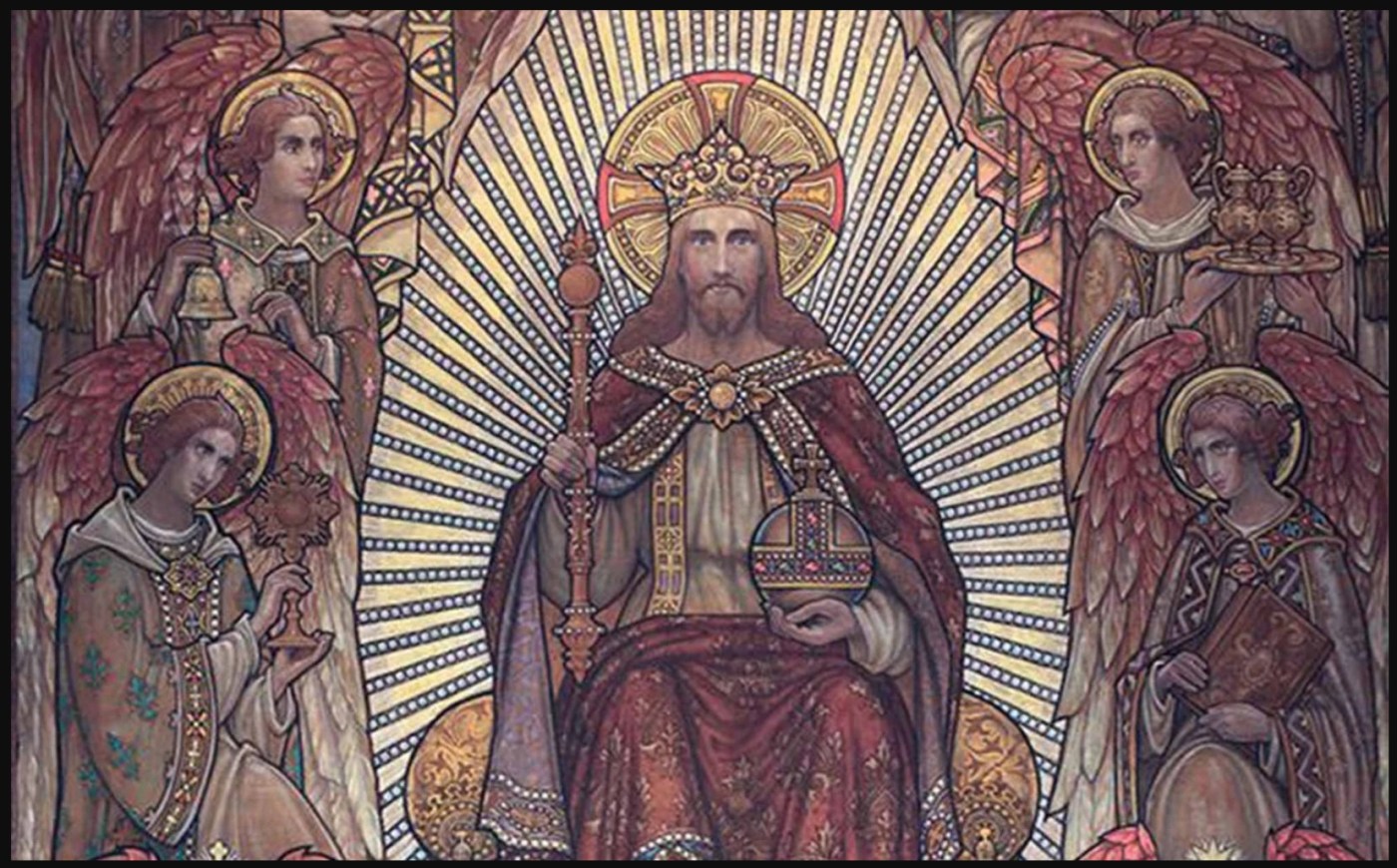
Sermon delivered at St. Mary’s Episcopal Church, Phoenix, on the feast of Christ the King.
The first chapter of Genesis tells us that we are created in the image of the unseen God. But here’s the problem. This act of creation is not a one-way process. Because of God’s very unseen-ness – God’s physical invisibility – all we know of God is a reflection of what we know about ourselves. So, we take our familiar self-awareness and project this back onto God. We clothe the invisible God in the all-too-familiar trappings of our human vesture.
The Bible is the written record of our human struggle to preserve the mystery and otherness of God, while at the same time clothing the divine nature with human characteristics. But being made in God’s image is a nicety when we are intent on recreating God in our own image.
The Ecumenical Lectionary dedicates the final Sunday before the start of the new liturgical year to commemorating Christ as King. All well and good, you might say – for as Anglo-Catholics this celebration offers yet another opportunity to deck ourselves in our best liturgical finery and close the liturgical year – which by this stage has become rather stale, with an exuberant bang.
But the commemoration of Christ as King begs the thorny question: what kind of king, what kind of kingship are we imagining here? This thorny question remains – Christ may be king, but what kind of king do we imagine him to be?
It’s time for some helpful historical context. The commemoration of Christ the King is barely a century old. In 1925, Pope Pius XI proclaimed the feast of Christ the King as an assertion of the Catholic Church’s resistance to the rise of fascist and communist authoritarianism.
It comes as little surprise that the monarchical pope would reach for images of imperial strength depicted in the image of Pantocrator – of Christ, ruler of the world – Christ crowned and robed in the garments of imperial power. After all, this is the image of Christ frequently portrayed in the concave apse above the altar in Orthodox churches as well as many pre-Renaissance churches in the West. For Pope Pius XI, Christ Pantocrator — the true ruler of the world — expressed a desire to fight fire with fire. At a considerable cost to liberty and freedom of thought within the Church, Pius XI marshaled the Catholic legions for battle against the Church’s fascist and communist foes.
Remembering the historical context for the origins of the commemoration of Christ the King reminds us that the militant and triumphant image of Christ, robed in earthly imperial glory, carries a tone that is both timely and problematic today. Once again — a timely reminder that as Christians we are called to face down a dark resurgence of totalitarian forces. Yet Pius XI’s conception of one authoritarian system pitting itself against rivals in a contest of strength against strength is also a problem for many Christians today.
As Anglican Christians, we do not subscribe to the notion of an authoritarian church — although for some this is a very regrettable accident of our history. As Episcopalians in an era marked by the sharp rise of an ugly Christian Nationalism, we reject any message that conflates right with might.
The problem with Pius XI’s formulation in the Catholic Church’s proclamation of Christ the King is that it drew on a very old story. As human beings, we are storied creatures—meaning we only ever have the stories we construct to make sense of our experience and the world around us. So it matters which stories we choose to tell. Old and familiar stories lock us into cycles of repetition. Repetition protects us from our fear of the unfamiliar. The unfamiliar has the power to disrupt our comfortable stability.
We don’t need to choose recycled stories—which, if we remember, didn’t work that well last time we let them rule us. What we need are stories that let new spiritual insight break through—disrupting the familiar and taking us in unforeseen directions. Only dreaded disruption in the repetition of familiar stories can open us to new insight that leads to different conclusions.
Jesus’ parables are examples of disruptive stories that jolt us onto new and unexpected pathways. Like the needle on an old vinyl record when it hits a scratch on the surface, the familiar melody is disrupted.
Matthew’s Jesus parable of the Sheep and the Goats works in this way to challenge our more earthy notions of kingship. In this parable, Jesus presents kingship as strength through service, strength through compassion. Jesus presents us with an image of kingship not in the trappings of earthly imperial power, but as a echo of the shepherd proclaimed by Ezekiel (34:11-16,20-24 I myself will be the shepherd of my people. I will seek the lost, brin -g back the strayed, bind up the injured, strengthen the weak, while the fat and strng I will destroy.
Where Ezekiel pictures the actions of a shepherd, Matthew pictures Jesus’ return at the end time as one whose kingship functions as herald of God’s kingdom – Come you blessed by my father, inherit the kingdom prepared for you from the foundation of the world.
It seems that Jesus understanding of kingship is closer to Ezekiel’s shepherd of the people, than Pius XI’s imperial ruler. Jesus is king as one who ushers in the reign of God’s kingdom. Truly I tell you, just as you did it to one of the least of those who are members of my family, you did it to me. Kingship not as power, but as service.
Today, we reject the image of Christ as king lifted high above us, decked in robes of imperial power, in favor of an image of Christ as Ezekiel’s shepherd king – or Matthew’s hearld of God’s kingdom.
Christ’s kingship confounds our desire for easy answers, our willing embrace of half-truths, our settling for the superficial in relationships.
Christ’s kingship fills us with an anger at injustice, oppression, and the exploitation of the helpless.
Christ’s kingship inspires us to work tirelessly to promote peace – not any kind of peace, but peace with justice.
Christ’s kingship compels us to embrace the rejected, welcome the stranger, and see ourselves in the feared other.
Christ’s kingship dares us to embrace the foolishness of believing we can make a difference in this world—risking what others claim cannot be done. Amen


Leave a Reply